66. Under variable costing, which of the following is not considered a product cost?
a.
Direct materials
b.
Direct labor
c.
Fixed manufacturing overhead
d.
Variable manufacturing overhead
67. Under absorption costing, which of the following is not considered a product cost?
a.
Direct labor
b.
Fixed manufacturing overhead
c.
Variable manufacturing overhead
d.
Administrative costs
68. The primary difference between variable and absorption costing is the treatment of:
a.
fixed selling and administrative costs.
b.
variable selling and administrative costs.
c.
fixed manufacturing overhead.
d.
variable manufacturing overhead.
69. Which of the following statements is false regarding absorption costing?
a.
Variable overhead is treated as a product cost.
b.
Absorption costing is required for external financial statements prepared in accordance
with generally accepted accounting principles (GAAP).
c.
Fixed overhead is treated as a product cost.
d.
Fixed overhead is expensed in the period incurred.
70. Which of the following statements is false regarding variable costing?
a.
Variable overhead is treated as a product cost.
b.
Variable costing is required for external financial statements prepared in accordance with
generally accepted accounting principles (GAAP).
c.
Fixed overhead is treated as a period cost.
d.
Period costs are expensed as they are incurred.
71. Which of the following descriptions would not be found on an income statement prepared using
variable costing?
a.
Sales
b.
Fixed costs
c.
Cost of goods sold
d.
Net income
Managerial ACCT Test Bank Chapter 3 18
72. Which of the following line descriptions would not be found on an income statement prepared using
absorption costing?
a.
Sales
b.
Contribution margin
c.
Cost of goods sold
d.
Net income
73. Assuming the number of units sold and produced are the same, which of the following statements is
true when comparing net income using absorption and variable costing?
a.
Absorption costing will yield a higher net income.
b.
Variable costing will yield a higher net income.
c.
Net income will be the same under both methods.
d.
Variable costing will have higher sales revenue.
74. Assuming that the number of units produced is greater than the number of units sold, which of the
following statements is true when comparing net income using absorption and variable costing?
a.
Absorption costing will yield a higher net income.
b.
Variable costing will yield a higher net income.
c.
Net income will be the same under both methods.
d.
Sales revenue will be less using absorption costing.
75. Assuming that the number of units produced is less than the number of units sold, which of the
following statements is true when comparing net income using absorption and variable costing?
a.
Absorption costing will yield a higher net income.
b.
Variable costing will yield a higher net income.
c.
Net income will be the same under both methods.
d.
The sales price per unit will be less using absorption costing.
76. Tyson Manufacturing
Tyson Manufacturing has the following cost information available for 2009:
Direct materials
$6.00 per unit
Direct labor
$2.00 per unit
Variable manufacturing overhead
$1.50 per unit
Variable selling and administrative costs
$3.00 per unit
Fixed manufacturing overhead
$40,000
Fixed selling and administrative costs
$50,000
During 2009, Tyson produced 10,000 units out of which 9,100 units were sold for $50 each
Managerial ACCT Test Bank Chapter 3 19
Refer to the Tyson Manufacturing information above. What is net income under variable costing?
a.
$251,250
b.
$254,850
c.
$285,000
d.
$291,250
77. Refer to the Tyson Manufacturing information above. What is net income under absorption costing?
a.
$251,250
b.
$254,850
c.
$285,000
d.
$299,850
78. Cornell Products
Cornell Products has the following cost information available for 2009:
Direct materials
$1.00 per unit
Direct labor
$2.00 per unit
Variable manufacturing overhead
$1.50 per unit
Variable selling and administrative costs
$ .50 per unit
Fixed manufacturing overhead
$30,000
Fixed selling and administrative costs
$25,000
During 2009, Cornell produced 6,000 units out of which 5,400 units were sold for $20 each.
Refer to the Cornell Products information above. What is net income under variable costing?
a.
$35,000
b.
$29,000
c.
$26,000
d.
$23,000
79. Refer to the Cornell Products information above. What is net income under absorption costing?
a.
$23,000
b.
$29,000
c.
$26,000
d.
$35,000
80. B & B Manufacturing
B & B Manufacturing produces a single product. Last year, the company produced 10,000 units out of
which 9,500 were sold. There were no units in beginning inventory. The company had the following
costs:
Variable costs per unit:
Production
$6.00
Selling and administrative
$2.00
Fixed costs (total):
Production
$15,000
Selling and administrative
$10,000
Refer to the B & B Manufacturing information above. What is the unit product cost using variable
costing?
a.
$ 8.00
b.
$ 6.00
c.
$ 7.50
d.
$10.50
81. Refer to the B & B Manufacturing information above. What is the unit product cost using absorption
costing?
a.
$ 8.00
b.
$ 6.00
c.
$ 7.50
d.
$10.50
82. Lockhart Products produces a single product. During 2009 the company incurred the following costs:
Variable product costs
$8.00 per unit
Variable period costs
$2.00 per unit
Total fixed product costs
$21,000
Total fixed period costs
$10,000
Lockhart had no units in beginning inventory. During 2009, 6,000 units were produced and 5,000 units
were sold. Which of the following statements is true when comparing net income using absorption
versus variable costing?
a.
Net income will be $3,500 higher using absorption costing than using variable costing.
b.
Net income will be $3,500 lower using absorption costing than using variable costing.
c.
Net income will be $4,200 higher using absorption costing than using variable costing.
d.
Net income will be $4,200 lower using absorption costing than using variable costing.
83. Variable costing has the following advantages:
a.
CVP requires the use of information provided by variable costing.
b.
Changes in production and inventory levels do not impact the calculation of profits.
c.
Under variable costing, cost behavior is emphasized and fixed costs are separated from
variable costs on the income statement.
d.
All of these are advantages of variable costing.
Managerial ACCT Test Bank Chapter 3 21
SHORT ANSWER
1. Label whether each of the following costs is most likely fixed (F) or variable (V).
Direct materials
Factory rent
Sales commissions expense
Direct labor
Depreciation on factory building
2. Label whether each of the following costs is most likely fixed (F) or variable (V).
Factory insurance
Direct materials
Secretary salary
Shipping supplies
Gasoline costs
Factory insurance
Direct materials
Secretary salary
Shipping supplies
Gasoline costs
3. For each of the following statements, fill in the blank with either the word increase, decrease, or stays
the same.
a.
As production increases, total fixed costs ______________.
b.
As production increases, fixed costs per unit _____________.
c.
As production decreases, variable costs per unit _____________.
d.
As production decreases, total variable costs _______________.
Direct materials
Factory rent
Sales commissions expense
Direct labor
Depreciation on factory building
As production increases, total fixed costs stay the same .
b.
As production increases, fixed costs per unit decrease .
As production decreases, variable costs per unit stay the same .
d.
As production decreases, total variable costs decrease .
4. For each of the following statements, fill in the blank with either the word increase, decrease, or stays
the same.
a.
As production decreases, total fixed costs ______________.
b.
As production decreases, fixed costs per unit _____________.
c.
As production increases, variable costs per unit _____________.
d.
As production increases, total variable costs _______________.
a.
As production decreases, total fixed costs stay the same .
b.
As production decreases, fixed costs per unit increase .
As production increases, variable costs per unit stay the same .
d.
As production increases, total variable costs increase .
5. Briefly describe the difference between fixed, variable, and mixed costs. Give one example of each.
6. You are the manager of a small cookie stand. The variable cost of producing one chocolate chip cookie
is $.75. Your fixed costs per week are $1,000. What is the total cost per unit if 1,000 cookies are
produced and sold per week? 2,000 cookies? Do your answers for the two quantities differ? Why or
why not?
7. Jameson Inc. plans to double its rental space next year, which will increase its fixed costs by 40%.
Current year costs include variable costs of $3 per unit and fixed costs of $40,000. With the expansion
of the rental space, next year’s production is expected to be 10,000 units.
Required: Calculate total estimated costs for next year.
8. Richardson Corporation plans to increase its advertising budget by 20% next year. The company
currently spends $15,000 on advertising costs. In addition to advertising, Richardson spends $50,000
per year for other fixed costs and $10 per unit for variable costs. If Richardson anticipates producing
30,000 units next year, what will be next year’s total costs?
Required: Calculate total estimated costs for next year.
9. Compare and contrast the two methods that are used to predict mixed costs.
10. Describe regression analysis and list several of its possible uses.
11.
11. You are trying to determine whether machine hours or direct labor dollars would be the best cost
driver for overhead costs. You run two regression analyses and obtain the following results:
Machine hours:
Multiple R
.39429
R square
.15547
Adjusted R square
.14964
Standard error
.44416
Direct labor dollars:
Multiple R
.89429
R square
.79547
Adjusted R square
.28964
Standard error
.44416
Which variable would be the best selection for a cost driver and why?
12. Why should income taxes be considered by corporate decision-makers?
Managerial ACCT Test Bank Chapter 3 25
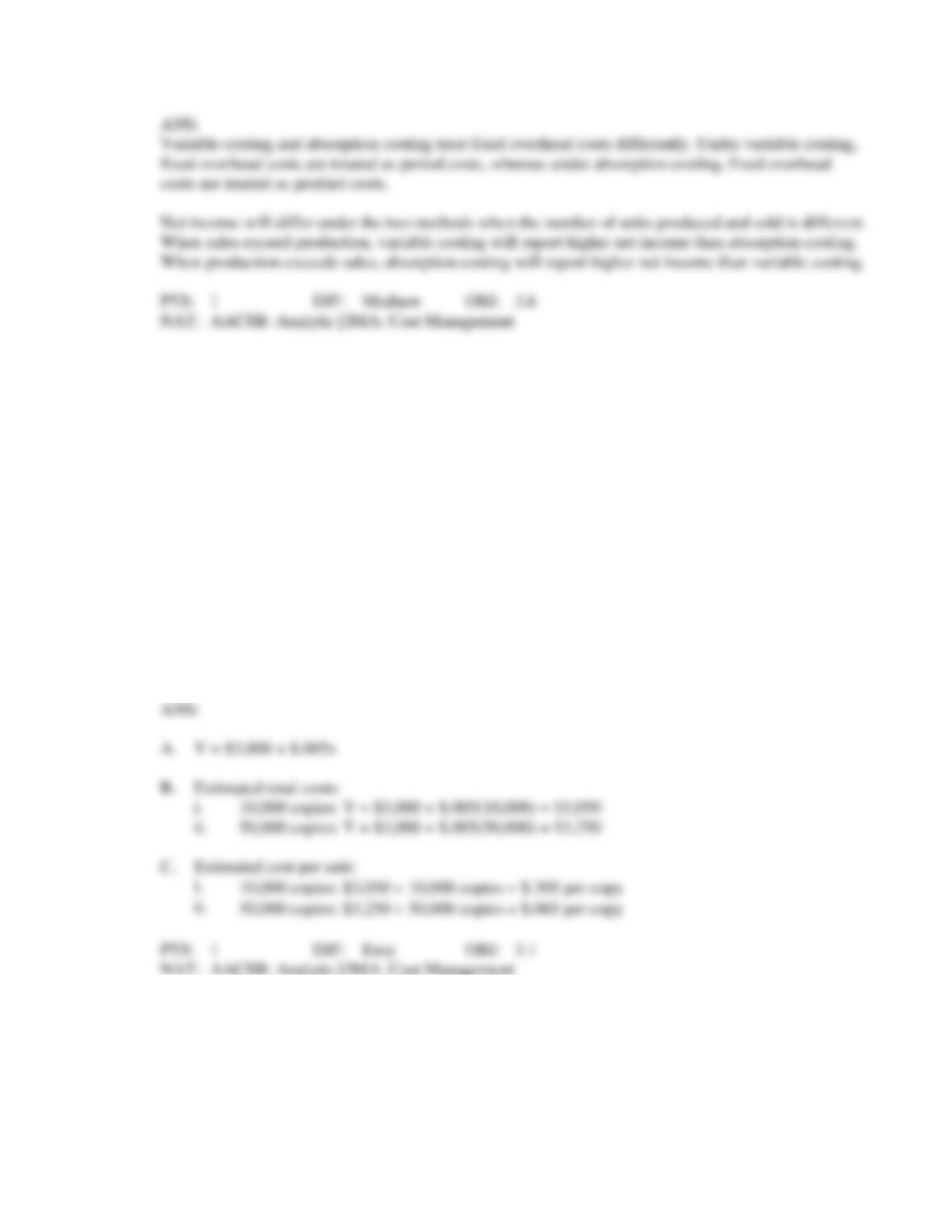
13. How do variable costing and absorption costing differ? When is net income different under the two
methods?
PROBLEM
1. Your company leases a copier. The contract states that you must pay the leasing company $3,000 per
year and $.005 per copy.
Required:
A.
Write the equation to predict estimated total lease cost.
B.
Compute the estimated total costs if:
i.
10,000 copies are made.
ii.
50,000 copies are made.
C.
Compute the estimated cost per unit if:
i.
10,000 copies are made.
ii.
50,000 copies are made.
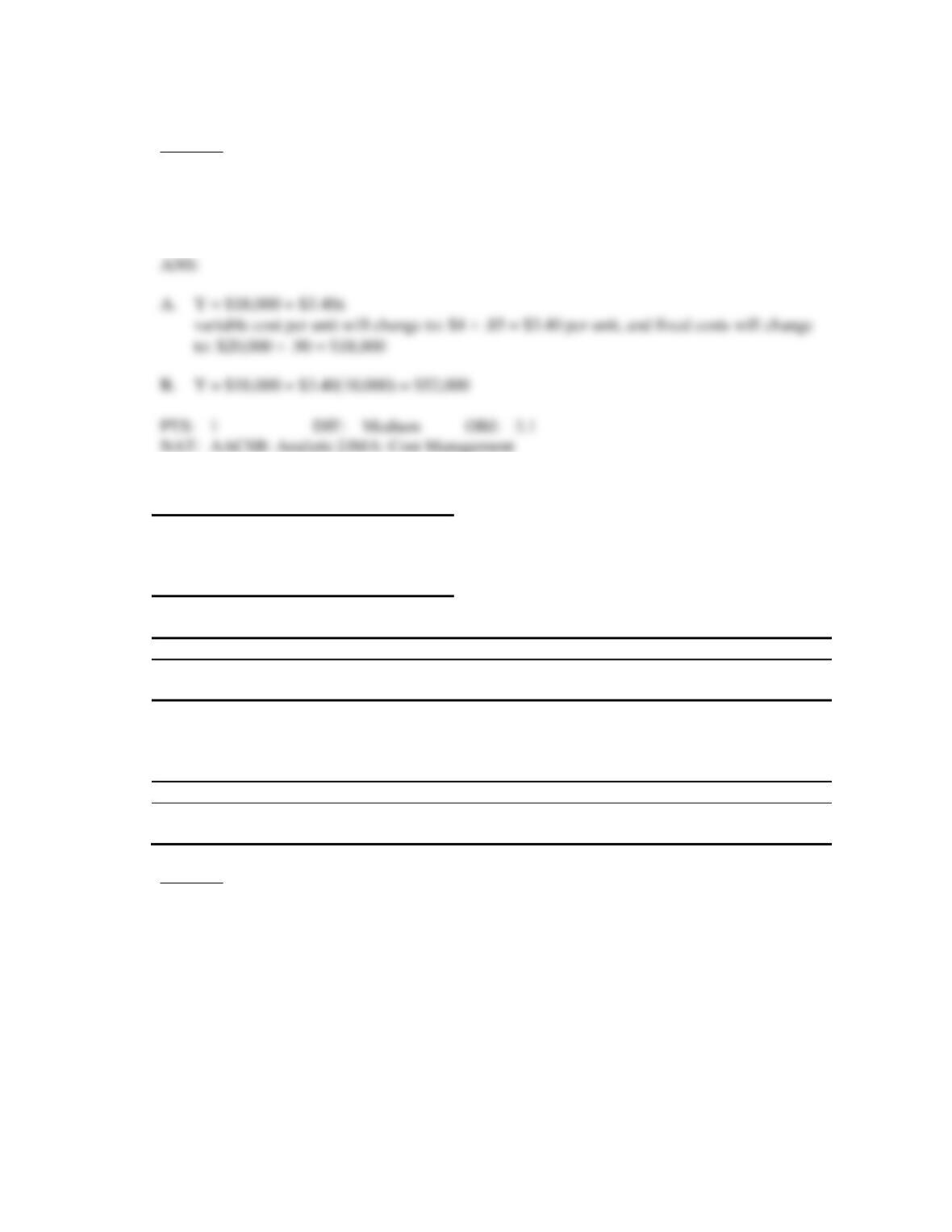
A.
Y = $3,000 + $.005x
B.
Estimated total costs:
i.
10,000 copies: Y = $3,000 + $.005(10,000) = $3,050
ii.
50,000 copies: Y = $3,000 + $.005(50,000) = $3,250
Estimated cost per unit:
10,000 copies: $3,050 10,000 copies = $.305 per copy
50,000 copies: $3,250 50,000 copies = $.065 per copy
2. Sabina and Associates has the following current year costs:
Variable costs
$4 per unit
Fixed costs
$20,000
Managerial ACCT Test Bank Chapter 3 26
Next year, the company plans to enter into an arrangement with a supplier that will result in a 15%
decrease in variable costs. They also plan on reducing their rental space, which will decrease fixed
costs by 10%.
Required:
A.
What will be the new equation to predict total costs?
B.
If next year’s production is expected to be 10,000 units, what will be total estimated costs?
3. You run a regression analysis and receive the following results:
Multiple R
.39429
R Square
.15547
Adjusted R Square
.14964
Standard Error
.44416
Analysis of Variance
DF
Sum of Squares
Mean Square
Regression
1
5.26588
5.26588
Residual
145
28.60536
.19728
F = 26.69262
Signif F = .0000
Variables in the Equation
Variable
Coefficients
Standard error
t Stat
P-value
X Variable 1
11.0300
.021000
5.166
.0000
Intercept
8833.0700
.090000
9.751
.0000
Required:
A.
What is the fixed cost in this regression analysis?
B.
What is the variable cost per unit?
C.
Prepare the cost equation based upon these results.
D.
Does this regression equation “fit” the data well? What information did you examine to
answer this question?
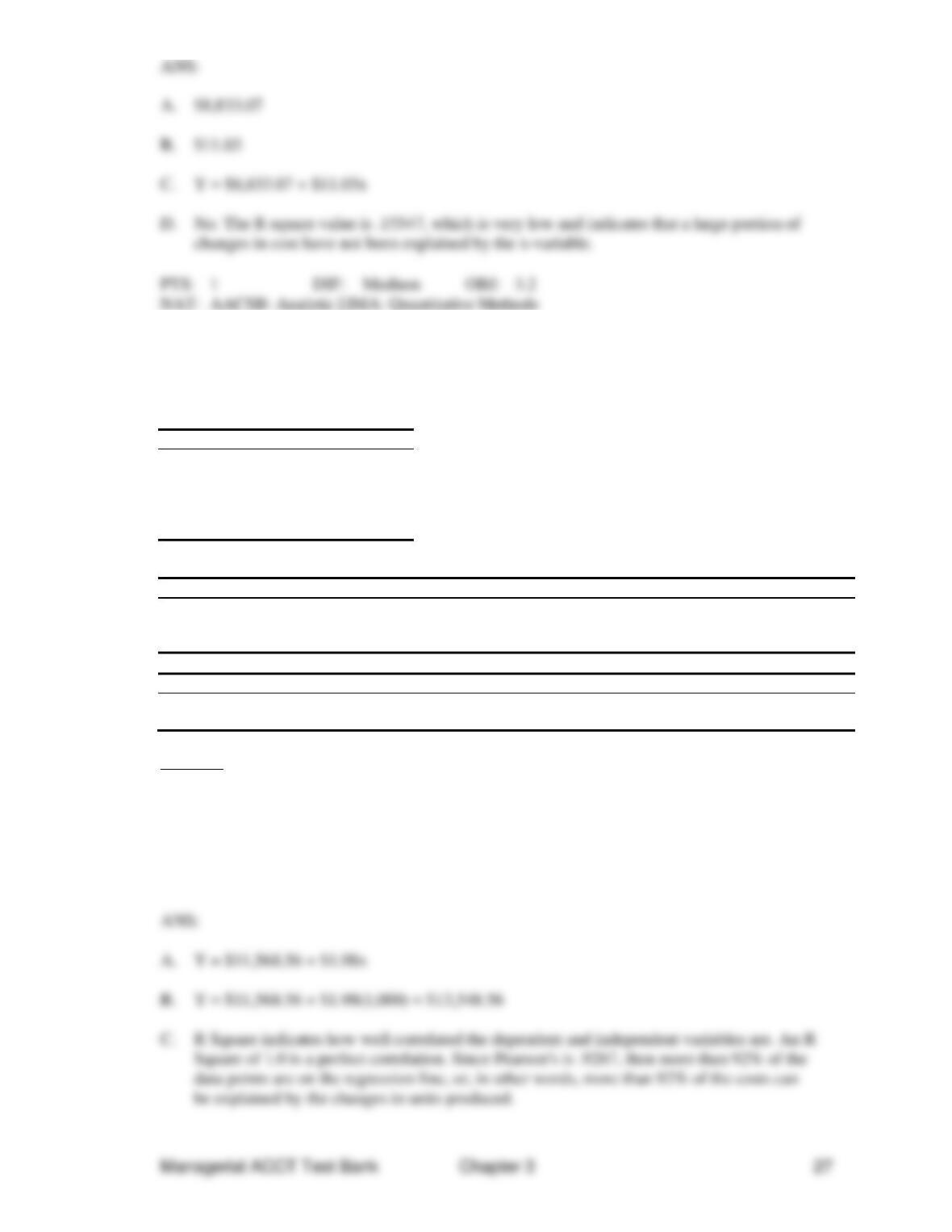
Y = $18,000 + $3.40x
B.
Y = $18,000 + $3.40(10,000) = $52,000
A.
$8,833.07
B.
$11.03
C.
Y = $8,833.07 + $11.03x
4. Pearson Products believes one of its costs is a mixed cost and has run a regression analysis which
shows the following:
SUMMARY OUTPUT
Regression Statistics
Multiple R
0.963711945
R Square
0.928740713
Adjusted R Square
0.916864165
Standard Error
946.0983069
Observations
8
ANOVA
df
SS
MS
F
Significance F
Regression
1
69996575.46
69996575.46
78.19955153
0.000116235
Residual
6
5370612.038
895102.0063
Total
7
75367187.5
Coefficients
Standard Error
t Stat
P-value
Intercept
11568.56000
1352.390000
8.554149469
0.000140059
X Variable 1
1.9800000
0.223900000
8.843051031
0.000116235
Required:
A.
Write the equation to predict estimated total mixed costs.
B.
If 1,000 units are produced, what will be total mixed costs?
C.
What does the “R Square” number tell Pearson? Interpret the “R Square” data for Pearson.
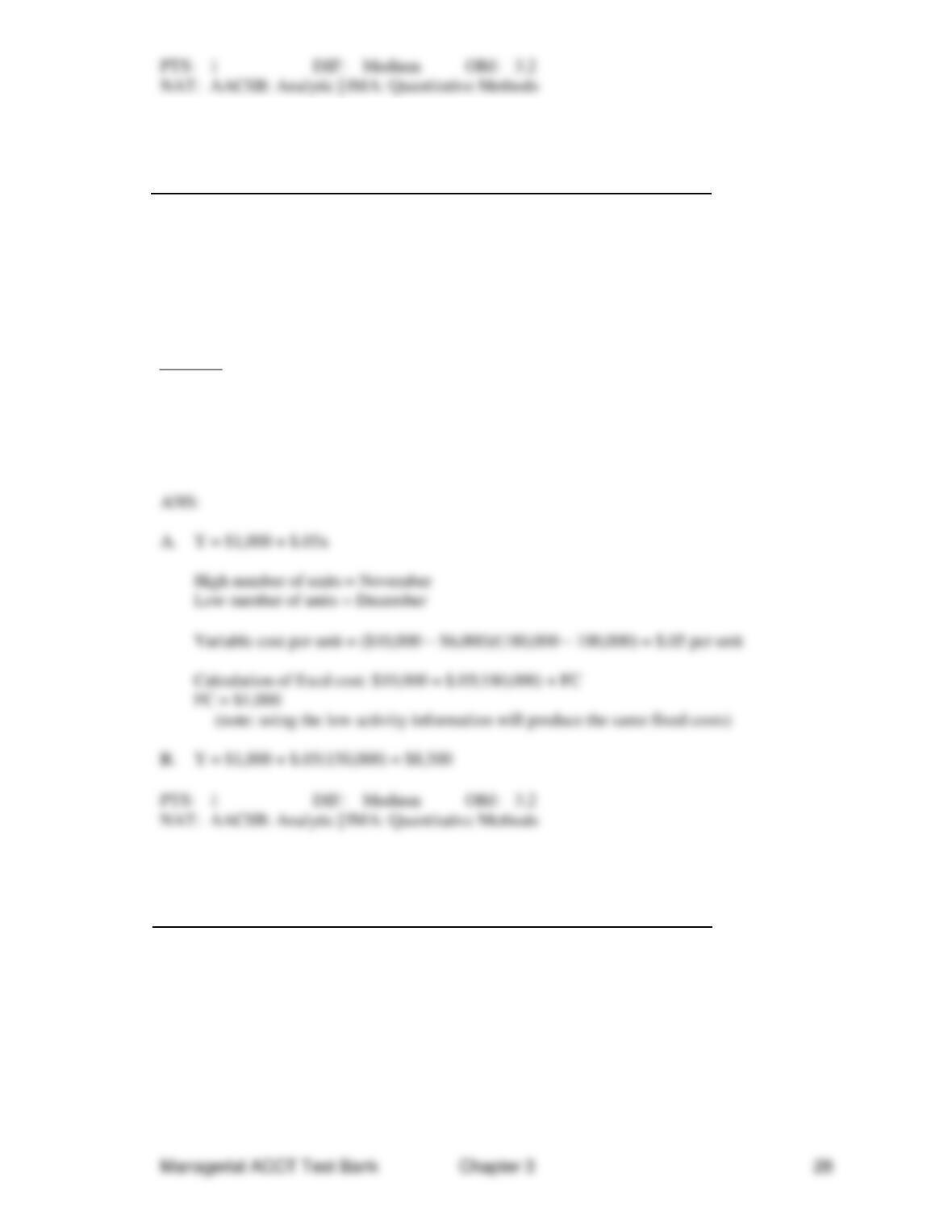
A.
Y = $11,568.56 + $1.98x
B.
Y = $11,568.56 + $1.98(1,000) = $13,548.56
5. Noble Inc. documented the number of units produced as well as maintenance costs for the past five
months as follows:
Number of units
Total overhead costs
October
120,000
$ 6,200
November
180,000
10,000
December
100,000
6,000
January
110,000
8,000
February
135,000
9,000
Noble uses the high/low method of estimating mixed costs.
Required:
A.
What is the equation to predict estimated total overhead costs?
B.
If the company expects to produce 150,000 units in March, what will be the estimated
total overhead costs?
Y = $1,000 + $.05x
High number of units = November
Low number of units = December
Variable cost per unit = ($10,000 − $6,000)/(180,000 − 100,000) = $.05 per unit
Calculation of fixed cost: $10,000 = $.05(180,000) + FC
FC = $1,000
(note: using the low activity information will produce the same fixed costs)
Y = $1,000 + $.05(150,000) = $8,500
6. Reliable Movers Inc. documented the miles driven and total moving van costs for the past five months
as follows:
Number of miles
Total vehicle costs
January
3,000
$4,800
February
3,500
5,200
March
5,000
6,100
April
4,000
5,000
May
6,000
6,000
In order to budget total vehicle costs for the upcoming summer months, Reliable wishes to estimate
total vehicle costs using the high/low method.
Required:
A.
What is the equation to predict estimated total vehicle costs?
B.
If the company expects to drive 9,000 miles in June, what will be the estimated total
vehicle costs?
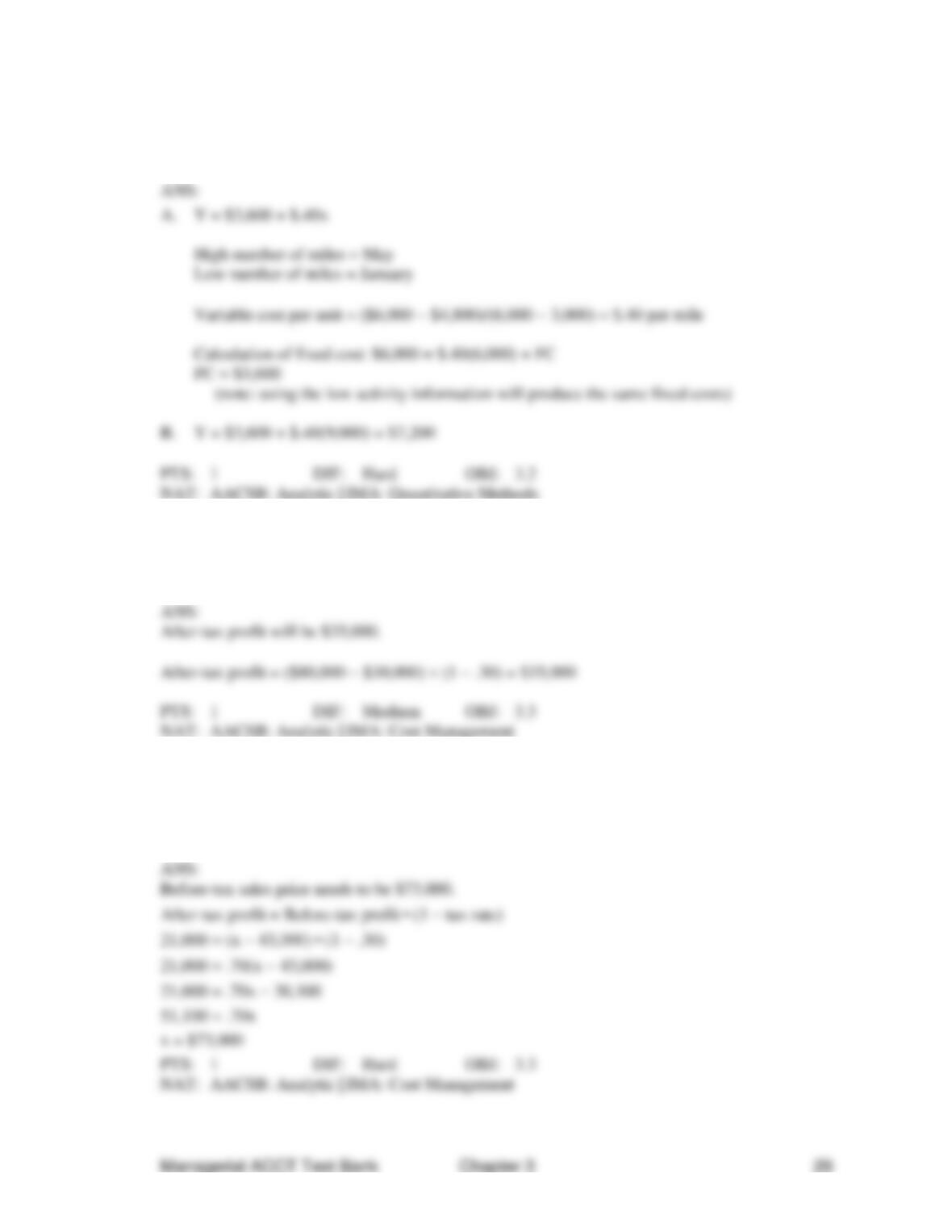
Y = $3,600 + $.40x
High number of miles = May
Low number of miles = January
Variable cost per unit = ($6,000 − $4,800)/(6,000 − 3,000) = $.40 per mile
Calculation of fixed cost: $6,000 = $.40(6,000) + FC
FC = $3,600
(note: using the low activity information will produce the same fixed costs)
Y = $3,600 + $.40(9,000) = $7,200
7. A manager is considering a special project that will increase cash sales by $80,000 and increase costs
by $30,000. All cash receipts are taxable and all costs are tax deductible. If the tax rate is 30%, what
will be the after-tax profit from the special project?
8. A manager is considering a special project. Corporate policy dictates that all special projects must
generate an after-tax profit of $21,000. If the company expects costs related to the project to be equal
to $43,000, what is the before-tax cash sales price that should be charged in order to adhere to
corporate policy assuming the company has a tax rate of 30%?
Managerial ACCT Test Bank Chapter 3 30
9. Preferred Products has the following cost information available for 2009:
Direct materials
$4.00 per unit
Direct labor
$3.00 per unit
Variable manufacturing overhead
$2.00 per unit
Variable selling and administrative costs
$1.00 per unit
Fixed manufacturing overhead
$25,000
Fixed selling and administrative costs
$10,000
During 2009, Preferred produced 5,000 units out of which 4,600 units were sold for $30 each.
Required:
A.
Calculate Preferred’s net income assuming the company uses variable costing.
B.
Calculate Preferred’s net income assuming the company uses absorption costing.
10. Hellman Manufacturing has the following cost information available for 2009:
Direct materials
$6.00 per unit
Direct labor
$4.00 per unit
Variable manufacturing overhead
$2.00 per unit
Variable selling and administrative costs
$1.00 per unit
Fixed manufacturing overhead
$80,000
Fixed selling and administrative costs
$25,000
During 2009, Merriman produced 12,500 units out of which 11,000 units were sold for $60 each.
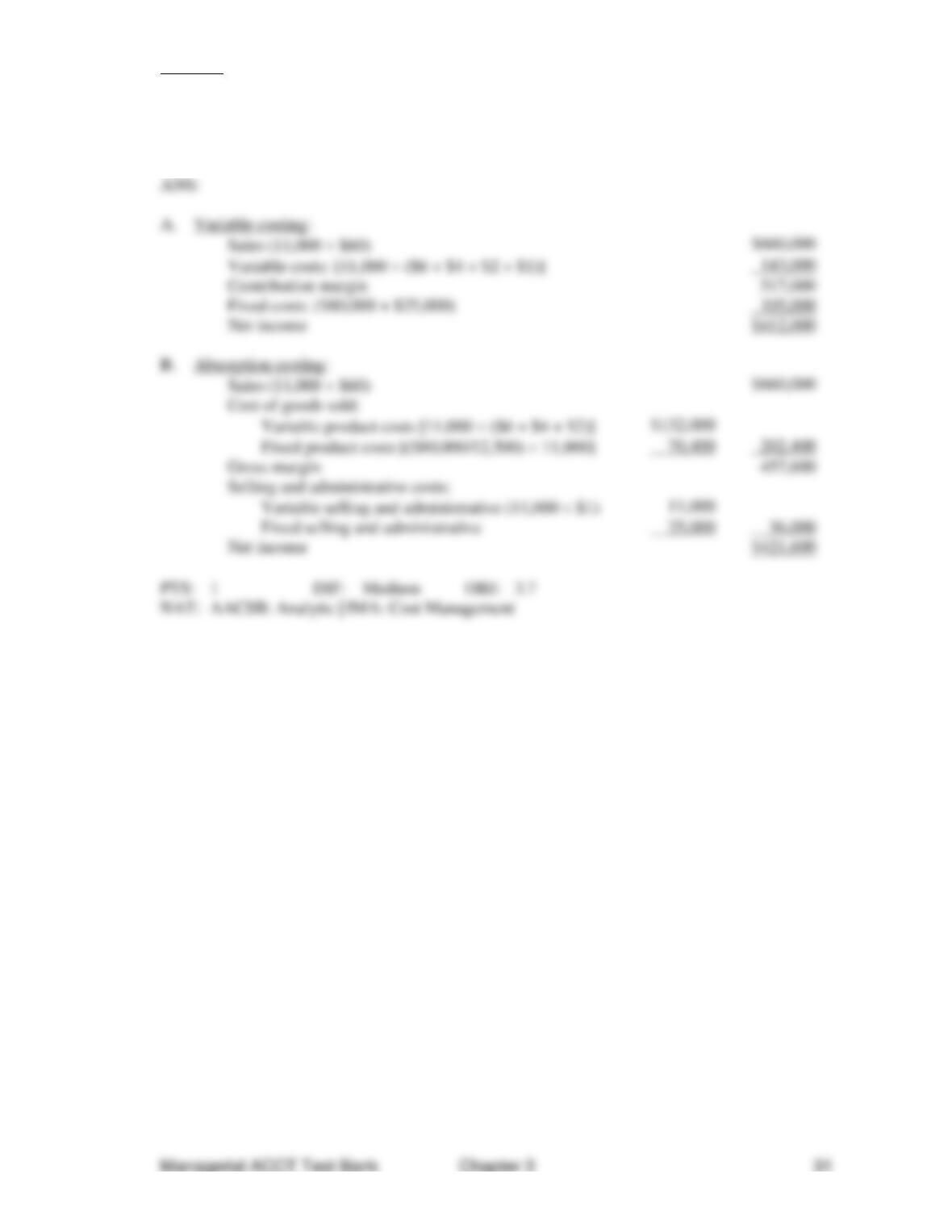
Variable costing:
Sales (4,600 $30)
Variable costs: [4,600 ($4 + $3 + $2 + $1)]
Contribution margin
Fixed costs: ($25,000 + $10,000)
Net income
B.
Absorption costing:
Sales (4,600 $30)
Cost of goods sold:
Fixed product costs [($25,000/5,000) 4,600]
Gross margin
Selling and administrative costs:
Variable selling and administrative (4,600 $1)
Fixed selling and administrative
Net income
Required:
A.
Calculate Hellman’s net income assuming the company uses variable costing.
B.
Calculate Hellman’s net income assuming the company uses absorption costing.
Sales (11,000 $60)
Fixed costs: ($80,000 + $25,000)
B.
Absorption costing:
Cost of goods sold:
Gross margin
Fixed selling and administrative