74. Refer to the Peace Products Inc. information above. If Peace uses the first-in, first-out (FIFO) method
of computing equivalent units and assigning product costs, what is the cost of goods transferred out
during the year?
a.
$517,350
b.
$539,400
c.
$544,620
d.
$565,300
Nunez Products Inc.
Nunez Products Inc. uses process costing. The following information was available for the current
year:
Number
of units
Production
Costs
Beginning work-in-process (20% complete)
400
$ 640
Units started in the current period
20,000
133,760
Ending work-in-process (40% complete)
6,000
75. Refer to the Nunez Products Inc. information above. If Nunez uses the first-in, first-out (FIFO) method
of computing equivalent units and assigning product costs, what is the cost per equivalent unit? (round
to nearest penny)
a.
$5.89
b.
$8.00
c.
$8.12
d.
$8.04
76. Refer to the Nunez Products Inc. information above. If Nunez uses the weighted-average method of
computing equivalent units and assigning product costs, what is the cost per equivalent unit? (round to
nearest penny)
a.
$7.43
b.
$7.47
c.
$7.96
d.
$8.00
77. Delaney Products uses process costing. The following information is available for the current year:
Number of units in beginning work–in-process inventory
3,000
(25% complete)
Units started in the current period
50,000
Number of units in ending work–in-process inventory
10,000
(20% complete)
If Delaney has already calculated their cost per equivalent unit to be $18 per unit, what would be the
cost of the ending work–in-process inventory assuming they use the weighted-average method?
a.
$ 54,000
b.
$ 36,000
c.
$145,800
d.
$180,000
Bost Products Inc.
Bost Products Inc. manufactures plastic products and uses process costing to account for the cost of
products manufactured. All product costs are added evenly throughout the production process. The
following information was available for the plastic department for the month of December:
Number
of units
Production
Costs
Beginning work-in-process (60% complete)
20,000
$ 72,000
Units started in the current period
300,000
1,809,000
Ending work-in-process (35% complete)
10,000
78. Refer to the Bost Products Inc. information above. If Bost uses the first-in, first-out (FIFO) method of
computing equivalent units and assigning product costs, what is the cost per equivalent unit? (round to
nearest penny)
a.
$6.24
b.
$5.81
c.
$6.00
d.
$5.94
79. Refer to the Bost Products Inc. information above. If Bost uses the first-in, first-out (FIFO) method of
computing equivalent units and assigning product costs, what is the cost of the ending work–in-process
inventory for December?
a.
$39,000
b.
$21,000
c.
$20,335
d.
$20,790
80. Refer to the Bost Products Inc. information above. If Bost uses the weighted-average method of
computing equivalent units and assigning product costs, what is the cost per equivalent unit for
December?
a.
$6.00
b.
$5.77
c.
$5.94
d.
$6.16
81. Refer to the Bost Products Inc. information above. If Bost uses the weighted-average method of
computing equivalent units and assigning product costs, what is the cost of the ending work–in-process
inventory in December?
a.
$57,700
b.
$20,195
c.
$22,435
d.
$21,000
82. Refer to the Bost Products Inc. information above. If Bost uses the weighted-average method of
computing equivalent units and assigning product costs, what is the cost of goods transferred out in
December?
a.
$1,860,805
b.
$1,860,000
c.
$1,877,500
d.
$1,858,565
83. Which of the following statements about service department costs is not true?
a.
Service department costs include the costs of providing services to other departments
within an organization.
b.
Service department costs are not allocated to other service departments.
c.
Service department costs should be allocated using an allocation base or cost driver related
to the costs incurred.
d.
Service department costs do not include the costs of providing services to external
customers.
84. Companies allocate service department costs to other departments for all of the following reasons
except:
a.
to improve decisions concerning how to use scarce resources.
b.
to hold departments that consume the resources accountable for the services they consume.
c.
to provide more accurate product cost information.
d.
to determine what the salary of service department employees should be.
85. Which of the following would be classified as a service department?
a.
The bottling department of a soft drink manufacturer.
b.
The painting department of an automobile manufacturer.
c.
The accounting department of a manufacturing company.
d.
The claims processing department of an insurance company.
86. Danville Manufacturing
The Danville Manufacturing Company has two service departments and two production departments.
The following data are available for 2011.
Service
Service
Production
Production
Dept. 1
Dept. 2
Dept. 1
Dept. 2
Department Costs
$24,000
$16,000
$80,000
$75,000
Number of Transactions
6,000
6,000
6,000
12,000
Square Feet Occupied
4,000
3,000
4,000
6,000
The costs of service departments 1 and 2 are allocated on the basis of number of transactions and
square feet occupied, respectively.
Assuming that Danville Manufacturing Company allocates service department 1 costs first, the amount
of service department 1 costs allocated to service department 2 under the step-down method would be:
a.
$ 0
b.
$12,000
c.
$ 6,000
d.
$ 2,000
87. Danville Manufacturing
The Danville Manufacturing Company has two service departments and two production departments.
The following data are available for 2011.
Service
Service
Production
Production
Dept. 1
Dept. 2
Dept. 1
Dept. 2
Department Costs
$24,000
$16,000
$80,000
$75,000
Number of Transactions
6,000
6,000
6,000
12,000
Square Feet Occupied
4,000
3,000
4,000
6,000
The costs of service departments 1 and 2 are allocated on the basis of number of transactions and
square feet occupied, respectively.
Assuming that Danville Manufacturing Company allocates service department 1 costs first, the amount
of service department 2 costs allocated to production department 1 under the step-down method would
be:
a.
$3,200
b.
$4,000
c.
$3,000
d.
$2,400
88. Danville Manufacturing
The Danville Manufacturing Company has two service departments and two production departments.
The following data are available for 2011.
Service
Service
Production
Production
Dept. 1
Dept. 2
Dept. 1
Dept. 2
Department Costs
$24,000
$16,000
$80,000
$75,000
Number of Transactions
6,000
6,000
6,000
12,000
Square Feet Occupied
4,000
3,000
4,000
6,000
The costs of service departments 1 and 2 are allocated on the basis of number of transactions and
square feet occupied, respectively.
Assuming that Danville Manufacturing Company uses the direct method of allocating service costs,
the amount of service department 1 costs allocated to production department 1 would be: (If necessary,
round your answer to the nearest whole number.)
a.
$ 5,143
b.
$ 3,000
c.
$12,000
d.
$ 8,000
89. Danville Manufacturing
The Danville Manufacturing Company has two service departments and two production departments.
The following data are available for 2011.
Service
Service
Production
Production
Dept. 1
Dept. 2
Dept. 1
Dept. 2
Department Costs
$24,000
$16,000
$80,000
$75,000
Number of Transactions
6,000
6,000
6,000
12,000
Square Feet Occupied
4,000
3,000
4,000
6,000
The costs of service departments 1 and 2 are allocated on the basis of number of transactions and
square feet occupied, respectively.
Assuming that Danville Manufacturing Company uses the direct method of allocating service costs,
the amount of service department 2 costs allocated to producing 2 would be:
a.
$4,800
b.
$4,364
c.
$9,600
d.
$5,600
SHORT ANSWER
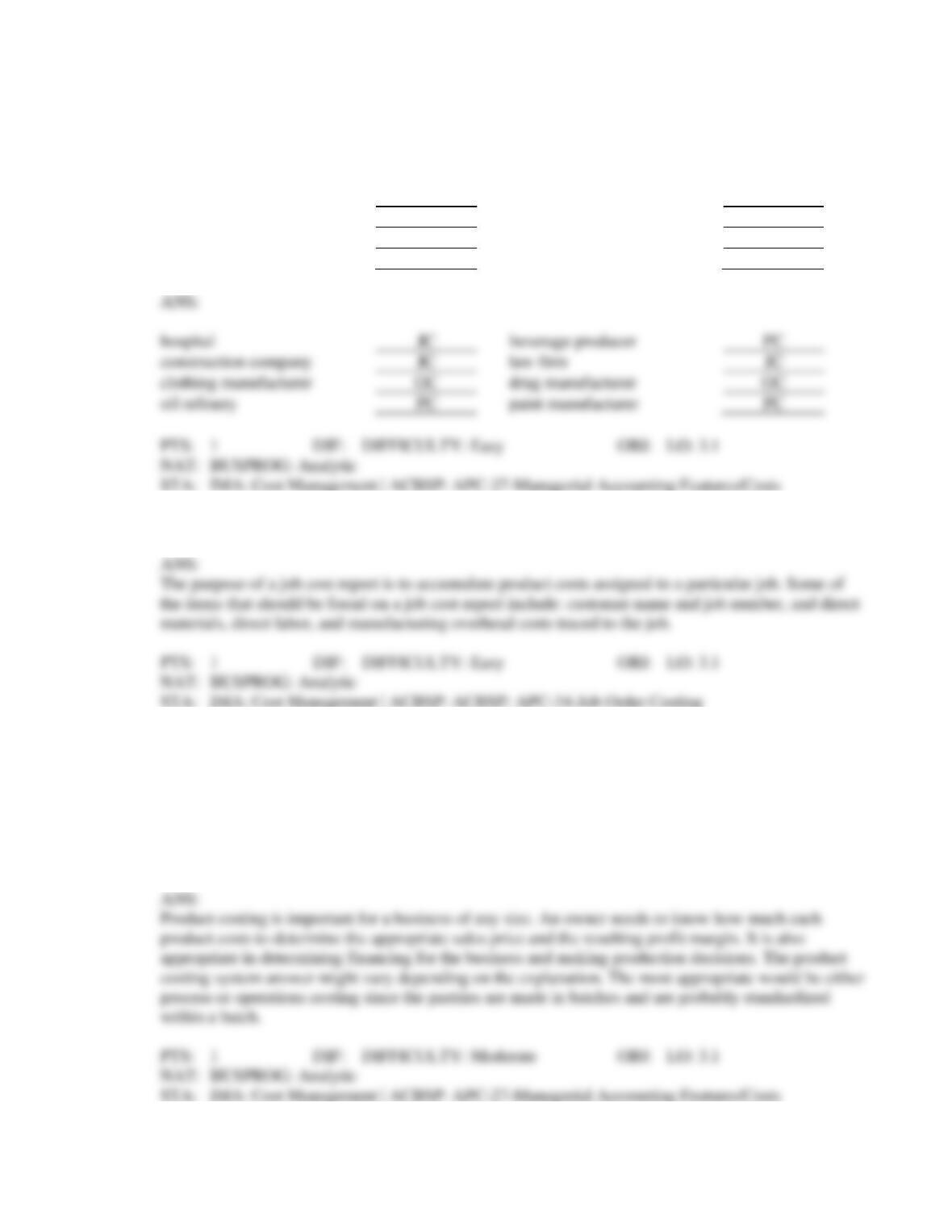
1. For each of the following organizations, indicate which type of costing system would be the most
appropriate: job costing (JC), operations costing (OC), or process costing (PC).
hospital
beverage producer
construction company
law firm
clothing manufacturer
drug manufacturer
oil refinery
paint manufacturer
2. What is the purpose of a job cost report and what are some of the items that should be found on one?
3. You enjoy making cakes and pastries and have decided to open up a small bakery across from campus.
You plan on making a variety of baked items, probably a couple of different batches each day since the
processes differ for each variety. You recall from your managerial accounting class that product
costing is important and that there are a few different choices in determining product costs.
Would product costing be important for a small operation such as this? Why or why not? If you were
to use a product costing system, which one would you use and why?
hospital
beverage producer
construction company
law firm
clothing manufacturer
drug manufacturer
oil refinery
paint manufacturer
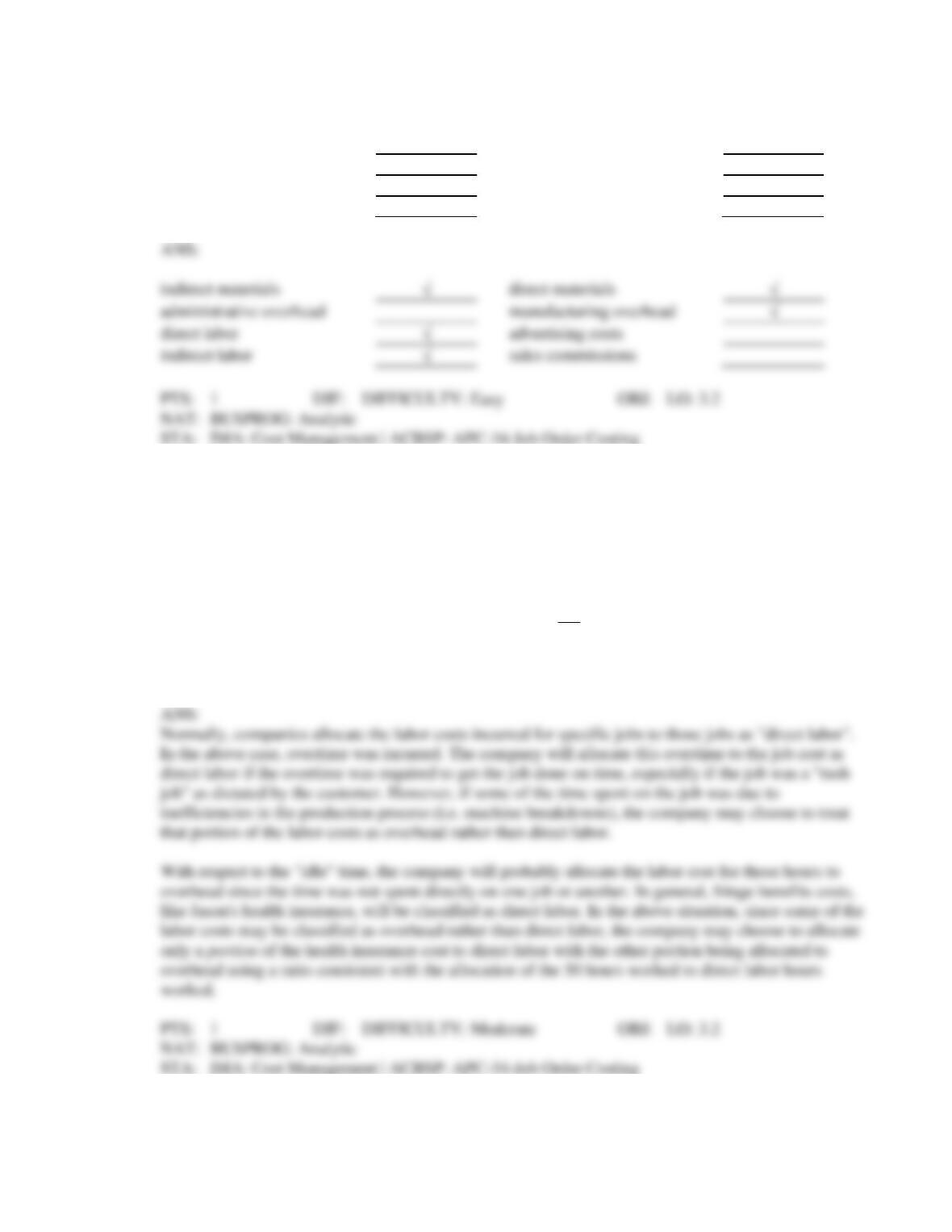
4. Which of the following types of costs would be classified as a product cost in a job order costing
system? Check those that apply.
indirect materials
direct materials
administrative overhead
manufacturing overhead
direct labor
advertising costs
indirect labor
sales commissions
5. Jason Harmon, an employee with Nelson Products, earned a gross wage of $825 for the 50 hours he
worked last week. Jason earns $15 per hour and is paid time-and-a-half for overtime.
In addition, Nelson paid $100 for Jason’s health insurance. The following chart shows a breakdown of
Jason’s time worked:
Hours worked on a specific job
47
Hours spent as “idle”
3
Total hours worked
50
Discuss how the company should allocate Jason’s wage and health insurance costs to products.
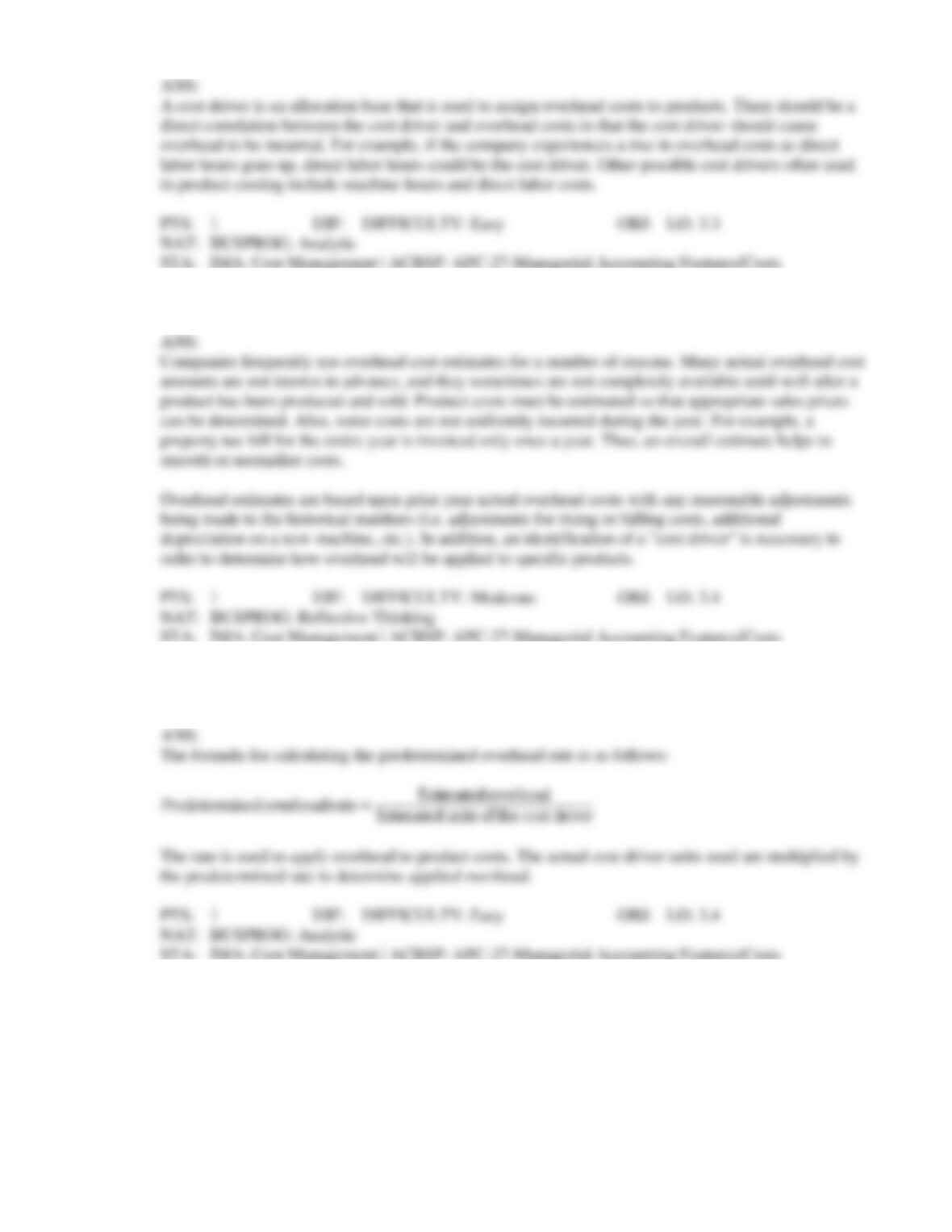
6. Explain the term “cost driver” and give several examples.
7. Why do companies develop estimates for overhead costs? How are estimates developed?
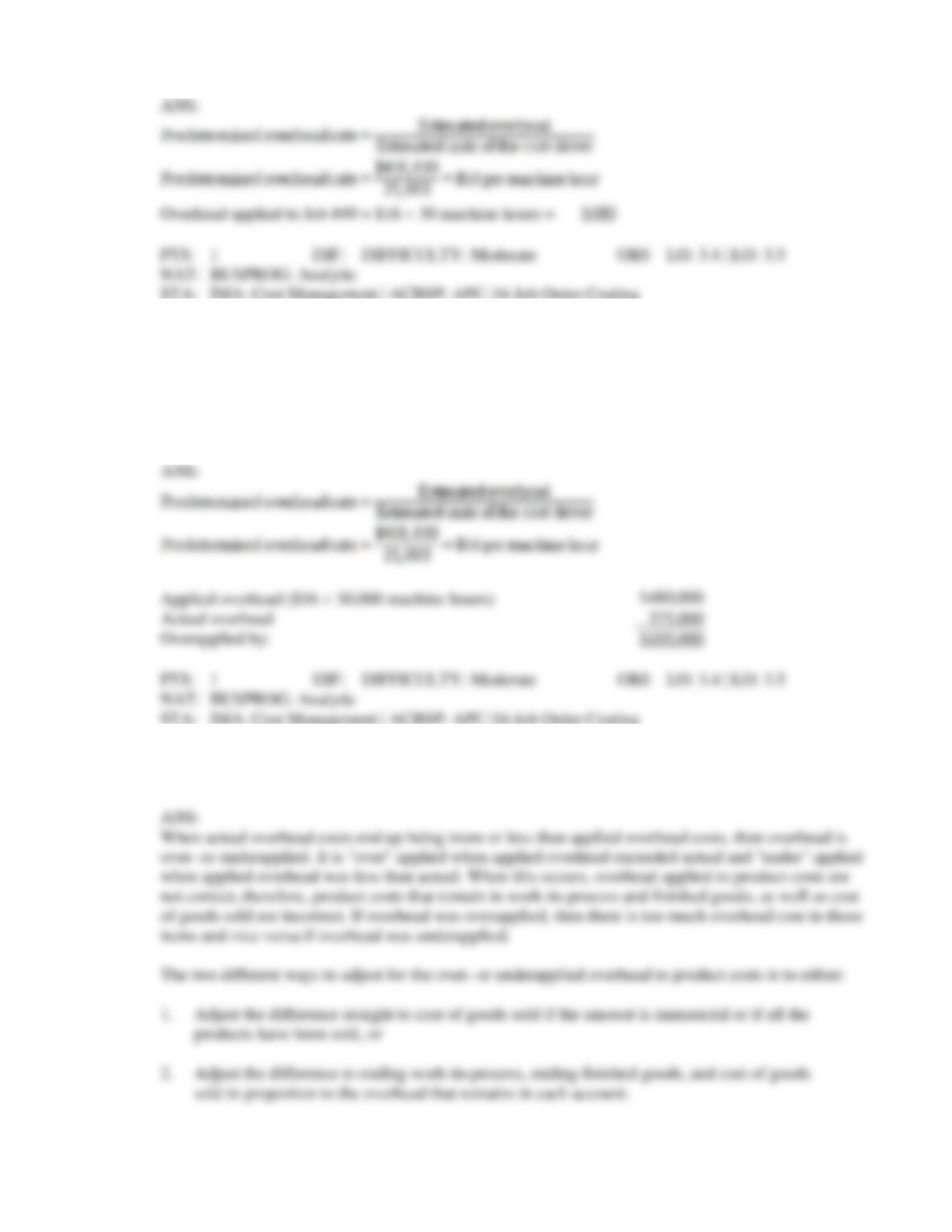
8. What is the formula for calculating the predetermined overhead rate? How is the rate used in product
costing?
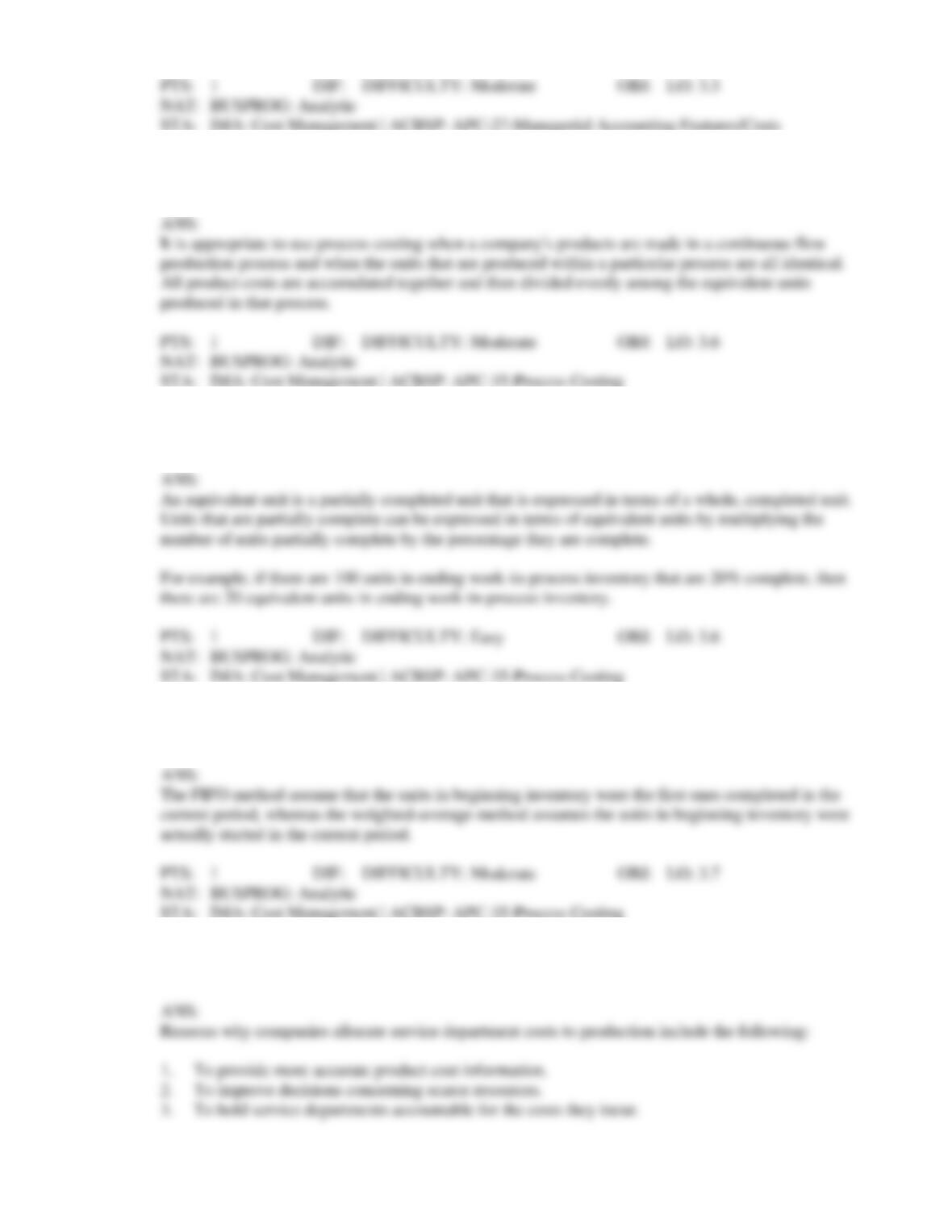
9. Samantha’s Sundries Inc. assigns overhead to specific jobs based on machine hours. At the beginning
of the current year, estimated overhead costs were $400,000 and estimated machine hours were
25,000. By the end of the year, actual overhead costs were calculated to be $375,000 and actual
machine hours were 30,000. One of the jobs worked on during the year was Job #49 which used 30
machine hours.
How much overhead was applied to Job #49?
10. Samantha’s Sundries Inc. assigns overhead to specific jobs based on machine hours. At the beginning
of the current year, estimated overhead costs were $400,000 and estimated machine hours were
25,000. By the end of the year, actual overhead costs were calculated to be $375,000 and actual
machine hours were 30,000.
By how much was overhead over– or underapplied for the year?
11. What does it mean when overhead is over- or underapplied? What costs are affected by this and what
are the two different ways to adjust for the over- or underapplied amount?
12. When is it appropriate to use process costing? Describe how costs are accumulated and assigned to
products.
13. Define the term “equivalent unit” as it relates to process costing along with a simple numerical
example of its calculation.
14. With respect to process costing, what is the difference in how the weighted-average and first-in,
first-out (FIFO) methods treat beginning work–in-process units?
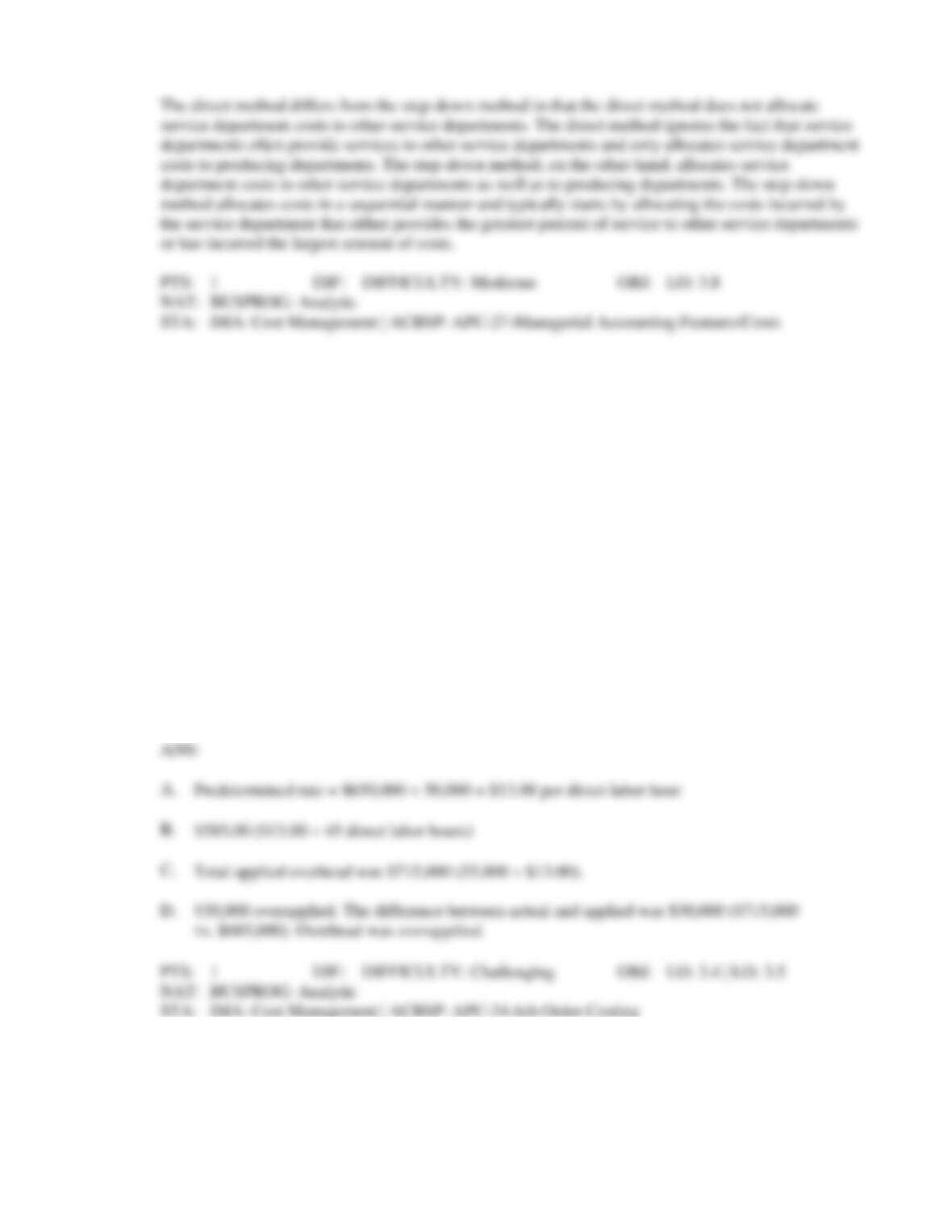
15. List three reasons why service department costs should be allocated to production and explain the
difference between the direct method and the step-down method of allocating service costs.
4.
To hold producing departments accountable for the services they consume.
PROBLEM
1. Triangle Catering assigns overhead to specific jobs based on direct labor hours. At the beginning of the
current year, estimated overhead costs were $650,000 and estimated direct labor hours were 50,000.
By the end of the year, actual overhead costs were calculated to be $685,000 and actual direct labor
hours were 55,000.
Required:
A.
Calculate the predetermined overhead rate.
B.
How much overhead would be applied to a particular catering job that required 45 direct
labor hours?
C.
How much total overhead was applied during the year?
D.
By how much was overhead over– or underapplied for the year? Be sure to indicate
whether it was over- or underapplied.
D.
$30,000 overapplied. The difference between actual and applied was $30,000 ($715,000
vs. $685,000). Overhead was overapplied.
2. Pioria Products assigns overhead to specific jobs based on machine hours. At the beginning of the
current year, estimated overhead costs were $2,150,000 and estimated machine hours were 500,000.
By the end of the year, actual overhead costs were calculated to be $2,000,000 and actual machine
hours were 475,000.
Required:
A.
Calculate the predetermined overhead rate.
B.
How much overhead would be applied to a particular job that required 315 machine
hours?
C.
How much total overhead was applied during the year?
D.
By how much was overhead over– or underapplied for the year? Be sure to indicate
whether it was over- or underapplied.
3. J & J Products uses operational costing. One of their customers has requested 1,000 units of an
identical product. J & J estimates the following will be incurred to fulfill the customer order:
Total direct materials
$2,000
Total direct labor hours
50 hours
Direct labor cost per hour
$20 per hour
In addition, J & J allocates overhead based on direct labor cost. At the beginning of this year, they
estimated overhead costs would total $800,000 and direct labor would cost a total of $3,200,000.
Required:
A.
What will be the predetermined overhead rate used during the year?
B.
What will be the total manufacturing costs for the above customer’s order?
(or 25% of direct labor cost)
B.
The total product cost is $3,250 calculated as follows:
Direct material
D.
$42,500 overapplied. The difference between actual and applied was $42,500 ($2,042,500
vs. $2,000,000). Overhead was overapplied.
4. Greenlaw Products uses job order costing and applies overhead to products using direct labor hours.
Greenlaw has determined that their predetermined overhead is $4.00 per direct labor hour when an
estimated 200,000 direct labor hours are incurred.
During 2011 Greenlaw actually incurred a total of 215,000 direct labor hours and actual overhead
costs ended up being $900,000.
Greenlaw has no ending work–in-process or finished goods inventories.
Required:
A.
What were Greenlaw’s estimated total overhead costs for the year?
B.
By how much was overhead over– or underapplied?
C.
Assuming that cost of goods sold was $3,000,000 prior to the adjustment for over– or
underapplied overhead, what will be the cost of goods sold amount after the year-end
adjustment?
C.
$3,040,000 ($3,000,000 + $40,000 underapplied = $3,040,000)
5. Collins Inc. applies overhead using direct labor hours. The following data are available for the year:
Estimated direct labor hours
1,050,000
Actual direct labor hours
1,000,000
Overhead applied
$5,000,000
Actual overhead
$4,850,000
What predetermined overhead rate did Collins use?
Total product cost
6. Sherrell Inc. applies overhead using direct labor hours. The following data are available for the year:
Estimated direct labor hours
170,000
Actual direct labor hours
160,000
Actual overhead
$600,000
At the end of the year, it was determined that overhead was overapplied by $40,000.
Required:
A.
What was the total applied overhead for the year?
B.
What was the predetermined overhead rate?
B.
$4.00 per direct labor hour calculated as follows:
Predetermined overhead rate = $4.00
7. Hudson Manufacturing uses process costing. The following information was available for the current
year:
Number of units in beginning work–in-process inventory
5,000
(20% complete)
Number of units started in the current period
60,000
Number of units in ending work–in-process inventory
8,000
(60% complete)
Required:
A.
If Hudson uses the first-in, first-out (FIFO) method, calculate total equivalent units for the
year.
B.
If Hudson uses the weighted-average method, calculate total equivalent units for the year.
A.
FIFO total equivalent units = 60,800
Units started and completed in the current year
52,000
equivalent units
8. Koole Products Inc. uses the first-in, first-out (FIFO) method of process costing. The following
information was available for the current year:
Number
of units
Production
Costs
Beginning work-in-process (80% complete)
1,000
$ 6,400
Units started in the current period
70,000
548,800
Ending work-in-process (60% complete)
4,000
Required:
A.
How many total equivalent units were completed during the year?
B.
What was the cost per equivalent unit?
C.
What is the cost allocated to the ending work–in-process units?
D.
What is cost of goods manufactured for the year?
A.
Total equivalent units = 68,600
9. Harrelson Products uses the first-in, first-out (FIFO) method of process costing. The following
information was available for the current year:
Number
of units
Production
Costs
Beginning work-in-process (40% complete)
20,000
$
Total equivalent units
60,800
equivalent units
B.
Weighted average equivalent units = 61,800
Units completed in the current year
57,000
equivalent units
Total equivalent units
61,800
equivalent units
125,000
Units started in the current period
210,000
3,060,000
Ending work-in-process (40% complete)
30,000
Required:
A.
How many total equivalent units were completed during the year?
B.
What was the cost per equivalent unit?
C.
What is the cost allocated to the ending work–in-process units?
D.
What is cost of goods manufactured for the year?
10. Robinson Products uses the weighted-average method of process costing. The following information
was available for the current year:
Number of
units
Production
Costs
Beginning work-in-process (10% complete)
5,000
$ 1,500
Units started in the current period
90,000
279,900
Ending work-in-process (40% complete)
2,000
Required:
A.
How many total equivalent units were completed during the year?
B.
What was the cost per equivalent unit?
C.
What is the cost allocated to the ending work–in-process units?
D.
What is cost of goods manufactured for the year?
A.
Total equivalent units = 93,800
A.
Total equivalent units = 204,000
11. Aster Manufacturing uses the weighted-average method of process costing. The following information
was available for the current year:
Number
of units
Production
Costs
Beginning work-in-process (90% complete)
20,000
$
126,000
Units started in the current period
1,400,000
8,974,000
Ending work-in-process (50% complete)
40,000
Required:
A.
How many total equivalent units were completed during the year?
B.
What was the cost per equivalent unit?
C.
What is the cost allocated to the ending work–in-process units?
D.
What is cost of goods manufactured for the year?
A.
Total equivalent units = 1,400,000