21
MASTER SCHEDULING
CHAPTER 3
ANSWERS TO PROBLEMS
3.1
3.2
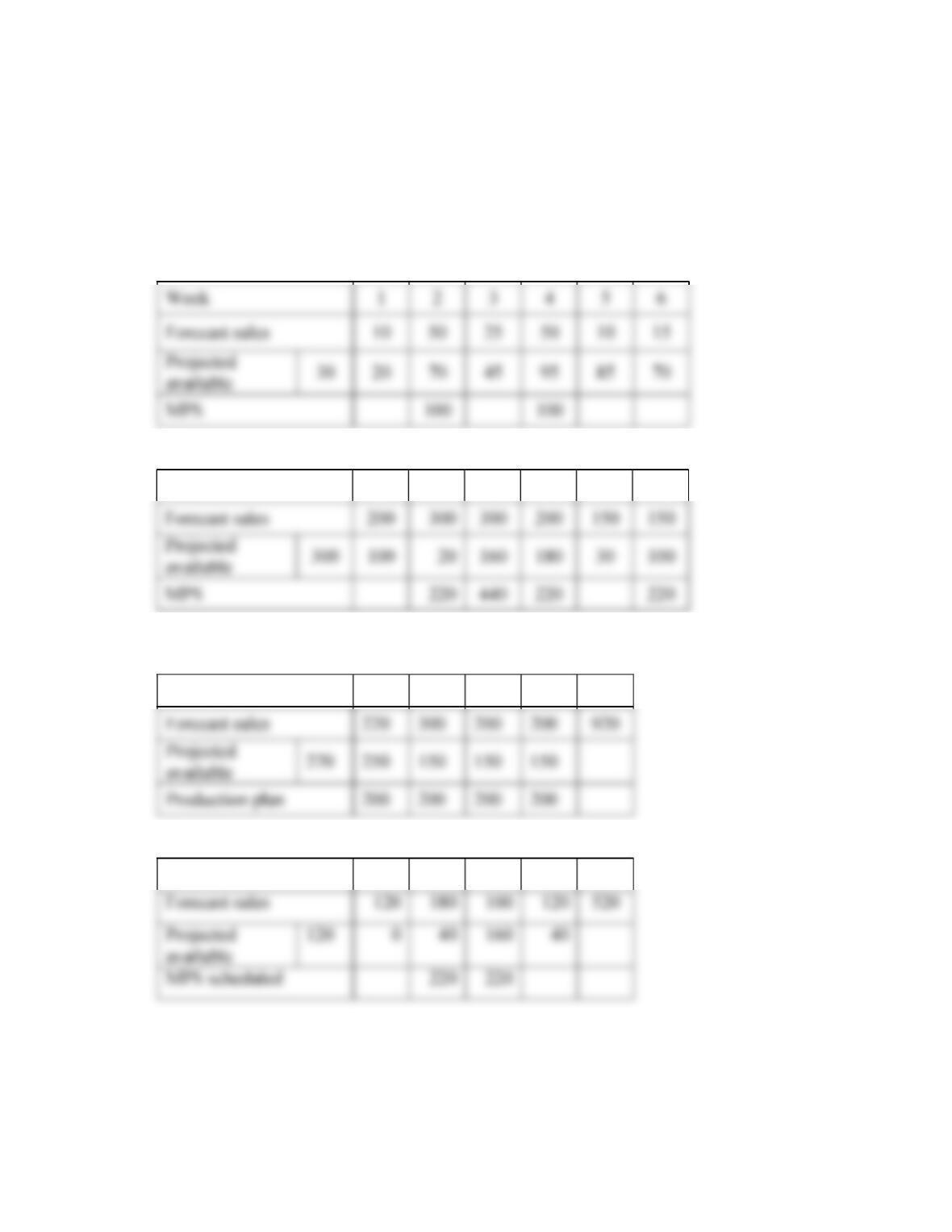
Week 1 2 3 4 5 6
3.3
Production Plan
Quarter 1 2 3 4 Total
Mailbox A. Lot size: 200
Quarter 1 2 3 4 Total
22
Mailbox B. Lot size: 200
Quarter 1 2 3 4 Total
3.4
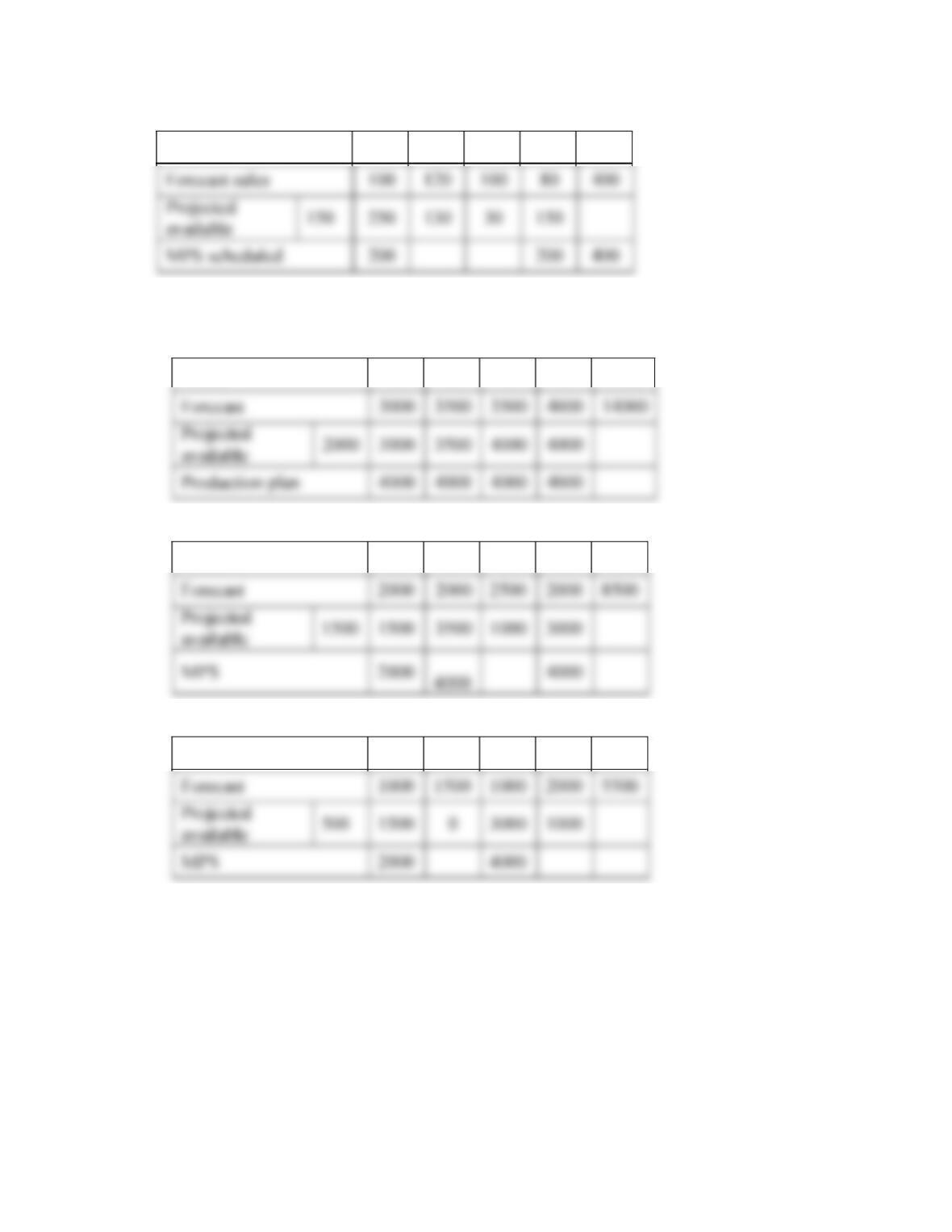
Production plan
Week 1 2 3 4 Total
Model A.
Week 1 2 3 4 Total
Model B.
Week 1 2 3 4 Total
23
3.5
Master production schedule
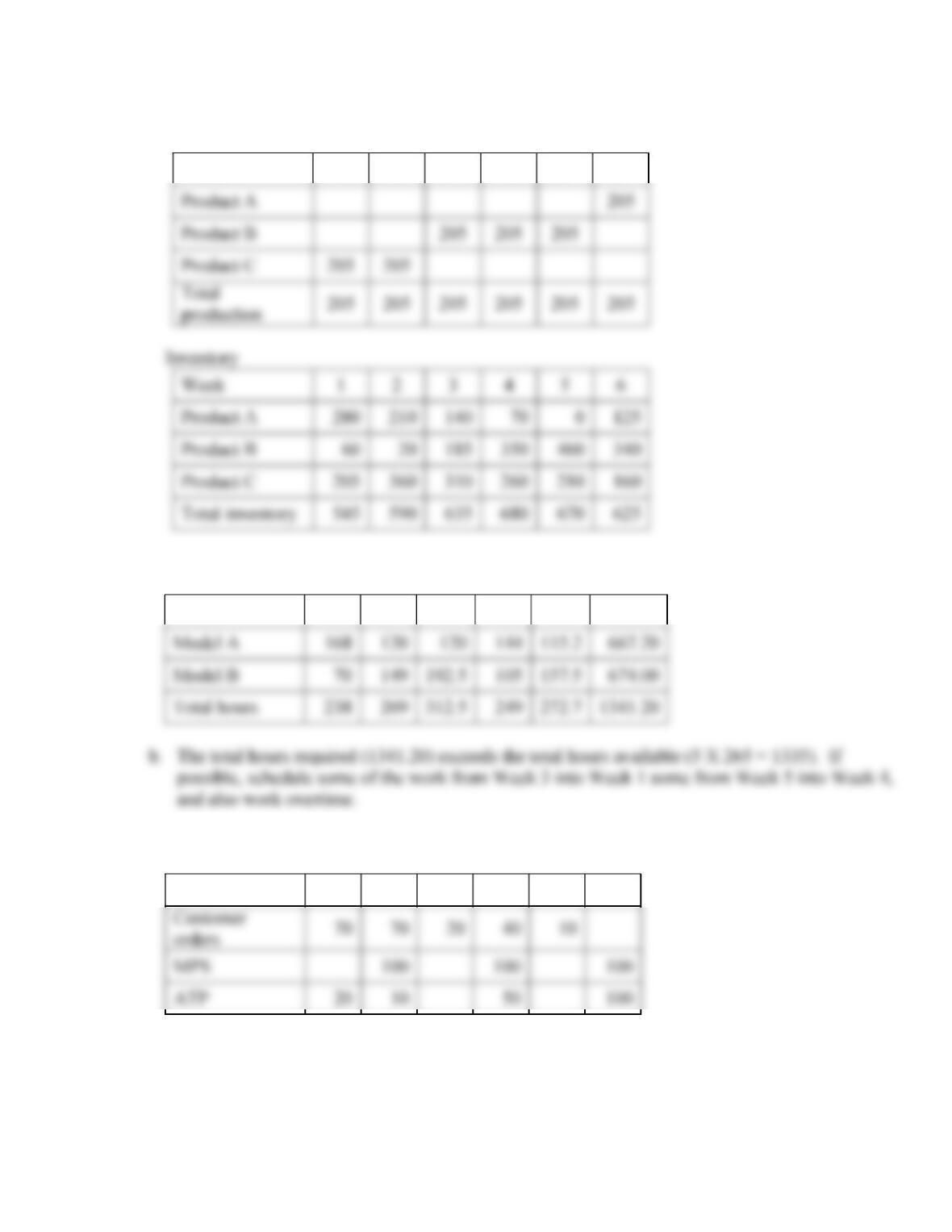
Week 1 2 3 4 5 6
3.6 a.
Week 1 2 3 4 5 Total
3.7
Week 1 2 3 4 5 6
24
3.8
Week 1 2 3 4 5 6
3.9
Week 1 2 3 4 5 6 7 8 9 10
3.10
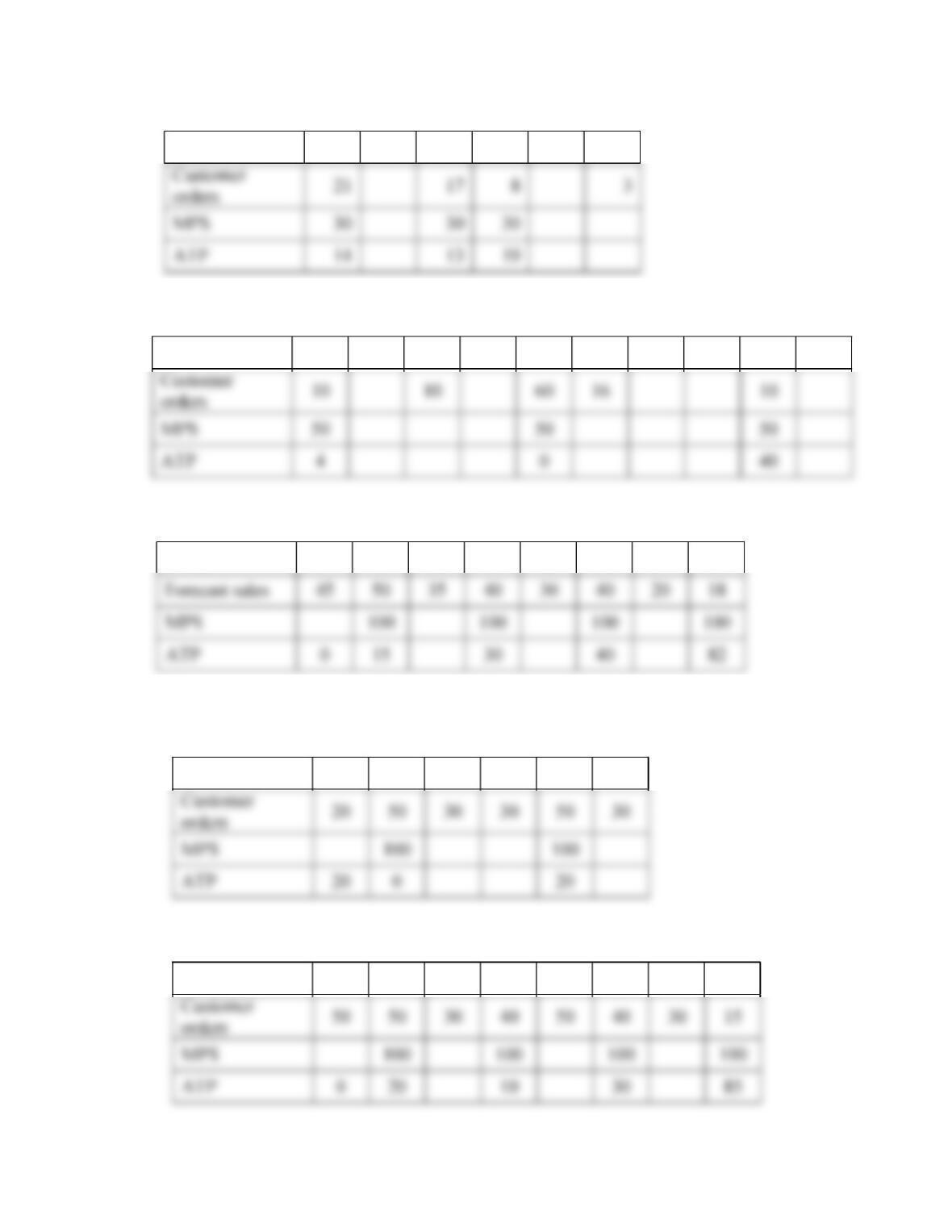
Week 1 2 3 4 5 6 7 8
3.11
On hand: 60 units
Week 1 2 3 4 5 6
3.12
On hand: 50 units
Week 1 2 3 4 5 6 7 8
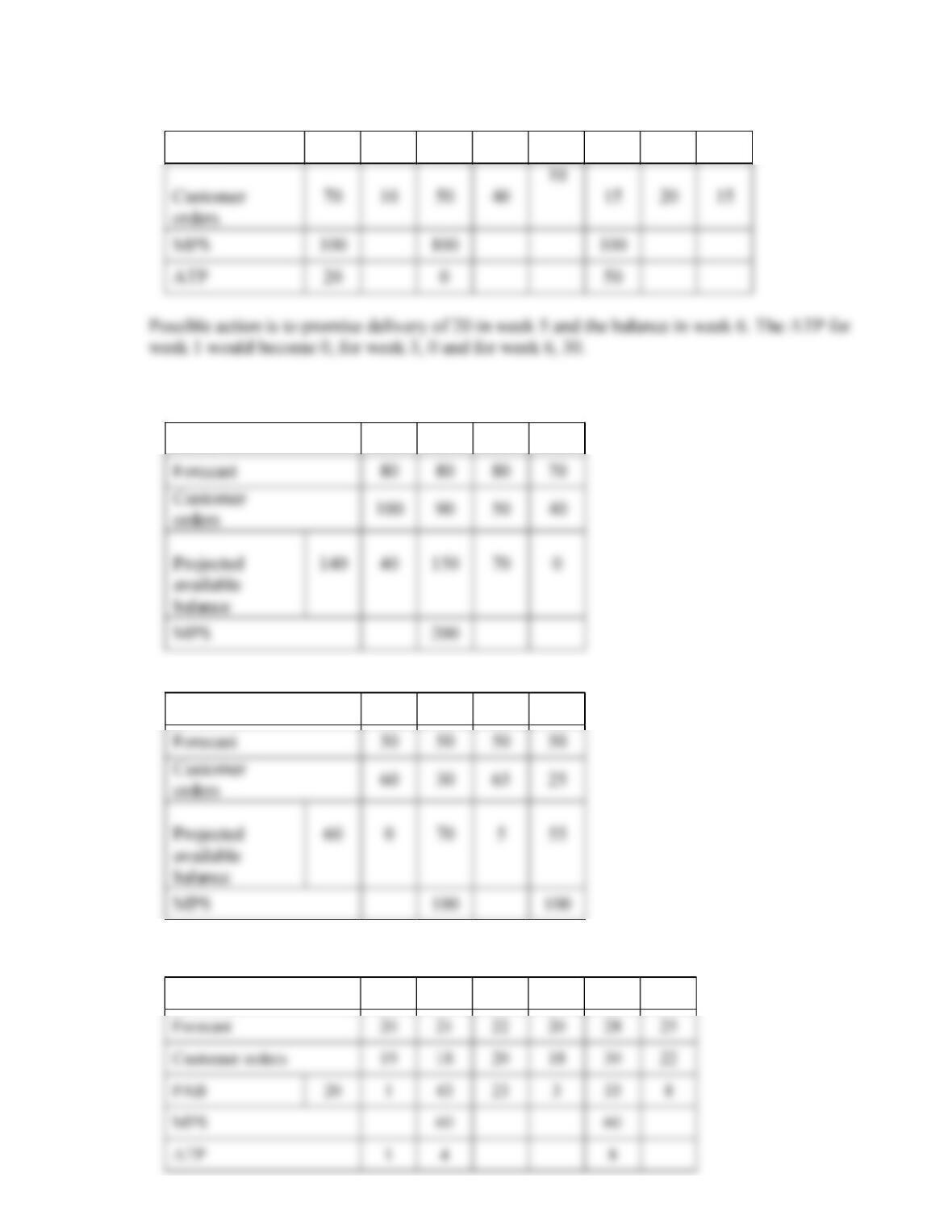
25
3.13
Week 1 2 3 4 5 6 7 8
3.14
Week 1 2 3 4
3.15
Week 1 2 3 4
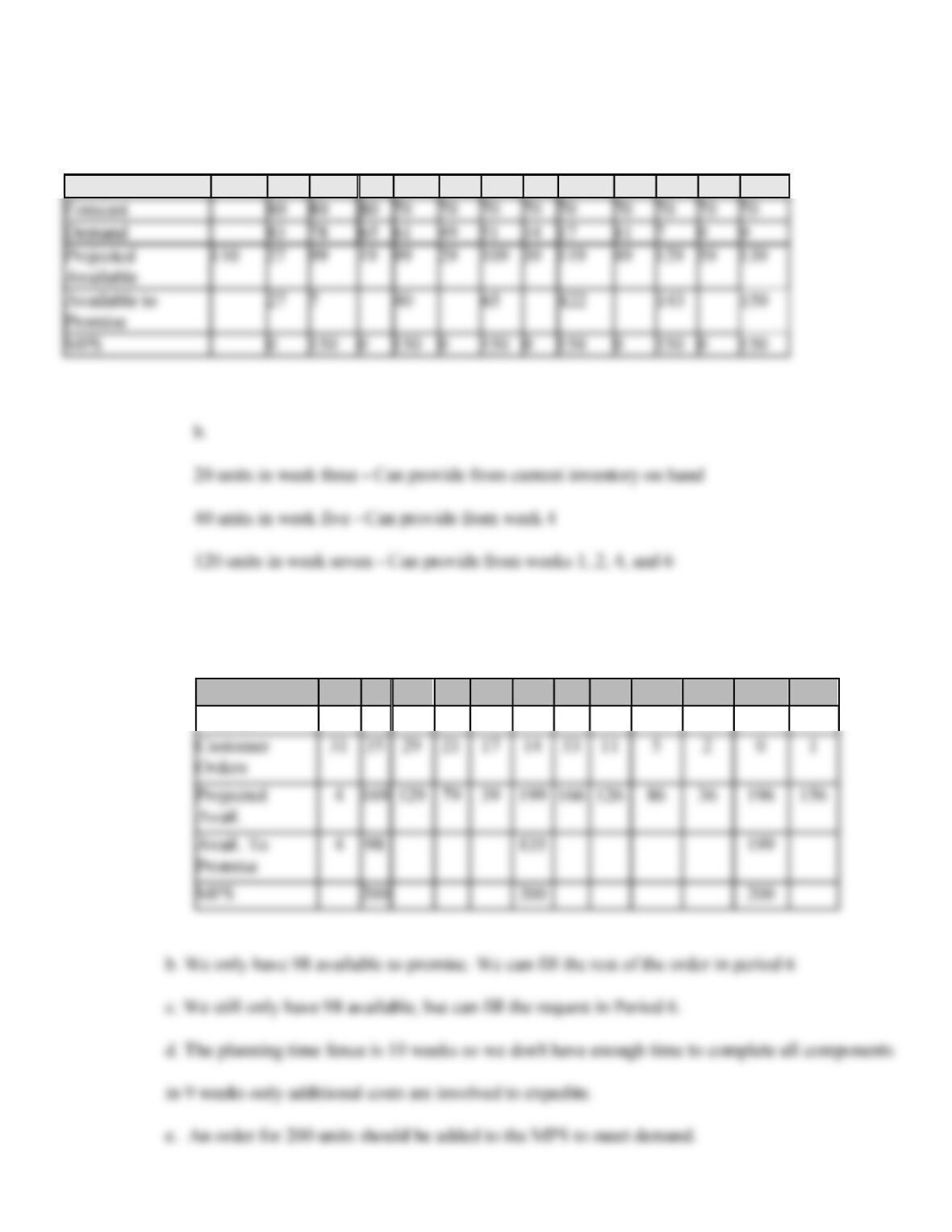
3.16
Period 1 2 3 4 5 6
26
3.17a.
Week 1 2 3 4 5 6 7 8 9 10 11 12
3.18
a.
Period 1 2 3 4 5 6 7 8 9 10 11 12
Forecast 30 40
40 50
40 40 30
40 40 50 40 40
27
MULTIPLE CHOICE QUESTIONS
1. The information needed to develop a master production schedule will be obtained from:
a. the production plan
b. the forecast of individual end items
c. inventory levels for individual end items
d. all of the above
e. none of the above
2. The MPS is a vital link the production planning system because it:
I. Keeps priorities valid.
II. Forms the basis for determining the capacity needed.
III. Is input to the material requirements plan.
IV. Is input to the production plan.
a. I, II, III and IV only
b. I, II and III only
c. I, II and IV only
d. II, IIII and IV only
e. I, II, III, and IV
3. The MPS:
a. facilitates order promising
b. works with individual end products
c. is an agreed-upon plan between production and marketing
d. all of the above
e. none of the above
4. The functions of a master production schedule are to:
I. Plan material components
II. Plan capacity requirements
III. Keep priorities valid
a. I, II and III
b. I and II only
c. I and III only
d. II and III only
e. none of the above is a function of the MPS
5. Which of the following are objectives of an MPS?
I. Maintain the desired level of customer service.
II. Keep the sales department happy.
III. Make the best use of material, labor and equipment.
IV. Maintain inventory investment as required.
a. only I is an objective
b. only I and II are objectives
c. only I, II and III are objectives
d. only I, III and IV are objectives
e. only II, III and IV are objectives
28
6. The process of checking the MPS against available capacity is called:
a. capacity planning
b. shop-floor control
c. rough-cut capacity planning
d. capacity control
e. process checking
7. In an assemble-to-order company, at which level should master scheduling take place?
a. the component/subassembly level
b. the end item level
c. the raw material/component level
d. it does not matter, any level will do
e. none of the above levels
8. The final assembly schedule (FAS):
a. schedules customer orders as they are received based on components planned in the
MPS
b. is really a synonym for the master production schedule
c. is basically the same as the MPS for a make-to-order product
d. a and b above
e. none of the above is true
9. Which of the following statements is best regarding the master production schedule?
a. it is an agreed-upon plan between marketing and manufacturing
b. if it is poorly done we can expect past-due schedules and unreliable delivery promises
c. it is a plan for specific end items that manufacturing expects to make over some period
in the future
d. all of the above are true
e. none of the above is true
10. The portion of inventory or production not committed to customer orders is called:
a. free stock
b. available to promise
c. excess production
d. waste
e. excess capacity
11. If there are customer orders the projected available is based on:
a. forecast demand
b. customer orders
c. the greater of forecast demand and customer orders
d. the opinion of the planner
12. Which of the following is (are) true about time fences in a master production schedule system?
I. Changes far out in the planning horizon can be made with little or no cost to manufacturing.
II. In the “frozen zone,” capacity and materials are committed to specific orders.
III. Changes in the near future on the planning horizon are less costly to make than changes far
out.
29
a. I and II only
b. II and III only
c. I and III only
d. I, II, and III
e. none of the above
13. Which of the following is NOT an input to the master production schedule?
a. sales forecast for items
b. current inventory status
c. final assembly schedule
d. customer orders
e. production plan
14. The MPS is constrained by:
I. The availability of material.
II. Available capacity.
III. Inventory policies.
IV. Production plan.
a. all of the above
b. I, II, III only
c. I and II only
d. II and III only
e. none of the above
30
15. Given the following data, complete the table. There are 30 on hand. Order quantity is 60 units.
Week 1 2 3 4
Forecast 20 30 50 20
Projected available
Scheduled receipts
a. the projected available in week 3 is 40
b. the projected available in week 4 is 30
c. there is a scheduled receipt in week 4
d. a and b are true
e. b and c are true
16. Given the following table, calculate the ATP. There are 50 units on hand.
Week 1 2 3 4 5
Customer orders 20 20 15 30 10
Scheduled receipts 50
ATP
a. the ATP in week one is 10
b. the ATP in week one is 30
c. the ATP in week one is 5
d. the ATP in week two is 10
e. the ATP in week three is 35
17. The time span for which the master schedule extends is called the:
a. time fence
b. planning horizon
c. time bucket
d. forecast period
e. none of the above
18. The final assembly schedule as different from the master schedule is primarily used:
a. in a make-to-stock environment
b. in a assemble-to-order environment
c. in either environment
d. in neither environment
19. Which of the following is true concerning the demand time fence?
a. Beyond the time fence only forecasts are considered
b. The demand time fence resprsents the cumulative lead time of the product c.
Inside the time fence only customer orders are considered for planning
d. No more orders are allowed inside the demand time fence
e. The demand time fence is longer than the planning time fence
31
20. Which of the following is the term applied to a master schedule for a purchased item?
a. Supplier scheduling
b. Master scheduling
c. Material scheduling
d. Purchase order
21. Which of the following is a contract between manufacturing and marketing?
a. Production plan
b. Master schedule
c. Forecast
d. Customer order
22. Master scheduling is a balancing act between which of the following?
a. Forecasts and orders
b. Inventory and customer service
c. Supply and demand
d. Forecast and inventory
23. Which of the following modules follows the Sales and Operations Plan?
a. Business planning
b. Production planning
c. Master scheduling
d. Material requirements planning
24. Shifting customer design decisions as far down the supply chain as possible is typically called
which of the following?
a. Planning horizon
b. Planning time fence
c. Postponment
d. Reverse supply chain
25. A customer requests a new order in a period where there is inadequate material available in the
available-to-promise (ATP) for that period, and the period is within the planning time fence. Which of
the following is the best first course of action to take in such a situation?
a. Increase the master schedule quantity for that period by enough to cover the order
b. Shift the planning time fence inward
c. Tell the customer they cannot have the order in that period
d. Look for additional material in an earlier ATP quantity

32
Answers.