Introduction to Operations and Supply Chain Management, 4e (Bozarth/Handfield)
Chapter 3 Process Choice and Layout Decisions in Manufacturing and Services
Learning Objective 3-1
1) No manufacturing process can be best at everything.
2) A product-based layout arranges resources sequentially according to the steps required to
make a product.
3) A job shop manufacturing process is better suited to make a variety of products than a
continuous flow process.
4) A batch process is less flexible than a production line and less efficient that a job shop.

5) A cellular layout is another name for a functional layout.
6) A customer service function at an insurance firm that handles claims based on the first letter
of the customer’s last name is an example of applying group technology to a service operation.
7) The product-process matrix illustrates that low volume, one-of-a-kind products are ideally
suited to a job shop process.
8) A manufacturing process decision affects:
A) the type of workforce needed.
B) the type of equipment needed.
C) the type of products that can be made.
D) All of the above are correct.
9) Highly automated batch processes that can reduce the cost of making similar groups of
products are:
A) functional layouts.
B) flexible manufacturing systems.
C) make-to-stock.
D) adjacent processes.
10) The time between completions of successive units on a production line is called:
A) cycle time.
B) takt time.
C) elapsed time.
D) work time.
11) An advantage of a production line process is:
A) the volume of output needed to justify the investment.
B) the degree of flexibility of the process.
C) the per unit cost of items produced on the line.
D) the range of output typically produced on such a process.
12) The manufacturing process used to make a wide variety of highly customized products in
quantities as small as one is a:
A) production line.
B) continuous flow process.
C) job shop.
D) fixed position.
13) A sporting apparel manufacturer that produces t-shirts to commemorate significant athletic
achievements for proud students and alumni probably uses:
A) a fixed position layout.
B) batch manufacturing.
C) a continuous flow process.
D) a production line.
14) The Devon Tower graces the Oklahoma City skyline and is officially the tallest building in
the state. The manufacturing process used to produce this jewel is most probably:
A) a fixed-position layout.
B) a batch manufacturing process.
C) a hybrid process.
D) a job shop.
15) Which of these manufacturing processes is most likely dictated by the physical
characteristics of the product being produced?
A) job shop
B) batch
C) production line
D) continuous flow
16) A(n) ________ is a highly automated batch process that can reduce the cost of making
groups of similar products.
17) ________ gets its name from the fact that items are moved through the different
manufacturing steps in groups.
18) “My tour of the Duff Brewery was the greatest experience of my life,” Homer recalled.
Lenny’s favorite part was the batch process that was evident during the fermenting stage but
Carl’s favorite part was the high speed continuous flow process evident in the bottling line.
“You’re both right,” Homer declared, “Duff takes both elements to create a(n) ________
process.”

19) A cellular layout is essentially the opposite of a(n) ________ layout.
20) The product process matrix uses a scale of ________ and ________.
21) Why are process decisions important?

22) What are the two types of product-based layouts? What are their similarities and differences
and their advantages and disadvantages compared with other types of layouts and processes?
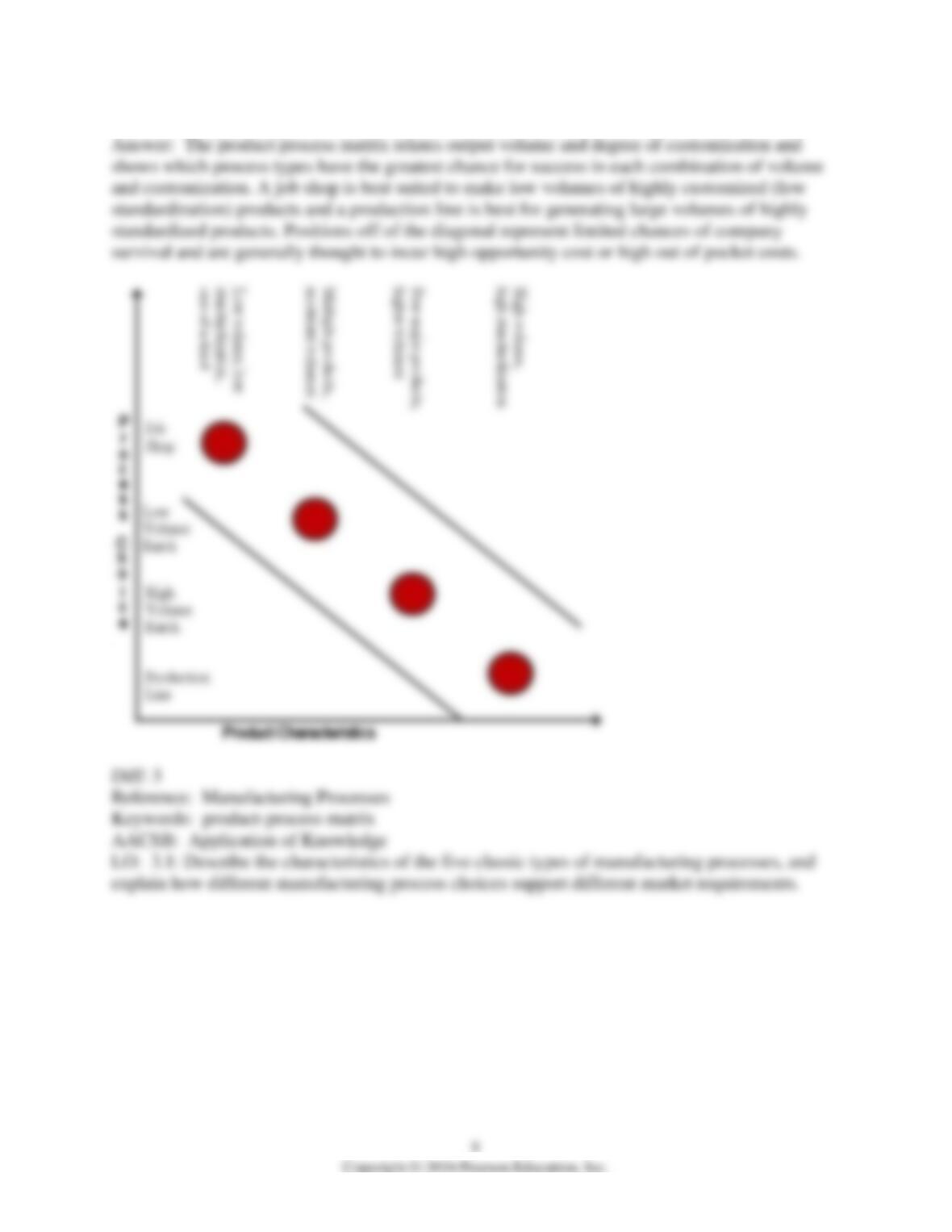
23) Draw the product-process matrix and discuss the placement of each process choice.
24) What is a cellular layout and what are its advantages?
Learning Objective 3-2
1) Make-to-stock products are typically produced using a production line.
2) Products that use standard components, but the final configuration of those components is
customer-specific, are called make-to-order products.
3) Activities that take place prior to the point of customization are called upstream activities.
4) According to the law of variability, converting from an assemble-to-order to a make-to–order
production process should increase productivity of the manufacturing processes.
5) Products that are customized only at the very end of the manufacturing process are known as:
A) make-to-stock.
B) assemble-to-order.
C) make-to-order.
D) engineer-to-order.
6) Products that use standard components but the final configuration of those components is
customer-specific are known as:
A) make-to-stock.
B) assemble-to-order.
C) make-to-order.
D) engineer-to-order.

7) An assemble-to-order process occurs upstream from:
A) design.
B) material sourcing.
C) fabrication.
D) assembly/finishing.
8) ________ products involve no customization but ________ products are completely
customized.
9) ________ are products that are customized only at the very end of the manufacturing process.
10) According to the law of variability, the ________ the random variability either demanded of
the process or inherent in the process itself or in the items processed, the ________ productive
the process is.
11) What are the four levels of customization and at what place does each occur in the supply
chain?
Learning Objective 3-3
1) In a service process, the greater the emphasis on intangible activities is, the more critical is the
training and retention of skilled employees and the development and maintenance of the firm’s
knowledge assets.
2) Capability variety is the difference in how customers view an identical service outcome. What
some customers might view as economical and thrifty others might view as cheap and poor
value.
3) As the degree of service customization decreases, managers have more opportunity to focus
on cost and productivity.
4) The back room refers to the part of the service process where the customer is not visible to the
other customers waiting for service.
5) In a service blueprint, the line of internal interaction falls between the customer and the
onstage service provider.
6) The three dimensions of service positioning are the nature of the service package, the degree
of customization and the degree of customer contact.
7) The greater the emphasis on intangible activities, the more management’s attention will be
directed to:
A) buildings and property.
B) training employees.
C) truck fleets.
D) material costs.
8) The point where the customer interfaces directly with the service organization is:
A) the front room.
B) the back room.
C) onstage.
D) the floor.
9) A legal service in a corporate acquisition probably scores:
A) low on customization and high on physical activities.
B) high on customer contact and low on intangible activities.
C) high on customization and high on intangible activities.
D) low on customer contact and low on intangible activities.
10) The ________ includes all the value-added physical and intangible activities that a service
organization provides to the customer.
11) As the degree of customer contact decreases, more of the service package is provided by the
________.
12) In a service blueprint, the two layers the customer is involved with are the ________ and the
________.
13) Service operations compete and position themselves in the marketplace based on the three
dimensions — ________, ________, and ________.

14) Define the term service package and describe management’s focus for each activity.
15) Define the terms front room and back room and describe the roles these processes play in
service operations. What must operations managers take into consideration when setting up these
two processes?

Learning Objective 3-4
1) Cycle time is the sum of all of the task times.
2) Takt time sets the upper limit on the elapsed time between completions of successive items on
a production line.
3) Regardless of the number of tasks or their durations, a line balance that is 100% efficient is
achievable if CT = ΣT.
4) The shorter the required takt time, the more workstations will be required to balance a
production line.