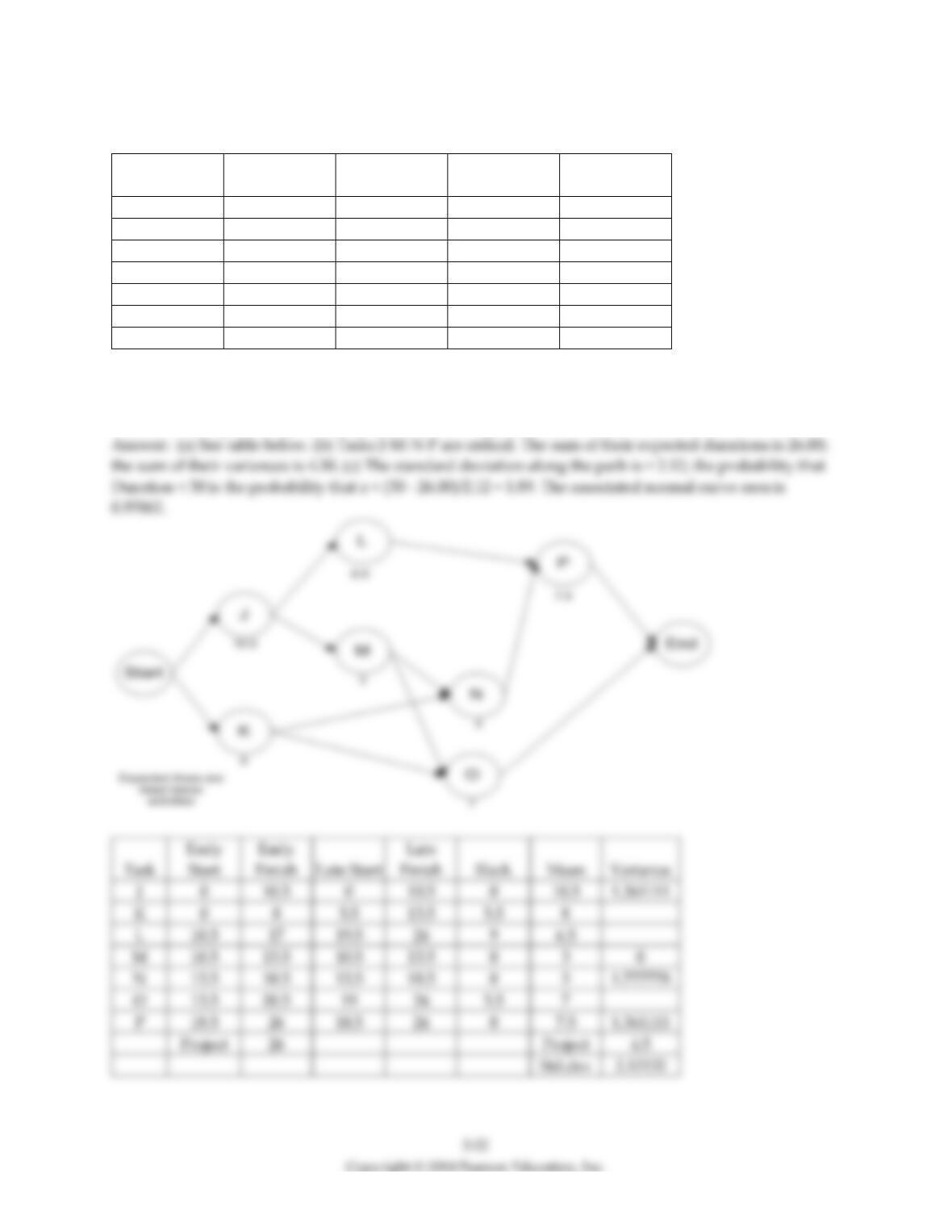
30) Consider the network described in the table below.
Activity
Immediate
Predecessor(s)
Pessimistic
Probable
Optimistic
J
—
15
10
8
K
—
9
8
7
L
J
10
6
5
M
J
3
3
3
N
K,M
9
5
1
O
K,M
10
7
4
P
L,N
10
8
3
a. Calculate the expected duration of each activity.
b. Calculate the expected duration and variance of the critical path.
c. Calculate the probability that the project will be completed in fewer than 30 time units.
Early
Start
Slack
7.5
3-33
31) A network consists of the following list. Times are given in weeks.
Activity
Preceding
Optimistic
Probable
Pessimistic
A
—
5
11
14
B
–
3
3
9
C
—
6
10
14
D
A, B
3
5
7
E
B
4
6
11
F
C
6
8
13
G
D, E
2
4
6
H
F
3
3
9
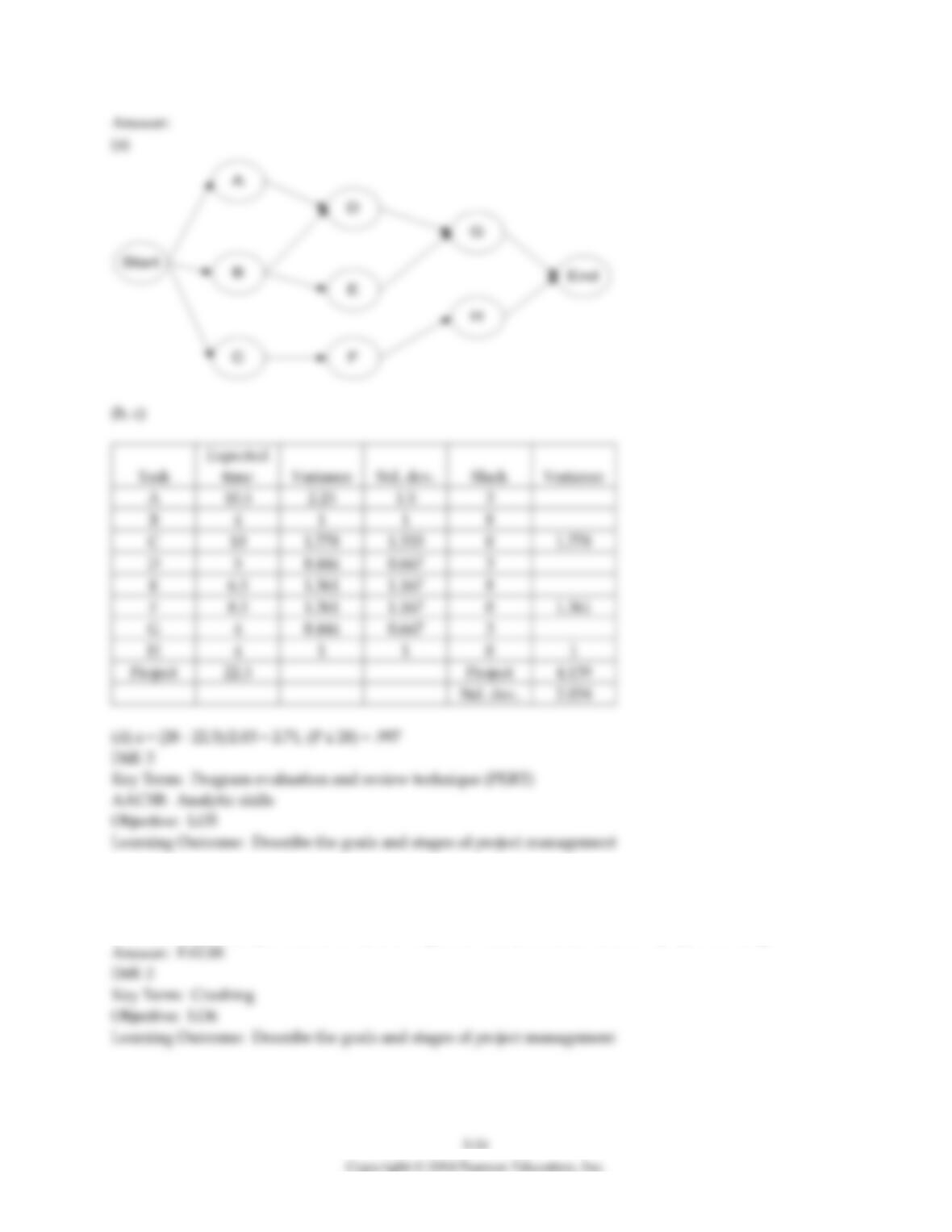
a. Draw the network diagram.
b. Calculate the expected duration and variance of each activity.
c. Calculate the expected duration and variance of the critical path.
d. Calculate the probability that the project will be completed in less than 28 weeks.
Section 8 Cost-Time Trade-offs and Project Crashing
1) Shortening the project’s duration by deleting unnecessary activities is called “project crashing.”
2) In project management, crashing an activity must consider the impact on all paths in the network.
3) A project manager is interested in crashing a project with variable activity times. Which of the
following tools should he/she employ?
A) PERT
B) CPM
C) Gantt Chart
D) either PERT or CPM
E) PERT, CPM, or a Gantt chart are fine.
4) Which of these statements regarding time-cost tradeoffs in CPM networks is true?
A) Crashing is not possible unless there are multiple critical paths.
B) Crashing a project often reduces the length of long-duration, but noncritical, activities.
C) Activities not on the critical path can never be on the critical path, even after crashing.
D) Crashing shortens the project duration by assigning more resources to one or more of the critical tasks.
E) The crash time always exceeds the normal time.
5) What was the name of the construction project to rebuild the Pentagon after the terrorist attacks on
Sept. 11, 2001?
A) Project Panther
B) Project Pit Bull
C) Project Python
D) Project Piranha
E) Project Phoenix
6) Which of the following statements regarding time-cost tradeoffs in CPM networks is false?
A) Crashing shortens project duration by assigning more resources to critical tasks.
B) Crashing sometimes has the reverse result of lengthening the project duration.
C) Crashing must consider the impact of crashing an activity on all paths in the network.
D) Activities not on the critical path can become critical after crashing takes place.
E) A negative crash cost per period would imply that either crashing is cheaper than not crashing or that
the crash time was slower than the normal time.
7) If an activity whose normal duration is 13 days can be shortened to 10 days for an added cost of $1,500,
what is the crash cost per period?
A) $500
B) $1,500
C) $750
D) $13,000
E) $15,000
8) Two critical path activities are candidates for crashing on a CPM network. Activity details are in the
table below. To cut one day from the project’s duration, activity ________ should be crashed first, adding
________ to project cost.
Activity
Normal Time
Normal Cost
Crash Time
Crash Cost
One
8 days
$6,000
6 days
$6,800
Two
10 days
$4,000
9 days
$5,000
A) One; $400
B) One; $6,800
C) Two; $1,000
D) Two; $5,000
E) One or Two should be crashed; $1,400
9) If an activity whose normal duration is 15 days can be shortened to 10 days for an added cost of $2,000,
what is the crash cost per period?
A) $400
B) $2,000
C) $10,000
D) $20,000
E) $30,000
10) A network has been crashed to the point where all activities are critical. Additional crashing:
A) is unnecessary.
B) is impossible.
C) is prohibitively expensive.
D) may require crashing multiple tasks simultaneously.
E) can be done, but all critical tasks must be reduced in duration.
11) Two critical path activities are candidates for crashing on a CPM network. Activity details are in the
table below. To cut one day from the project’s duration, activity ________ should be crashed first, adding
________ to project cost.
Activity
Normal Time
Normal Cost
Crash Time
Crash Cost
B
4 days
$6,000
3 days
$8,000
C
6 days
$4,000
4 days
$6,000
A) B; $2,000
B) B; $8,000
C) C; $1,000
D) C; $2,000
E) C; $6,000
12) ________ is decreasing activity time in a network to reduce time on the critical path so total
completion time is reduced.
13) Three critical path activities are candidates for crashing on a CPM network. Activity details are in the
table below.
Activity
Normal Time
Normal Cost
Crash Duration
Crash Cost
X
8 days
$6,000
6 days
$8,000
Y
3 days
$1,800
2 days
$2,400
Z
12 days
$5,000
9 days
$7,700
a. What is the crash cost per unit time for each of the three activities?
b. Which activity should be crashed first to cut one day from the project’s duration; how much is added to
project cost?
c. Which activity should be the next activity crashed to cut a second day from the project’s duration; how
much is added to project cost?
14) Three critical path activities are candidates for crashing on a CPM network. Activity details are in the
table below.
Activity
Normal Time
Normal Cost
Crash Duration
Crash Cost
A
9 days
$8,000
7 days
$12,000
B
5 days
$2,000
3 days
$10,000
C
12 days
$9,000
11 days
$12,000
a. What is the crash cost per unit time for activity A?
b. What is the crash cost per unit time for activity B?
c. Which activity should be crashed first to cut one day from the project’s duration; how much is added to
project cost?
d. Which activity should be the next activity crashed to cut a second day from the project’s duration; how
much is added to project cost?
e. Assuming no other paths become critical, how much can this project be shortened at what total added
cost?
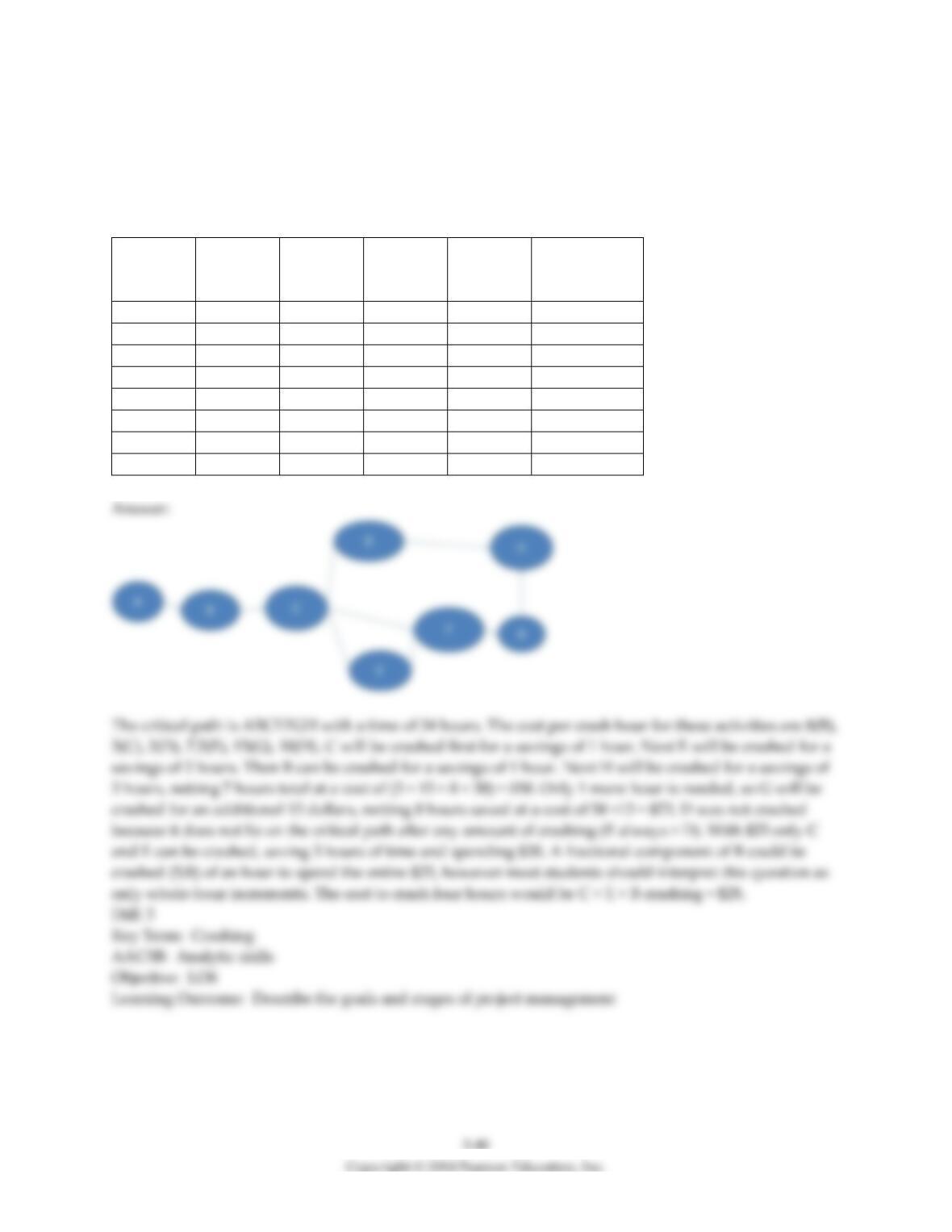
15) Pirmin’s Bike Shop is behind on a custom bike and needs to crash 8 hours of time from the 8-step
project. Given the project table below calculate the crash cost for 8 hours of time-savings. Suppose Pirmin
calls the customer and asks for a project extension, reducing the amount of time he needs to crash.
Calculate both the maximum time-savings available on a $25 crash budget and the cost to crash four
hours of savings.
Activity
Normal
Duration
(hours)
Normal
Cost ($)
Crash
Duration
(hours)
Crash
Cost (S)
Immediate
Predecessors
A
2
10
2
0
None
B
3
15
2
23
A
C
5
25
4
30
B
D
3
20
1
24
C
E
6
30
4
45
C
F
1
5
1
0
C,E
G
7
35
6
50
F
H
10
50
7
80
D,G
16) Given the critical path below, calculate the following:
a. The crash cost per unit time savings for each activity.
b. The maximum total crash time savings and cost.
c. The maximum total time-savings with a $3000 budget.
Activity
Normal Time
Normal Cost
Crash Duration
Crash Cost
A
8 days
$8,000
7 days
$12,000
B
5 days
$2,000
3 days
$10,000
C
10 days
$9,000
9 days
$12,000
Section 9 A Critique of PERT and CPM
1) Which of the following is NOT a limitation of PERT?
A) Project activities have to be clearly defined, independent, and stable in their relationships.
B) Precedence relationships must be specified and networked together.
C) Only one time estimate can be used for each activity.
D) Time estimates tend to be subjective and are subject to fudging by managers.
E) There is the inherent danger of placing too much emphasis on the critical path.
2) Identify several advantages of using PERT (and CPM).

Section 10 Using Microsoft Project to Manage Projects
1) Which of the following is NOT performed by Microsoft Project?
A) drawing the project AON network
B) identifying the critical path
C) providing PERT probability calculations
D) tracking the progress of the project
E) creating the project Gantt chart