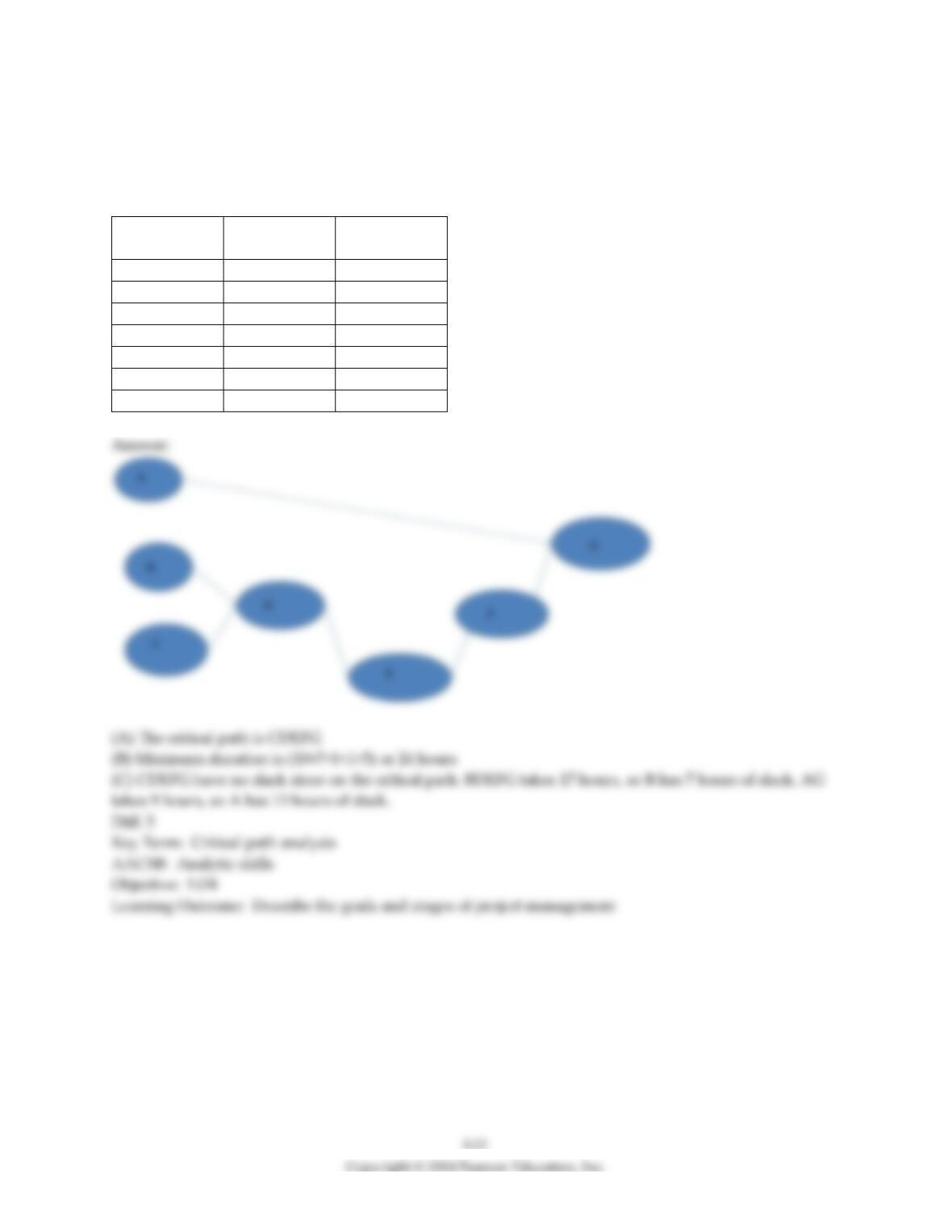
26) Given the project within the table below, calculate the following:
a. The critical path
b. The minimum project duration
c. The amount of slack for each activity
Activity
Duration
(hours)
Immediate
Predecessors
A
4
None
B
3
None
C
10
None
D
7
B,C
E
1
D
F
1
E
G
5
A,F
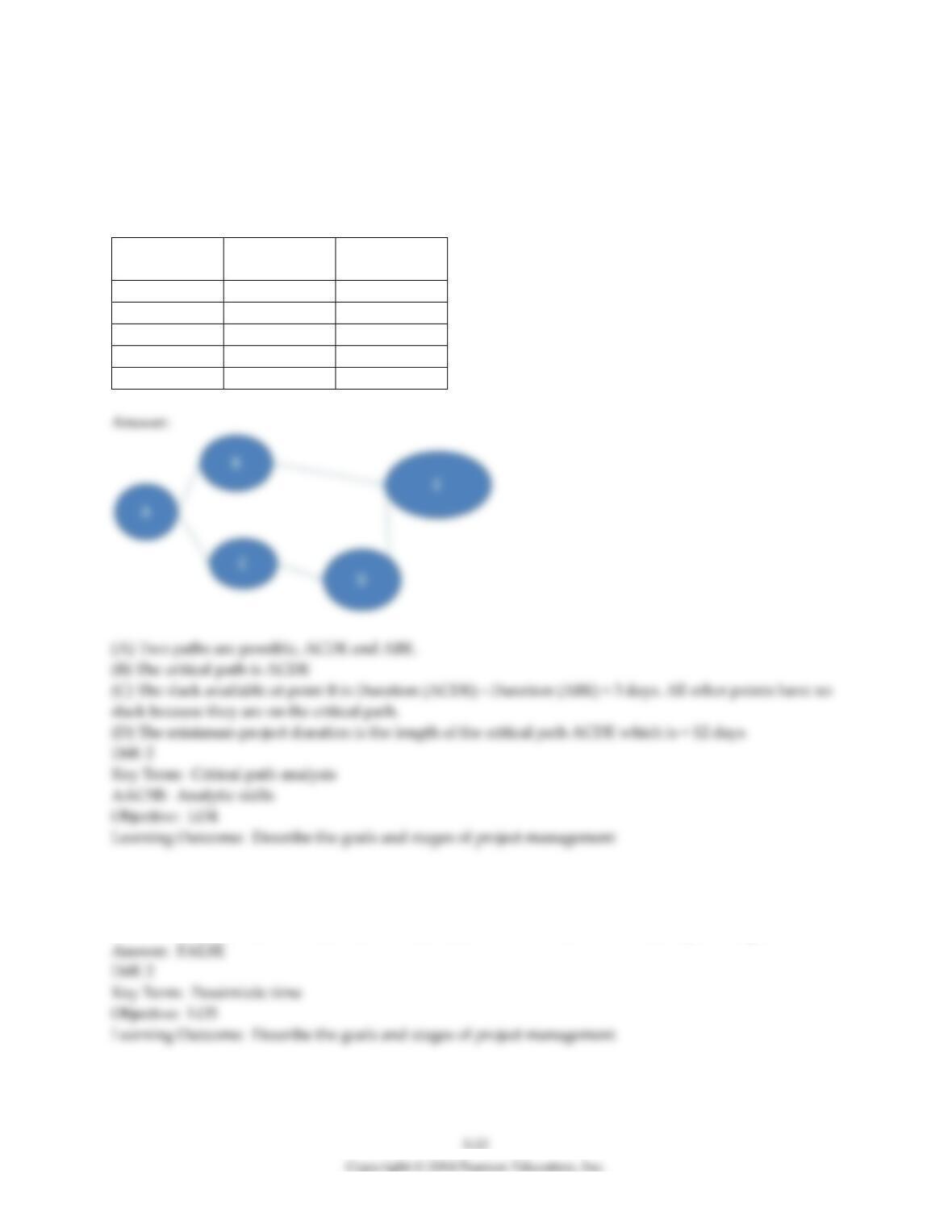
27) Consider the network presented in the following table. Calculate
a. All possible paths
b. The critical path
c. The slack available at any non-critical points
d. The minimum project duration
Task
Duration
(Days)
Immediate
Predecessors
A
5
None
B
3
A
C
4
A
D
2
C
E
1
B,D
Section 7 Variability in Activity Times
1) The PERT pessimistic time estimate is an estimate of the minimum time an activity will require.
2) The standard deviation of project duration is the average of the standard deviation of all activities on
the critical path.
3) In PERT analysis, the identification of the critical path can be incorrect if a noncritical activity takes
substantially more than its expected time.
4) The time an activity will take assuming very unfavorable conditions is:
A) the optimistic time.
B) the pessimistic time.
C) the activity variance.
D) the minimum time.
E) exactly twice as long as the expected time.
5) The ________ distribution is used by PERT analysis to calculate expected activity times and variances.
A) Normal
B) Beta
C) Alpha
D) Gaussian
E) Binomial
6) The expected activity time in PERT analysis is calculated as:
A) the simple average of the optimistic, pessimistic, and most likely times.
B) the weighted average of a, m, and b, with m weighted 4 times as heavily as a and b.
C) the sum of the optimistic, pessimistic, and most likely times.
D) the sum of the optimistic, pessimistic, and most likely times, divided by six.
E) the sum of the activity variances, divided by six.
7) Which of the following statements regarding PERT times is true?
A) The optimistic time estimate is an estimate of the minimum time an activity will require.
B) The optimistic time estimate is an estimate of the maximum time an activity will require.
C) The expected time estimate is calculated as t = (a + 4m + b).
D) The pessimistic time estimate is an estimate of the minimum time an activity will require.
E) The most likely time estimate is an estimate of the maximum time an activity will require.
8) Which of the following statements regarding PERT times is true?
A) The expected time is an estimate of the time an activity will require if everything goes as planned.
B) The optimistic time estimate is an estimate of the maximum time an activity will require.
C) The expected time estimate is calculated as t = (a + 4m + b)/6.
D) The pessimistic time estimate is an estimate of the minimum time an activity will require.
E) The most likely time estimate is an estimate of the maximum time an activity will require.
9) The beta distribution is used in project management to:
A) calculate slack on activities not on the critical path.
B) calculate the probability that a project will be completed within its budget.
C) calculate pessimistic and optimistic activity times.
D) determine which activity should be crashed.
E) none of the above
10) The beta distribution is used in project management to:
A) determine which activity should be crashed.
B) calculate the probability that a project will be completed within its budget.
C) calculate expected activity times.
D) calculate slack for activities on the critical path.
E) none of the above
11) In a PERT network, non-critical activities that have little slack need to be monitored closely:
A) because PERT treats all activities as equally important.
B) because near-critical paths could become critical paths with small delays in these activities.
C) because slack is undesirable and needs to be eliminated.
D) because they are causing the entire project to be delayed.
E) because they have a high risk of not being completed.
12) Which of the following statements regarding PERT analysis is true?
A) Each activity has two estimates of its duration.
B) Project variance is the sum of all activity variances.
C) Project standard deviation is the sum of all critical activity standard deviations.
D) Only critical activities contribute to the project variance.
E) The most likely time is equivalent to the expected activity time.
13) A project being analyzed by PERT has 60 activities, 13 of which are on the critical path. If the
estimated time along the critical path is 214 days with a project variance of 100, what is the probability
that the project will take 224 days or more to complete?
A) near zero
B) 0.0126
C) 0.1587
D) 0.8413
E) 2.14
14) An activity on a PERT network has these time estimates: optimistic = 2, most likely = 5, and
pessimistic = 10. What is its expected activity time?
A) 5.00
B) 5.33
C) 5.67
D) 10.67
E) 32.00
15) An activity on a PERT network has these time estimates: optimistic = 1, most likely = 2, and
pessimistic = 5. What is its expected activity time?
A) 2.00
B) 2.33
C) 2.67
D) 4.67
E) 14.00
16) An activity on a PERT network has these time estimates: optimistic = 2, most likely = 3, and
pessimistic = 8. What is its expected activity time and variance?
A) 3.67; 1
B) 3.67; 6
C) 4.33; 1
D) 4.33; 6
E) none of the above
17) A local project being analyzed by PERT has 42 activities, 13 of which are on the critical path. If the
estimated time along the critical path is 105 days with a project variance of 25, what is the probability that
the project will be completed in 95 days or less?
A) -0.4
B) 0.0228
C) 0.3444
D) 0.9772
E) 4.2
18) A project being analyzed by PERT has 38 activities, 16 of which are on the critical path. If the
estimated time along the critical path is 90 days with a project variance of 25, what is the probability that
the project will be completed in 88 days or less?
A) 0.0228
B) 0.3446
C) 0.6554
D) 0.9772
E) 18
19) A PERT project has 45 activities, 19 of which are on the critical path. The estimated time for the critical
path is 120 days. The sum of all activity variances is 64, while the sum of variances along the critical path
is 36. What is the probability that the project can be completed between days 108 and 120?
A) -2.00
B) 0.0227
C) 0.1058
D) 0.4773
E) 0.9773
20) A contractor’s project being analyzed by PERT has an estimated time for the critical path of 120 days.
The sum of all activity variances is 81; the sum of variances along the critical path is 64. What is the
probability that the project will take 130 or more days to complete?
A) 0.1057
B) 0.1335
C) 0.8512
D) 0.8943
E) 1.29
21) Analysis of a PERT problem shows the estimated time for the critical path to be 108 days with a
variance of 64. There is a .90 probability that the project will be completed before approximately day:
A) 98.
B) 108.
C) 109.
D) 115.
E) 118.
22) A project whose critical path has an estimated time of 120 days with a variance of 100 has a 20%
chance that the project will be completed before which day (rounded to nearest day)?
A) 98
B) 112
C) 120
D) 124
E) 220
23) A project whose critical path has an estimated time of 820 days with a variance of 225 has a 20%
chance that the project will be completed before which day (rounded to nearest day)?
A) 631
B) 689
C) 807
D) 833
E) 1009
24) Contract requirements state that a project must be completed within 180 working days, or it will incur
penalties for late completion. Analysis of the activity network reveals an estimated project time of 145
working days with a project variance of 400. What is the probability that the project will be completed
before the late-payment deadline?
A) 0.0401
B) 0.4599
C) 0.8056
D) 0.9599
E) near 1.0000, or almost certain

25) The ________ distribution is appropriate for calculating expected activity times and activity variances
in PERT networks.
26) PERT calculations typically include the duration variance of each activity. What is the purpose of this
calculation, i.e. what’s the role of variances in PERT analysis?
27) How is the expected completion time of a project activity, and of a PERT project, computed?
28) Describe in words how to calculate a project’s standard deviation. What assumption allows that
calculation to be accurate?

29) A partially solved PERT problem is detailed in the table below. Times are given in weeks.
Activity
Preceding
Optimistic
Time
Probable
Time
Pessimistic
Time
Expected
Time
Variance
A
—
7
9
14
1.361
B
A
2
2
8
0
C
A
8
12
16
0
D
A
3
5
10
1.361
E
B
4
6
8
0
F
B
6
8
10
0
G
C, F
2
3
4
0
H
D
2
2
8
1.000
I
H
6
8
16
2.778
J
G, I
4
6
14
2.778
K
E, J
2
2
5
0.250
a. Calculate the expected time for each activity. Enter these values in the appropriate column in the
table above.
b. Which activities form the critical path?
c. What is the estimated time of the critical path?
d. What are the project variance and the project standard deviation?
e. What is the probability of completion of the project after week 40?