Chapter 03 – Forecasting
58. Which of the following is not a type of judgmental forecasting?
59. Accuracy in forecasting can be measured by:
Chapter 03 – Forecasting
60. Which of the following would be an advantage of using a sales force composite to develop
a demand forecast?
61. Which phrase most closely describes the Delphi technique?
Chapter 03 – Forecasting
62. The forecasting method which uses anonymous questionnaires to achieve a consensus
forecast is:
63. One reason for using the Delphi method in forecasting is to:
Chapter 03 – Forecasting
64. Detecting non-randomness in errors can be done using:
65. Gradual, long-term movement in time series data is called:
Chapter 03 – Forecasting
66. The primary difference between seasonality and cycles is:
67. Averaging techniques are useful for:
Chapter 03 – Forecasting
68. Putting forecast errors into perspective is best done using
69. Using the latest observation in a sequence of data to forecast the next period is:
Chapter 03 – Forecasting
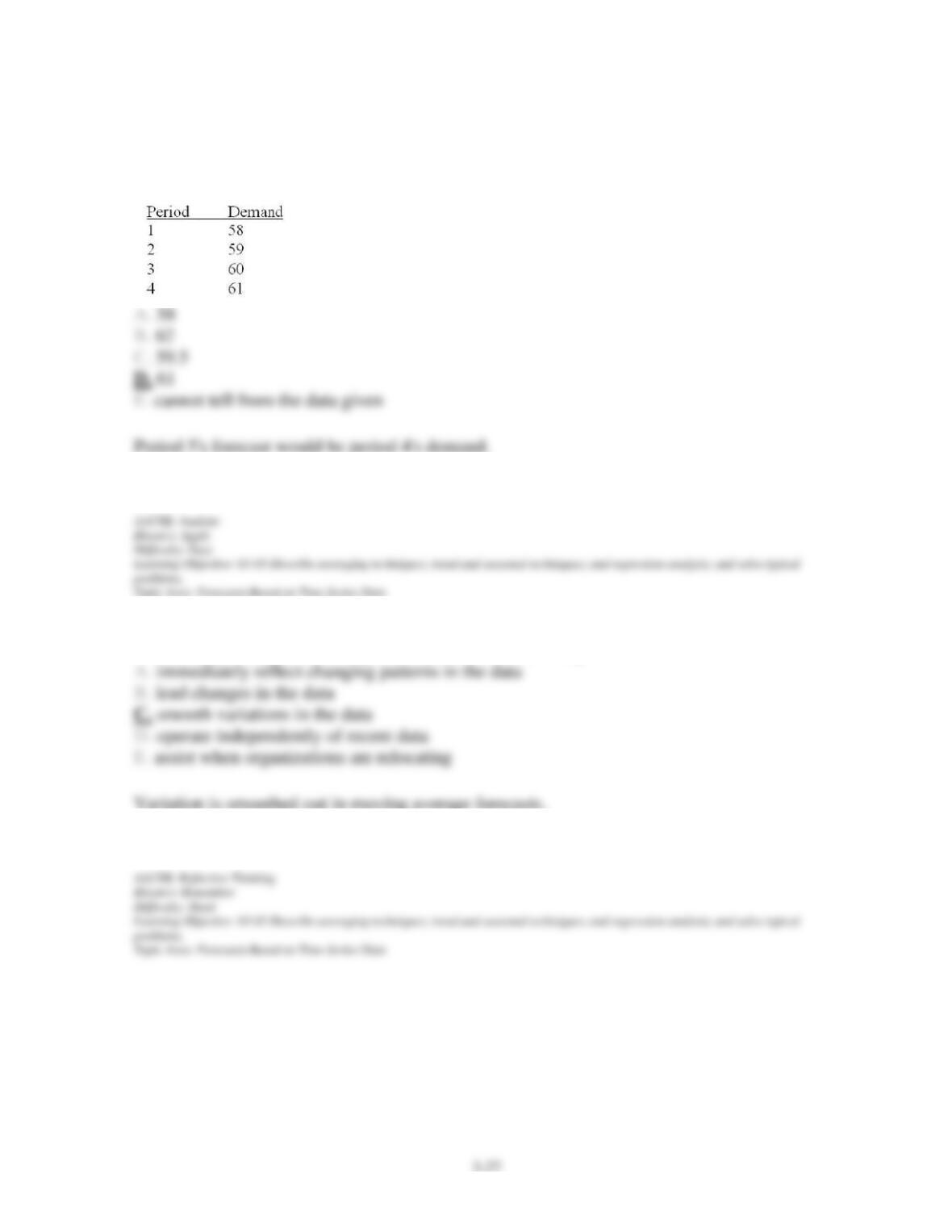
70. For the data given below, what would the naive forecast be for the next period (period
#5)?
71. Moving average forecasting techniques do the following:
Chapter 03 – Forecasting
72. Which is not a characteristic of simple moving averages applied to time series data?
73. In order to increase the responsiveness of a forecast made using the moving average
technique, the number of data points in the average should be:
Chapter 03 – Forecasting
74. A forecast based on the previous forecast plus a percentage of the forecast error is:
75. Which is not a characteristic of exponential smoothing?
Chapter 03 – Forecasting
76. Which of the following smoothing constants would make an exponential smoothing
forecast equivalent to a naive forecast?
77. Simple exponential smoothing is being used to forecast demand. The previous forecast of
66 turned out to be four units less than actual demand. The next forecast is 66.6, implying a
smoothing constant, alpha, equal to:
Chapter 03 – Forecasting
78. Given an actual demand of 59, a previous forecast of 64, and an alpha of .3, what would
the forecast for the next period be using simple exponential smoothing?
79. Given an actual demand of 105, a forecasted value of 97, and an alpha of .4, the simple
exponential smoothing forecast for the next period would be:
Chapter 03 – Forecasting
3-32
80. Which of the following possible values of alpha would cause exponential smoothing to
respond the most quickly to forecast errors?
81. A manager uses the following equation to predict monthly receipts: Yt = 40,000 + 150t.
What is the forecast for July if t = 0 in April of this year?
Topic Area: Forecasts Based on Time-Series Data
Chapter 03 – Forecasting
82. In trend-adjusted exponential smoothing, the trend adjusted forecast (TAF) consists of:
83. In the “additive” model for seasonality, seasonality is expressed as a ______________
adjustment to the average; in the multiplicative model, seasonality is expressed as a
__________ adjustment to the average.
Chapter 03 – Forecasting
84. Which technique is used in computing seasonal relatives?
85. A persistent tendency for forecasts to be greater than or less than the actual values is
called:
Chapter 03 – Forecasting
86. Which of the following might be used to indicate the cyclical component of a forecast?
87. The primary method for associative forecasting is:
Chapter 03 – Forecasting
88. Which term most closely relates to associative forecasting techniques?
89. Which of the following corresponds to the predictor variable in simple linear regression?
Chapter 03 – Forecasting
90. The mean absolute deviation (MAD) is used to:
91. Given forecast errors of 4, 8, and – 3, what is the mean absolute deviation?

Chapter 03 – Forecasting
92. Given forecast errors of 5, 0, – 4, and 3, what is the mean absolute deviation?
93. Given forecast errors of 5, 0, – 4, and 3, what is the bias?
Chapter 03 – Forecasting
94. Which of the following is used for constructing a control chart?
95. The two most important factors in choosing a forecasting technique are:
Chapter 03 – Forecasting
96. The degree of management involvement in short range forecasts is:
97. Which of the following is not necessarily an element of a good forecast?