
Operations Management, 11e (Heizer/Render)
Chapter 3 Project Management
Section 1 The Importance of Project Management
1) One phase of a large project is scheduling.
2) Which of the following statements regarding Bechtel is true?
A) Its competitive advantage is project management.
B) Bechtel was the construction contractor for the Hoover Dam.
C) While helping to rebuild Iraq, Bechtel’s crews had to travel under armed escort.
D) Bechtel’s procurement program is global in nature.
E) All of the above are true.
3) Which of the following statements about Bechtel is true?
A) Even though Bechtel is over 100 years old, the Kuwaiti oil fields was its first “project.”
B) Bechtel is the world’s premier manager of massive construction and engineering projects.
C) Bechtel’s competitive advantage is supply chain management.
D) While its projects are worldwide, its network of suppliers is largely in the United States
E) All of the above are true.
4) Which of the following projects were completed by Bechtel?
A) Hoover Dam
B) Boston Central Artery/Tunnel
C) Rebuilding Kuwait after Iraq’s invasion in 1990
D) Rebuilding Iraq after the U.S. invasion, starting in 2003
E) All of the above were Bechtel projects
5) The phases of project management are:
A) planning, scheduling, and controlling.
B) planning, programming, and budgeting.
C) planning, organizing, staffing, leading, and controlling.
D) different for manufacturing projects than for service projects.
E) GANTT, CPM, and PERT.
6) Which of the following is NOT one of the phases of project management?
A) planning
B) scheduling
C) controlling
D) budgeting
E) All of the above are project management phases.
7) What are the three phases of a project? Describe each in a sentence or two.
Section 2 Project Planning
1) A project organization works best for an organization when the project resides in only one of its
functional areas.
2) One responsibility of a project manager is to make sure that the project meets its quality goals.

3) Work breakdown structure is a useful tool in project management because it addresses the timing of
individual work elements.
4) Project managers have their own code of ethics, established by the Project Management Institute.
5) Ethical issues that can arise in projects include gifts from contractors, pressure to mask delays with
false status reports, and pressure to compromise project quality to meet bonuses or avoid penalties
related to schedules.
6) A project organization:
A) is effective for companies with multiple large projects.
B) is appropriate only in construction firms.
C) often fails when the project cuts across organizational lines.
D) is most helpful for ongoing projects with no termination date.
E) is most helpful when the work contains simple and unrelated tasks.
7) A code of ethics especially for project managers:
A) has been established by the Project Management Institute.
B) has been formulated by the Federal government.
C) has been formulated by the World Trade Organization.
D) is inappropriate, since everyone should use the same guidance on ethical issues.
E) does not exist at this time.

8) Ethical issues that may arise in projects large and small include:
A) gifts from contractors.
B) exaggerated expense reports.
C) compromised quality standards to meet bonuses or avoid penalties related to schedules.
D) pressure to mask delays with false status reports.
E) all of the above.
9) The project organization works best when which of the following conditions are satisfied?
I. Work tasks can be defined with a specific goal and deadline.
II. The job is typical and familiar to the existing organization.
III. The work contains interrelated tasks requiring specialized skills.
IV. The project is temporary but unimportant to long-term organizational success.
V. The project cuts across organizational lines.
A) I, II, III, IV, V
B) None of the above conditions need to be satisfied.
C) I, III, V
D) I, II, III, V
E) I, III, IV, V
10) A project organization that becomes permanent is often referred to as a:
A) fixed project organization.
B) matrix organization.
C) normal organization.
D) standard organization.
E) permanent project organization.
11) WBS stands for which of the following project management tools?
A) work break schedule
B) work breakdown status
C) work breakdown schedule
D) work breakdown structure
E) work break status
12) Match the following steps in Microsoft’s development of Windows 8 to their respective WBS level.
Step Level
Develop Windows 8 Operating System ?
System Testing ?
Compatible with Windows 7 ?
Develop GUI’s ?
Module Testing ?
A) Level 1, Level 2, Level 4, Level 3, Level 3
B) Level 1, Level 2, Level 3, Level 4, Level 5
C) Level 0, Level 1, Level 2, Level 3, Level 4
D) Level 0, Level 2, Level 2, Level 3, Level 3
E) Level 5, Level 3, Level 4, Level 1, Level 2
13) A(n) ________ is an organization formed to ensure that programs (projects) receive the proper
management and attention.
14) A(n) ________ divides a project into more and more detailed components.
15) The ________ has established a code of ethics especially for project managers.

16) Identify the responsibilities of project managers.
17) What is a project organization?
18) What are some of the ethical issues faced by project managers?
Section 3 Project Scheduling
1) Gantt charts give a timeline for each of a project’s activities, but they do not adequately illustrate the
interrelationships between the activities and the resources.
2) PERT, but not CPM, has the ability to consider the precedence relationships in a project.
3) A combination of effective Gantt chart use and other tactics allowed Delta to cut the average time for a
plane layover by what % of the original 60 minute duration?
A) 33%, to 40 minutes
B) 50%, to 30 minutes
C) 20%, to 48 minutes
D) 25%, to 45 minutes
E) 40%, to 36 minutes
4) Which of the following statements regarding Gantt charts is true?
A) Gantt charts give a timeline and precedence relationships for each activity of a project.
B) Gantt charts use the four standard spines of Methods, Materials, Manpower, and Machinery.
C) Gantt charts are visual devices that show the duration of activities in a project.
D) Gantt charts are expensive.
E) All of the above are true.
5) Identify each of the purposes of project scheduling.
6) Describe the differences between a Gantt chart and a PERT/CPM network.

Section 4 Project Controlling
1) The control of projects involves close monitoring of which of the following?
A) resources
B) costs
C) quality
D) budgets
E) all of the above
2) Describe some of the challenges faced in the construction of the new 11-story building at Arnold
Palmer Hospital in Orlando, Florida.
Section 5 Project Management Techniques: PERT and CPM
1) The shortest of all paths through the network is the critical path.
2) The fundamental difference between PERT and CPM is that PERT uses the beta distribution for
crashing projects while CPM uses cost estimates.
3) The main difference between PERT and CPM is that:
A) PERT is more accurate than CPM.
B) PERT assumes that activity durations are known.
C) PERT ignores activity costs.
D) CPM assumes activity durations can vary.
E) PERT employs three time estimates for each activity.

4) The difference between AON and AOA networks is that:
A) AOA networks sometimes require dummy activities.
B) nodes consume no resources or time in AOA networks.
C) both are acceptable in practice; however, Microsoft Project uses AON.
D) nodes designate activities in AON, while arrows designate activities in AOA.
E) All of the above are true.
5) A simple CPM network has five activities, A, B, C, D, and E. A is an immediate predecessor of C and of
D. B is also an immediate predecessor of C and of D. C and D are both immediate predecessors of E.
Which of the following statements is true?
A) There are two paths in this network.
B) There are four paths in this network.
C) There are five paths in this network.
D) There are 25 paths in this network.
E) There are six paths in this network.
6) The ________ is a project management technique using only one time factor per activity that enables
managers to schedule, monitor, and control large and complex projects.
7) The ________ is the computed longest time path(s) through a network.
8) The network analysis method that allows activity times to vary is ________.
9) Identify, in order, the six steps basic to both PERT and CPM.
10) What is the basic difference between PERT and CPM?
Section 6 Determining the Project Schedule
1) The ES of an activity that has only one predecessor is simply the EF of that predecessor.
2) Slack is the amount of time an activity can be delayed without delaying the entire project.
3) Every network has at least one critical path.

4) The critical path can be determined by use of either the “forward pass” or the “backward pass.”
5) Which of the following statements regarding critical paths is true?
A) The shortest of all paths through the network is the critical path.
B) Some activities on the critical path may have slack.
C) Every network has only one critical path.
D) On a specific project, there can be multiple critical paths, all with exactly the same duration.
E) The duration of the critical path is the average duration of all paths in the project network.
6) Which of the following statements regarding CPM is true?
A) The critical path is the shortest of all paths through the network.
B) The critical path is that set of activities that has positive slack.
C) Some networks have no critical path.
D) All activities on the critical path have their LS equal to the maximum EF of all immediate
predecessors.
E) All activities on the critical path have their ES equal to their LF.
7) A simple CPM network has three activities, A, B, and C. A is an immediate predecessor of B and of C. B
is an immediate predecessor of C. The activity durations are A=4, B=3, C=8.
A) The critical path is A-B-C, duration 15.
B) The critical path is A-C, duration 12.
C) The critical path is A-B-C, duration 13.5
D) The critical path cannot be determined without knowing PERT expected activity times.
E) The network has no critical path.

8) A simple CPM network has three activities, D, E, and F. D is an immediate predecessor of E and of F. E
is an immediate predecessor of F. The activity durations are D=4, E=3, F=8.
A) The critical path is D-E-F, duration 15.
B) The critical path is D-F, duration 12.
C) Slack at D is 3 periods.
D) Slack at E is 3 periods.
E) Both A and C are true.
9) Activity D on a CPM network has predecessors B and C, and has successor F. D has duration 6. B’s
earliest finish is 18, while C’s is 20. F’s late start is 26. Which of the following is definitely true?
A) B is a critical activity.
B) C is completed before B.
C) D has no slack but is not critical.
D) D is critical, and has zero slack.
E) F is critical, and has zero slack.
10) Which of the following statements regarding CPM networks is true?
A) There can be multiple critical paths on the same project, all with different durations.
B) The early finish of an activity is the latest early start of all preceding activities.
C) The late start of an activity is its late finish plus its duration.
D) If a specific project has multiple critical paths, all of them will have the same duration.
E) None of the above are true.
11) Activity R on a CPM network has predecessors M and N, and has successor S. R has duration 5. N’s
late finish is 18, while M’s is 20. S’s late start is 14. Which of the following is definitely true?
A) R is critical and has zero slack.
B) R has no slack but is not critical.
C) The set of times cannot all be possible.
D) N is a critical activity.
E) S is a critical activity.
12) Which of the following statements concerning CPM activities is false?
A) The early finish of an activity is the early start of that activity plus its duration.
B) The late finish is the earliest of the late start times of all successor activities.
C) The late start of an activity is its late finish less its duration.
D) The late finish of an activity is the earliest late start of all preceding activities.
E) The early start of an activity is the latest early finish of all preceding activities.
13) The critical path for the network activities shown below is ________ with duration ________.
Activity
Duration
Immediate
Predecessors
A
4
—
B
2
A
C
7
—
D
4
A
E
5
B,C,D
A) A-B-D; 10
B) A-B-E; 11
C) C-E; 12
D) A-D-E; 13
E) A-B-C-D-E; 22
14) The critical path for the network activities shown below is ________ with duration ________.
Activity
Duration
Immediate
Predecessors
A
2
—
B
4
—
C
6
A,B
D
1
A,B
E
2
B,C,D
A) A-D-E; 5
B) B-E; 6
C) B-D-E; 7
D) A-C-E; 10
E) B-C-E; 12
15) The critical path for the network activities shown below is ________ with duration ________.
Activity
Duration
Immediate
Predecessors
A
10
—
B
8
—
C
2
A
D
4
A
E
5
B,C, D
A) A-C; 12
B) A-D-E; 19
C) B-E; 13
D) A-B-C-D-E; 29
E) none of the above

16) ________ is the amount of time an individual activity in a network can be delayed without delaying
the entire project.
17) What is the objective of critical path analysis?
18) Explain why the critical path is the longest, not the shortest, path through a network.
19) Define slack time.
20) What are the earliest activity start time and latest activity start time, and how are they computed?
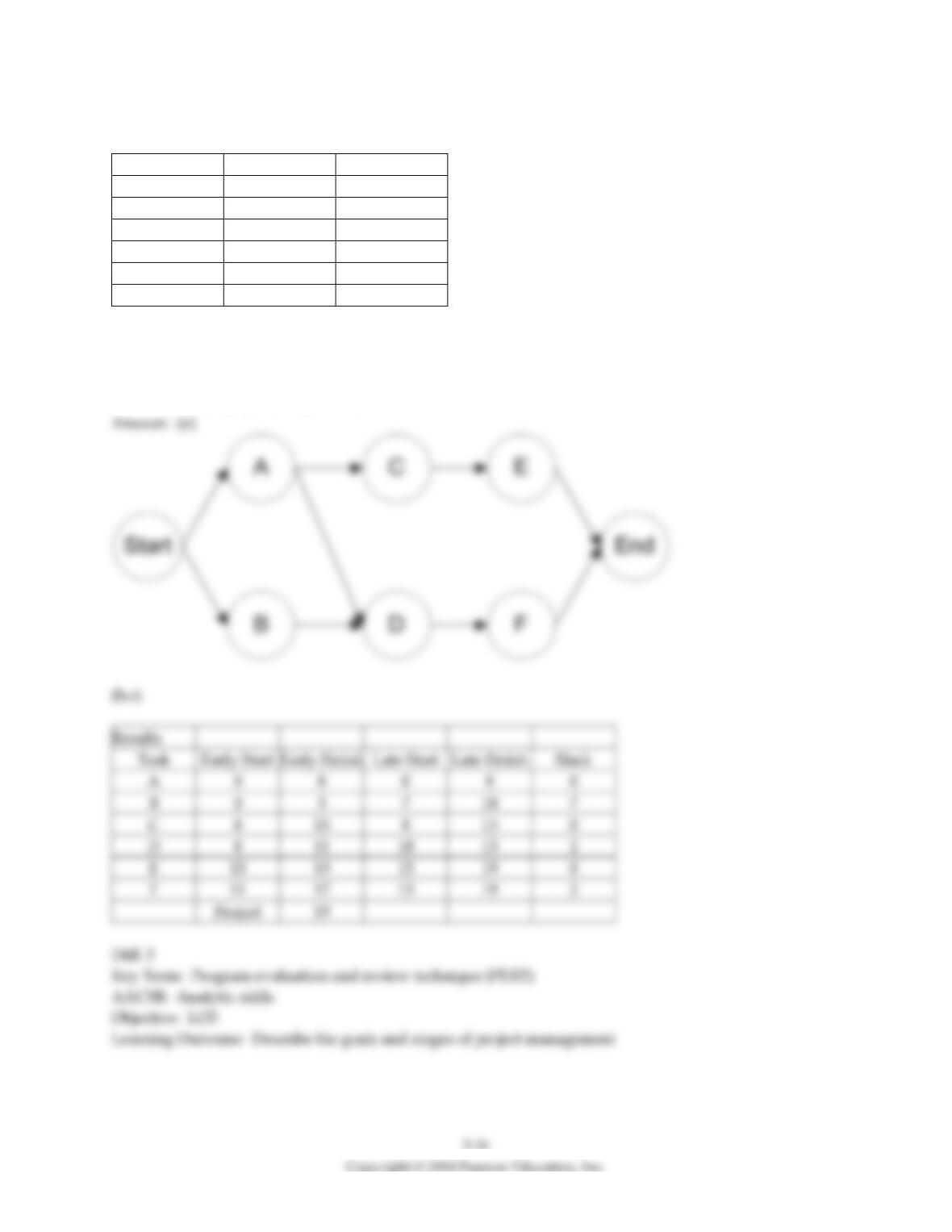
21) A network consists of the activities in the following list. Times are given in weeks.
Activity
Preceding
Time
A
—
8
B
—
3
C
A
7
D
A, B
3
E
C
4
F
D
6
a. Draw the network diagram.
b. Calculate the ES, EF, LS, LF, and Slack for each activity.
c. What is project completion time?
0
3
7
7
8
8
0
0
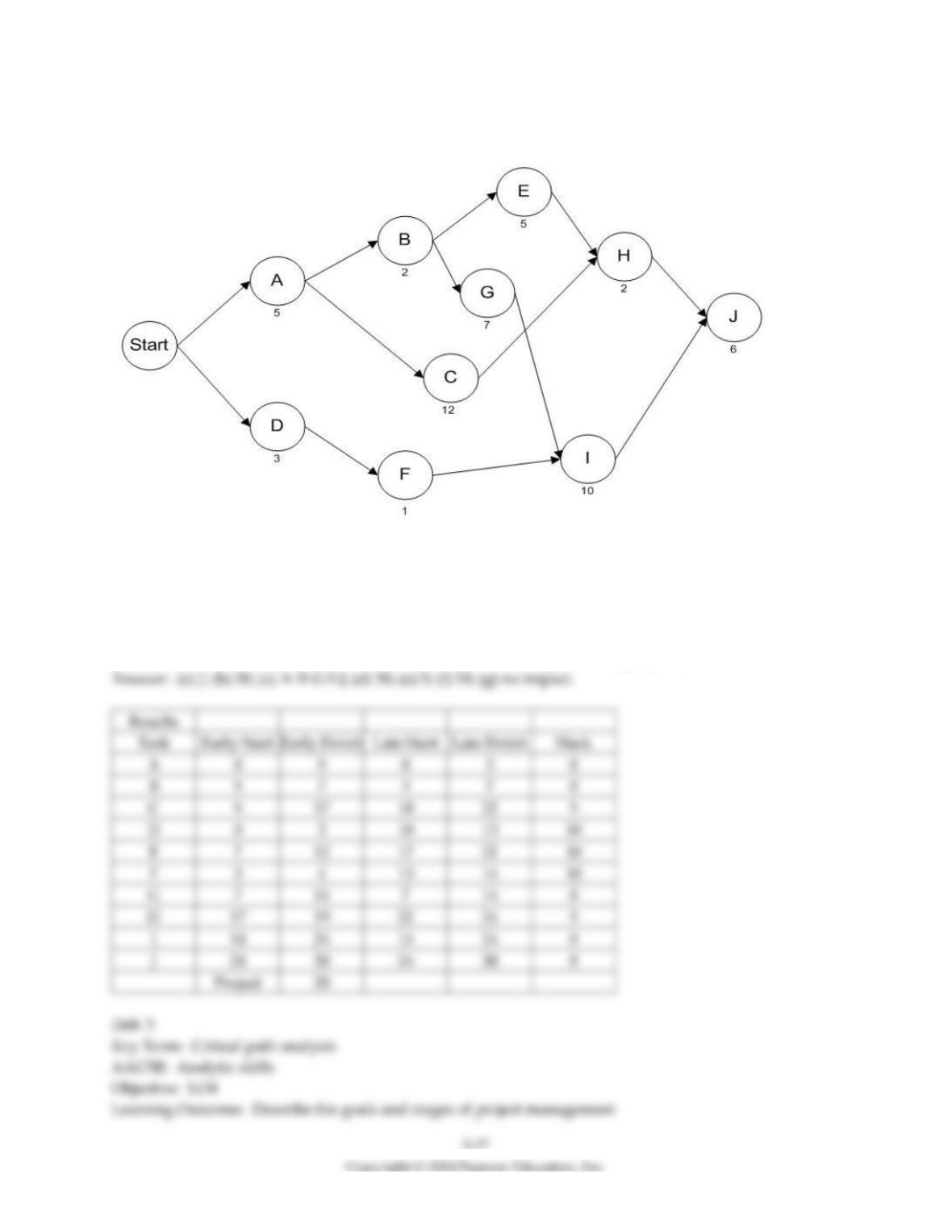
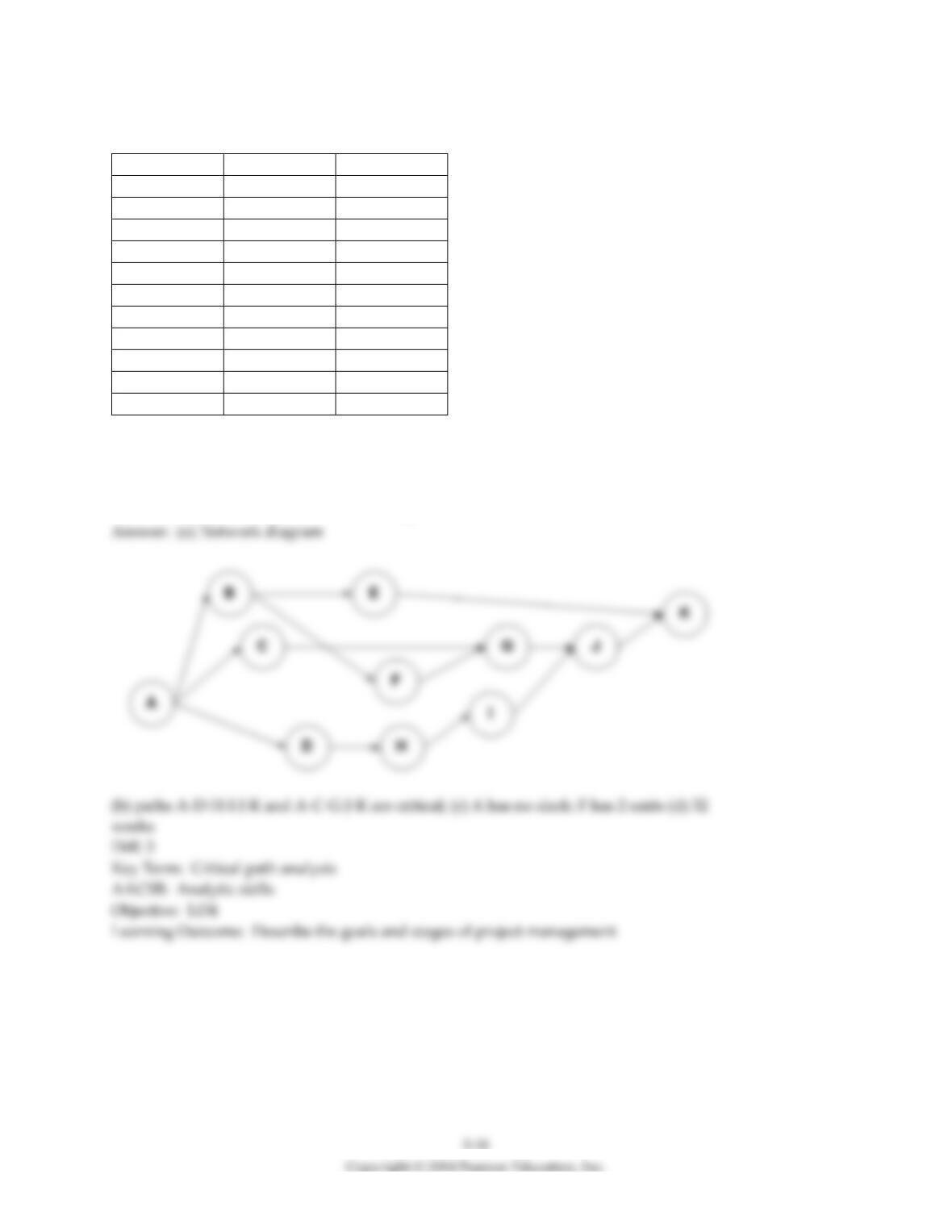
22) The network below represents a project being analyzed by the critical path method. Activity durations
are A=5, B=2, C=12, D=3, E=5, F=1, G=7, H=2, I=10, and J=6.
a. What task must be on the critical path, regardless of activity durations?
b. What is the duration of path A-B-E-H-J?
c. What is the critical path of this network?
d. What is the length of the critical path?
e. What is slack time at activity H?
f. What is the Late Finish of activity H?
g. If activity C were delayed by two time units, what would happen to the project duration?
23) A network consists of the following list. Times are given in weeks.
Activity
Preceding
Duration
A
—
9
B
A
2
C
A
12
D
A
5
E
B
6
F
B
8
G
C, F
3
H
D
2
I
H
8
J
G, I
6
K
E, J
2
a. Draw the network diagram.
b. Which activities form the critical path?
c. How much slack exists at activities A and F?
d. What is the duration of the critical path?
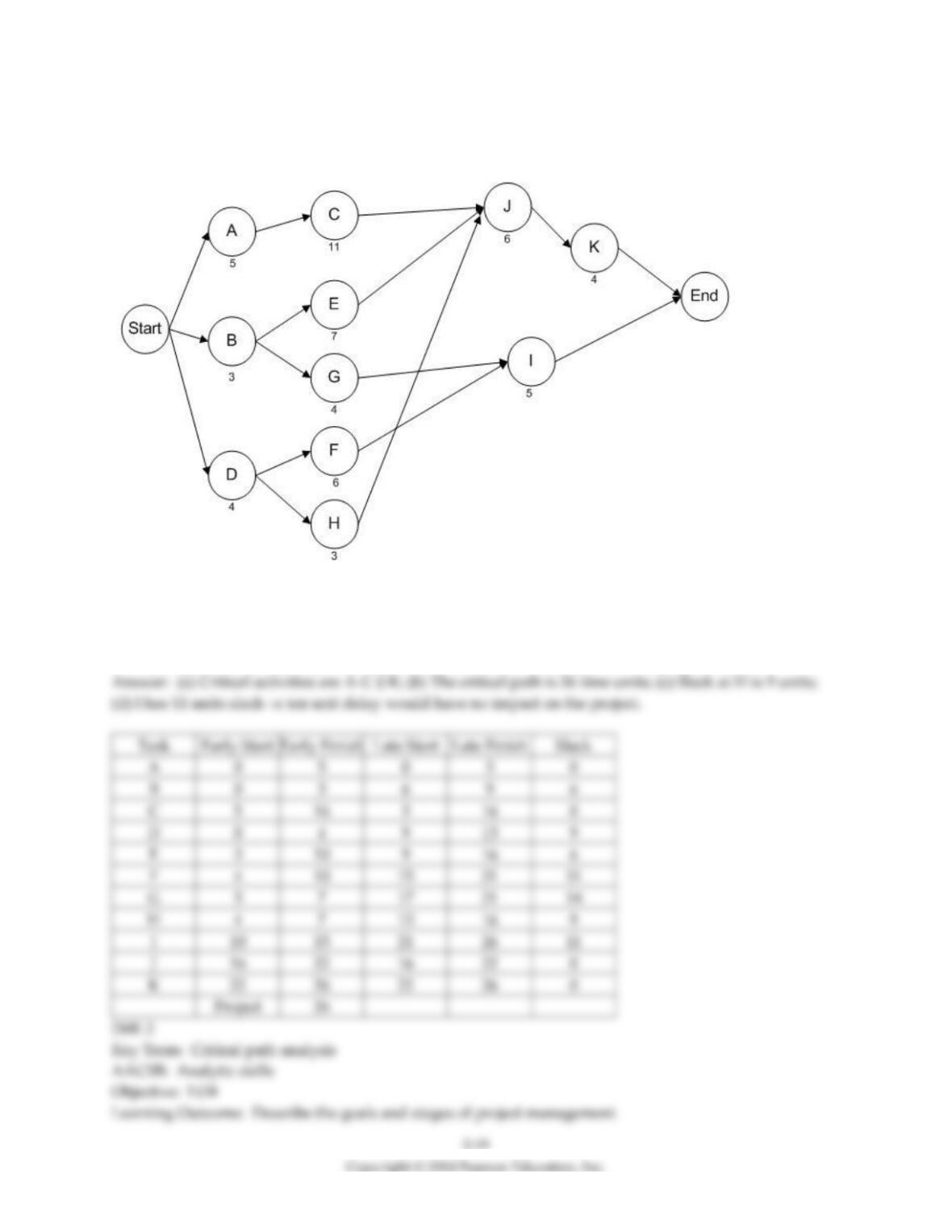
24) The network below represents a project being analyzed by the critical path method. Activity durations
are indicated on the network.
a. Identify the activities on the critical path.
b. What is the duration of the critical path?
c. Calculate the amount of slack time at activity H.
d. If activity I were delayed by ten time units, what would be the impact on the project duration?
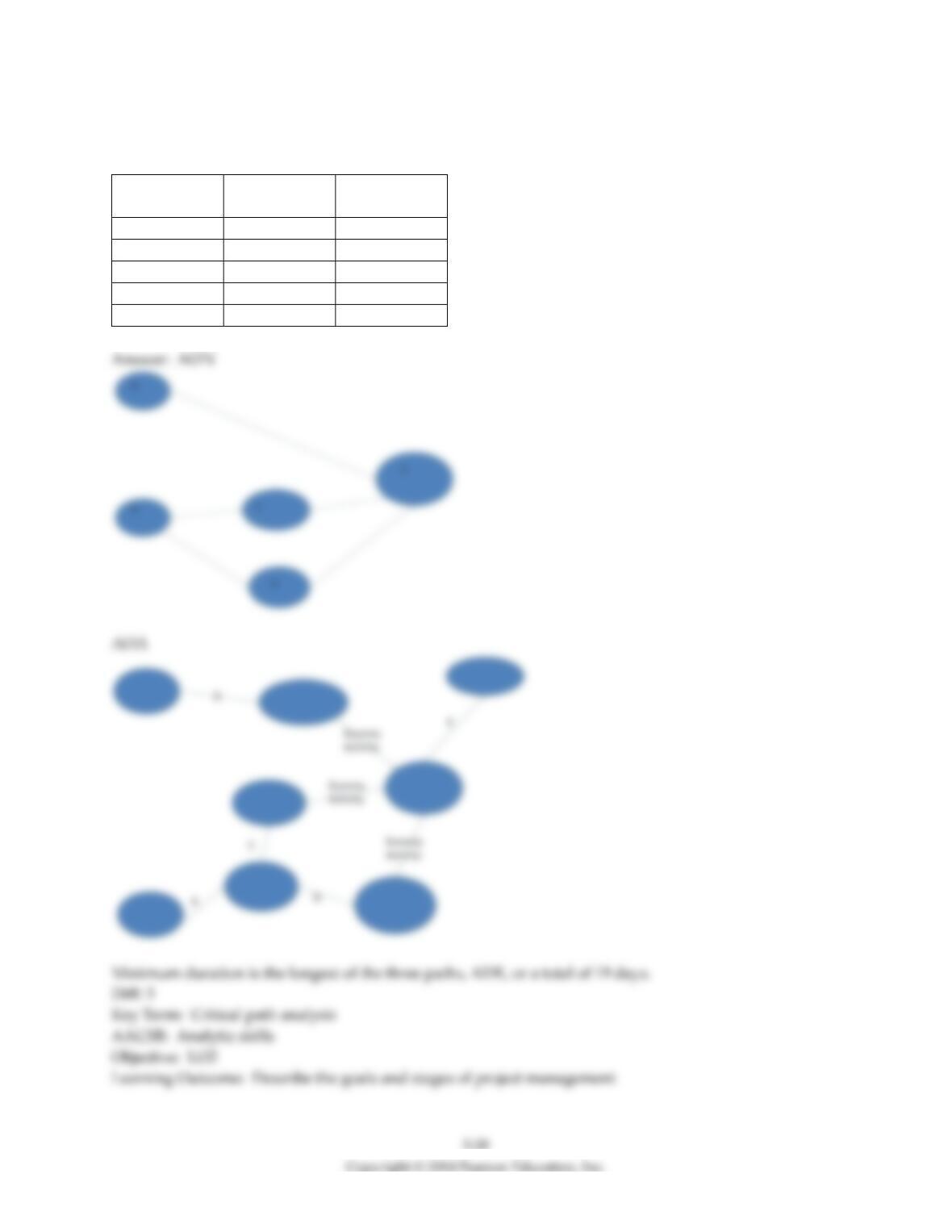
25) Draw the AOA and AON networks for the following project and calculate the minimum project
duration.
Activity
Duration
(days)
Immediate
Predecessors
A
10
—
B
8
—
C
2
A
D
4
A
E
5
B,C, D