
1. The growth of the commercial paper market as well as the increased ability of banks to underwrite
commercial paper has reduced the importance of short-term segment of the loan sales market.
2. Banks began selling short-term loans only since the passage of the Financial Services Modernization Act in
1999.
3. Historically, correspondent banking relationships have been important in the sale of bank loans.
4. When a portion of a loan is sold from a large bank to a small bank, it is often called a participation.
5. When an FI sells a loan without recourse, the credit risk of the loan is completely eliminated.
6. In the sale of a loan in an investor/buyer, there are fewer agency costs associated with loan participation
contracts than with loan assignment contracts.

7. A bank loan sale occurs when an FI originates a loan and sells the loan without recourse to an outside buyer.
8. The loan sales market in which an FI originates and sells a short-term loan of a corporation can be considered
a close substitute to the issuance of commercial paper.
9. Most loans originated and sold in the short-term market are secured loans to below investment grade entities.
10. HLT loans typically are used to finance new fixed assets of an ongoing firm.
11. Highly leveraged transaction (HLT) loans are typically unsecured, short term and have fixed rates.
12. The definition of a highly leveraged transaction is any transaction that involves a buyout, acquisition or
recapitalization.
13. Most HLT loans are very heterogeneous with respect to the size of the issue, the interest payment date,
interest indexing, and prepayment features.

14. The buyer of a loan participation benefits because the only risk exposure is to the borrower.
15. Floating-rate loan assignments typically occur on the loan repricing date as an effort to minimize confusion
regarding the calculation and transfer of accrued interest.
16. Assignments of fixed-rate loans typically do not have difficulties in the calculation and transfer of accrued
interest.
17. Investment banks are the predominant buyers of HLT loans because they are more informed agents in this
market than other investors.
18. The traditional interbank loan sale market has been growing rapidly due to an increase in the number of
mergers and acquisitions.
19. Loans originated by domestic U.S. banks cannot be sold to foreign banks.

20. Insurance companies and pension funds are important buyers of long-maturity loans.
21. Credit derivatives allow FIs to reduce credit risks without removing loan assets from their balance sheet.
22. Closed-end bank loan mutual funds are restricted to investing in loans only through the loan resale or
secondary market.
23. The primary sellers of domestic loans are medium-sized regional banks.
24. Because a bad-bank has a difficult time gaining deposits for funding, it also has a difficult time devising an
optimal strategy to manage and dispose of bad assets.
25. Selling loans without recourse is a way for FIs to remove loans from their balance sheet for the purpose of
reducing the cost associated with reserve requirements.
26. One way to boost the capital to assets ratio of an FI is through loan sales.

27. Some corporate customers that rely on bank loans may see the sale of one of its loan by the bank as an
adverse event in the customer-bank relationship.
28. A loan credit rating is the same as bond credit rating in that it is based solely on the financial soundness of
the underlying corporation.
29. The move by regulators toward market value accounting of the loan portfolios likely will have an
encouraging effect on the secondary loan sale markets.
30. An originate-to-sell model when dealing with below investment grade companies is considered an attractive
alternative for FIs, which have specialized credit monitoring skills, as compared with keeping the loans in their
portfolio.
31. Mutual funds are prohibited from purchasing/participating in the FI loan sales market by the SEC.
32. Most vulture funds are formed by the mutual fund industry as a way around SEC restrictions from
participating in the FI-originated loan sales market.

33. Research has shown that current-year income for an FI is rarely affected by the decision to sell loans from
their balance sheet.
34. Although a loan sale strategy for an FI may reduce or eliminate credit risk, the strategy does not affect the
FI’s liquidity risk.
35. The Resolution Trust Corporation (RTC), a government agency formed to manage failed S&Ls in the early
1990s, followed a Good Bank/Bad Bank concept in the sale of loans.
36. As of 2010, the Department of Housing and Urban Development (HUD) no longer sells loans that were used
to purchase multifamily apartment properties.
37. As FIs consolidate and expand their range of financial services, customer relationships with commercial
entities are likely to become more important.
38. Besides reducing credit risks, an FI has an incentive to sell loans it originates for all of the following reasons
EXCEPT to:
39. Which of the following is NOT a contractual mechanism used by FIs to control credit risks?
40. A loan made to finance a merger and acquisition that usually results in a high leverage ratio for the borrower
is a
41. Which of the following is NOT a reason for a FI to sell loans with recourse?
42. Which of the following is NOT true of a loan that is sold without recourse?
43. Which of the following is true concerning loans sold with recourse?
44. Which of the following observations is NOT correct?
45. Which of the following refers to a period when a borrower is unable to meet a payment obligation to lenders
and other creditors?
46. Which of the following is NOT a key characteristic of loans sold in the short-term loan sale market?
47. What are the two basic types of loan sale contracts or mechanisms by which loans can be transferred
between seller and buyer?
48. Currently, this basic type of loan sale contracts comprises the bulk of loan sales trading.
49. Loan participations
50. In a loan participation
51. Loan participations are typically sold to correspondent banks because
52. A buyer of a loan participation is exposed to
53. The definition of an HLT loan as adopted by U.S. bank regulators in 1989 includes
54. Which of the following transactions meets the legal definition of a highly leveraged transaction (HLT)?
55. Which of the following transactions does not meet the legal definition of a highly leveraged transaction
(HLT)?
56. Why do spreads on HLT loans behave more like investment-grade bonds than like high– yield bonds?
57. HLT loans typically have all of the following characteristics except which of the following?
58. Loan assignments make up more than 90 percent of the U.S. domestic loan sale market because
59. What is NOT true of loan assignments?
60. Assignments
61. Identify the correct observation.
62. A type of FI company that predominantly buys HLT loans because these loans require the kinds of
investment analysis skills used in other parts of the FI’s business is
63. A type of company that recently has moved from only purchasing loans on the secondary market into
primary loan syndication is
64. A type of company that specializes in distressed loans is
66. Which of the following rely on nondistressed HLT loan purchases as a means of diversifying without the
high cost of developing costly nationwide banking networks?
67. The traditional interbank loan sale market has been shrinking for which of the following reasons?
68. Vulture funds are
69. The major buyers of U.S. domestic loans of non-distressed companies include all of the following EXCEPT
70. The sellers of domestic loans and HLT loans include all of the following EXCEPT
71. If an FI embraces the concept of good bank/bad bank,
72. The principal objective in the creation of _____ is to maximize asset values by separating good loans from
bad loans.
73. Which of the following is NOT a reason for using a bad bank as a vehicle to add value in the loan sale
process?
74. Which legislation authorizes federal agencies to sell delinquent and defaulted loan assets?
75. Which of the following is NOT a reason for FIs to sell loans?
76. The implementation of BIS capital requirements may be expected to
77. Loan sales do not completely protect the lending FI from credit risk exposure because
78. The growth of the commercial paper market has hurt the market for loan sales by
79. Loan sales by foreign banks
80. The move toward market value accounting
81. Banks that sell many of their loans
82. Banks and other FIs sell loans because of all of the following EXCEPT
83. Which of the following aided in allowing Federal Government Agencies (such as the FDIC) to sell loans of
institutions for which the agency has become responsible?
84. Which of the following is NOT a factor that may tend to increase loan sales in the future?
85. Which of the following is a reason for an FI to sell a residential real estate loan rather than securitize it
through GNMA?
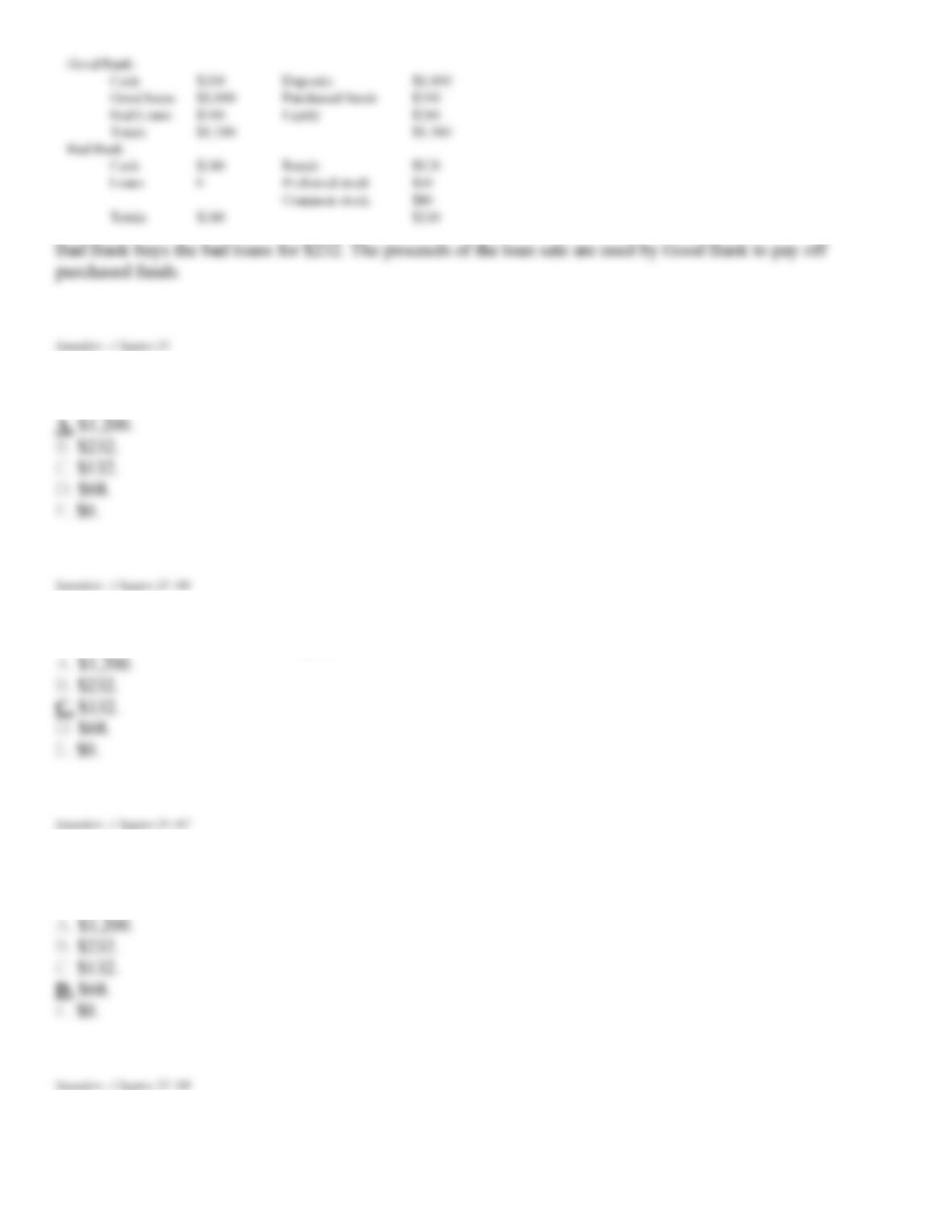
86. What will be the total assets of Good Bank after the sale of the loans?
87. What will be the amount of equity on the balance sheet of Good Bank after the sale of the loans?
88. If the proceeds of the loan sale are used to pay off purchased funds, what will be the balance of the
purchased funds for Good Bank after the transaction?