71. Which of the following is a good strategy to adopt when interest rates are expected to rise?
72. What is the advantage of an options hedge over a futures hedge?
73. What is the advantage of a futures hedge over an options hedge?
74. The combination of being long in the bond and buying a put option on a bond mimics the profit function of
75. Identify a problem associated with using the Black-Scholes model to value bond options.
76. Contrast the marking to market characteristics of options versus futures contracts.
77. What reflects the degree to which the rate on the option’s underlying asset moves relative to the spot rate on
the asset or liability that is being hedged?
78. Which of the following shows the change in the value of a put option for each $1 change in the underlying
bond?
79. For put options, the delta has a negative sign
80. KKR issues a $10 million 18-month floating rate note priced at LIBOR plus 400 basis points. What is
KKR’s interest rate risk exposure and how can it be hedged?
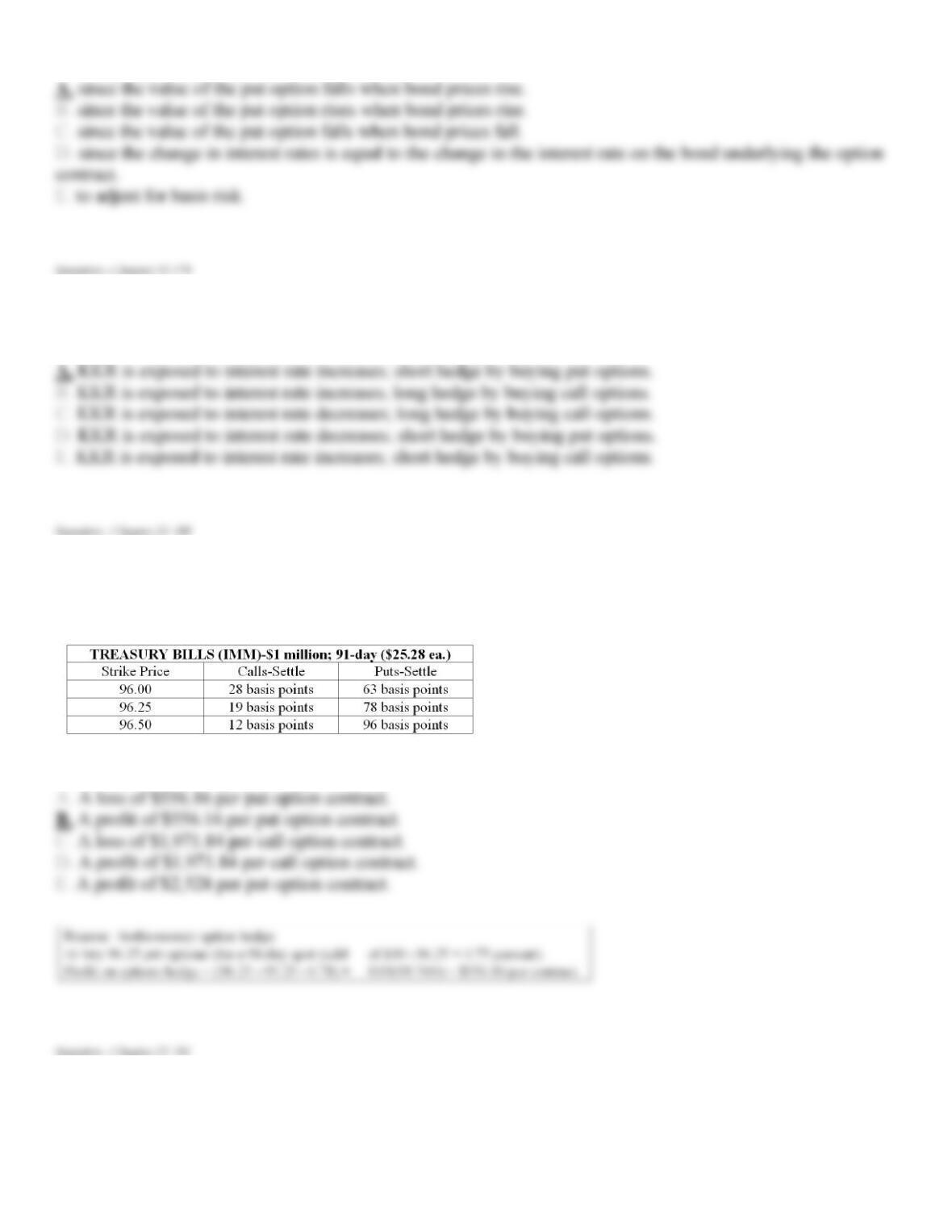
81. A bank with total assets of $271 million and equity of $31 million has a leverage adjusted duration gap of
+0.21 years. Use the following quotation from the Wall Street Journal to construct an at-the-money futures
option hedge of the bank’s duration gap position.
If 91-day Treasury bill rates increase from 3.75 percent to 4.75 percent, what will be the profit/loss per contract
on the bank’s futures option hedge?
82. Credit spread call options are useful because
83. An FI concerned that the risk on a loan will increase can
84. A digital default option
85. Buying a cap option agreement
86. What is the yield to maturity for the two-year bond if held to maturity?
87. Given the expected one-year rates in one year, what are the possible bond prices in one year?
88. If the manager buys a one-year option with an exercise price equal to the expected price of the bond in one
year, what will be the exercise price of the option?
89. Given the exercise price of the option, what premium should be paid for this option?
90. What is the yield to maturity for the two-year bond if held to maturity?
91. Given the expected one-year rates in one year, what are the possible bond prices in one year?
92. If the manager buys a one-year option with an exercise price equal to the expected price of the bond in one
year, what will be the exercise price of the option?
93. Given the exercise price of the option, what premium should be paid for this option?
94. The duration of the T-notes, Baa bonds, and GICs is 1.93 years, 6.9 years, and 4.5 years respectively. What
is the leverage-adjusted duration gap for Allright?
95. If Allright wanted to hedge the balance sheet position, what is the interest rate risk exposure and what hedge
would be appropriate?
96. Market interest rates are expected to increase 1 percent to 11 percent in the next year. If this occurs, what
will be the effect on the market value of equity of Allright?
97. On the advice of its chief financial officer, Allright wants to hedge the balance sheet with T-bond option
contracts. The underlying bonds currently have a duration of 8.82 years and a market value of $97,000 per
$100,000 face value. Further, the delta of the options is 0.5. What type of contract, and how many contracts
should Allright use to hedge this balance sheet?
98. If rates increase 1 percent, what will be the change in value of the option position?
99. At the time of placement, the premium on the options are quoted at 1¾. What is the cost to Allright in
placing the hedge?
100. Given this information, what type of T-bond option, and how many options should be purchased, to hedge
this investment?
101. Using the above information, what will happen to the market value of the Eurobonds if market interest
rates fall 1 percent to 9 percent?
102. Using the above information and your answer to the previous question, will the investment company gain
or lose on the option position if interest rates decrease 1 percent to 9 percent?
103. What is the net gain or loss to the investment company resulting from the change in rates given that the
hedge was placed?
]
104. What is the foreign exchange risk that the FI is facing, and what type of currency option should be
purchased to hedge this risk?
105. How many options should the FI purchase, and what will be the cost?
106. If the exchange rate in one month is $1.55/1, what action should the FI take in regards to the hedge?
107. Assume interest rates are 5 percent in year 2 and 7 percent in year 3. Which of the following is true?
108. Instead of a cap, if the bank had purchased a 3-year 6 percent floor and interest rates are 5 percent and 6
percent in years 2 and 3, respectively, what are the payoffs to the bank?
109. In addition to purchasing the cap, if the bank also purchases a 3-year 6 percent floor and interest rates are 5
percent and 7 percent in years 2 and 3, respectively, what are the payoffs to the bank? Specifically, the bank
will
110. In addition to purchasing the cap, if the bank also sells a 3-year 6 percent floor and interest rates are 5
percent and 7 percent in years 2 and 3, respectively, what are the payoffs to the bank? Specifically, the bank
111. What should be the price of a three-year 6 percent cap if the current (spot) rates are also 6 percent? The
face value is $5,000,000, and time periods are zero, one, and two.
112. What should be the price of a three-year 6 percent floor if the current (spot) rates are also 6 percent? The
face value is $5,000,000, and time periods are zero, one, and two.
113. What should be the price of a three-year 5 percent floor if the current (spot) rates are also 6 percent? The
face value is $5,000,000, and time periods are zero, one, and two.
114. What should be the price of a $5,000,000 collar if the bank purchases a three-year 6 percent cap and sells a
5 percent floor, if the current (spot) rates are 6 percent?