
1. The payoff values on bond options are positively linked to the changes in interest rates.
2. A bond call option gives the holder the right to sell the underlying bond at a prespecified exercise price.
3. FIs may increase fee income by serving as a counterparty for other entities wanting to hedge risk on their
own balance sheet.
4. The buyer of a bond call option stands to make a positive payoff if changes in market interest rates cause the
bond price to rise above the exercise price.
5. Buying a call option on a bond ensures a bank that it will be able to sell the bond at a given point in time for a
price at least equal to the exercise price of the option.
6. The payoffs on bond call options move symmetrically with changes in interest rates.
7. The gain to a buyer of bond call options is unlimited, even if interest rates decrease to zero.
8. The buyer of a bond put option stands to make a profit if changes in market interest rates cause the bond price
to fall below the exercise price.
9. The loss to a buyer of bond put options is limited to the premium paid.

10. The gain to the writer of a bond option is unlimited.
11. The loss to the buyer of a bond option is unlimited.
12. The trading process of options is the same as that of futures contracts.
13. The profit on bond call options moves asymmetrically with interest rates.
14. Regulators tend to discourage, and even prohibit in some cases, FIs from writing options because the upside
potential is unlimited and the downside losses are potentially limited.
15. Writing an interest rate call option may hedge an FI when rates rise and bond prices fall.
16. When interest rates rise, writing a bond call option may cause profits to offset the loss on an FI’s bonds.
17. Hedging the FI’s interest rate risk by buying a put option on a bond is an attractive alternative to a manager.
18. The losses on a purchased put option position when rates fall are limited to the option premium paid.
19. Simultaneously buying a bond and a put option on a bond produces the same payoff as buying a call option
on a bond.

20. A naked option is an option written that has no identifiable underlying asset or liability position.
21. A hedge with a futures contract reduces volatility in payoff gains on both the upside and downside of
interest rate movements.
22. A hedge using a put option contract completely offsets gains but only partially offsets losses on an FI’s
balance sheet.
23. The Black-Scholes model does not work well to value bond options because of violations of the underlying
assumption of a constant variance of returns on the underlying asset.
24. All else equal, the value of an option increases with an increase in the variance of returns in the underlying
asset.
25. The concept of pull-to-maturity reflects the increasing variance of a bond’s price as the maturity of the bond
approaches.
26. Options become more valuable as the variability of interest rates decreases.
27. Most bond options trade on the over the counter markets as opposed to organized exchanges such as the
Chicago Board Options Exchange.
28. An option’s delta has a value between 0 and 100.

29. Open interest refers to the dollar amount of outstanding option contracts.
30. Futures options on bonds have interest rate futures contracts as the underlying asset.
31. Interest rate futures options are preferred to bond options because they have more favorable liquidity, credit
risk, and market-to-market features.
32. Exercise of a put option on futures by the buyer of the option will occur if interest rates have increased.
33. Exercise of a put option on interest rate futures by the buyer of the option results in the buyer putting to the
writer the bond futures contract at an exercise price higher than the currently trading bond future.
34. The total premium cost to an FI of hedging by buying put options is the price of each put option times the
number of put options purchased.
35. A hedge of interest rate risk with a put option completely offsets gains but only partly offsets losses.
36. The premium on a credit spread call option is the maximum loss attainable to the buyer of the option in
situations where the credit spread increases.
37. The payoff of a credit spread call option increases as the yield spread on a specified benchmark bond
increases above some exercise spread.

38. A digital default option expires unexercised in situations where the loan is paid in accordance with the loan
agreement.
39. A digital default option pays a stated amount in the event that a portion of the loan is not paid.
40. CBOT catastrophe call spread options have variable payoffs that are capped at a level of less than 100
percent of extreme losses.
41. Buying a cap is like buying insurance against a decrease in interest rates.
42. Buying a floor means buying a put option on interest rates.
43. An FI buys a collar by buying a floor and selling a cap.
44. An FI would normally purchase a cap if it was funding fixed-rate assets with variable-rate liabilities.
45. Banks that are more exposed to rising interest rates than falling interest rates may seek to finance a cap by
selling a floor.
46. One advantage of caps, collars, and floors is that because they are exchange-traded options there is no
counterparty risk present in the transactions.
47. Managing interest rate risk for less creditworthy FIs by running a cap/floor book may require the backing of
external guarantees such as standby letters of credit because of the nature of the options.
48. As of June 2009, commercial banks had listed for sale option contracts with a notational value of
approximately
49. The purchaser of an option must pay the writer a
50. Giving the purchaser the right to buy the underlying security at a prespecified price is a
51. Giving the purchaser the right to sell the underlying security at a prespecified price is a
52. The buyer of a bond call option
53. The writer of a bond call option
54. The writer of a bond put option
55. The buyer of a bond put option
56. A contract that results in the delivery of a futures contract when exercised is a
57. An option that does NOT identifiably hedge an underlying asset is a
58. A contract whose payoff increases as a yield spread increases above some stated exercise spread is a
59. A contract that pays the par value of a loan in the event of default is a
60. The tendency of the variance of a bond’s price to decrease as maturity approaches is called
62. The outstanding number of put or call contracts is called
63. The purchase often of a series of put options with multiple exercise dates results in a
64. Using the proceeds from the simultaneous sale of a floor to finance the purchase of a cap is to open a
position called a
65. Purchasing a succession of call options on interest rates is called a
66. Buying a cap is similar to
67. As interest rates increase, the writer of a bond call option stands to make
69. As interest rates increase, the buyer of a bond put option stands to
70. Rising interest rates will cause the market value of
71. Which of the following is a good strategy to adopt when interest rates are expected to rise?
72. What is the advantage of an options hedge over a futures hedge?
73. What is the advantage of a futures hedge over an options hedge?
74. The combination of being long in the bond and buying a put option on a bond mimics the profit function of
75. Identify a problem associated with using the Black-Scholes model to value bond options.
76. Contrast the marking to market characteristics of options versus futures contracts.
77. What reflects the degree to which the rate on the option’s underlying asset moves relative to the spot rate on
the asset or liability that is being hedged?
78. Which of the following shows the change in the value of a put option for each $1 change in the underlying
bond?
79. For put options, the delta has a negative sign
80. KKR issues a $10 million 18-month floating rate note priced at LIBOR plus 400 basis points. What is
KKR’s interest rate risk exposure and how can it be hedged?
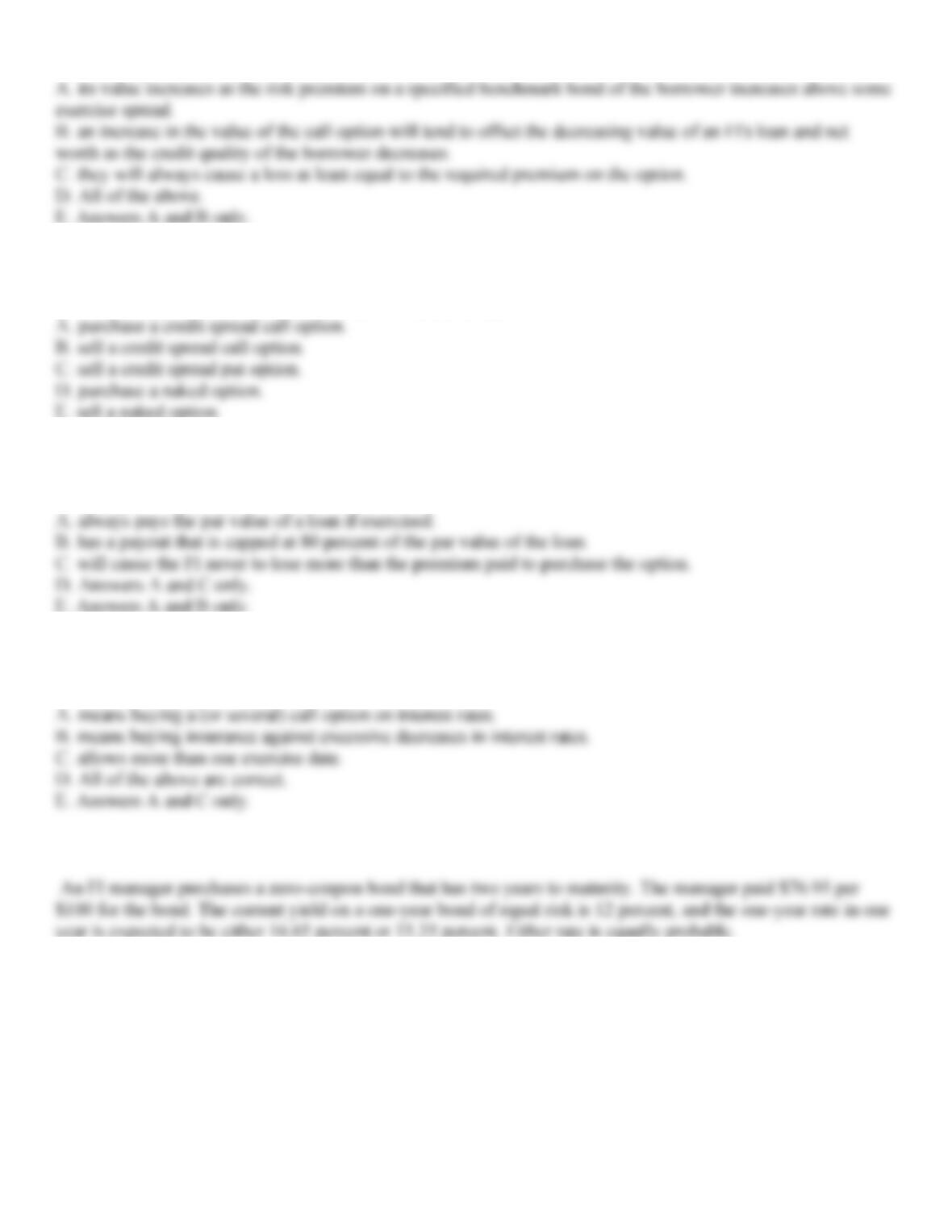
81. A bank with total assets of $271 million and equity of $31 million has a leverage adjusted duration gap of
+0.21 years. Use the following quotation from the Wall Street Journal to construct an at-the-money futures
option hedge of the bank’s duration gap position.
If 91-day Treasury bill rates increase from 3.75 percent to 4.75 percent, what will be the profit/loss per contract
on the bank’s futures option hedge?
82. Credit spread call options are useful because
83. An FI concerned that the risk on a loan will increase can
84. A digital default option
85. Buying a cap option agreement
86. What is the yield to maturity for the two-year bond if held to maturity?
87. Given the expected one-year rates in one year, what are the possible bond prices in one year?
88. If the manager buys a one-year option with an exercise price equal to the expected price of the bond in one
year, what will be the exercise price of the option?
89. Given the exercise price of the option, what premium should be paid for this option?
90. What is the yield to maturity for the two-year bond if held to maturity?
91. Given the expected one-year rates in one year, what are the possible bond prices in one year?
92. If the manager buys a one-year option with an exercise price equal to the expected price of the bond in one
year, what will be the exercise price of the option?
93. Given the exercise price of the option, what premium should be paid for this option?
94. The duration of the T-notes, Baa bonds, and GICs is 1.93 years, 6.9 years, and 4.5 years respectively. What
is the leverage-adjusted duration gap for Allright?
95. If Allright wanted to hedge the balance sheet position, what is the interest rate risk exposure and what hedge
would be appropriate?
96. Market interest rates are expected to increase 1 percent to 11 percent in the next year. If this occurs, what
will be the effect on the market value of equity of Allright?
97. On the advice of its chief financial officer, Allright wants to hedge the balance sheet with T-bond option
contracts. The underlying bonds currently have a duration of 8.82 years and a market value of $97,000 per
$100,000 face value. Further, the delta of the options is 0.5. What type of contract, and how many contracts
should Allright use to hedge this balance sheet?
98. If rates increase 1 percent, what will be the change in value of the option position?
99. At the time of placement, the premium on the options are quoted at 1¾. What is the cost to Allright in
placing the hedge?
100. Given this information, what type of T-bond option, and how many options should be purchased, to hedge
this investment?
101. Using the above information, what will happen to the market value of the Eurobonds if market interest
rates fall 1 percent to 9 percent?
102. Using the above information and your answer to the previous question, will the investment company gain
or lose on the option position if interest rates decrease 1 percent to 9 percent?
103. What is the net gain or loss to the investment company resulting from the change in rates given that the
hedge was placed?
]
104. What is the foreign exchange risk that the FI is facing, and what type of currency option should be
purchased to hedge this risk?
105. How many options should the FI purchase, and what will be the cost?
106. If the exchange rate in one month is $1.55/1, what action should the FI take in regards to the hedge?
107. Assume interest rates are 5 percent in year 2 and 7 percent in year 3. Which of the following is true?
108. Instead of a cap, if the bank had purchased a 3-year 6 percent floor and interest rates are 5 percent and 6
percent in years 2 and 3, respectively, what are the payoffs to the bank?
109. In addition to purchasing the cap, if the bank also purchases a 3-year 6 percent floor and interest rates are 5
percent and 7 percent in years 2 and 3, respectively, what are the payoffs to the bank? Specifically, the bank
will
110. In addition to purchasing the cap, if the bank also sells a 3-year 6 percent floor and interest rates are 5
percent and 7 percent in years 2 and 3, respectively, what are the payoffs to the bank? Specifically, the bank
111. What should be the price of a three-year 6 percent cap if the current (spot) rates are also 6 percent? The
face value is $5,000,000, and time periods are zero, one, and two.
112. What should be the price of a three-year 6 percent floor if the current (spot) rates are also 6 percent? The
face value is $5,000,000, and time periods are zero, one, and two.
113. What should be the price of a three-year 5 percent floor if the current (spot) rates are also 6 percent? The
face value is $5,000,000, and time periods are zero, one, and two.
114. What should be the price of a $5,000,000 collar if the bank purchases a three-year 6 percent cap and sells a
5 percent floor, if the current (spot) rates are 6 percent?