35. We calculate the expected payoff with perfect information (EPPI) by multiplying the probability of
each state of nature by the smallest payoff associated with that state of nature, and then summing the
products.
36. The expected value of perfect information (EVPI) is always the same as the expected opportunity loss
for the best alternative. That is, EVPI = EOL*.
37. To calculate expected profit under certainty, we need to have perfect information about which event
will occur.
38. The expected value of sample information (EVSI) is the difference between the expected monetary
value with additional information (EMV’) and the expected monetary value without additional
information (EMV*). That is, EVSI = (EMV‘) − EMV*.
39. The expected value of perfect information is the same as the:
a.
expected monetary value for the best alternative.
b.
expected monetary value for worst alternative.
c.
expected opportunity loss for the best alternative.
d.
expected opportunity loss for the worst alternative.
40. Which of the following statements is correct?
a.
The expected value of perfect information (EVPI) equals the largest expected monetary
value (EMV*).
b.
The expected value of perfect information (EVPI) equals the smallest expected
opportunity loss (EOL*).
c.
The expected value of perfect information (EVPI) equals the expected payoff with perfect
information (EPPI).
d.
All of these choices are true
41. The procedure for revising probabilities based upon additional information is referred to as:
a.
utility theory.
b.
Bernoulli’s theorem.
c.
central limit theorem.
d.
Bayes Law.
42. Which of the following statements is correct?
a.
The EMV criterion selects the act with the largest expected monetary value.
b.
The EOL criterion selects the act with the smallest expected opportunity loss.
c.
The expected value of perfect information (EVPI) equals the smallest expected
opportunity loss.
d.
All of these choices are true.
43. The difference between expected payoff under certainty and expected value of the best act without
certainty is the:
a.
expected monetary value.
b.
expected net present value.
c.
expected value of perfect information.
d.
expected rate of return.
ANS:
44. The minimum expected opportunity loss is also equal to the:
a.
expected profit under certainty.
b.
expected value of perfect information.
c.
coefficient of variation.
d.
expected value under certainty minus the expected monetary value of the worst alternative.
45. The expected value of sample information (EVSI) is the difference between:
a.
the posterior probabilities and the prior probabilities of the states of nature.
b.
the expected payoff with perfect information (EPPI) and the expected monetary value for
the best decision (EMV*).
c.
the expected monetary value with additional information (EMV’) and the expected
monetary value for the best decision (EMV*).
d.
the expected value of perfect information (EVPI) and the smallest expected opportunity
loss (EOL*).
46. The EVPI represents the ____________________ amount that a decision maker should be willing to
pay for perfect information.
47. We compute the ____________________ by multiplying the probability of each state of nature by the
largest payoff associated with that state of nature, then summing the resulting products.
48. The expected value of perfect information (EVPI) equals the smallest ____________________. This is
not a coincidence.
49. ____________________ probabilities are determined before any additional information is acquired.
50. ____________________ probabilities are revised probabilities that occur after additional information
has been received.
51. Incorporating an investor’s subjective probabilities with a consultant’s numerical forecasts requires the
use of ____________________ Law.
52. The objective of a(n) ____________________ analysis is to determine whether the value of the
prediction is greater or less than the cost of the information.
53. The difference between the expected monetary value with additional information (EMV’) and the
expected monetary value without additional information (EMV*) is called the expected value of
____________________ information and is denoted EVSI.
54. ____________________ statistics specifies that parameters are variables that can assume various
probability distributions.
55. A(n) ____________________ tree is helpful in describing the acts and states of nature, and for making
calculations involving these items easier.
56. A(n) ____________________ probability is based on ideas, attitudes, or opinions that an investor may
have.
57. What is meant by the expected payoff with perfect information (EPPI)?

Maintenance Company
For a maintenance company, a payoff table, the prior probabilities for three states of nature, and the
likelihood probabilities are shown below:
Payoff Table:
Alternative
State of Nature
a1
a2
a3
s1
80
120
90
s2
60
130
170
s3
200
140
100
Prior Probabilities:
P(s1) = 0.4, P(s2) = 0.5, and P(s3) = 0.1.
Likelihood Probabilities:
I1
I2
I3
s1
0.5
0.3
0.2
s2
0.2
0.6
0.2
s3
0.1
0.2
0.7
58. {Maintenance Company Narrative} What is the expected payoff with perfect information?
59. {Maintenance Company Narrative} What is the expected value of perfect information?
60. {Maintenance Company Narrative} Use the prior and likelihood probabilities to calculate the posterior
probabilities for the experimental outcome I1.
Likelihood Prob.
Posterior Prob.
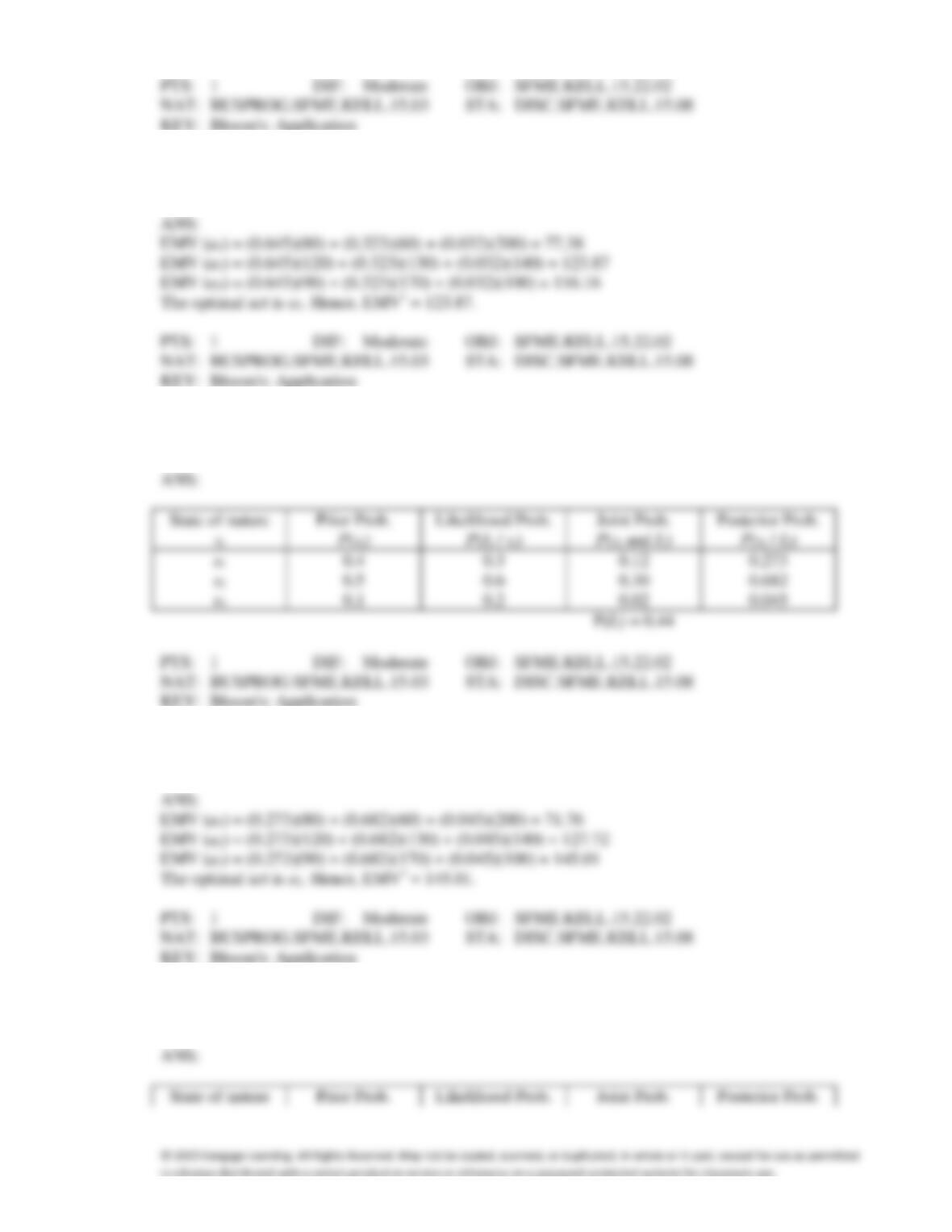
61. {Maintenance Company Narrative} Use the posterior probabilities for I1 in the previous question to
recalculate the expected monetary value of each act, then determine the optimal act and the EMV*.
62. {Maintenance Company Narrative} Use the prior and likelihood probabilities to calculate the posterior
probabilities for the experimental outcome I2.
63. {Maintenance Company Narrative} Use the posterior probabilities for I2 in the previous question to
recalculate the expected monetary value of each act, then determine the optimal act and the EMV*.
64. {Maintenance Company Narrative} Use the prior and likelihood probabilities to calculate the posterior
probabilities for the experimental outcome I3.
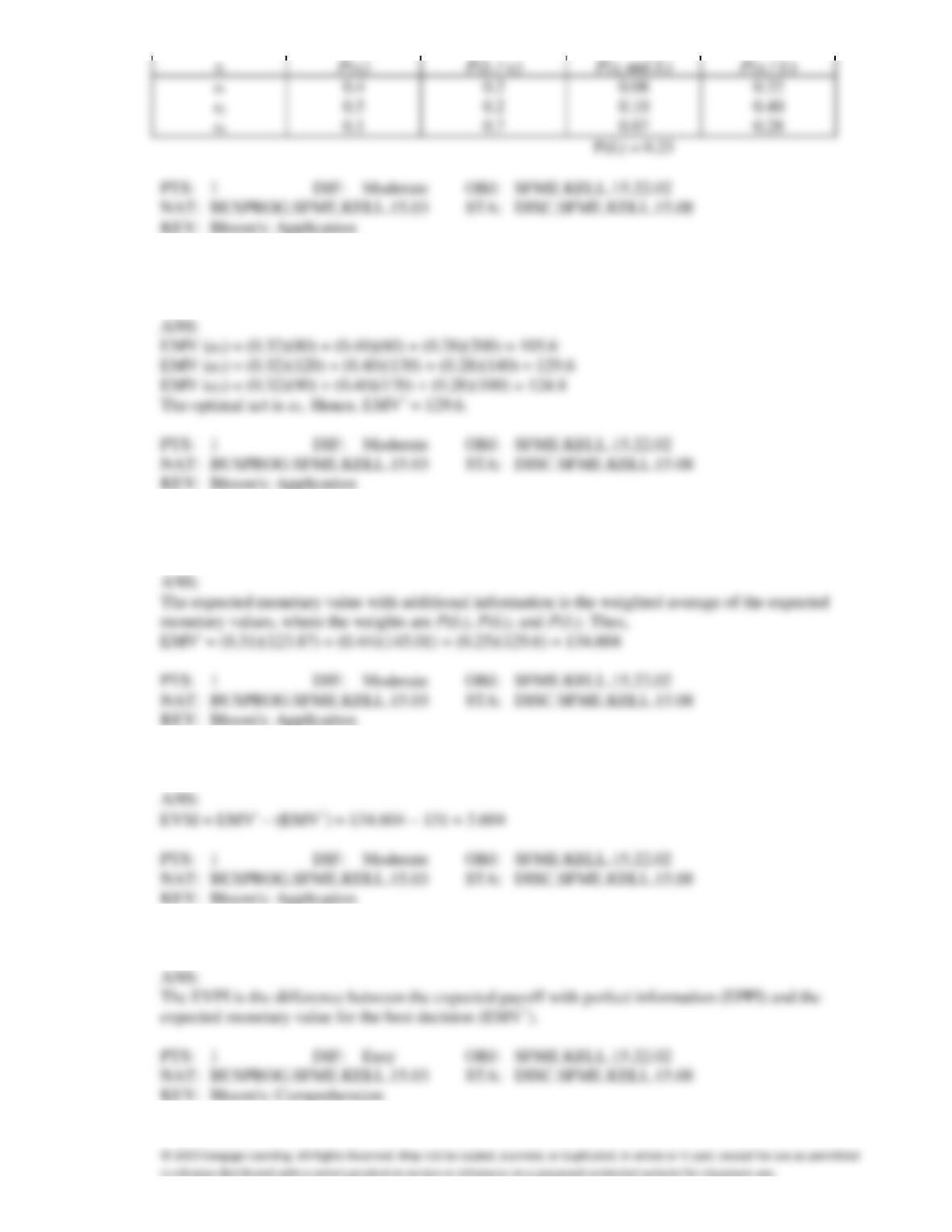
65. {Maintenance Company Narrative} Use the posterior probabilities for I3 in the previous question to
recalculate the expected monetary value of each act, then determine the optimal act and the EMV*.
66. {Maintenance Company Narrative} Use your answers to the previous questions to calculate the
expected monetary value with additional information.
67. {Maintenance Company Narrative} Calculate the expected value of sample information.
68. What is meant by the expected value of perfect information (EVPI)?

69. A company must decide whether or not to change its packaging to a more environmentally safe
material. The impact of the decision on profits depends on which of the following three possible
scenarios develops in the future.
Scenario 1:
The media does not focus heavily on concerns about packaging and no new laws requiring changes in
packaging are passed. Under this scenario, the company will make $35 million if they change their
packaging now, but will make $75 million if they do not change their packaging now.
Scenario 2:
The media does focus heavily on concerns about packaging and no new laws requiring changes in
packaging are passed. Under this scenario, the company will make $50 million if they change their
packaging now, but will make $55 million if they do not change their packaging now.
Scenario 3:
The media does focus heavily on concerns about packaging and new laws requiring changes in
packaging are passed. Under this scenario, the company will make $60 million if they change their
packaging now, but will make only $15 million if they do not change their packaging now.
The prior probabilities of the three scenarios are 0.3, 0.5, and 0.2, respectively. What is the most the
company should be willing to pay for a research study designed to reduce its uncertainty about media
and legal developments concerning packaging?
Candy Store
A payoff table for a Candy store is shown below.
Alternative
State of Nature
a1
a2
a3
s1
25
8
−3
s2
12
8
6
s3
−13
8
13
The following prior probabilities are assigned to the states of nature: P(s1) = 0.2, P(s2) = 0.6, and P(s3)
= 0.2.
70. {Candy Store Narrative} What is the expected payoff with perfect information?

71. {Candy Store Narrative} What is the expected value of perfect information?
Power Company
A payoff table for a power company is shown below:
Alternative
State of Nature
a1
a2
a3
a4
s1
7
0
4
6
s2
2
4
3
5
The following prior probabilities are assigned to the states of nature: P(s1) = 0.3, P(s2) = 0.7.
72. {Power Company Narrative} What is the expected payoff with perfect information?
73. {Power Company Narrative} What is the expected value of perfect information?
Car Audio Store
For a car audio store, a payoff table, the prior probabilities for two states of nature, and the likelihood
probabilities are shown below:
Payoff Table:
Alternative
State of Nature
a1
a2
a3

s1
20
28
33
s2
32
29
25
Prior Probabilities:
Likelihood Probabilities:
I1
I2
P(s1) = 0.4, and P(s2) = 0.6.
s1
0.95
0.05
s1
0.08
0.92
74. {Car Audio Store Narrative} What is the expected payoff with perfect information?
75. {Car Audio Store Narrative} What is the expected value of perfect information?
76. {Car Audio Store Narrative} Use the prior and likelihood probabilities to calculate the posterior
probabilities for the experimental outcome I1.
77. {Car Audio Store Narrative} Use the posterior probabilities for I1 in the previous question to
recalculate the expected monetary value of each act, then determine the optimal act and the EMV*.
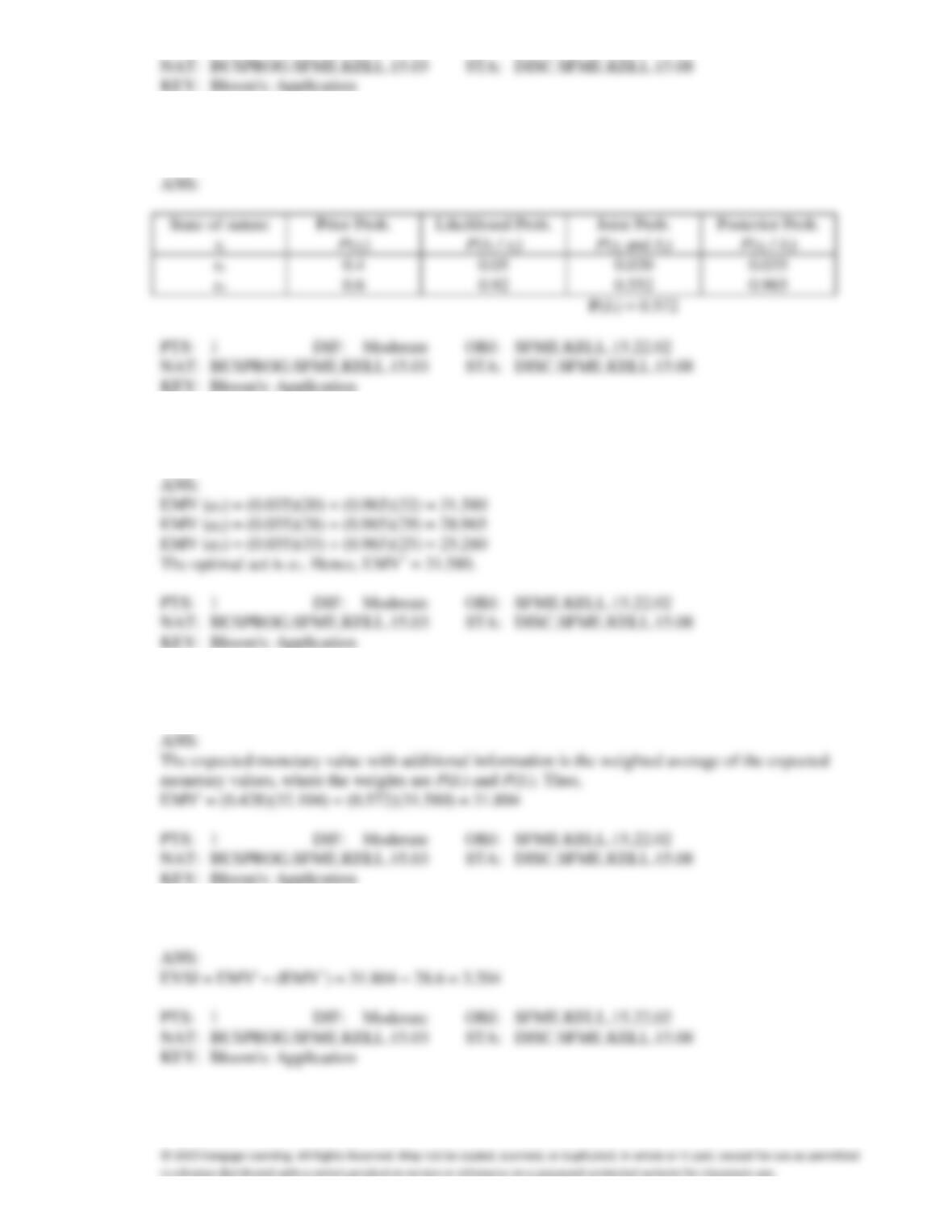
78. {Car Audio Store Narrative} Use the prior and likelihood probabilities to calculate the posterior
probabilities for the experimental outcome I2.
79. {Car Audio Store Narrative} Use the posterior probabilities for I2 in the previous questions to
recalculate the expected monetary value of each act, then determine the optimal act and the EMV*.
80. {Car Audio Store Narrative} Use your answers to the previous questions to calculate the expected
monetary value with additional information.
81. {Car Audio Store Narrative} Calculate the expected value of sample information.
Custom Home Designs

Three different designs are being considered for new custom homes, and profits will depend on the
combination of the custom home design and market condition. The following payoff table summarizes
the decision situation, with amounts in millions of dollars.
Alternative (Design)
State of Nature
a1
a2
a3
(Market condition)
s1
$30
$20
$10
s2
$19
$21
$15
s3
$11
$23
$45
Assume that the following probabilities are assigned to the three market conditions: P(s1) = 0.1, P(s2) =
0.6, and P(s3) = 0.3.
82. {Custom Home Designs Narrative} Determine the expected payoff that would be realized if perfect
information were available.
83. {Custom Home Designs Narrative} What is the most the firm would be willing to pay for a research
study designed to reduce its uncertainty about market conditions?
Graphic Design Business
A high school student, who started doing graphic designs as a hobby, is considering going into the
graphic design business. The anticipated payoff table is:
Alternative
State of Nature
Start
Do Not Start
new business
new business
Poor
−$12,000
0
Fair
$10,000
0
Super
$15,000
0

The following prior probabilities are assigned to the states of nature: P(poor) = 0.4, P(fair) = 0.4, and
P(super) = 0.2.
84. {Graphic Design Business Narrative} What is the expected payoff with perfect information?
85. {Graphic Design Business Narrative} What is the expected value of perfect information? What does it
mean?
Lingerie Store
The following table displays the payoffs (in thousands of dollars) for five different decision
alternatives under three possible states of nature for a new Lingerie store:
Alternative
(Decision)
State of Nature
a1
a2
a3
a4
a5
s1
$100
$80
$35
$20
$0
s2
$70
$75
$55
$50
$15
s3
−$30
$0
$35
$55
$60
The prior probabilities of the states of nature are: P(s1) = 0.2, P(s2) = 0.3, and P(s3) = 0.5.
86. {Lingerie Store Narrative} Calculate the expected payoff with perfect information.
87. {Lingerie Store Narrative} Calculate the expected value of perfect information.