CHAPTER 22: DECISION ANALYSIS
TRUE/FALSE
1. We can use the payoff table to calculate the expected monetary value (EMV) and the expected
opportunity loss (EOL) of each act (alternative).
2. All entries of any opportunity loss table are negative values since they represent losses.
3. An opportunity loss is the difference between what the decision maker’s profit for an act (alternative)
is and what the profit could have been had the best decision been made.
4. Incentive programs for sales staff would be considered a state of nature for a business firm.
5. Worker safety laws would be considered a state of nature for a business firm.
6. The expected monetary value decision is always the same as the expected opportunity loss decision.
7. In making decisions, we choose the decision with the largest expected monetary value, or the smallest
expected opportunity loss.
8. In general, the branches of a decision tree represent acts and states of nature.
9. Opportunity loss is the difference between the lowest profit for an event and the actual profit obtained
for an action taken.
10. The payoff table is a table in which the rows are states of nature, the columns are decision alternatives,
and the entry at each intersection of a row and column is a numerical payoff such as a profit or loss.
11. The expected monetary value (EMV) of a decision alternative is the sum of the products of the payoffs
and the state of nature probabilities.
12. The expected monetary value (EMV) decision is always the same as the expected opportunity loss
(EOL) decision because the opportunity loss table is produced directly from the payoff table.
13. In general, the expected monetary values (EMV) represent possible payoffs.
14. If EMV(a1) = $50,000, EMV(a2) = $65,000, and EMV(a3) = $45,000, then EMV* = $160,000.
15. If EOL(a1) = $13,000, EOL(a2) = $25,000, and EOL(a3) = $20,000, then EOL* = $13,000.
MULTIPLE CHOICE
1. A surgeon is involved in a $3 million malpractice suit. He can either settle out of court for $750,000 or
go to court. If he goes to court and loses, he must pay $2,500,000 plus $500,000 in court costs. If he
wins in court the plaintiffs pay the court costs. Identify the actions of this decision-making problem.
a.
Two choices: (1) go to court and (2) settle out of court.
b.
Two choices: (1) win the case in court and (2) lose the case in court.
c.
Four consequences resulting from Go/Settle and Win/Lose combinations.
d.
The amount of money paid by the doctor.
2. A tabular presentation that shows the outcome for each decision alternative under the various states of
nature is called a:
a.
payback period matrix.
c.
decision tree.
b.
decision matrix.
d.
payoff table.
3. Which of the following would be considered a state of nature for a business firm?
a.
Inventory levels
c.
Site for new plant
b.
Worker safety laws
d.
Salaries for employees
4. Which of the following would not be considered a state of nature for a business firm?
a.
Federal Reserve regulations
c.
The number of employees to hire
b.
Food and Drug Administration regulations
d.
Minimum wage regulations
5. A payoff table lists the monetary values for each possible combination of the
a.
event (state of nature) and act (alternative).
b.
mean and standard deviation.
c.
mean and median.
d.
None of these choices.
6. Which of the following is true?
a.
The process of determining the EMV decision is called the rollback technique.
b.
We choose the act that produces the smallest expected opportunity loss (EOL)
c.
The EMV decision is always the same as the EOL decision.
d.
All of these choices are true.
7. Which of the following statements is false regarding the expected monetary value (EMV)?
a.
To calculate the EMV, the probabilities of the states of nature must be already decided
upon.
b.
We choose the decision with the largest EMV.
c.
In general, the expected monetary values represent possible payoffs.
d.
None of these choices.
8. A company that manufactures baseball gloves is contemplating whether to increase its advertising
budget by $3 million for next year. If the expanded advertising campaign is successful, the company
expects sales to increase by $4.8 million next year. If the advertising campaign fails, the company
expects sales to increase by only $900,000 next year. If the advertising budget is not increased, the
company expects sales to increase by $450,000. Identify the possible outcomes in this decision-making
problem.
a.
Two choices: (1) increase the budget and (2) do not increase the budget.
b.
Four consequences resulting from the Increase/Do Not Increase and Successful/Not
Successful combinations.
c.
Two choices: (1) campaign is successful and (2) campaign is not successful.
d.
The increase in sales dollars next year.
COMPLETION
Gross Profits
The following payoff table shows gross profits (in $1000) associated with a set of 3 acts under 2
possible states of nature.
States of Nature
a1
a2
a3
s1
12
−2
8
s2
4
10
5
1. {Gross Profits Narrative} The opportunity loss for a3 when s2 occurs is________________.
2. {Gross Profits Narrative} The opportunity loss for a2 when s1 occurs is________________.
3. {Gross Profits Narrative} If the probability of s1 is 0.4, then the probability of s2 is______________.
4. {Gross Profits Narrative} If the probability of s1 is 0.2 and s2 is 0.8, then the expected monetary value
(EMV) of a1 is ____________________.
5. {Gross Profits Narrative} If the probability of s1 is 0.2 and s2 is 0.8, then the expected opportunity loss
(EOL) for a1 is ____________________.
6. {Gross Profits Narrative} If the probability of s1 is 0.2, the optimal alternative using EOL is
____________________.
7. {Gross Profits Narrative} If the probability of s1 is 0.5, then the expected monetary value (EMV) for a1
is ____________________.
8. {Gross Profits Narrative} If the probability of s1 is 0.5, then the expected monetary value (EMV) for a2
is ____________________.
9. {Gross Profits Narrative} If the probability of s1 is 0.5, then the expected opportunity loss (EOL) for a1
is ____________________.
10. {Gross Profits Narrative} If the probability of s1 is 0.5, then the expected opportunity loss (EOL) for a3
is ____________________.
11. {Gross Profits Narrative} If the probability of s1 is 0.5, then the optimal alternative using EMV is
____________________.
SHORT ANSWER
1. What is meant by a payoff table?
2. What is meant by the expected monetary value (EMV) of a decision alternative?
Sporting Goods Store
A payoff table for a clothing store is shown below.
Alternative
State of Nature
a1
a2
a3
s1
25
8
−3
s2
12
8
6
s3
−13
8
13
The following prior probabilities are assigned to the states of nature: P(s1) = 0.2, P(s2) = 0.6, and P(s3)
= 0.2.
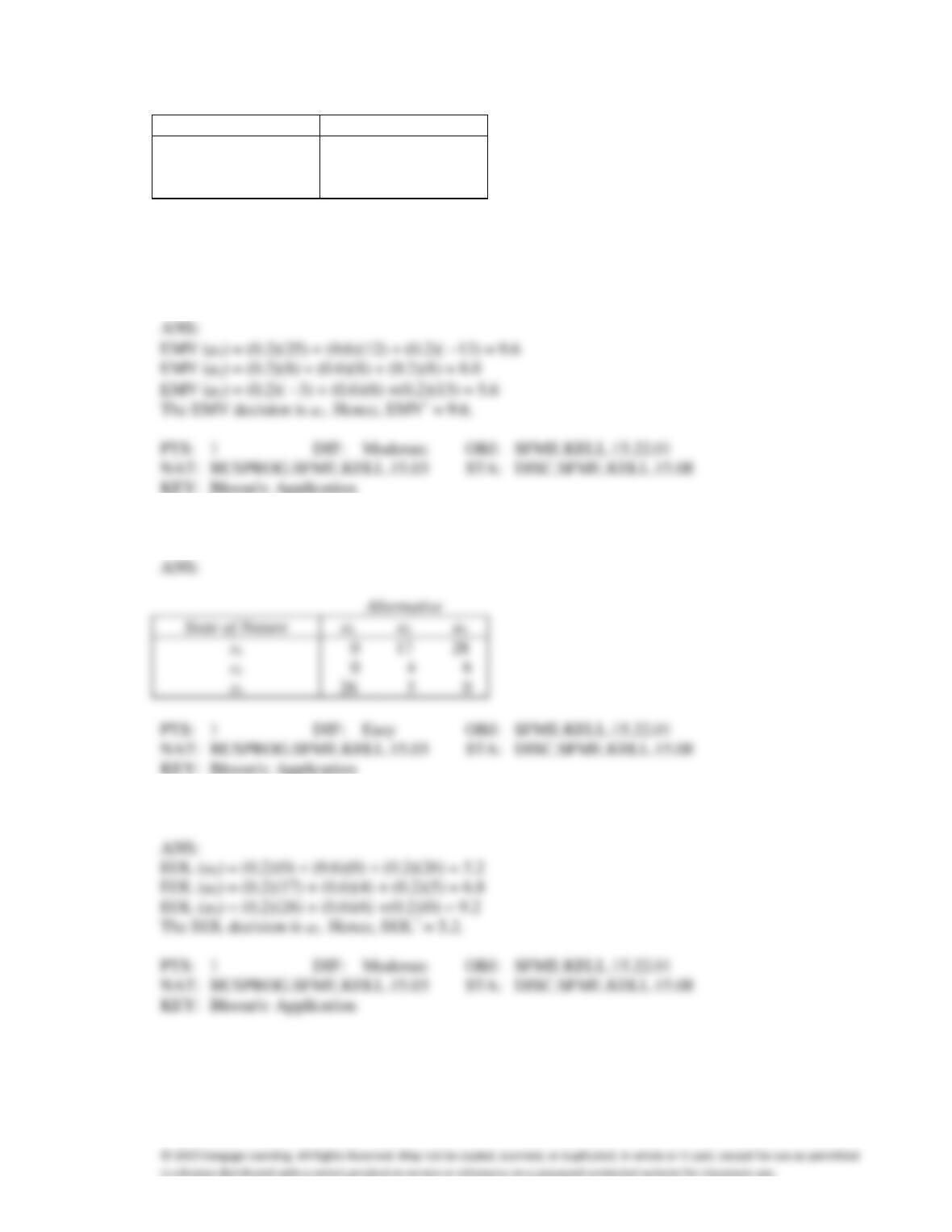
3. {Sporting Goods Store Narrative} Determine the EMV decision.
4. {Sporting Goods Store Narrative} Set up the opportunity loss table.
Alternative
a1
a2
a3
s2
0
4
6
5. {Sporting Goods Store Narrative} Determine the EOL decision.
Gas Company
A payoff table for an electric company is shown below:
Alternative
State of Nature
a1
a2
a3
a4
s1
7
0
4
6
s2
2
4
3
5
The following prior probabilities are assigned to the states of nature: P(s1) = 0.3, P(s2) = 0.7.
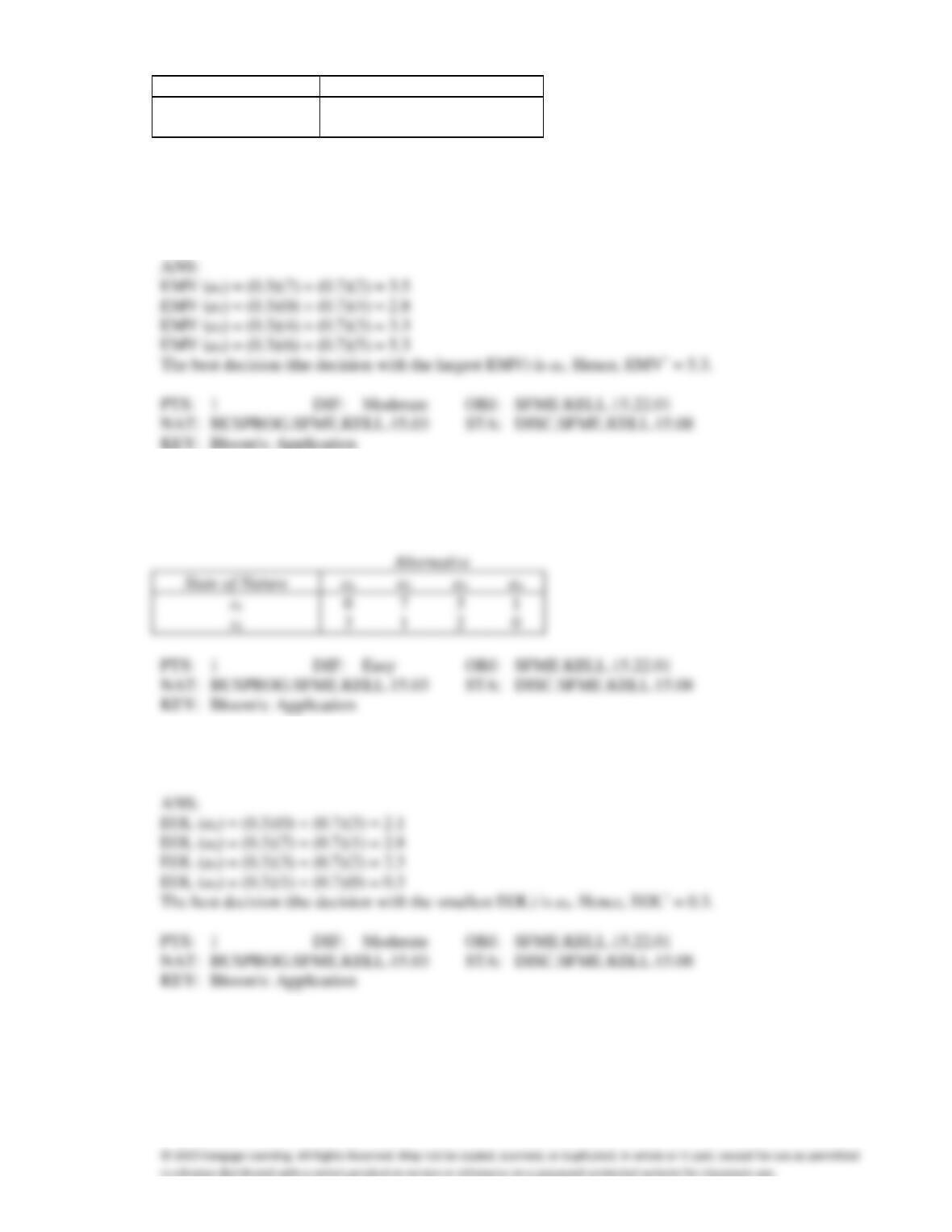
6. {Gas Company Narrative} Calculate the expected monetary value for each act with present
information. What decision should be made using the EMV criterion?
7. {Gas Company Narrative} Convert the payoff table to an opportunity loss table.
ANS:
State of Nature
a1
a2
a3
a4
s1
0
7
3
1
s2
3
1
2
0
8. {Gas Company Narrative} Calculate the expected opportunity loss for each act with present
information. What decision should be made using the EOL criterion?
Video Business
A high school student, who started doing videos as a hobby, is considering going into the videography
business. The anticipated payoff table is:
Alternative
Start
Do Not Start
State of Nature
new business
new business
Poor
−$12,000
0
Fair
$10,000
0
Super
$15,000
0
The following prior probabilities are assigned to the states of nature: P(poor) = 0.4, P(fair) = 0.4, and
P(super) = 0.2.
9. {Video Business Narrative} Calculate the expected monetary value for each act with present
information. What decision should be made using the EMV criterion?
10. {Video Business Narrative} Convert the payoff table to an opportunity loss table.
Alternative
Poor
Fair
Super
11. {Video Business Narrative} Calculate the expected opportunity loss for each act with present
information. What decision should be made using the EOL criterion?
12. {Video Business Narrative} Review the decisions made in the previous questions. Is this a
coincidence? Explain.
Hobby Shop
A payoff table and the prior probabilities for two states of nature for a Hobby Shop are shown below:
Payoff Table:
Alternative
State of Nature
a1
a2
a3
s1
20
28
33
s2
32
29
25
Prior Probabilities:
P(s1) = 0.4, and P(s2) = 0.6.
13. {Hobby Shop Narrative} Determine the EMV decision.
14. {Hobby Shop Narrative} Set up the opportunity loss table.
15. {Hobby Shop Narrative} Determine the EOL decision.
Container Company
A company must decide whether or not to change its packaging to a more environmentally safe
material. The impact of the decision on profits depends on which of the following three possible
scenarios develops in the future.
Scenario 1:
The media does not focus heavily on concerns about packaging and no new laws requiring changes in
packaging are passed. Under this scenario, the company will make $35 million if they change their
packaging now, but will make $75 million if they do not change their packaging now.
Scenario 2:
The media does focus heavily on concerns about packaging and no new laws requiring changes in
packaging are passed. Under this scenario, the company will make $50 million if they change their
packaging now, but will make $55 million if they do not change their packaging now.
Scenario 3:
The media does focus heavily on concerns about packaging and new laws requiring changes in
packaging are passed. Under this scenario, the company will make $60 million if they change their
packaging now, but will make only $15 million if they do not change their packaging now.
The prior probabilities of the three scenarios are 0.3, 0.5, and 0.2, respectively.
16. {Container Company Narrative} Develop a payoff table for this decision situation.
17. {Container Company Narrative} What decision will be made to maximize expected payoff?
18. {Container Company Narrative} Set up the opportunity loss table.
s1
s2
s3
19. {Container Company Narrative} Which decision has the minimum expected opportunity loss?
Food Market
The following table displays the payoffs (in thousands of dollars) for five different decision
alternatives under three possible states of nature for a new food market:
Alternative
(Decision)
State of Nature
a1
a2
a3
a4
a5
s1
$100
$80
$35
$20
$0
s2
$70
$75
$55
$50
$15
s3
−$30
$0
$35
$55
$60
The prior probabilities of the states of nature are: P(s1) = 0.2, P(s2) = 0.3, and P(s3) = 0.5.
20. {Food Market Narrative} Calculate the expected monetary value for each alternative with present
information. What decision should be made using the EMV criterion?
21. {Food Market Narrative} Convert the payoff table to an opportunity loss table.
a1
a2
a3
a4
a5
s1
$20
$65
$80
s3
$90
$60
$25
22. {Food Market Narrative} Calculate the expected opportunity loss for each act with present
information. What decision should be made using the EOL criterion?
Dishwasher Designs
Three different designs are being considered for a new dishwasher, and profits will depend on the
combination of the dishwasher design and market condition. The following payoff table summarizes
the decision situation, with amounts in millions of dollars.
Alternative
(Design)
State of Nature
a1
a2
a3
(Market condition)
s1
$30
$20
$10
s2
$19
$21
$15
s3
$11
$23
$45
0.6, and P(s3) = 0.3.
23. {Dishwasher Designs Narrative} Calculate the expected monetary value for each design with present
information. Which design should be selected in order to maximize the firm’s expected profit?
24. {Dishwasher Designs Narrative} Convert the payoff table to an opportunity loss table.
25. {Dishwasher Designs Narrative} Calculate the expected opportunity loss for each design with present
information. Which design should be selected in order to minimize the firm’s expected loss?
Demolition Company
The payoff table and the prior probabilities for three states of nature for a demolition company are
shown below:
Alternative
State of Nature
a1
a2
a3
s1
80
120
90
s2
60
130
170
s3
200
140
100
Prior Probabilities:
P(s1) = 0.4, P(s2) = 0.5, and P(s3) = 0.1.
26. {Demolition Company Narrative} Determine the EMV decision.
27. {Demolition Company Narrative} Set up the opportunity loss table.
State of Nature
a1
a2
a3
s1
40
30
s2
110
28. {Demolition Company Narrative} Determine the EOL decision.
29. The preposterior analysis determines whether or not sample information should be purchased to revise
the prior probabilities associated with the states of nature.
30. The objective of a preposterior analysis is to determine whether the value of the prediction is greater or
less than the cost of the information.
31. Removal of uncertainty from a decision-making problem leads to a case referred to as perfect
information.
32. The expected value of perfect information (EVPI) is the difference between the expected payoff with
perfect information (EPPI) and the expected monetary value (EMV*). That is, EVPI = EPPI − EMV*.
33. The expected value of perfect information (EVPI) equals the largest expected opportunity loss (EOL*).
34. The expected payoff with perfect information (EPPI) represents the maximum amount a decision
maker would be willing to pay for perfect information.