CHAPTER 20: TIME-SERIES ANALYSIS AND FORECASTING
TRUE/FALSE
1. The purpose of using the moving average is to take away the short-term seasonal and random
variation, leaving behind a combined trend and cyclical movement.
2. The cyclical variation component of a time series measures the over-all general directional movement
over a long period of time.
3. Smoothing time series data by the moving average method or exponential method is an attempt to
dampen the effects of seasonal variation.
4. Any variable that is measured over time in sequential order is called a time series.
5. A trend is one of the four different components of a time series. It is a long-term, relatively smooth
pattern or direction exhibited by a series, and its duration is more than one year.
6. Given a data set with 15 yearly observations, there are only thirteen 3-year moving averages.
7. In forecasting, we use data from the past in predicting the future value of the variable of interest.
8. The effect that business recessions and prosperity have on time series values is an example of the
disaster component of a time series.
9. Seasonal variation is one of the four different components of a time series. These are cycles that occur
over short repetitive calendar periods and, by definition, have duration of less than one year.
10. The time series component that reflects a long-term, relatively smooth pattern or direction exhibited by
a time series over a long time period is called seasonal.
11. We calculate the three-period moving average for a time series for all time periods except the first
period.
12. The equation: St = w yt + (1 − w) St − 1 (for t 2) refers to exponentially smoothed time series.
13. To calculate the five-period moving average for a time series, we average the value in that time period,
the values in the two preceding time periods, and the values in the two following time periods.
14. The term “seasonal variation” may refer to the four traditional seasons, or to systematic patterns that
occur during a month, a week, or even one day.
15. In exponentially smoothed time series, the smoothing constant w is chosen on the basis of how much
smoothing is required. In general, a small value of w such as 0.1 results in very little smoothing, while
a large value of w such as 0.8 results in too much smoothing.
16. Random variation is one of the four different components of a time series. It is caused by irregular and
unpredictable changes in a time series that are not caused by any other component. It tends to mask the
existence of the other more predictable components.
17. The time series component that reflects a wavelike pattern describing a long-term trend that is
generally apparent over a number of years is called cyclical.
18. Given a data set with 15 yearly observations, there are only seven 9-year moving averages.
19. One of the simplest ways to reduce random variation is to smooth the time series using moving
averages and exponential smoothing.
20. The time series component that reflects the irregular changes in a time series that are not caused by any
other component, and tends to hide the existence of the other more predictable components, is called
random variation.
21. The seasonal variation, one of the four different components of a time series, is more likely to exhibit
the relatively steady growth of the population of the United States from 181 million in 1960 to 273
million in 1999.
22. Cyclical variation, one of the four different components of a time series, is more likely to exhibit
business cycles that record periods of economic recession and inflation.
23. We compute the five-period moving averages for all time periods except the first two and last two time
periods.
24. We compute the three-period moving averages for all time periods except the first and the last.
25. Given a data set with 15 yearly observations, a 3-year moving average will have fewer observations
than a 5-year moving average.
26. A time series can consist of four different components: long-term trend, cyclical variation, seasonal
variation, and random variation.
27. Smoothing time series data by the moving average method or exponential smoothing method is an
attempt to remove the effect of the random variation component.
28. If a time series does not exhibit a long-term trend, the method of exponential smoothing may be used
to obtain short-term predictions about the future.
29. A trend is a persistent pattern in annual time-series data that has to be followed for several years.
30. The principle of parsimony indicates that the simplest model that gets the job done adequately should
be used.
31. Each forecast using the method of exponential smoothing depends on all the previous observations in
the time series.
MULTIPLE CHOICE
1. A time series is:
a.
a set of measurements on a variable collected at the same time or approximately the same
period of time.
b.
a set of measurements on a variable taken over some time period in sequential order
c.
a model that attempts to analyze the relationship between a dependent variable and one or
more independent variables
d.
a model that attempts to forecast the future value of a variable
2. The time series component that reflects a long-term, relatively smooth pattern or direction exhibited by
a time series over a long time period (more than one year) is called:
a.
random variation
c.
seasonal variation
b.
cyclical variation
d.
long-term trend
3. The time series component that reflects variability over short repetitive time periods and has duration
of less than one year is called:
a.
long-term trend
c.
seasonal variation
b.
cyclical variation
d.
random variation
4. The time series component that reflects the irregular changes in a time series that are not caused by any
other component, and tends to hide the existence of the other more predictable components, is called:
a.
long-term trend
c.
seasonal variation
b.
cyclical variation
d.
random variation
5. Which of the four-time series component is more likely to exhibit the changes in stock market prices at
particular times during the course of one day?
a.
Long-term trend
c.
Seasonal variation
b.
Cyclical variation
d.
Random variation
6. The term “seasonal variation” may refer to:
a.
systematic patterns that occur during the period of one week
b.
systematic patterns that occur over the course of one day
c.
the four traditional seasons
d.
All of these choices are true
7. Which of the four time series components is more likely to exhibit the relative steady growth of the
population of Las Vegas from 1964 to 2004?
a.
Long-term trend
c.
Seasonal variation
b.
Cyclical variation
d.
Random variation
8. The time series component that reflects a wavelike pattern describing a long-term trend that is
generally apparent over a number of years is called:
a.
long-term trend
c.
seasonal variation
b.
cyclical variation
d.
random variation
9. We calculate the three-period moving averages for a time series for all time periods except the:
a.
first period
c.
first and last period
b.
last period
d.
first and last two periods
10. We calculate the five-period moving average for a time series for all time periods except the:
a.
first five periods
c.
first and last period
b.
last five periods
d.
first two and last two periods
11. The way a seasonal index is computed involves which of the following steps?
a.
Remove the effect of seasonal and random variation by regression analysis.
b.
For each time period, compute the ratio, which removes most of the trend variation
for that time period.
c.
Calculate the average of all the ratios: over all time periods to remove random
variation and leaving a measure of seasonality.
d.
All of these choices are true.
12. If we want to measure the seasonal variations on stock market performance by quarter, we would need:
a.
4 indicator variables
c.
2 indicator variables
b.
3 indicator variables
d.
1 indicator variable
13. The number of four-period centered moving averages of a time series with 20 time periods is:
a.
16
c.
24
b.
20
d.
28
14. In exponentially smoothed time series, the smoothing constant w is chosen on the basis of how much
smoothing is required. In general, which of the following statements is true?
a.
A small value of w such as w = 0.1 results in very little smoothing, while a large value
such as w = 0.8 results in too much smoothing
b.
A small value of w such as w = 0.1 results in too much smoothing, which a large value
such as w = 0.8 results in very little smoothing
c.
A small value of w such as w = 0.1 and a large value such as w = 0.8 may both result in
very little smoothing
d.
A small value of w such as w = 0.1 and a large value such as w = 0.8 may both result in
too much smoothing
15. Which of the following statements is false?
a.
A moving average for a time period is the simple arithmetic average of the values in that
time period and those close to it.
b.
A value of the smoothing constant w close to 1 results in a very large smoothing, whereas
a value of w close to zero results in very little smoothing.
c.
The accuracy of the forecast with exponential smoothing decreases rapidly for predictions
of the time series more than one period into the future.
d.
A moving average “forgets” most of the previous time-series values and is considered a
relatively crude method of removing the random variation.
16. In general, it is easy to identify the trend component of a time series by using:
a.
exponential smoothing
c.
regression analysis
b.
moving averages
d.
seasonally adjusted time series
17. In measuring seasonal and random variation of a time series with no cyclical effect, we may use the:
a.
ratio of the time series divided by the moving average
b.
ratio of the time series divided by the predicted values
c.
trend value
d.
Both a and b
18. If we want to measure the seasonal variations on stock market performance by month, we would need:
a.
50 indicator variables since the stock market has a 5-day work per week
b.
12 indicator variables to represent the 12 months
c.
11 indicator variables
d.
52 indicator variables
19. The NYSE works 5-day work per week. If we want to measure the impact of the day of the week on
NYSE performance we would need:
a.
7 indicator variables
c.
5 indicator variables
b.
6 indicator variables
d.
4 indicator variables
20. If data for a time series analysis are collected on a monthly basis only, which component of the time
series may be ignored?
a.
Long-term trend
c.
Seasonal variation
b.
Cyclical variation
d.
Random variation
21. The time-series model yt = Tt Ct St Rt is used for forecasting, where Tt, Ct, St, and Rt are
respectively the trend, cyclical, seasonal, and random variation components of the time series, and yt is
the value of the time series at time t. The following estimates are obtained: = 120, = 1.02, =
0.95, and = 0.90. The model will produce a forecast of:
a.
122.870
c.
116.280
b.
104.652
d.
102.600
22. Which of the following methods is appropriate for forecasting a time series when the trend, cyclical,
and seasonal components of the series are not significant?
a.
Moving averages
c.
Mean absolute deviation
b.
Exponential smoothing
d.
Seasonal indexes
23. Which of the following is not true in regard to the weights used in exponential smoothing?
a.
They are all positive
c.
They add up to 1
b.
The last weight is always the smallest
d.
They decrease exponentially into the past
24. The formula St = wyt + (1 − w)St−1 is used in time-series forecasting with exponential smoothing, where
St is the exponentially smoothed time series at time t, yt is the value of the time series at time t, and w is
the smoothing constant. The forecasted value at time t + 1 where w = .4 is given by:
a.
Ft + 1 = 0.4yt +1 + 0.6St + 1
c.
Ft + 1 = 0.4yt + 0.6St − 1
b.
Ft + 1 = 0.4yt + 0.6St
d.
Ft + 1 = 0.4yt − 1 + 0.6St
25. The trend line = 0.70 + 0.005t was calculated from quarterly data for 2000-2004, where t = 1 for the
first quarter of 2000. The trend value for the second quarter of the year 2005 is:
a.
0.705
c.
0.815
b.
0.820
d.
0.810
26. The following are the values of a time series for the first four time periods:
t
1
2
3
4
yt
23
25
28
24
Using a four-period moving average, the forecasted value for time period 5 is:
a.
25.3
c.
25.0
b.
25.7
d.
26.0
27. The linear trend = 115.8 + 2.5t was estimated using a time series with 25 time periods. The
forecasted value for time period 26 is:
a.
180.8
b.
178.3
c.
175.8
d.
Not enough information given to answer this question.
28. The effect of an unpredictable, rare event will be contained in which component of the time series?
a.
Long-term trend
c.
Seasonal variation
b.
Cyclical variation
d.
Random Variation
29. The model yt = Tt + Ct + St + Rt +
t that assumes the time series value at time t is the sum of the four
time series components Tt, Ct, St, and Rt is referred to as:
a.
additive model
c.
moving averages model
b.
multiplicative model
d.
forecast model
30. The model yt = Tt Ct St Rt that assumes the time series value at time t is the product of the four
time series components is referred to as:
a.
additive model
c.
moving averages model
b.
forecast model
d.
multiplicative model
31. Suppose that we calculate the four-period moving average of the following time series
t
1
2
3
4
5
6
yt
16
28
21
15
26
12
The centered moving average for period 3 is:
a.
22.5
c.
20.50
b.
21.25
d.
18.5
32. Smoothing time series data by the moving average method or exponential smoothing method is an
attempt to remove the effect of the:
a.
trend component
c.
seasonal component
b.
cyclical component
d.
random variation component
33. The high level of airline ticket sales that travel agencies experience during summer is an example of
what component of a time series?
a.
Long-term trend
c.
Seasonal variation
b.
Cyclical variation
d.
Random variation
34. For which of the following values of the smoothing constant w will the smoothed series catch up most
quickly whenever the original time series changes direction?
a.
0.90
c.
0.40
b.
0.50
d.
0.10
35. The following are the values of a time series for the first four time periods:
t
1
2
3
4
yt
23
25
28
24
Using exponential smoothing, with w = 0.30, the forecasted value for time period 5 is:
a.
24.920
c.
23.600
b.
24.644
d.
23.000
36. Which of the following smoothing constants causes the most rapid reaction to a change in the current
time series value?
a.
0.40
c.
0.20
b.
0.30
d.
0.10
37. The overall upward or downward pattern of the data in an annual time series will be contained in
which component of the time series?
a.
Long-term trend
c.
Seasonal variation
b.
Cyclical variation
d.
Random variation
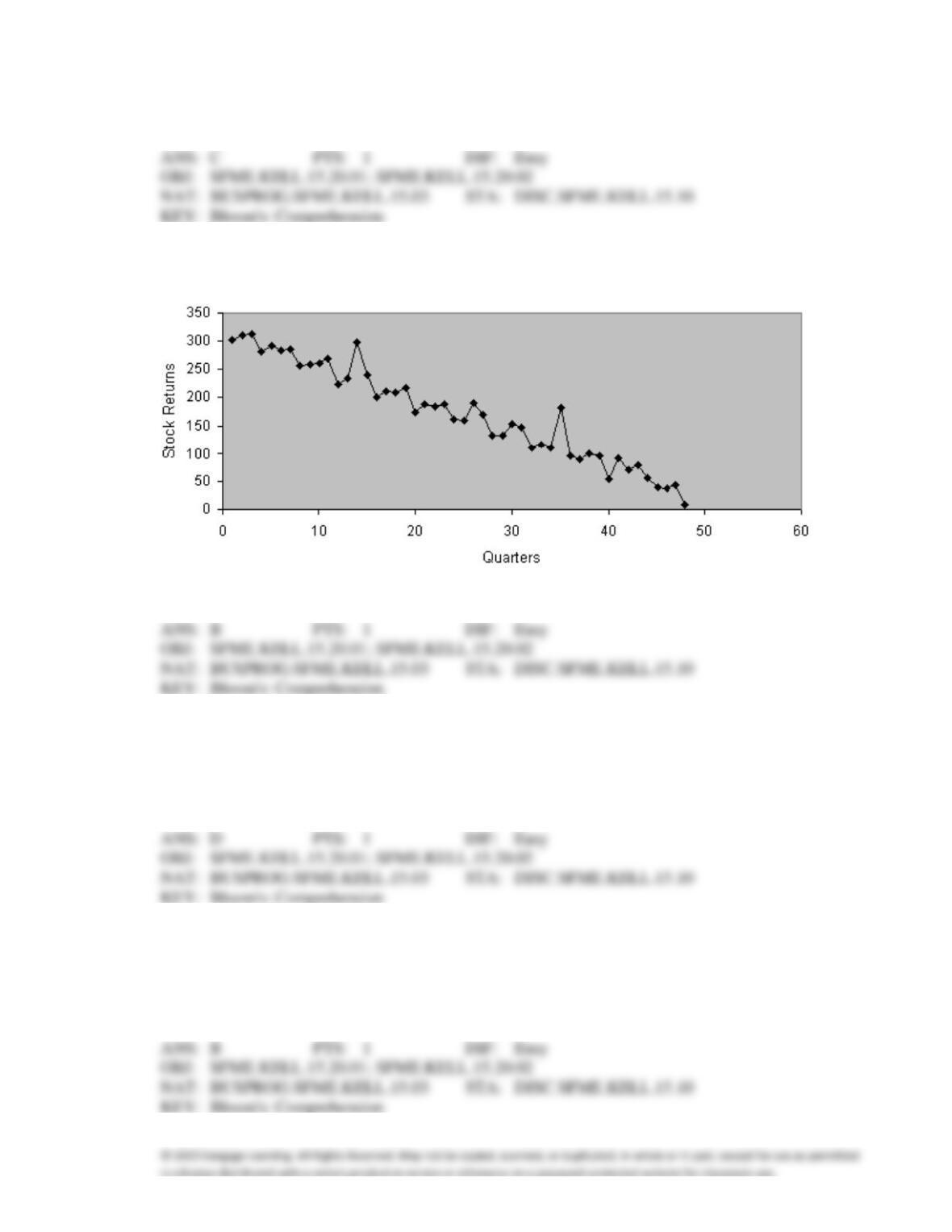
38. The fairly regular fluctuations that occur within each year would be contained in which component of
the time series?
a.
Long-term trend
c.
Seasonal variation
b.
Cyclical variation
d.
Random variation
39. Based on the following scatter plot, which of the time-series components is not present in this
quarterly time series?
a.
Long-term trend
c.
Seasonal variation
b.
Cyclical variation
d.
Random variation
40. The method of moving averages is used to:
a.
take away short term seasonal variation
b.
reduce random variation
c.
leave the combined trend and cyclical movement
d.
All of these choices are true.
41. Which of the following is not an advantage of exponential smoothing?
a.
It enables us to perform on-period ahead forecasting
b.
It enables us to perform more than one-period ahead forecasting
c.
It enables us to smooth out seasonal components
d.
It enables us to smooth out cyclical components
42. Which of the following statements about moving averages is not true?
a.
It can be used to smooth a series
b.
It gives equal weight to all values in the computation
c.
It is simpler than the method of exponential smoothing
d.
It gives greater weight to more recent data
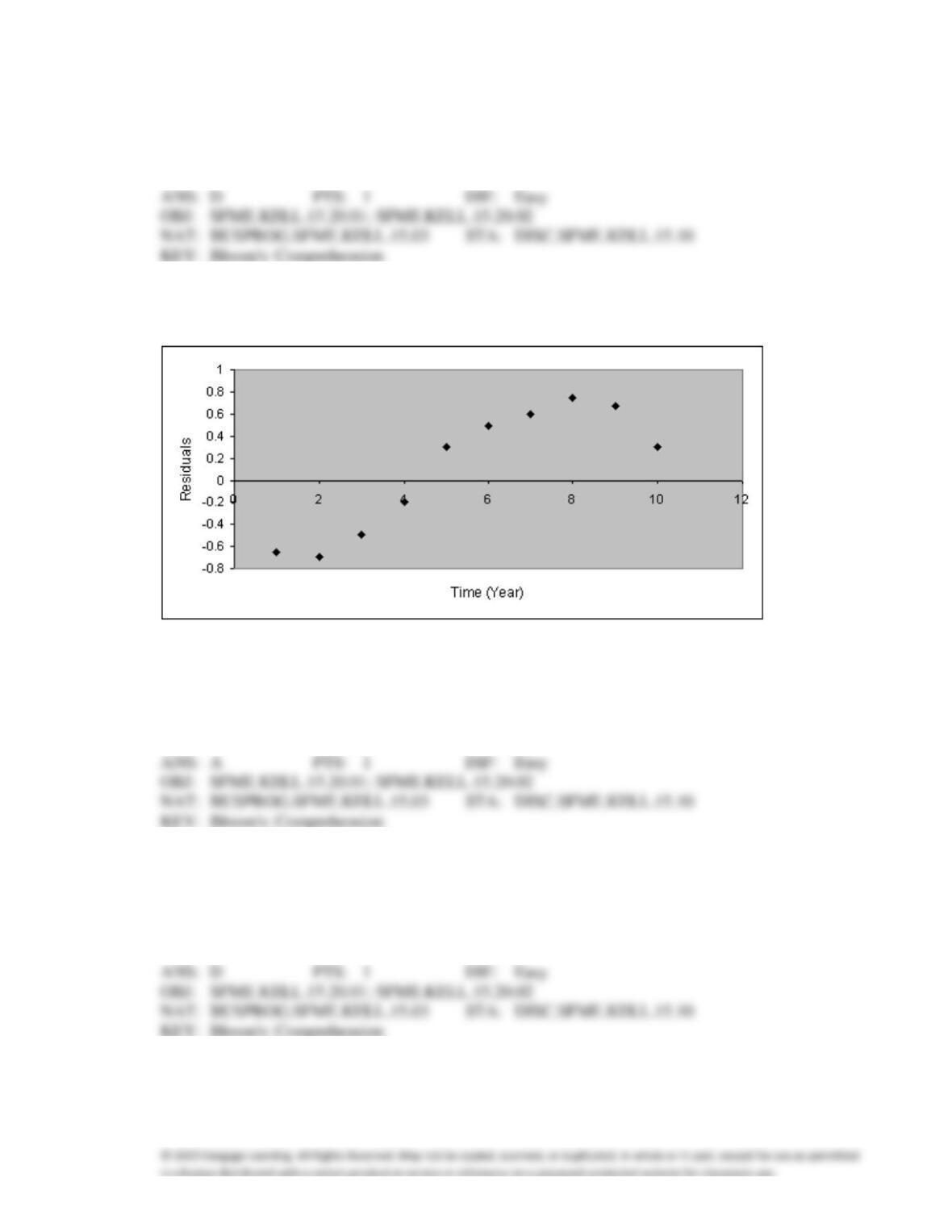
43. After estimating a trend model for annual time-series data, you obtain the following residual plot
against time.
The problem with your model is that:
a.
the cyclical component has not been accounted for
b.
the seasonal component has not been accounted for
c.
the trend component has not been accounted for
d.
the irregular component has not been accounted for
44. Which of the following statements about the method of exponential smoothing is not true?
a.
It gives greater weight to more recent data
b.
It can be used for forecasting
c.
It uses all earlier observations in each smoothing calculation
d.
It gives greater weight to the earlier observations in the series
45. The cyclical component of a time series
a.
represents periodic fluctuations which reoccur within one year
b.
represents periodic fluctuations which usually occur in two or more years
c.
is obtained by adding up the seasonal indexes
d.
is obtained by adjusting for calendar variation
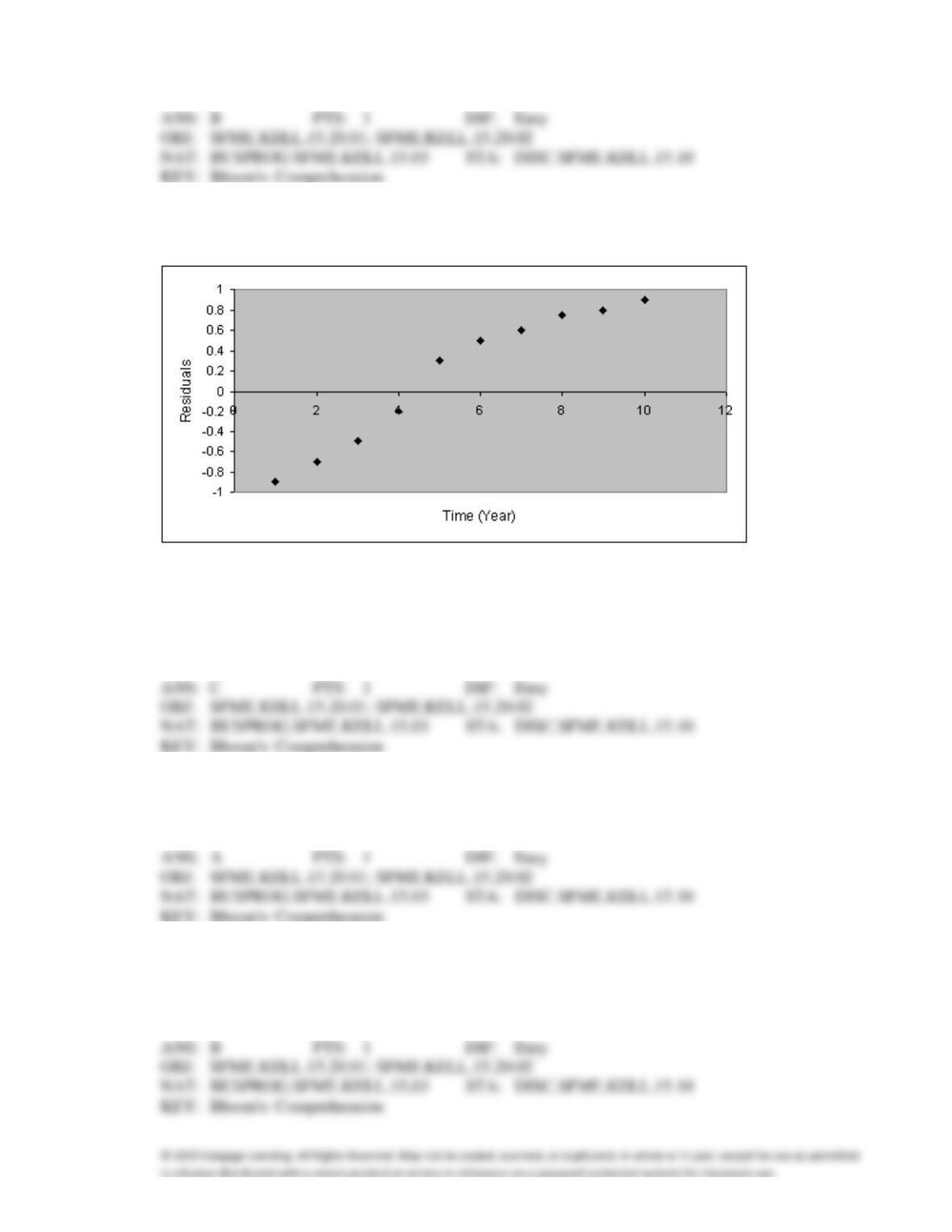
46. After estimating a trend model for annual time-series data, you obtain the following residual plot
against time.
The problem with your model is that:
a.
the cyclical component has not been accounted for
b.
the seasonal component has not been accounted for
c.
the trend component has not been accounted for
d.
the irregular component has not been accounted for
47. Which of the following terms describes the overall long-term tendency of a time series?
a.
Long-term trend component
c.
Random variation component
b.
Cyclical variation component
d.
Seasonal variation component
48. Which of the following terms describes the up and down movements of a time series that vary both in
length and intensity?
a.
Long-term trend component
c.
Random variation component
b.
Cyclical variation component
d.
Seasonal variation component
COMPLETION
Liquor Sales
The number of cases of liquor sold by a liquor wholesaler in an 8-year period follows.
2011
270
2012
356
2013
398
2014
456
2015
358
2016
500
2017
410
2018
376
1. {Liquor Sales Narrative} A centered 3-year moving average is to be constructed for the liquor sales.
The result of this process will lead to a total of ____________________ moving averages.
2. {Liquor Sales Narrative} A centered 3-year moving average is to be constructed for the liquor sales.
The moving average for 2012 is ____________________.
3. {Liquor Sales Narrative} A centered 3-year moving average is to be constructed for the liquor sales.
The moving average for 2015 is ____________________.
4. {Liquor Sales Narrative} A centered 5-year moving average is to be constructed for the liquor sales.
The number of moving averages that will be calculated is ____________________.
5. {Liquor Sales Narrative} A centered 5-year moving average is to be constructed for the liquor sales.
The moving average for 2013 is ____________________.
6. {Liquor Sales Narrative} A centered 5-year moving average is to be constructed for the liquor sales.
The moving average for 2016 is ____________________.
7. {Liquor Sales Narrative} Exponential smoothing with a weight or smoothing constant of 0.2 will be
used to smooth the liquor sales. The smoothed value for 2012 is_________________.
8. {Liquor Sales Narrative} Exponential smoothing with a weight or smoothing constant of 0.2 will be
used to smooth the liquor sales. The smoothed value for 2014 is_________________.
9. {Liquor Sales Narrative} Exponential smoothing with a weight or smoothing constant of 0.2 will be
used to forecast liquor sales. The forecast for 2019 is ____________________.
10. {Liquor Sales Narrative} Exponential smoothing with a weight or smoothing constant of 0.4 will be
used to smooth the liquor sales. The smoothed value for 2012 is_________________.
11. {Liquor Sales Narrative} Exponential smoothing with a weight or smoothing constant of 0.4 will be
used to smooth the liquor sales. The smoothed value for 2015 is_________________.
12. {Liquor Sales Narrative} Exponential smoothing with a weight or smoothing constant of 0.4 will be
used to forecast liquor sales. The forecast for 2019 is ____________________.
SHORT ANSWER
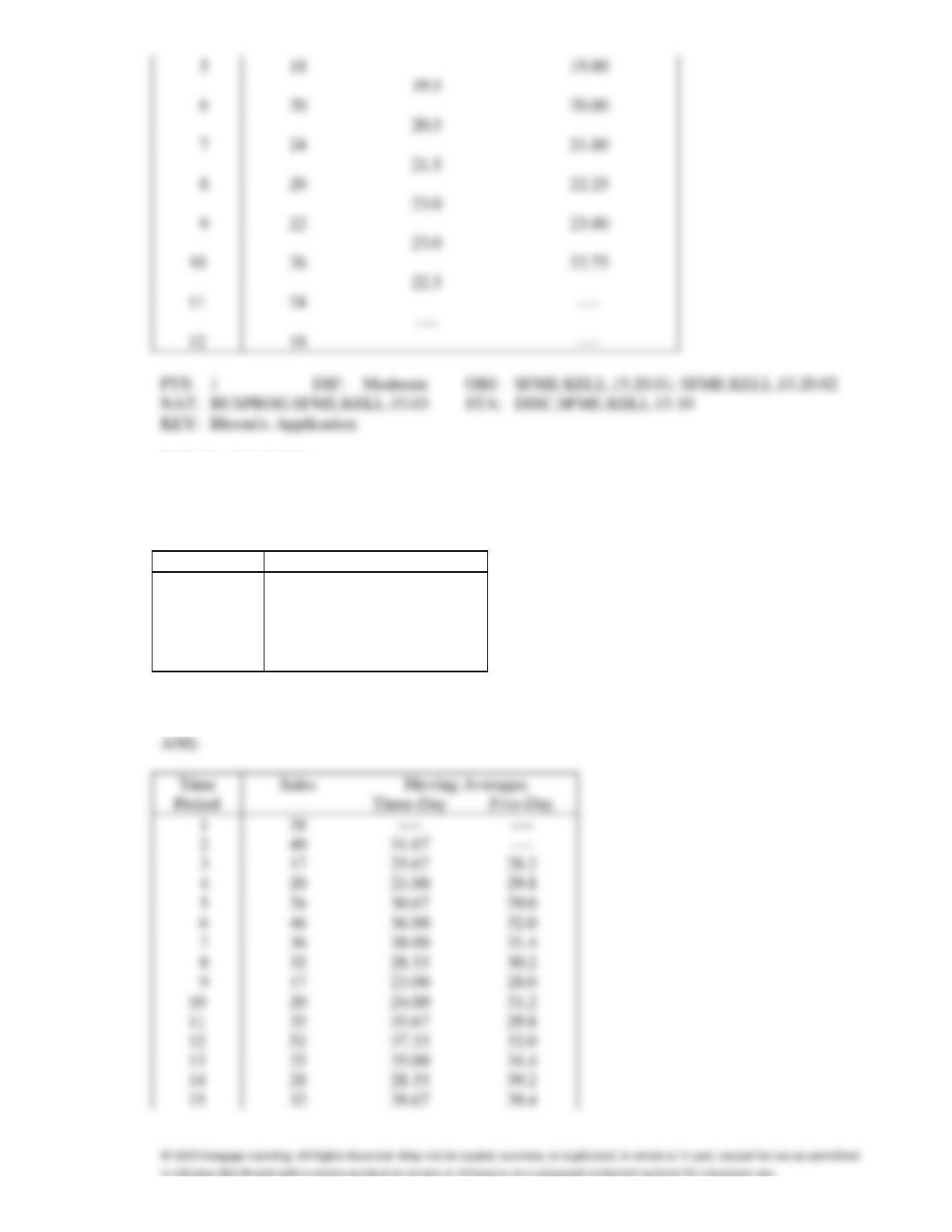
1. Weekly iPhones sales (in $1,000s) in an Apple store for the past three months are shown in the table
below. Compute the four-week centered moving averages.
Month
Week
Sales
1
1
14
2
22
3
20
4
16
2
1
18
2
20
3
24
4
20
3
1
22
2
26
3
24
4
18
ANS:
Period
14
22
20
16
Daily Sandwich Sales
The daily sales figures shown below have been recorded in a sandwich shop.
Week
Day
1
2
3
4
Monday
38
46
35
59
Tuesday
40
36
52
53
Wednesday
17
32
25
28
Thursday
20
17
28
33
Friday
26
20
32
20
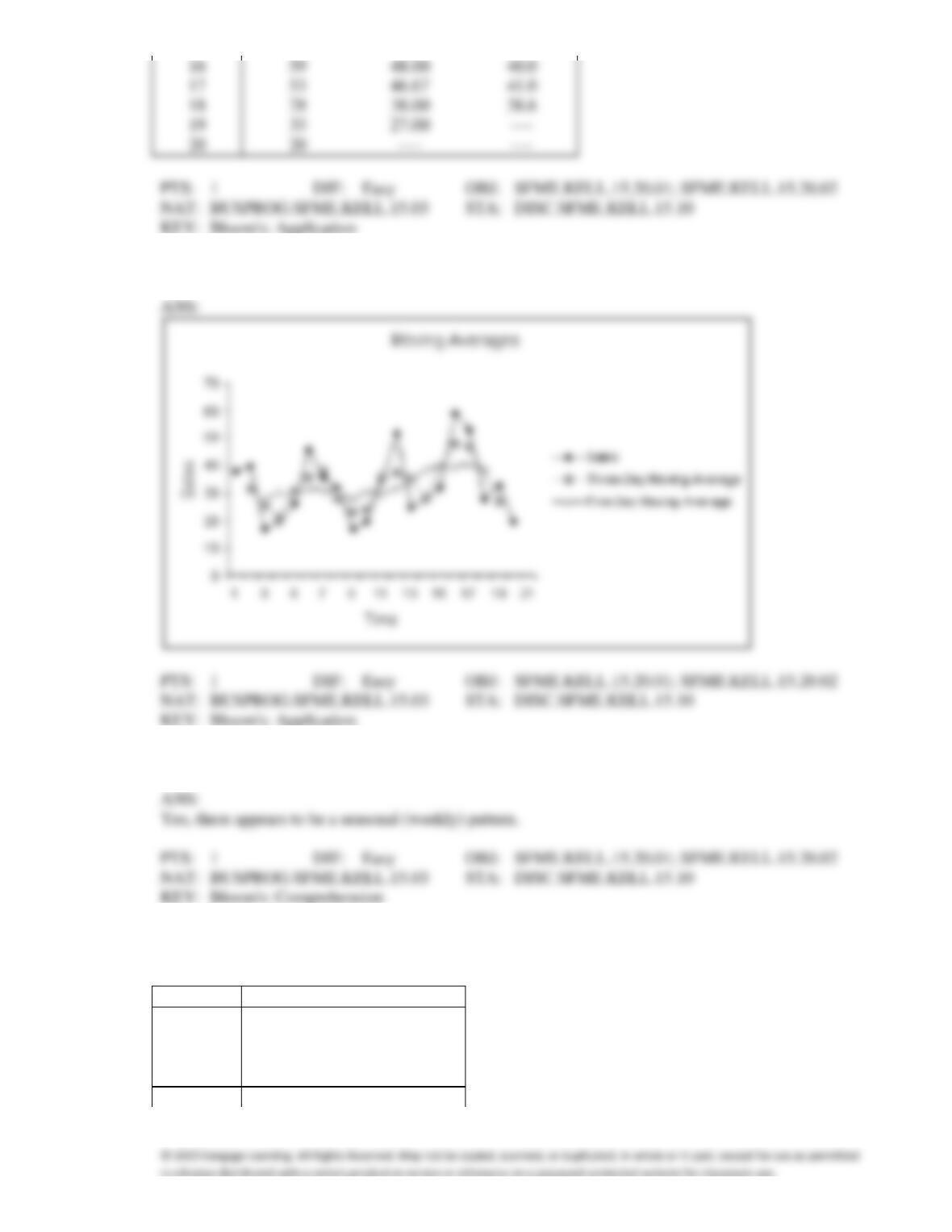
2. {Daily Sandwich Sales Narrative} Compute the three-day and five-day moving averages.
Three-Day
59
53
28
33
—-
3. {Daily Sandwich Sales Narrative} Plot the series and the moving averages on the same graph.
4. {Daily Sandwich Sales Narrative} Does there appear to be a seasonal (weekly) pattern?
5. Quarterly enrollments in business statistics class for three years are shown in the table below. Compute
the four-quarter centered moving averages.
Year
Quarter
Enrollment
2011
1
26
2
29
3
33
4
18
2012
1
27