90. Which ratio shows degree of discrepancy between the market value of an FI’s equity capital as perceived by
investors in the stock market and the book value of capital on its balance sheet?
91. Error! Hyperlink reference not valid.
92. According to FDICIA, a bank’s leverage ratio must be greater than _______ to be considered
well-capitalized.
93. Which of the following is NOT a typical argument against market value accounting?
94. The U.S. banking industry built up record levels of capital in the early 2000s because
95. Bank regulators set minimum capital standards to
96. The concept of prompt corrective action refers to the requirement
97. Which of the following is NOT a criticism of the leverage ratio as a measure of capital?
98. The Basel capital requirements differ from previous capital standards in all except one of the following
ways?
99. The Basle capital requirements are based upon the premise that
100. The Basel I capital requirements as currently implemented include
101. The Basel II Accord effective at year-end 2007 in the United States
102. The measurement of credit risk under the Basel II Accord allows banks to choose between
103. The bank is considering changing its asset mix by moving $100 million of commercial loans into Treasury
securities. If it does change the asset mix and capital remains the same, the risk-based capital ratio
104. Which of the following statements best describes the treatment of adjusting for credit risk of
off-balance-sheet activities?
105. Broker-dealers must calculate a market value for their net worth on a day-to-day basis and ensure that their
net worth-assets ratio
106. A criticism of the Basel I risk-based capital ratio is
107. Which of the following is NOT a criticism of the Basel I risk-based capital ratio?
108. The primary difference between Basel I and the proposed Basel II in calculating risk-adjusted assets is
109. The primary difference between Basel I and the proposed Basel II in converting OBS values to
on-balance-sheet credit equivalent amounts is
110. Counter party credit risk in OBS contracts
111. The potential exposure component of the credit equivalent amount of OBS derivative items reflects
112. The current exposure component of the credit equivalent amount of OBS derivative items reflects
113. The calculation of the risk-adjusted asset values of OBS market contracts
114. Calculation of the “add-on” to the risk-based capital ratio to measure market risk
115. Calculation of the “add-on” to the risk-based capital ratio to measure operational risk
116. Which approach used in calculating capital to cover operational risk allow banks to rely on internal data
for the calculation of regulatory capital requirements?
117. In calculating the net capital for a securities firms, which of the following is NOT an adjustment to the
book value of net worth?

118. Which of the following risk categories is NOT covered by the risk-based model for the life insurance
industry?
119. In the NAIC model for life insurance companies, which risk covers the amount of capital necessary to meet
the maximum contribution that an insurance company may need to make to the state guarantee fund?
120. In the NAIC model for life insurance companies, which risk captures the risk of adverse changes in
mortality risk and morbidity risk?
121. In the NAIC model for life insurance companies, this risk measures the liquidity of liabilities for given rate
changes.
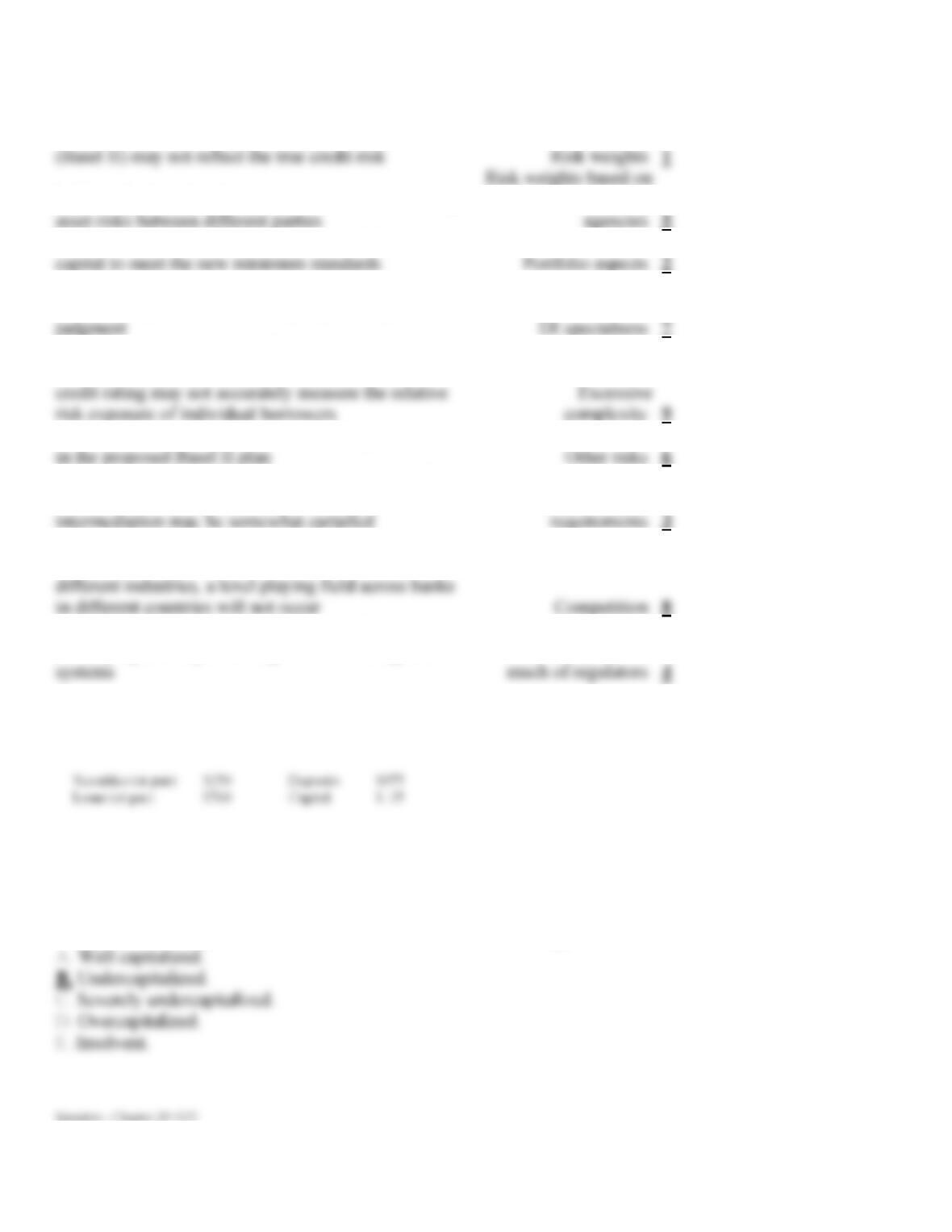
122. The risk-based capital requirements have received several types of criticism. Please match the criticism
headings below (as stated in the text) with the appropriate criticism explanations in questions 122 to 130.
1. The four (five) risk weight categories in Basel I
Risk weights based on
2. The BIS plans largely ignore the covariance among
external credit rating
3. Banks in the U.S. likely would need additional
4. Regulators may not be trained or willing to make
the necessary decisions that may rely heavily on
5. Because rating agencies often lag rather than lead
the business cycle, risk weights based on a loan’s
6. Interest rate and liquidity risks are not yet included
7. Because DIs may have little incentive to make high
risk commercial loans, one important aspect of
Impact on capital
8. Because of different tax, accounting, and safety-net
rules and the application of the new Basel II rules to
different industries, a level playing field across banks
9. The benefits may not support the significant cost of
developing and implementing new risk management
Pillar 2 may ask too
Saunders – Chapter 20 #122
Saunders – Chapter 20
123. How would regulators characterize this FI based on the leverage ratio zones of FDICIA?

124. If problem loans reduce the market value of the loan portfolio by 25 percent, what is the value of
regulatory defined (book value) capital?
125. If problem loans reduce the market value of the loan portfolio by 25 percent, what is the market value of
capital?
126. Given that 25 percent of the loans have been identified as problem loans, and if historical cost accounting
methods allow the bank to write down only 10 percent of the problem loans, what will be the book value of
capital?
127. If the loan portfolio consists of a five-year, 10 percent annual coupon loan selling at par, what is the
market, or economic, value of capital if interest rates increase 1 percent?

128. If the loan portfolio consists of five-year, 10 percent annual coupon par value loans, what is the market, or
economic, value of capital if interest rates decrease 2 percent?
129. If the bank has capital of $50 million, what is the leverage ratio?
130. What is the amount of risk-adjusted assets?
131. What is the ratio of capital to risk-adjusted assets, if the bank has capital of $50 million?
132. What is the bank’s risk-adjusted assets as defined by the Basel standards for its on- balance-sheet assets
only?
133. What is the required Tier I and Tier II capital for the on-balance-sheet assets?
134. Is the bank adequately capitalized for its on-balance-sheet assets based on the Basel standards?
135. What is the credit equivalent amount of the off-balance-sheet letters of credit, both standby and
commercial?
136. What is the minimum total capital (Tier I + Tier II) required for the off-balance-sheet letters of credit under
the Basel II standards?
137. What is the credit equivalent amount of the off-balance-sheet interest rate swaps if it is in- the-money by
$1 million?
138. What is the credit equivalent amount of the off-balance-sheet foreign exchange contracts if it is
out-of-the-money by $4 million?
139. What is the minimum total capital (Tier I + Tier II) required for the off-balance sheet derivative contracts
140. Using the model recommended by the National Association of Insurance Commissioners (NAIC), what is
the total risk-based capital charge for the P-C firm?
141. Is the firm adequately capitalized if it has total capital and surplus of $10 million?