Beginning
Ending
Raw materials
$ 5,000
$ 8,000
Work in process
60,000
55,000
Finished goods
17,250
9,200
Number of units produced
20,000 units
Number of units sold
(sales price of $25 per unit)
21,400 units
59. Refer to the Jones Manufacturing Inc. information above. Cost of goods manufactured in November is:
a.
$ 91,000.
b.
$115,000.
c.
$155,000.
d.
$143,000.
60. Refer to the Jones Manufacturing Inc. information above. Net operating income for November is:
(Ignore taxes)
a.
$371,950.
b.
$411,950.
c.
$369,150.
d.
$382,000.
61. Refer to the Jones Manufacturing Inc. information above. The product cost per unit in November is:
a.
$4.55.
b.
$7.75.
c.
$5.75.
d.
$5.37.
Scott Products
Scott Products manufactures high-quality running shoes. The following information is available for
2011:
Beginning
Ending
Raw materials inventory
$ 65,000
$ 82,000
Work-in-process inventory
280,000
130,000
Finished goods inventory
90,000
120,000
Raw materials purchased
$250,000
Direct labor costs
340,000
Factory rent
60,000
Factory supplies
20,000
Factory utilities
15,000
Factory depreciation
30,000
Marketing costs
25,000
Administrative costs
100,000
In addition, 42,400 pairs were produced in 2011 out of which 40,900 pairs were sold for $70 each.
62. Refer to the Scott Products information above. Cost of goods manufactured for 2011 is:
a.
$990,000.
b.
$973,000.
c.
$848,000.
d.
$865,000.
63. Refer to the Scott Products information above. What is net operating income for 2011? (ignore taxes)
a.
$1,920,000.
b.
$2,025,000.
c.
$1,890,000.
d.
$2,045,000.
Hillsborough Street Manufacturing Inc.
Hillsborough Street Manufacturing Inc. incurred the following costs in 2011:
Direct materials used
$51,000
Direct labor costs
45,000
Factory rent and utilities
18,000
Factory equipment depreciation
7,500
Marketing expenses
8,000
Administrative expenses
10,000
45,000 units were produced during the year out of which 38,000 units were sold for $10 each. There
was no beginning or ending raw materials or work in process inventory.
64. Refer to the Hillsborough Street Manufacturing Inc. information above. What is the product cost per
unit?
a.
$3.67
b.
$3.20
c.
$3.10
d.
$2.70
65. Refer to the Hillsborough Street Manufacturing Inc. information above. What is cost of goods sold for
the year?
a.
$102,600
b.
$121,500
c.
$117,800
d.
$139,500
66. Refer to the Hillsborough Street Manufacturing Inc. information above. What is the net operating
income for the year? (Ignore taxes)
a.
$222,500
b.
$244,200
c.
$240,500
d.
$259,400
Hudson Inc.
Hudson Inc. has the following information available for September:
Beginning
Ending
Raw materials
$ 8,000
$ 5,000
Work-in-process
30,000
40,000
Finished goods
7,000
3,000
Raw materials purchased
25,000
Direct labor costs
70,000
Manufacturing overhead costs
30,000
Administrative costs
12,000
Marketing costs
6,000
67. Refer to the Hudson Inc. information above. Total nonmanufacturing costs for September are:
a.
$113,000.
b.
$161,000.
c.
$ 18,000.
d.
$ 43,000.
68. Refer to the Hudson Inc. information above. Cost of goods manufactured for September is:
a.
$118,000.
b.
$136,000.
c.
$115,000.
d.
$133,000.
69. Refer to the Hudson Inc. information above. Cost of goods sold for September is:
a.
$119,000.
b.
$143,000.
c.
$140,000.
d.
$122,000.
70. Refer to the Hudson Inc. information above. Sales revenue for September totaled $400,000. Net
operating income for September is: (Ignore taxes)
a.
$257,000.
b.
$260,000.
c.
$264,000.
d.
$278,000.
71. Which of the following statements accurately describes manufacturing cost flows in a just–in-time
(JIT) environment?
a.
Direct labor and overhead are maintained in a work in process account for long periods of
time.
b.
There is little need to maintain a cost of goods sold account.
c.
There is little need to maintain raw materials, work in process, or finished goods accounts.
d.
Manufacturing costs are maintained in the finished goods account for long periods of time.
SHORT ANSWER
1. Provide specific examples of why accurate product or service costing information is important for
internal purposes.
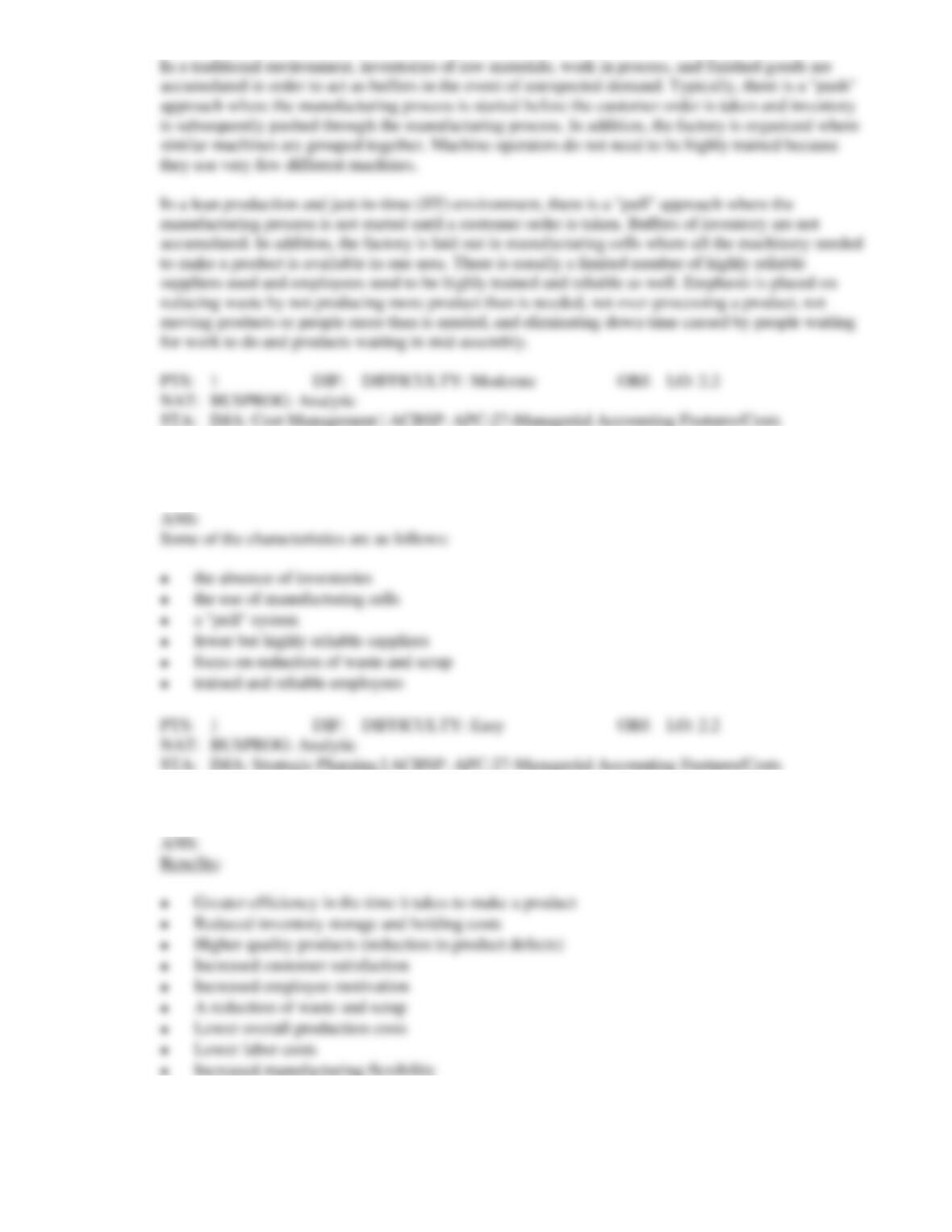
2. Briefly compare a traditional manufacturing environment with a lean production and just-in-time (JIT)
manufacturing environment.
3. Identify at least two characteristics of a lean production and just–in-time (JIT) manufacturing
environment.
4. Identify some of the benefits and risks of a lean production and just–in-time (JIT) environment.
•
•
•
•
•
•
•
•
•
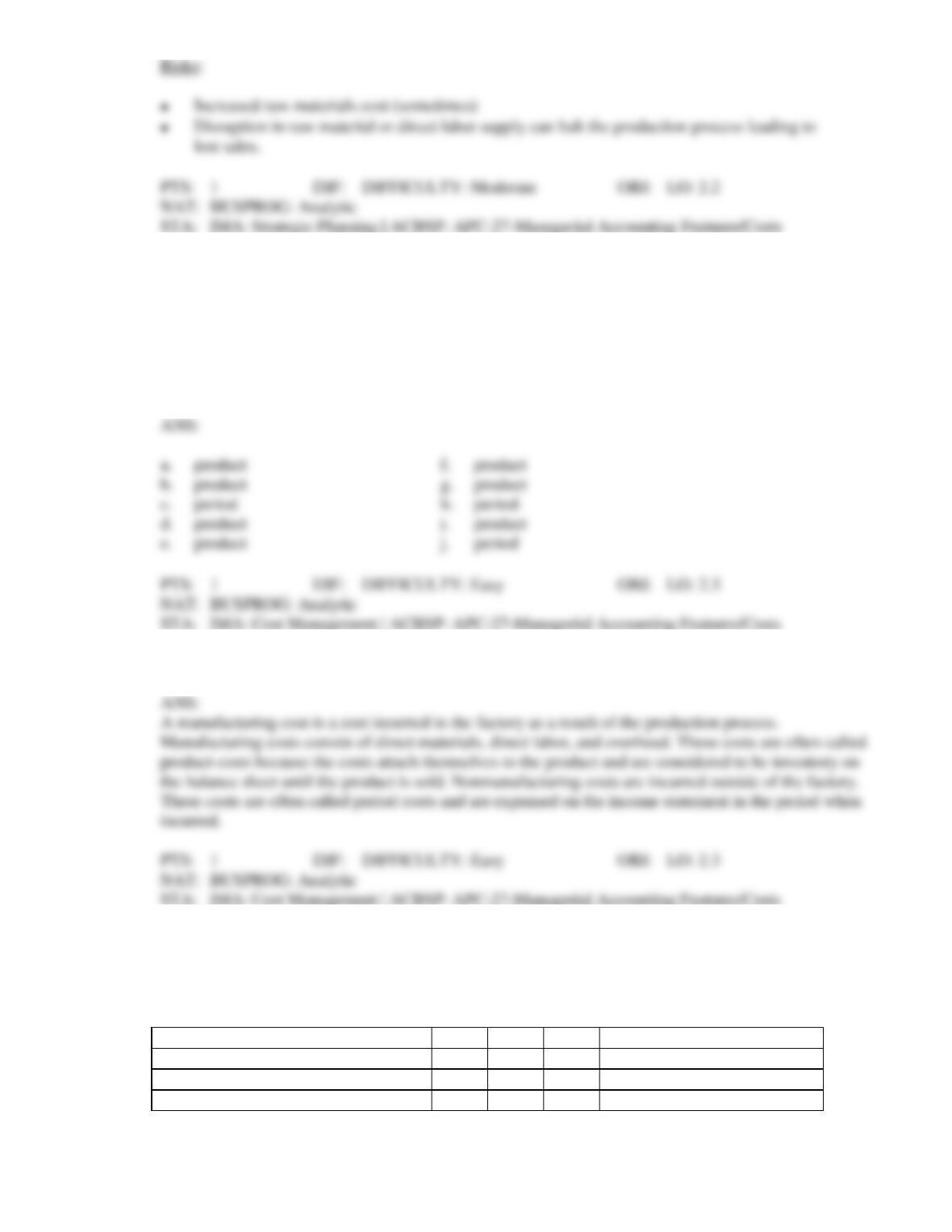
5. Describe each of the following as either a product or period cost.
a.
factory depreciation
f.
direct materials
b.
indirect labor
g.
indirect materials
c.
administrative salaries
h.
advertising
d.
direct labor
i.
factory insurance
e.
utilities used in the factory
j.
utilities used in the administrative offices
a.
product
f.
product
b.
product
g.
product
c.
period
h.
period
d.
product
i.
product
e.
product
j.
period
6. Briefly describe the difference between a manufacturing and a nonmanufacturing cost.
7. Identify with an “X” the following costs as either a manufacturing (product) or nonmanufacturing
(period) cost. If it is a manufacturing cost, further identify it as either direct material (DM), direct labor
(DL), or overhead (OH).
Manufacturing Cost
Nonmanufacturing Cost
DM
DL
OH
Indirect labor
Factory supplies
Material easily traced to product
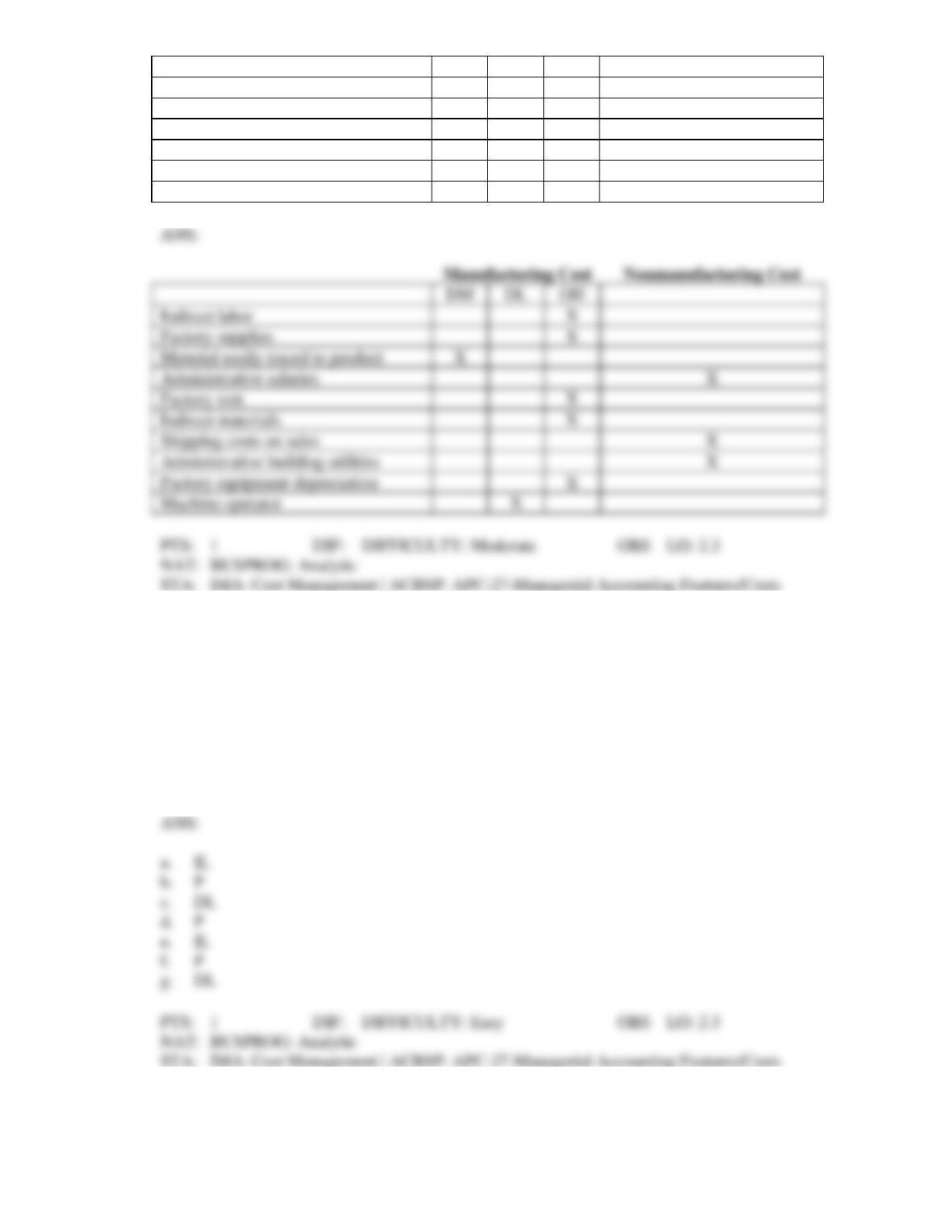
Administrative salaries
Factory rent
Indirect materials
Shipping costs on sales
Administrative building utilities
Factory equipment depreciation
Machine operator
8. Classify the following as either direct labor (DL), indirect labor (IL), or a period cost (P).
a.
factory maintenance worker
b.
company president
c.
assembly-line worker
d.
salesperson working on commission
e.
factory supervisor
f.
administrative assistant
g.
machine operator
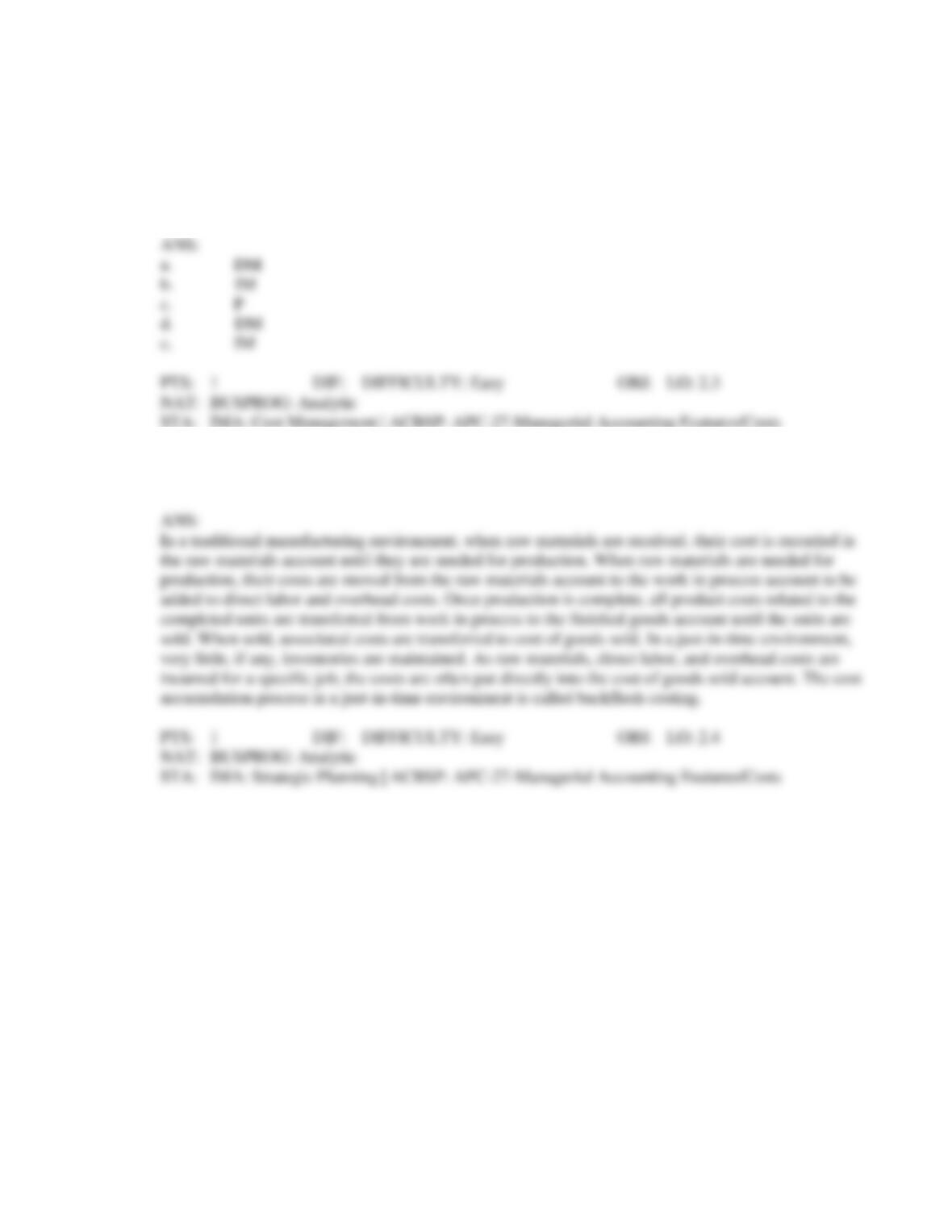
b.
P
c.
d.
P
e.
IL
f.
P
g.
Indirect labor
Factory supplies
Material easily traced to product
Administrative salaries
Factory rent
Indirect materials
Shipping costs on sales
Administrative building utilities
Factory equipment depreciation
Machine operator
9. Classify each of the following as either a direct material (DM), indirect material (IM), or period cost
(P).
a.
wood used to build custom bookshelves
b.
sandpaper, glue, and nails used to build customer bookshelves.
c.
paper supplies used in the administrative offices.
d.
computer chips used in computer
e.
cleaning supplies used in the factory
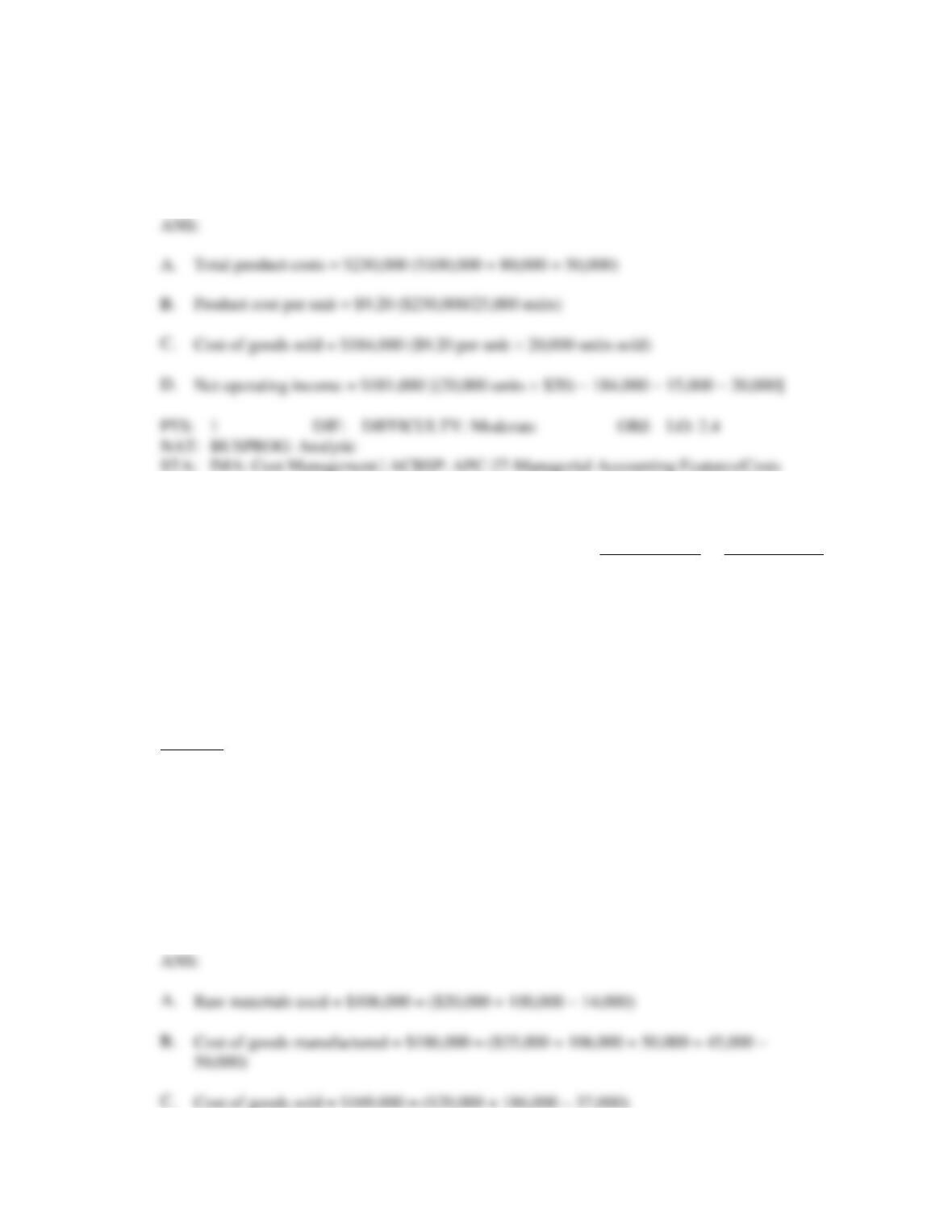
10. Describe the cost accumulation process in a traditional manufacturing environment versus a
just-in-time (JIT) environment.
PROBLEM
1. Capital Manufacturing produces a unique souvenir product for various museums around the country.
During the year, the company incurred the following costs:
Direct material used
$100,000
Direct labor
80,000
Manufacturing overhead
50,000
Marketing expenses
15,000
Administrative expenses
20,000
During the year, 25,000 units were produced out of which 20,000 units were sold for $20 each.
Required:
A.
Calculate the total product costs incurred for the year.
B.
What is the product cost per unit?
C.
What is cost of goods sold for the year?
D.
What is net operating income for the year? (Ignore taxes)
2. McClintock Manufacturing Inc. has the following information available for the month of July:
Beginning
Ending
Raw materials inventory
$20,000
$ 14,000
Work-in-process inventory
35,000
50,000
Finished goods inventory
20,000
37,000
Raw materials purchased
$100,000
Direct labor costs
50,000
Overhead costs
45,000
Selling and administrative costs
20,000
Required:
A.
Calculate raw materials used for July.
B.
Calculate cost of goods manufactured for July.
C.
Calculate cost of goods sold for July.
D.
Assume that sales revenue totaled $300,000, calculate net operating income for July.
(Ignore taxes)
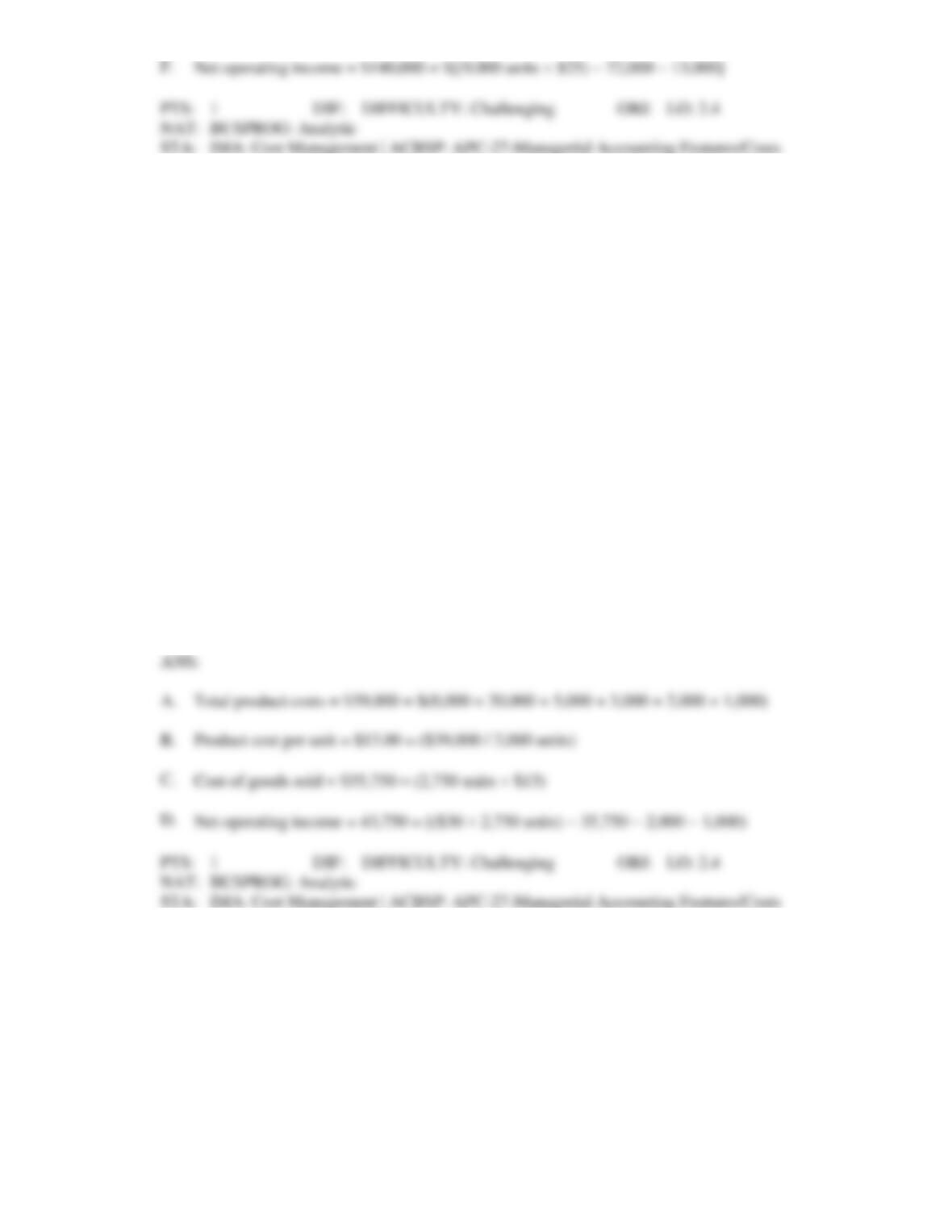
Raw materials used = $106,000 = ($20,000 + 100,000 − 14,000)
Cost of goods manufactured = $186,000 = ($35,000 + 106,000 + 50,000 + 45,000 −
50,000)
Cost of goods sold = $169,000 = ($20,000 + 186,000 − 37,000)
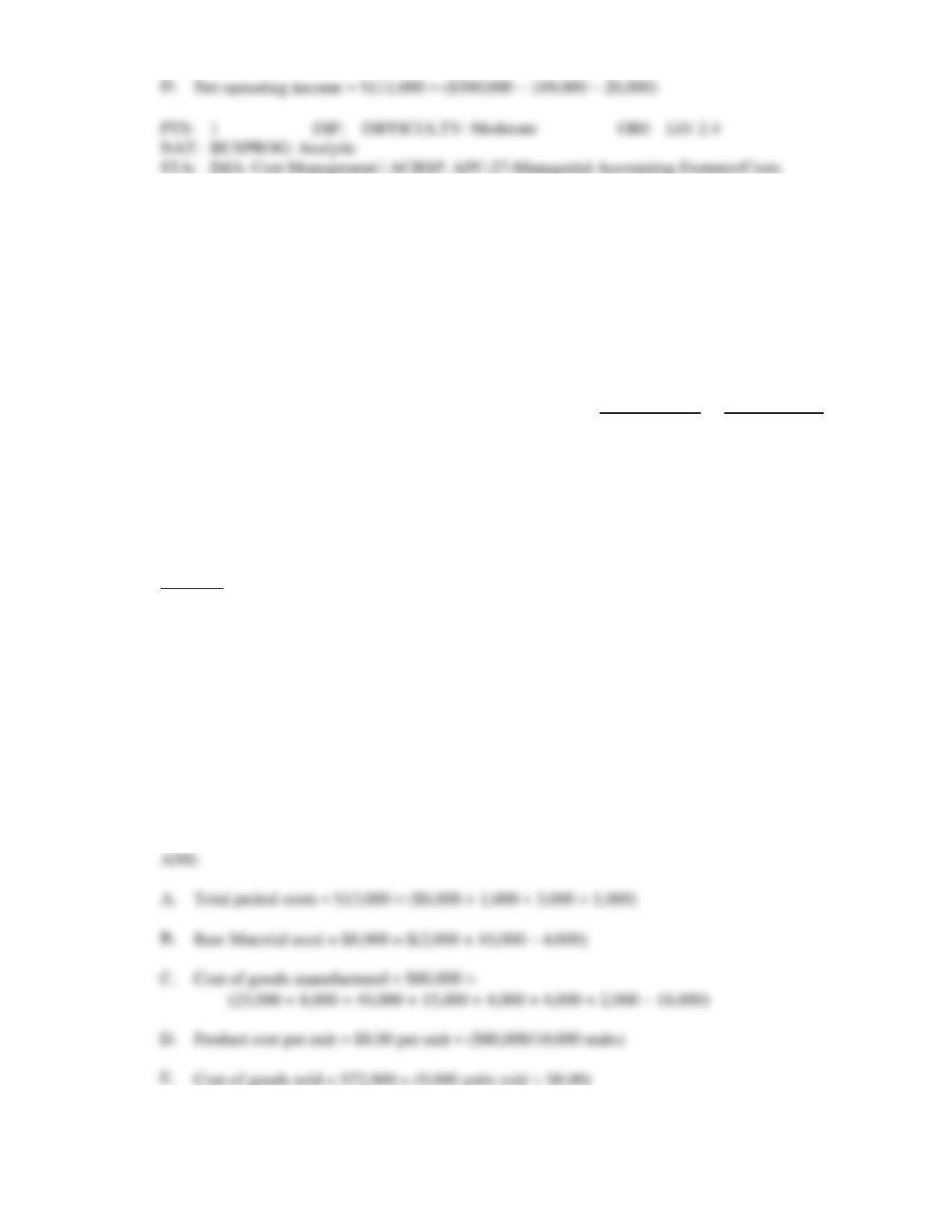
A.
Total product costs = $230,000 ($100,000 + 80,000 + 50,000)
B.
Product cost per unit = $9.20 ($230,000/25,000 units)
Cost of goods sold = $184,000 ($9.20 per unit 20,000 units sold)
Net operating income = $181,000 [(20,000 units $20) − 184,000 − 15,000 − 20,000]
3. Pearce Manufacturing Inc. incurred the following costs in February:
Direct labor
$40,000
Advertising costs
$1,000
Indirect labor
15,000
Factory rent
4,000
Administrative salaries
8,000
Factory depreciation
2,000
Raw materials purchased
10,000
Administrative rent
3,000
Indirect materials used
4,000
Administrative depreciation
1,000
In addition, the following information is also available:
Beginning
Ending
Raw materials
$ 2,000
$ 4,000
Work-in-process
25,000
18,000
Finished goods
4,000
12,000
Number of units produced
10,000 units
Number of units sold
(sales price of $25 per unit)
9,000 units
Required:
A.
Calculate total period costs.
B.
Calculate raw materials used.
C.
Calculate cost of goods manufactured.
D.
Calculate the product cost per unit.
E.
Calculate cost of goods sold.
F.
Calculate net operating income. (Ignore taxes)
A.
Total period costs = $13,000 = ($8,000 + 1,000 + 3,000 + 1,000)
Raw Material used = $8,000 = $(2,000 + 10,000 − 4,000)
C.
Cost of goods manufactured = $80,000 =
(25,000 + 8,000 + 40,000 + 15,000 + 4,000 + 4,000 + 2,000 − 18,000)
D.
Product cost per unit = $8.00 per unit = ($80,000/10,000 units)
Cost of goods sold = $72,000 = (9,000 units sold $8.00)
Net operating income = $111,000 = ($300,000 − 169,000 − 20,000)
4. Creative Products Inc. incurred the following costs (in alphabetical order) during 2012 related to one
of its products:
Administrative costs
$ 2,000
Advertising costs
1,000
Direct material used
8,000
Direct labor
20,000
Factory equipment depreciation
1,000
Factory rent
5,000
Indirect labor
3,000
Indirect materials
2,000
During the year, 3,000 units were produced out of which 2,750 units were sold for $30 each.
Required:
A.
Calculate the total product costs incurred for the year.
B.
What is the product cost per unit?
C.
What is cost of goods sold for the year?
D.
What is net operating income for the year? (Ignore taxes)
A.
Total product costs = $39,000 = $(8,000 + 20,000 + 5,000 + 3,000 + 2,000 + 1,000)
B.
Product cost per unit = $13.00 = ($39,000 / 3,000 units)
Cost of goods sold = $35,750 = (2,750 units $13)
Net operating income = 43,750 = [($30 2,750 units) − 35,750 − 2,000 − 1,000)
5. The following information is available for the Brown Company for the month ended July 31:
Direct materials purchased
$ 21,000
Direct labor (2,500 hrs@$12)
30,000
Indirect labor
3,000
Indirect materials
2,500
Office supplies expense
100
Factory equipment depreciation
2,000
Office equipment depreciation
750
Net operating income = $140,000 = $[(9,000 units $25) − 72,000 − 13,000]
Administrative expenses
20,000
Office utilities
75
Factory utilities
200
Marketing expense
2,500
Sales revenue
150,000
Sales commissions expense
1,500
Beginning
Ending
Direct materials inventory
$27,000
$ 24,500
Work in process inventory
25,000
29,000
Finished goods inventory
22,000
15,000
Required:
A.
Determine the direct materials used in July.
B.
Determine cost of goods manufactured in July.
C.
Determine cost of goods sold for July.
D.
Prepare an income statement for July. (Ignore taxes)
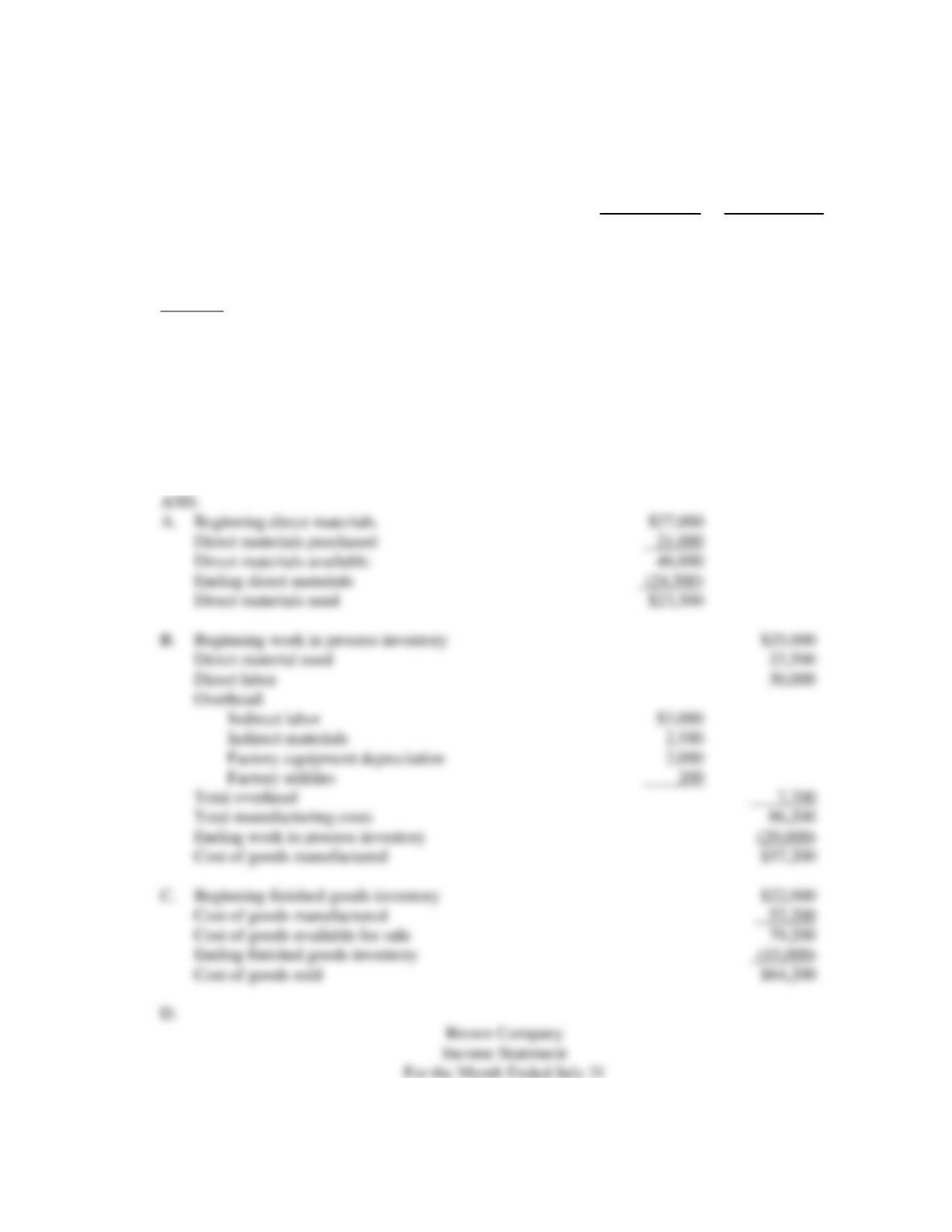
A.
Beginning direct materials
Direct materials purchased
Direct materials available
Ending direct materials
Direct materials used
B.
Beginning work in process inventory
Direct material used
Direct labor
Overhead:
Indirect labor
Indirect materials
Factory equipment depreciation
Factory utilities
Total overhead
Total manufacturing costs
Ending work in process inventory
(29,000)
Cost of goods manufactured
C.
Beginning finished goods inventory
Cost of goods manufactured
Cost of goods available for sale
Ending finished goods inventory
Cost of goods sold
D.