Chapter 2—Product Costing: Manufacturing Processes, Cost Terminology,
and Cost Flows
MULTIPLE CHOICE
1. Which of the following types of organizations is most likely to have a raw materials inventory
account?
a.
A retailer
b.
A manufacturer
c.
A service provider
d.
A government unit
2. Which of the following statements about manufacturing in a traditional environment is true?
a.
Factories are organized so that machines that are dissimilar are grouped together.
b.
It is not desirable to accumulate raw materials inventory to serve as buffers in case of
unexpected demand for products.
c.
The process begins with a customer order and products are “pulled” through the
manufacturing process.
d.
Partially completed inventory is accumulated in a work-in–process inventory account.
3. A traditional manufacturing environment does not have which of the following?
a.
An automated production process
b.
Trained employees
c.
Extremely low levels of work-in-process inventory
d.
Product cost information available
4. Which of the following statements is true about manufacturing companies over the past 20 years?
a.
The grouping of machines into “manufacturing cells” has increased.
b.
Carrying large amounts of inventory is often less costly than carrying small amounts of
inventory.
c.
They have moved from a “pull” approach to more of a “push” approach.
d.
The basic production process has changed very little over the past 20 years.
5. Which of the following statements regarding the traditional manufacturing environment is not true?
a.
Machines are often put into “manufacturing cells” whereby dissimilar machines are
grouped together.
b.
Raw material is “pushed” to the next production area in anticipation of customer demand.
c.
Manufacturers often have raw material, work-in-process, and finished goods inventory on
hand.
d.
Buffers of inventory may result in workers being less efficient.
6. Lean production is focused on eliminating waste associated with all of the following except:
a.
moving products farther than required.
b.
down time caused by people waiting for work to do.
c.
providing excessive customer service.
d.
over-processing a product.
7. Under ideal conditions, companies operating in a ____ environment would reduce inventories of raw
materials, work-in-process and finished goods to very low levels or even zero.
a.
volatile
b.
just-in-time
c.
traditional manufacturing
d.
favorable
8. Companies that operate in a lean production and just-in–time manufacturing environment are more
likely to experience which of the following?
a.
Reduced manufacturing flexibility
b.
Increased levels of raw materials inventory
c.
Increased production time
d.
Increased product quality
9. A “manufacturing cell” is defined as:
a.
grouping of all the machinery and equipment that are needed to make a product being
available in one area of the factory.
b.
restructuring of the factory so that the companies are able to manufacture products
quickly.
c.
an area in the warehouse where similar raw materials are grouped together.
d.
grouping of all the factories that are engaged in manufacturing similar products.
10. In a just-in-time environment, the production process often begins when:
a.
products are moved from raw materials to work-in-process.
b.
a customer places an order.
c.
the product is delivered to a customer.
d.
products are moved from work-in-process to finished goods.
11. Which of the following is an advantage of lean production and just-in-time (JIT) manufacturing
systems?
a.
Deliver the product to the customer on time, even if the workers go on a strike.
b.
Improved product quality and reduced processing time.
c.
Reduced reliance on highly skilled employees
d.
Increased reliance on few suppliers.
12. Which of the following is a disadvantage of lean production and just-in-time (JIT) manufacturing
systems?
a.
Increased customer delivery time
b.
Increased product defects
c.
Decreased flexibility of manufacturing facilities
d.
Increased reliance on fewer suppliers
13. Which of the following statements is true regarding the lean production and just-in-time (JIT)
manufacturing systems?
a.
Customers are often less satisfied with the purchased product.
b.
The number of product defects often increases.
c.
The number of suppliers the company can purchase raw materials from often increases.
d.
The factory is often restructured where dissimilar machines are grouped together.
14. Which of the following is a characteristic of a lean production and just–in-time (JIT) manufacturing
environment but not of a traditional manufacturing environment?
a.
Increased inventory levels
b.
Increased product defects
c.
Increased reliance on a select number of suppliers
d.
Increased production time
15. Which of the following is a characteristic of a traditional production environment but not of a lean
production and just-in-time (JIT) manufacturing environment?
a.
Increase in the need for highly skilled labor
b.
Increase in the need for highly reliable suppliers
c.
Reduction in the motivation of the work force
d.
Reduction in the processing time.
16. Which of the following is a risk that would more likely be seen in a lean production and just–in-time
manufacturing environment than in a traditional production environment?
a.
Reduced customer satisfaction due to higher product defects
b.
Reduced raw material supply bringing the production process to a halt
c.
Increased inventory storage costs
d.
Increased production time resulting in lost sales
17. Which of the following is not a type of manufacturing cost?
a.
Direct material costs
b.
Administrative costs
c.
Factory overhead costs
d.
Direct labor costs
18. In general, costs incurred in the factory that do not qualify as either direct material or direct labor are
called:
a.
manufacturing costs.
b.
manufacturing overhead.
c.
nonmanufacturing costs.
d.
selling and administrative costs.
19. Manufacturing costs typically consist of:
a.
direct materials, direct labor, and administrative costs.
b.
production and shipping costs.
c.
direct materials, direct labor, and manufacturing overhead.
d.
manufacturing overhead and selling costs.
20. Materials that can be directly traced to a particular product and become an integral part of the finished
product are called:
a.
indirect materials.
b.
direct materials.
c.
supplies.
d.
product materials.
21. Which of the following statements is true regarding manufacturing costs?
a.
They will be appear on the income statement as the product is made.
b.
They will not appear on the income statement or the balance sheet until the product is
completed.
c.
They will appear on the balance sheet as an inventory cost until the product is sold.
d.
They will appear on the balance sheet as an inventory cost after the product is sold.
22. Which of the following statements is false regarding nonmanufacturing costs?
a.
They are incurred outside the factory.
b.
They include selling and administrative costs.
c.
They are not directly incurred to make a product.
d.
They include indirect materials and indirect labor costs.
23. Which of the following types of employees would most likely have their wage be classified as direct
labor?
a.
Factory maintenance worker
b.
Factory supervisor
c.
Managerial accountant
d.
Assembly-line factory worker
24. Which of the following types of employees would most likely have their wage be classified as indirect
labor?
a.
Factory supervisor
b.
Managerial accountant
c.
Salesperson
d.
Machine operator
25. Manufacturing overhead includes:
a.
advertising costs.
b.
indirect materials.
c.
sales commissions.
d.
shipping charges for finished goods.
26. Which of the following is not an example of a manufacturing overhead cost?
a.
Shipping charges on finished products
b.
Indirect materials
c.
Indirect labor
d.
Depreciation on factory equipment
27. Which of the following is an example of a manufacturing overhead cost?
a.
Supplies used by administrative staff
b.
Supplies used by a salesperson
c.
Materials easily traced to a specific product
d.
Lubricants used by factory maintenance workers
28. Which of the following is not an example of manufacturing overhead costs?
a.
Fringe benefits paid to assembly-line workers
b.
Depreciation of factory machinery
c.
Overtime pay to factory supervisors
d.
Insurance on factory machinery
29. Which of the following is a product cost?
a.
Insurance on factory machinery
b.
Insurance on delivery trucks
c.
Lease expense on office computer
d.
Advertising costs
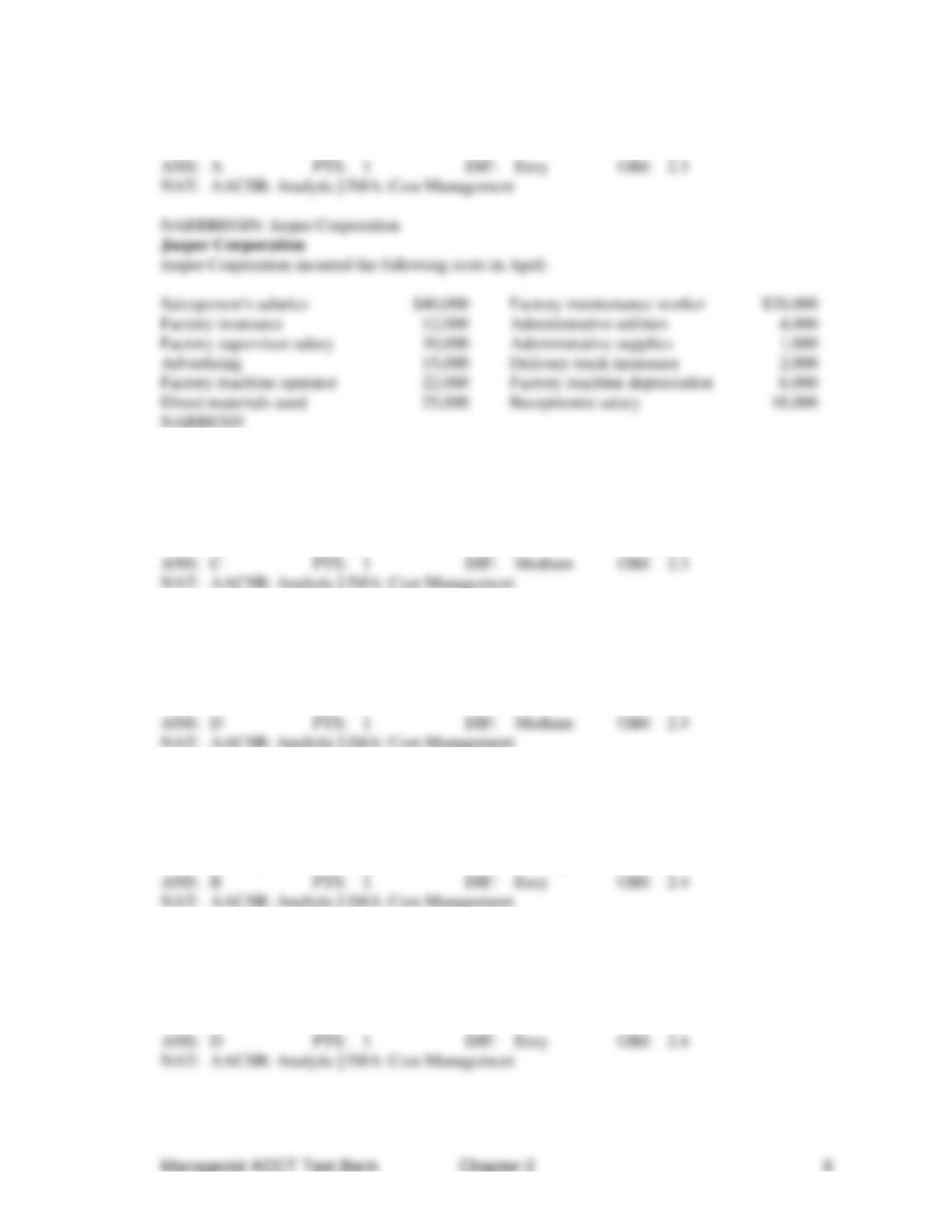
30. Refer to the Jasper Corporation information above. Total product costs are:
a.
$130,000
b.
$155,000
c.
$115,000
d.
$117,000
31. Refer to the Jasper Corporation information above. Total period costs are:
a.
$86,000
b.
$38,000
c.
$40,000
d.
$80,000
32. Products and their costs flow through a production facility in the following order:
a.
Work-in-process, finished goods, cost of goods sold
b.
Raw materials, work-in-process, finished goods, cost of goods sold
c.
Work-in-process, raw materials, cost of goods sold, finished goods
d.
Work-in-process, cost of goods manufactured, cost of goods sold
33. Which of the following increases the work-in-process account?
a.
Cost of goods sold
b.
Raw material purchased
c.
Administrative costs
d.
Raw material used
34. Which of the following decreases the work-in-process account?
a.
Raw materials used
b.
Cost of goods manufactured
c.
Direct labor
d.
Manufacturing overhead
35. Product costs that transfer into finished goods inventory are called:
a.
cost of goods manufactured.
b.
cost of goods sold.
c.
period costs.
d.
raw materials used.
36. Product costs that transfer out of finished goods are called:
a.
work-in-process.
b.
cost of goods manufactured.
c.
cost of goods sold.
d.
period costs.
37. Which of the following statements accurately describes manufacturing cost flows in a just–in-time
(JIT) environment?
a.
Direct labor and overhead are maintained in a work-in-process account for long periods of
time.
b.
There is little need to maintain a cost of goods sold account.
c.
There is little need to maintain raw materials, work-in-process, or finished goods accounts.
d.
Manufacturing costs are maintained in the finished goods account for long periods of time.
38. Which of the following types of companies would be the least likely to have the following cost
pattern?
Raw materials → Work-in-Process → Finished Goods → Cost of goods sold
a.
Tire manufacturer
b.
Computer software manufacturer
c.
Retailer/merchandiser
d.
Construction company
39. Clyde Retailer’s is a local merchandiser which buys vintage clothing and sells it to local college
students. Clyde began the year with inventory costing $60,000. During the year inventory costing
$300,000 was purchased. At the end of the year, inventory costing $45,000 still remained. What was
Clyde’s cost of goods sold for the year?
a.
$255,000
b.
$285,000
c.
$300,000
d.
$315,000
40. The journal entry to record raw materials used would include a:
a.
debit to finished goods.
b.
debit to raw materials.
c.
debit to work-in-process.
d.
debit to cost of goods sold.
41. In 2009 Bradshaw Inc. incurred $40,000 of manufacturing overhead costs which will be paid for in
2010 Which of the following would be the correct journal entry to record this transaction?
a.
Cost of goods sold 40,000
Accounts payable 40,000
b.
Inventory 40,000
Accounts payable 40,000
c.
Overhead expenses 40,000
Accounts payable 40,000
d.
Work-in-process inventory 40,000
Accounts payable 40,000
42. The journal entry to record cost of goods manufactured would include a:
a.
credit to work-in–process.
b.
credit to finished goods.
c.
debit to work-in-process.
d.
debit to cost of goods sold.
43. When the cost of a product is matched with its sales price, the result (difference) is called:
a.
net income.
b.
gross margin.
c.
cost of goods sold.
d.
cost of goods manufactured.
44. When nonmanufacturing costs are subtracted from gross margin, the result is called:
a.
cost of goods sold.
b.
net income.
c.
sales.
d.
nonmanufacturing income.
NARRBEGIN: Michael’s Manufacturing
Michael’s Manufacturing, Inc.
Michael’s Manufacturing, Inc. has the following information available for the month of July:
Beginning
Ending
Raw materials inventory
$50,000
$ 62,000
Work-in-process inventory
80,000
55,000
Finished goods inventory
24,000
35,000
Raw materials purchased
$120,000
Direct labor costs
60,000
Overhead costs
45,000
NARREND
45. Refer to the Michael’s Manufacturing, Inc. information above. Raw materials used for July is:
a.
$112,000
b.
$108,000
c.
$120,000
d.
$132,000
46. Refer to the Michael’s Manufacturing, Inc. information above. Cost of goods manufactured for July is:
a.
$188,000
b.
$250,000
c.
$238,000
d.
$213,000
47. Refer to the Michael’s Manufacturing, Inc. information above. Cost of goods sold for July is:
a.
$227,000
b.
$202,000
c.
$249,000
d.
$239,000
NARRBEGIN: Nate’s Novelties
Nate’s Novelties, Inc.
Nate’s Novelties, Inc. has the following information available for July:
Beginning
Ending
Raw materials inventory
$12,000
$ 9,000
Work-in-process inventory
35,000
20,000
Finished goods inventory
20,000
44,000
Raw materials purchased
$25,000
Direct labor costs
55,000
Overhead costs
35,000
NARREND
48. Refer to the Nate’s Novelties, Inc. information above. Raw materials used for July is:
a.
$21,000
b.
$22,000
c.
$25,000
d.
$28,000
49. Refer to the Nate’s Novelties, Inc. information above. Cost of goods manufactured for July is:
a.
$153,000
b.
$103,000
c.
$130,000
d.
$133,000
50. Refer to the Nate’s Novelties, Inc. information above. Cost of goods sold for July is:
a.
$106,000
b.
$157,000
c.
$129,000
d.
$109,000
Managerial ACCT Test Bank Chapter 2 11
NARRBEGIN: Scott Products
Scott Products
Scott Products manufactures high-quality running shoes. The following information is available for
2009:
Beginning
Ending
Raw materials inventory
$ 65,000
$ 82,000
Work-in-process inventory
280,000
130,000
Finished goods inventory
90,000
120,000
Raw materials purchased
$250,000
Direct labor costs
340,000
Factory rent
60,000
Factory supplies
20,000
Factory utilities
15,000
Factory depreciation
30,000
Marketing costs
25,000
Administrative costs
100,000
In addition, 42,400 pairs were produced in 2009out of which 40,900 pairs were sold for $70 each.
NARREND
51. Refer to the Scott Products information above. Cost of goods manufactured for 2009 is:
a.
$990,000
b.
$973,000
c.
$848,000
d.
$865,000
52. Refer to the Scott Products information above. What is net income for 2009? (ignore taxes)
a.
$1,920,000
b.
$2,025,000
c.
$1,890,000
d.
$2,045,000
53. Thompson Inc. has the following selected information available for 2009:
Cost of goods manufactured
$180,000
Cost of goods sold
150,000
Direct labor costs incurred
45,000
Raw material purchased
90,000
Raw material used
80,000
Beginning work-in-process
15,000
Ending work-in–process
9,000
Manufacturing overhead costs in 2009 amounted to:
a.
$39,000
b.
$55,000
c.
$49,000
d.
$31,000
NARRBEGIN: Hillsborough Street
Hillsborough Street Manufacturing Inc.
Hillsborough Street Manufacturing Inc. incurred the following costs in 2009:
Direct materials used
$37,000
Direct labor costs
45,000
Factory rent and utilities
18,000
Factory equipment depreciation
10,000
Marketing expenses
3,000
Administrative expenses
9,000
50,000 units were produced during the year out of which 40,000 units were sold for $10 each. There
was no beginning or ending raw materials or work-in-process inventory.
NARREND
54. Refer to the Hillsborough Street Manufacturing Inc. information above. What is the product cost per
unit?
a.
$3.05
b.
$2.75
c.
$2.44
d.
$2.20
55. Refer to the Hillsborough Street Manufacturing Inc. information above. What is cost of goods sold for
the year?
a.
$ 88,000
b.
$ 97,600
c.
$122,000
d.
$110,000
56. Refer to the Hillsborough Street Manufacturing Inc. information above. What is net income for the
year?
a.
$278,000
b.
$312,000
c.
$378,000
d.
$300,000
Hudson Inc.
Hudson Inc. has the following information available for September:
Beginning
Ending
Raw materials
$ 8,000
$ 5,000
Work-in-process
30,000
40,000
Finished goods
7,000
3,000
Raw materials purchased
25,000
Direct labor costs
70,000
Manufacturing overhead costs
30,000
Administrative costs
12,000
Marketing costs
6,000
NARREND
57. Refer to the Hudson Inc. information above. Total nonmanufacturing costs for September are:
a.
$113,000
b.
$161,000
c.
$ 18,000
d.
$ 43,000
58. Refer to the Hudson Inc. information above. Cost of goods manufactured for September is:
a.
$118,000
b.
$136,000
c.
$115,000
d.
$133,000
59. Refer to the Hudson Inc. information above. Cost of goods sold for September is:
a.
$119,000
b.
$143,000
c.
$140,000
d.
$122,000
60. Refer to the Hudson Inc. information above. Sales revenue for September totaled $400,000. Net
income for September is:
a.
$257,000
b.
$260,000
c.
$264,000
d.
$278,000