CHAPTER 2
INTRODUCTION TO MANAGEMENT SCIENCE MODELS
TRUE/FALSE QUESTIONS
1. Linear programming models are a subset of constrained
optimization models that require the assumptions of continuity of
the variables, certainty of the coefficients, additivity of terms,
and proportionality of costs, profits, and the use of resources to
2. When specifying linear constraints, the modeler must take into
account the unit specification of the decision variables so that the
units represented by the left side of the constraints are consistent
with the units represented by the right side of the constraints.
3. Minimization linear programming models may not involve “”
4. A linear programming problem with all “” functional
constraints and nonnegative right hand side values will never be
5. A non-binding constraint is always a redundant constraint.
6. If two extreme points are optimal, then so is every point on
7. “Range of optimality” describes the impact of simultaneous
changes in objective function values and right-hand-side values.
8. Linear programming and integer linear programming both yield a
9. Binary linear programming allows for the possibility of
10. Each decision variable must appear in at least two
12. The difference between a boundary point and an extreme point
13. An optimal solution must have no slack on at least one
14. One of the reasons we cannot use sensitivity analysis for an
integer linear program is that the shadow prices do not produce
linear effects. That is, although in a linear program the shadow
price for a resource represents the marginal improvement for each
added unit of that resource, in an integer linear program, we cannot
assume that each added unit of a resource will produce the same
15. The complementary slackness principle states that either there
MULTIPLE CHOICE QUESTIONS
1. Compared with standard linear programming algorithms, those
for treating integer linear programming problems usually are:
a. less complex due to fewer possible solutions.
b. less amenable to “what if” analysis.
c. always heuristic.
d. easier to formulate.
2. In the branch-and-bound technique for solving integer linear
programming models with a maximization objective function:
a. Once a feasible solution is found, it is optimal.
b. If the solution generated at one stage is X1 = 5.7, X2 = 3
but gives an objective function value higher than that
of the best integer solution found to date, X2 must be
either 0, 1, or 2 in the optimal solution.
c. If the solution generated at one stage is X1 = 5.7, X2 = 3
but gives an objective function value higher than that
of the best integer solution found to date, a new linear
programming problem is solved with two constraints
added: X1 6 and X1 5.
d. If the solution generated at one stage is X1 = 5.7, X2 = 3
but gives an objective function value higher than that
of the best integer solution found to date, two new
linear programs are solved, one with the constraint
X1 6 added, the other with the constraint X1 5 added.
3. In solving an integer linear programming problem, lifting the
integer requirements and first solving the underlying standard
linear programming problem:
a. never yields an optimal solution.
b. is not part of the branch-and-bound technique.
c. is not part of the cutting plane technique.
d. may yield an integer-valued solution.
4. When compared with standard linear programming, integer linear
programming typically has:
a. more feasible solution points to evaluate.
b. fewer feasible solution points to evaluate.
c. the same number of feasible solution points to evaluate.
d. more linear constraints.
5. Which of the following is not a necessary linear programming
assumption?
a. The decision variable values are discrete.
b. The parameters are specified with certainty.
c. Constant returns to scale in the linear constraints and
the object function coefficients.
d. No interactions permitted between decision variables.
6. The feasible region does not include:
a. interior points.
b. boundary points.
c. points at which at least one of the decision variables
is zero.
d. points which violate at least one of the functional or
non-negativity constraints.
7. A “non–binding” constraint is:
a. redundant.
b. not satisfied with an equality at the optimal solution.
c. one having zero slack or surplus
d. never a non-negativity variable constraint.
8. In a model with two decision variables, the restriction
3X1 + 2X2 6 represents:
a. a straight line.
b. the region of infeasibility.
c. an extreme point.
d. a linear constraint.
9. The effect of deleting a linear constraint from a linear
programming model depends on whether or not that constraint:
a. is a “” or a “” constraint.
b. had negative coefficients.
c. is redundant.
d. is binding.
10. An over-constrained linear programming problem results in what
type of solution?
a. Unbounded.
b. Degenerate.
c. Infeasible.
d. Sub-optimal.
11. The functional constraints of a linear model with nonnegative
variables are 3X1 + 5X2 16 and 4X1 + X2 10. Which of the
following points could not be an optimal solution for the model?
a. X1 = 2.5, X2 = 0
b. X1 = 0, X2 = 3.2
c. X1 = 1, X2 = 2.25
d. X1 = 2, X2 = 2
12. Which statement is not true if a maximization problem has an
unbounded solution?
a. A data entry error has been made or a limiting
constraint has been omitted.
b. The objective function value goes to +.
c. The values of all decision variables go to +.
d. The feasible region is unbounded.
13. Squire Leathers produces two sizes of wallets from cowhide.
The first requires 60 squire inches of cowhide and the second
requires 100 square inches. The company has 1000 square feet of
cowhide. Part of the model is:
a. 60X1 + 100X2 144,000
b. 60X1 + 100X2 144,000
c. 60X1 + 100X2 = 144,000
d. 60X1 144,000 and 100X2 144,000
14. Banner Tools produces two styles of steel hammers with wooden
handles. The first sells for $6 and consists of .5 pounds of steel;
the second sells for $15 and consists of 1 pound of steel. Since
steel costs the firm $4 per pound and the handle, labor, and
packaging costs amount to $1 for either hammer, the profits
coefficients are $6 – .5($4) – $1 = $3 for the smaller hammer and
$15 – 1($4) – $1 = $10 for the larger hammer. Thus the objective
function for this model is MAX 3X1 + 10X2. Given that the shadow
price for steel is $2, which of the following statements is correct?
a. Banner should not buy more steel.
b. Banner should buy all the steel it can only if it can
purchase it for less than $2 per pound.
c. Banner should buy at least as much as the “ALLOWABLE
INCREASE”, but only if it can be purchased for less than
$2 per pound.
d. Banner should buy at least as much as the “ALLOWABLE
INCREASE”, but only if it can be purchase for less than
$6 per pound.
15. The principle of “complementary slackness” implies that:
a. if the reduced cost is not zero, than the value of the
decision variable is zero.
b. if a decision variable is zero, then its reduced cost
must be positive.
c. if a decision variable is zero, then its reduced cost
must be non-zero.
d. if a decision variable is zero, then its reduced cost
must be zero.
16. The objective function coefficients for X1, X2, and X3 are 15,
32, and 48 respectively. Excel prints that their ranges of
optimality are from 10 to 20, from 30 to 40, and from – to 50
respectively. If the objective function coefficients are changed to
14, 31, and 45, the optimal solution:
a. will not change.
b. may not change.
c. will definitely change.
d. may change.
17. Excel Solver reports “Solver could not find a feasible
solution.” What is your best logical alternative?
a. Change the objective function.
b. Run Excel Solver again.
c. Relax a constraint.
d. Add a constraint.
18. Dean Air uses a linear programming model to schedule flights,
assign crews and meet passenger demand. The objective function is
to minimize downtime. Constraints include a limit on pilot hours,
meeting passenger demand, and scheduled downtime. Which of the
following cannot be accomplished with sensitivity analysis?
a. Add a constraint of airport gate usage.
b. Change the objective to maximize profits.
c. Increase values for demand.
d. Drop the crew assignment constraint from the model.
19. If the points (5, 5, 5) and (7, 9, 5) are both optimal
solutions to a linear programming problem, what other point is also
optimal?
a. (6,7,8)
b. (6,7,5)
c. (7,5,5)
d. (5,9,5)
20. Which of the following constraints is redundant?
a. X1 + X2 10
b. X1 – X2 10
c. X1 + 3X2 20
d. X1, X2 0
SHORT ANSWER QUESTIONS
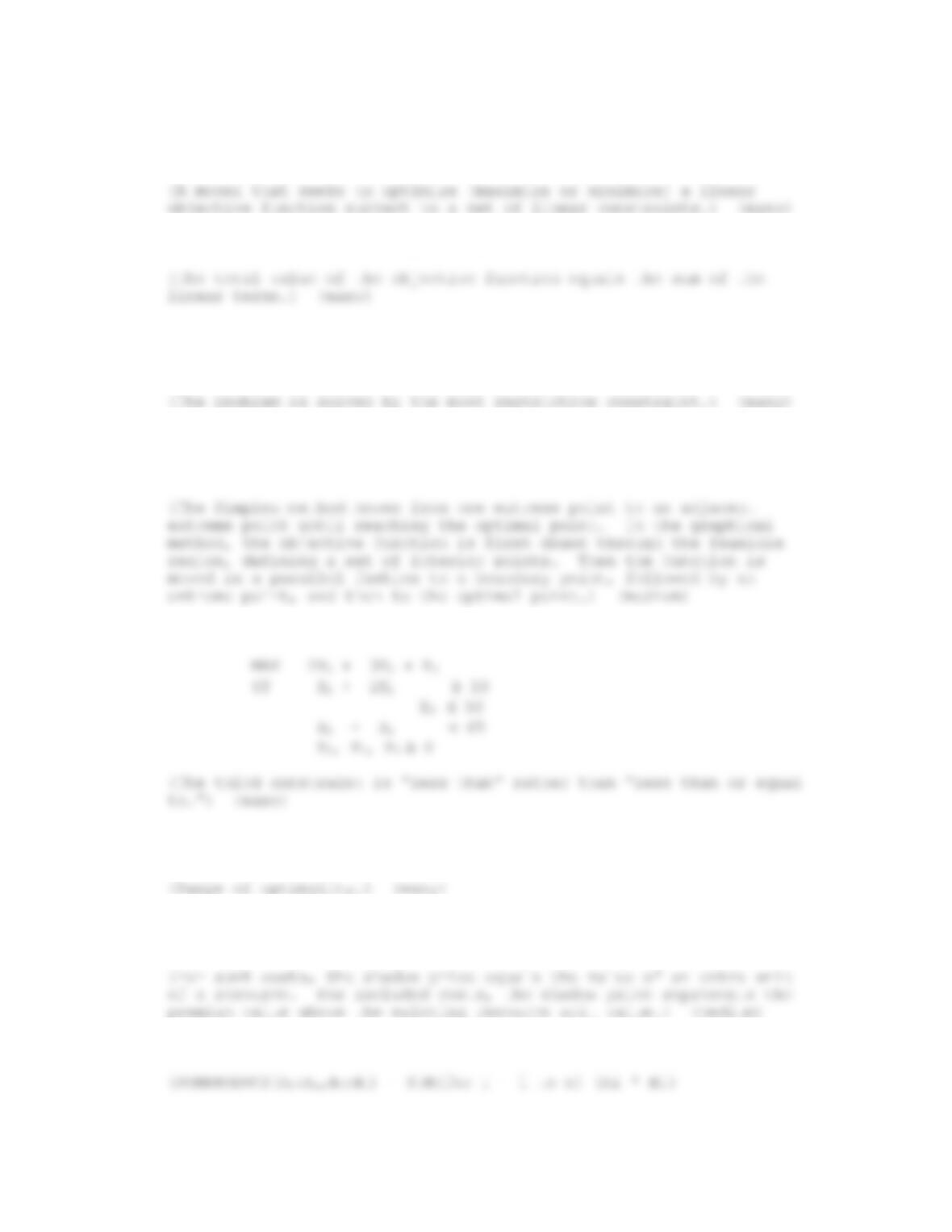
1. What is a linear programming model?
2. Define the additivity assumption.
3. Why would you not use linear programming to solve a problem
with a single decision variable linear objective function and
multiple constraints?
4. Compare the points that the Simplex method moves to with the
points touched by the graphical method for solving a two variable
linear program.
5. What is wrong with this linear programming model?
6. “Allowable Decrease” and “Allowable Increase” refer to what
range?
7. Explain the different interpretations of shadow costs when the
objective function is based on sunk costs versus included costs.
8. Explain the SUMPRODUCT function of Excel.
9. When running Excel, what does “The Set Cell values do not
converge” mean?
10. What clue does Excel give to the possible existence of
alternate optimal solutions?
11. What is the major difference between a product mix problem and
a diet problem?
12. How do you designate variables as integers when using Excel
Solver?
13. Ira Wax solved an integer linear programming problem by
setting up a linear programming model without the integer
constraints and rounding the solution. List the possible problems
with this approach.
FORMULATION/SOLUTION/ANALYSIS QUESTIONS
1. Office2000 produces expensive, quality 2-drawer and 4-drawer
filing cabinets from solid oak for major corporations. A 2-drawer
model utilizes 2 labor hours to produce and package for a net profit
of $75. The 4–drawer model utilizes 3 labor hours to produce and
package and nets a profit of $125. Each month Office2000 has 360
labor hours available and can obtain up to 200 2-drawer frames, 200
4-drawer frames, and 400 drawers from its oak supplier.
Formulate a linear programming model to maximize monthly profit from
the manufacture of filing cabinets at Office2000.
2. Jungle Figures, Inc. produces two models of its stuffed
giraffes, which it markets to high-end retail stores. The large
giraffe requires 2 pounds of stuffing material and 6 minutes of
machine time. The small giraffe requires 1 pound of stuffing
material and 12 minutes of machine time since its tighter stitching
pattern requires it to be stitched twice. There are 800 pounds of
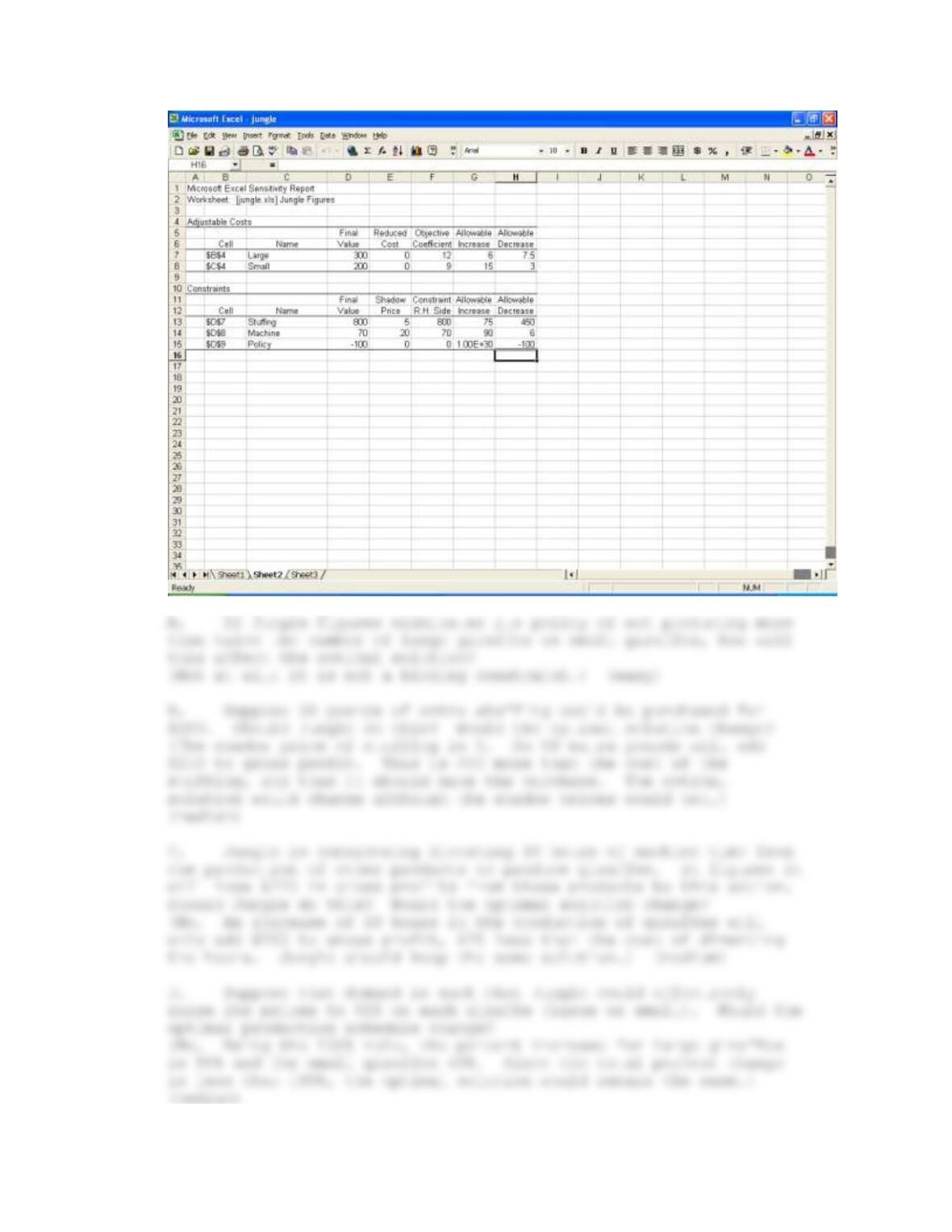
3. Consider the following sensitivity report from Excel for the
model in question 3, which has a profit of $5,400.
4. The University of Iowa is experimenting with a blend of soil
amendments to be used in an analysis of variance study of the
response of tomatoes to various amounts of sunlight. To perform
14. A farmer has three possible cereal grain crops to grow in the
coming planting season: barley, oats, and wheat. He has 240 acres
of arable land: 160 are considered high grade and the remainder is
low grade. He has $42,000 in available capital and can hire
virtually unlimited hours of field labor, locally, for $6 per hour.
Relevant crop factors are:
15. The Hawaii Surfboard Company produces three different styles
of surfboards (the Oahu, the Kauai, and the Maui) made from
combinations of three different materials, A, B, and C. The Oahu
model nets a $35 profit and requires 1 unit of A, 1 unit of B, and 1
unit of C. The Kauai model nets a $75 profit and requires 4 units
of A and 1 unit of B. The Maui model nets a $100 profit and
requires 1 unit of A, 4 units of B, and 1 unit of C. There are 200
units of A, 200 units of B, and 100 units of C available weekly.
16. The Carolina Chemical Company (CCC) makes two products, soap
and shampoo, both in liquid form. The same two raw material inputs,
glycerin and potash, and the same production line are used in the
manufacture of each. Each production day, one ton of glycerin and
17. Spee-D Delivery Service wants to blend two gasolines (R and S)
for use in its trucks. For the upcoming period, at least 10,000
gallons are required. Spee-D has a 20,000 gallon storage facility.
Any required quantities of R and S gasoline may be purchased from a
local refinery and mixed.
R is 87 octane and costs $0.90 a gallon. S is 93 octane and costs
$1.20 per gallon. Spee-D’s fleet of 100 trucks requires an octane
of no less than 89. Octane of the mixed output is linearly
proportional to input octane. For example, equal parts of R and S
would yield a 90 octane output. There is no gasoline loss in the
blending process.
Formulate a linear programming model for this problem. Is a
summation variable advisable here? Explain.
18. A small foundry has received an order for an iron alloy called
Falloy which has the following specifications:
19. Extel Industries produces integrated circuit components for
use in the next generation of automobiles. In particular, it can
make the AT50 unit that can control the air temperature in the car,
the V35 unit that monitors vibration and makes adjustments
accordingly, and the GM30 that regulates the engine so that the car
provides maximum efficiency. The unit profits on these units are
$84, $112, and $126, respectively. Each of these units uses
different quantities of three computer chips (as shown below), which
Extel purchases from a Taiwanese distributor.
20. The Finast Filter Company makes two types of filters for
domestic air purifiers: the standard (nicknamed the Cleaner) for
ordinary use, and the Scrubber for industrial-strength problems.
The Cleaners bring in a profit of $0.50 each, while the Scrubbers
command a profit of $1.25 each.