21) Closing the loop in the area of business strategy means that:
A) core competencies at the functional level feed back into the business strategy.
B) the mission statement is used to develop the business strategy.
C) the business strategy is translated into operations and supply chain actions.
D) other functional strategies, such as those of the marketing and finance functions are aligned with the
operations and supply chain strategy.
22) When the operations and supply chain areas are not linked with the overall business strategy, but
instead follow industry practices, the firm is in this stage of alignment.
A) internally neutral
B) externally neutral
C) internally supportive
D) externally supportive
23) Before firms can progress to the fourth stage of alignment, they must not only support business
strategies but also:
A) exploit core competencies.
B) develop a new mission statement.
C) develop order winners.
D) abandon order qualifiers.
24) An operations and supply chain strategy is a functional strategy that is, by definition, an
infrastructural strategy.
25) Conformance quality addresses whether the product was made or the service performed to
specifications.
26) If a logistics firm consistently makes deliveries within the agreed–upon delivery window, they are
exhibiting delivery reliability.
27) Changeover flexibility refers to the ability of a company to change production quickly from one
product to another with a minimal downtime in production.
28) Volume flexibility is the term used to describe the ability of a producer to produce a dazzling (wide)
array of products or services.
29) “I’ve never seen flavored marshmallows this size before!” Alice squealed as she emptied the shelves at
the local grocery store. The rest of the shoppers would have to make do with the other seventy bags of
miniature and standard-size marshmallows during this winter‘s hot chocolate festival. For Alice, the
jumbo size feature is an order winner.
30) Your employer prepares a request for proposal that describes in vivid detail all of the capabilities that
a new computer system should possess. A software product that can meet this request for proposal has
performance characteristics that can be described as order qualifiers.
31) Darrell and Dave were fierce competitors, which drove both of them to overpay for many of their
inputs, resulting in increased prices at their own stores. Dave realized this, and pondered how he could
be recognized as a cost leader by his customers and maintain his reputation for quality merchandise.
Sacrificing one element of his strategy at the expense of another is recognized as a trade–off in operations
management.
32) A logical tradeoff is sacrificing an order winner capability in favor of an order qualifier capability.
33) The phrase “closing the loop” means that strengths and weaknesses, as well as core competencies are
fed back into the mission statement.
34) In the internally supportive stage of business strategy alignment, management merely attempts to
minimize negative potential in the operations and supply chain area.
35) You decide to open a bookstore with a wide selection, comfortable seating, and an internal coffee
shop because it has worked very well for other bookstores you have visited. Your strategy could be
described as externally neutral.
36) The externally supportive stage of alignment is more desirable than the externally neutral stage of
alignment.
37) Decisions about capacity, facilities and technology fall in the ________ decision category?
38) Decisions about planning and control, sourcing, and quality management fall in the ________ decision
category.
39) One way to quantify the overall value of an item or service to a customer is by using a(n) ________.
40) The American-made car I purchased as a starving graduate student was not the sleek, high–
performance machine that full professors park in faculty parking, but it performed admirably. For the
next twenty years I could count on one thing; every morning it would start when I turned the key. This
vehicle had outstanding ________ quality.
41) The ability to produce a wide range of products or services is referred to as ________.
42) Between order qualifiers and order winners, superior performance on a(n) ________ will not, by itself,
give a company a competitive advantage.
43) A major retailer wants to sell items as cheaply as possible while maintaining an attractive and
enjoyable shopping atmosphere. Spending too much on ambience will raise prices and drive away
shoppers but spending too little will drive shoppers away also. Clearly, the retailer is faced with a(n)
________ between cost and aesthetic quality.
44) A trade-off is at its core, a change in emphasis between two ________ dimensions.
45) At the ________ stage of alignment, the business strategy seeks to exploit core competencies found
within the operations and supply areas.
46) The operations and supply chain strategy wasn’t aligned with the business strategy nor the mission,
so management could only hope to minimize the damage the operations function caused. This ________
stage was targeted for improvement next year.
47) Before firms can think about progressing to the fourth stage of alignment (________), they must
develop ________ within the operations and supply chain areas.
48) What are the three primary objectives of an operations and supply chain strategy?
49) What are three structural and three infrastructural decision categories in operations and supply chain
management? Pick one from each category and provide an example of a choice that an operations and
supply chain manager might make.
50) Which category of decision categories in operations and supply chain management requires the
greatest financial investment? Justify your answer.
51) Modelo, S.A., is considering three providers of automated visual inspection systems for their
packaging needs. A team of manufacturing engineers, production managers, and process engineers has
developed the following list of criteria and assigned them ratings on a scale of 1 (completely
unimportant) to 5 (critical). This team has also rated the candidate products on each of these dimensions
using a scale of 1 (poor) to 5 (excellent). Which provider should they choose and what caveats, if any,
should go with their recommendation?
Dimension
Importance
Provider A
Provider B
Provider C
4 megapixels
5
4
5
5
Minimal fringing
3
4
3
2
15 fps VGA movie mode
4
4
4
1
Minimal shutter lag
2
2
5
5
Works in dim light
1
2
3
4
Water resistant
5
5
2
1
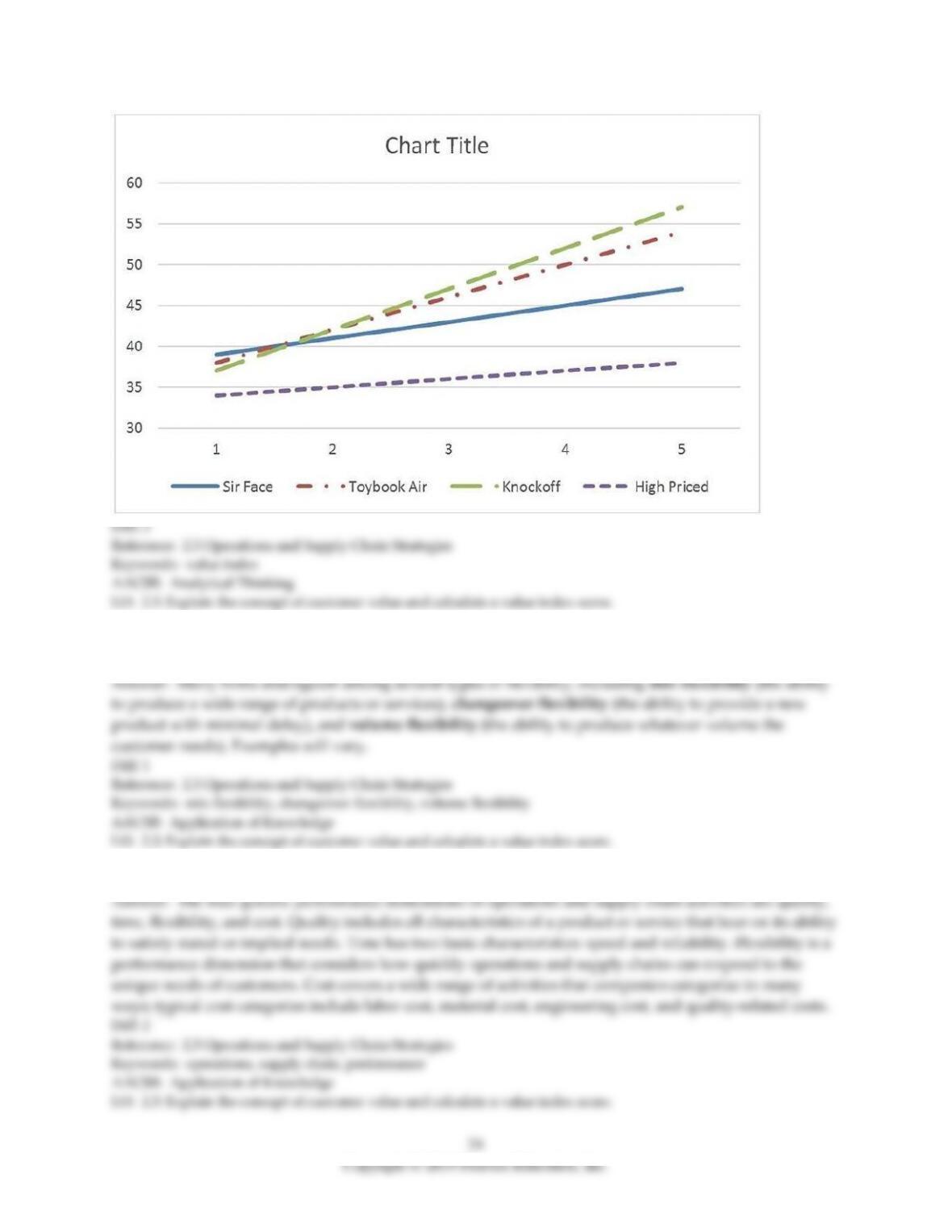
52) Electra wants to purchase a laptop for use in her MBA program so she can work on assignments and
surf the web while the professor drones on endlessly. After consulting with her colleagues, she chooses
the dimensions of cost, weight, processor speed, and touchscreen capability as critical to her long term
success and amusement. She evaluates four different laptops and rates their performance on each
criterion on a scale from 1 (poor) to 5 (excellent). She is struggling with her assessment of the importance
of the Cost criterion. As an avid lottery player, she is pretty sure that tonight’s drawing will result in at
least a two number match on the ticket she bought on the way to class and it could mean a three-number
match. Given her uncertainty, she would like to choose the laptop that performs the best overall across
the entire spectrum of possibilities of the outcome of tonight’s lottery. Which would you recommend?
Dimension
Importance
Sir Face
Toybook Air
Knockoff
High Priced
Weight
3
4
4
3
5
Speed
5
4
4
4
3
Cost
??
2
4
5
1
Touchscreen
1
5
2
3
3
53) Discuss the different types of flexibility that a producer can exhibit. Use any company mentioned in
the chapter and provide an example of each.
54) Describe the four generic performance dimensions of operations and supply chain activities.
55) What are the differences between performance, conformance, and reliability dimensions of quality?
56) A university is evaluating options for an enterprise information system to replace their antiquated
systems. The CIO has developed the following criteria:
At a minimum, the system (or system provider) must be capable of:
Technical support available 24/7
Have successfully installed and maintained systems in universities of similar size.
Beyond this, systems will be evaluated according to initial cost, annual maintenance and support costs,
and ease of use.
The three companies that are vying for the university’s business supplied the following information about
their performance on these criteria.
Criterion
A
B
C
Tech support 24/7
24/7
24/7
8-5 M-F
Installed base
3 installations
7 installations
1 installation
Initial cost
$2.3 million
$1.9 million
$1.25 million
Annual cost
$100K
$125K
$75K
Ease of use
20 hours training
20 hours training
40 hours training
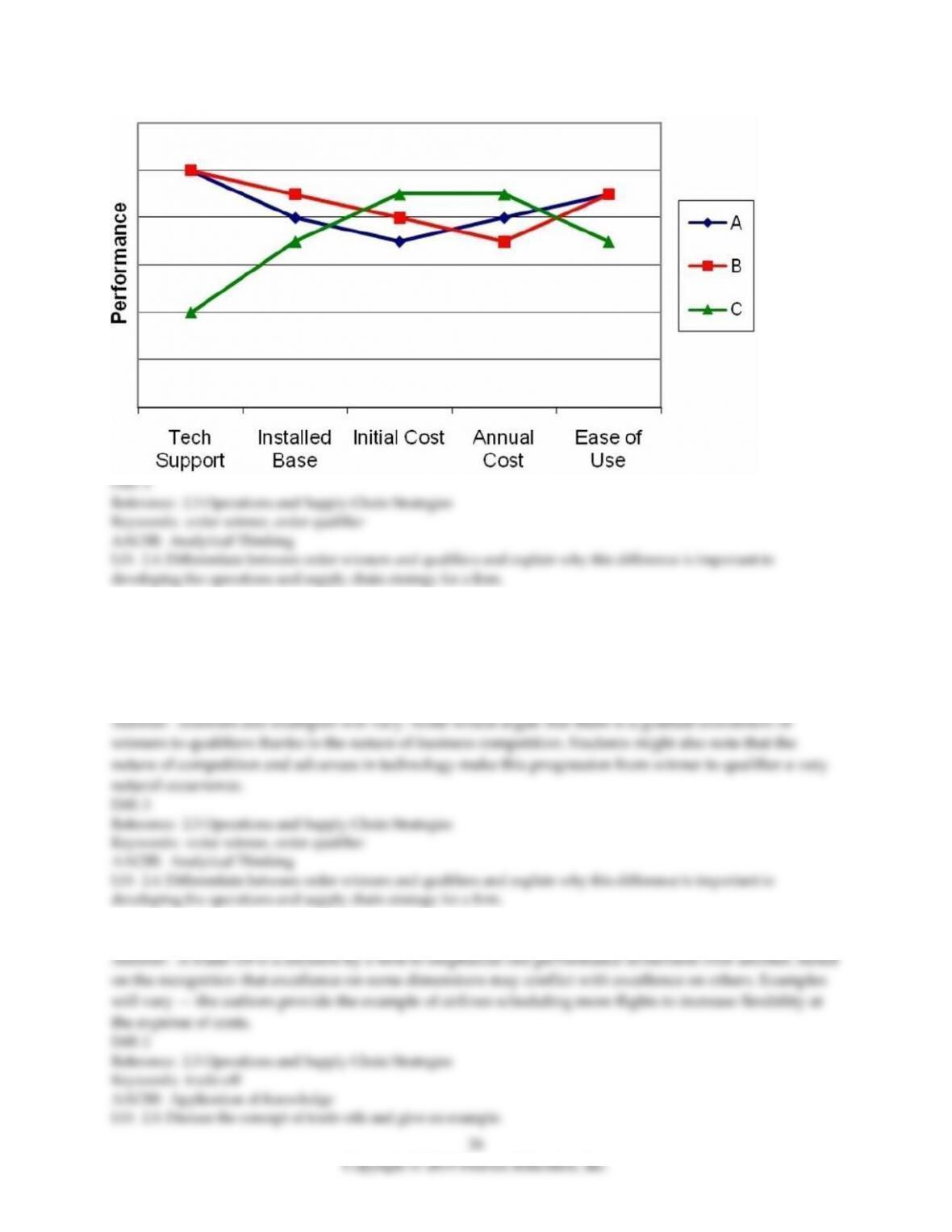
Create and analyze a graph showing each competitor’s performance with regards to order winners and
order qualifiers. Which firm should get the business and why? If you were consulting with the three
potential system providers, what advice would you give each one?
57) Provide a specific example of an order winner of a company that has evolved into an order qualifier.
Then provide a specific example of an order qualifier that has remained an order qualifier for many years
and remains one to this day. Which situation do you think is more natural, the eventual conversion from
winner to qualifier or the static status of “once an order winner, always an order winner”? Justify your
conclusions.
58) What is a trade-off ? Offer a definition and provide an example.
59) What creates the necessity for trade-offs?
60) Describe the four stages of operations and supply chain alignment with business strategy.