201. The largest liability on credit unions’ balance sheet as of year-end 2009 was
202. All commercial banks must be members of the Federal Reserve System.
203. Credit Unions were generally less affected than other depository institutions by the recent financial crisis
because
204. Small banks make proportionately larger amounts of real estate loans than large banks.
205. The most numerous of the institutions that define the depository institutions segment of the FI industry in
the US is (are)
206. The Federal Reserve System has regulatory supervision over all holding company banks whether they
include national- or state-chartered banks.
207. Which of the following observations concerning credit unions is NOT true?
208. The primary objective of the 1927 McFadden Act was to restrict interstate bank branching.
209. Compared to banks and savings institutions, credit unions are able to pay a higher rate on the deposits of
members because
210. The primary objective of the 1933 Glass-Steagall Act was to prevent commercial banks from competing
directly with commercial insurance companies.
211. Which of the following is NOT an off balance sheet activity for U.S. banks?
212. The DIDMCA of 1980 and the DIA of 1982 were the initial acts to begin the deregulation of the
commercial banking industry.
213. Correspondent banking may involve
214. The Riegle-Neal Act of 1994 removed many of the restriction on interstate banking that were originally
imposed by the 1933 Glass Steagall Act.
215. What is the defining characteristic of the dual banking system?

216. The Financial Services Modernization Act of 1999 allows commercial banking activities and securities
underwriting to operate simultaneously under the same ownership structure.
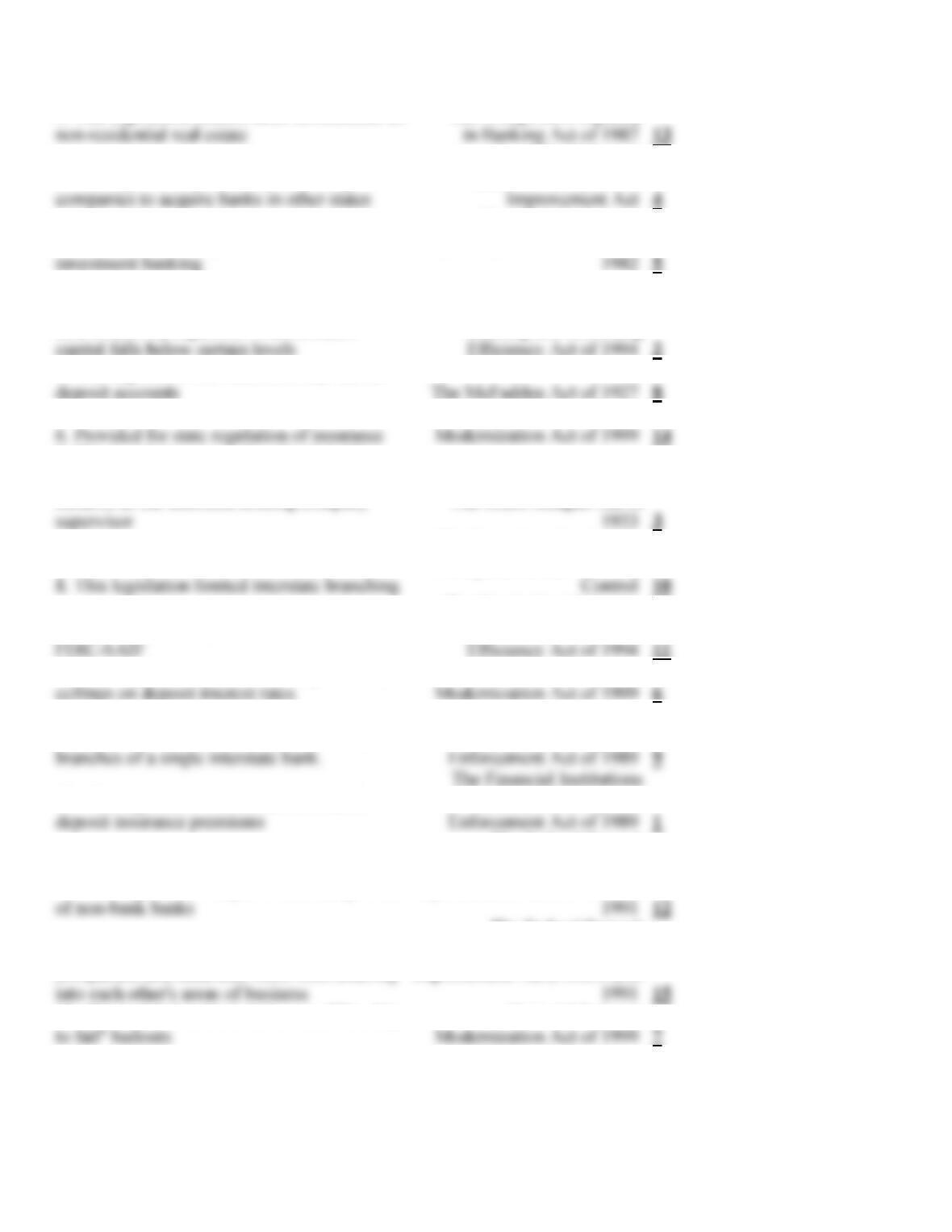
217. Choose among the following major banking laws
1. This legislation limited thrift investments in
The Competitive Equality
2. This legislation permits bank holding
The Federal Deposit
Insurance Corporation
3. This legislation separated commercial and
The Garn-St Germain
Depository Institutions Act of
4. This legislation introduced prompt
corrective action requiring mandatory
intervention by regulators when a bank’s
The Riegle-Neal Interstate
Banking and Branching
5. This legislation introduced money market
Financial Services
7. This legislation streamlined bank holding
company supervision, with the Federal
Reserve as the umbrella holding company
The Depository Institutions
Deregulation and Monetary
9. This legislation replaced FSLIC with
The Riegle-Neal Interstate
Banking and Branching
10. This legislation phased out Regulation Q
Financial Services
11. This law allows bank holding companies
to convert out-of-state subsidiary banks into
The Financial Institutions
The Financial Institutions
Reform, Recovery, and
12. This legislation introduced risk based
Reform, Recovery, and
13. This legislation sought to limit the growth
The Federal Deposit
Insurance Corporation
Improvement Act (FDICIA) of
14. Eliminated restrictions on banks, insurance
The Federal Deposit
Insurance Corporation
15. This legislation limited the use of “too big
Financial Services
Saunders – Chapter 02 #103
218. Savings banks and savings associations are savings institutions; with savings banks serving as the primary
providers of residential mortgage loans, and savings associations concentrating on commercial loans and
corporate bonds as well as mortgage assets.
219. Customer loans are classified on a DI’s balance sheet as
220. In general, the banking industry performed at higher levels of profitability in the decade of the 1990s than
the decade of the 1980s.
221. Holdings of U.S. Treasury securities are classified on a DI‘s balance sheet as
222. Commercial banks that have invested in Internet banking services and products have outperformed
significantly those banks that have chosen to avoid these markets.
223. Customer deposits are classified on a DI’s balance sheet as
224. Regulator forbearance is a policy of allowing economically insolvent FIs to continue in operation.
225. A primary advantage for a depository institution of belonging to the Federal Reserve System is
226. The primary reason for the decline of the S&L industry was the passage of legislation that gave
commercial lending powers to the S&L industry.
227. The FIRREA Act of 1989 introduced the qualified thrift lender test (QLT), which set the percentage of
assets required for qualification to be no less than
228. Savings associations and savings banks both are insured by insurance funds that are managed by the
FDIC.
229. Regulatory forbearance refers to a policy of
230. The savings association industry continues to be the primary lender of residential mortgages.
231. One of the primary reasons that investment banks were allowed to convert to bank holding companies
during the recent financial crisis was recognition that
232. As a percent of total assets, savings institutions hold lower amounts of cash and U.S. Treasury securities
than commercial banks.
233. A large number of the savings institution failures during the in the 1980s was a result of
234. The number of savings associations has been declining since 1990.
235. These organizations were originated to avoid the legal definition of a bank.
236. Savings associations and savings banks are chartered and regulated by the Federal Reserve Bank.
237. What was the primary objective of the Bank Holding Company Act of 1956?
238. Savings institutions enjoyed record profitability during the late 1990s and early 2000s.
239. Which of the following currently manages the insurance funds for both commercial banks and savings
institutions?
240. The common bond principle of credit unions emphasizes the depository and lending needs of credit union
members.
241. Which of the following identifies the primary function of the Office of the Comptroller of the Currency?
242. The credit union industry avoided much of the financial distress of the 1980s because of the short maturity
and relatively lower credit risk of their assets.
243. Which of the following observations concerning trust departments is true?
244. The primary objective of the Reigle-Neal Act was to ease branching across state lines by banks.
245. Which of the following is true of off-balance-sheet activities?
246. As with other DIs, profits or return on assets (ROA) is the primary goal of credit union management.
247. Which of the following dominates the loan portfolios of banks with assets less than one billion dollars?
248. A significant disadvantage for credit unions in competing with commercial banks is the severe restriction
in the variety of products and services that they can offer.
249. This broad class of loans constitutes the highest percentage of total assets for all U.S. commercial banks as
of the end of 2009.
250. A significant advantage for credit unions in competing with commercial banks is the tax-exempt status that
has been granted to credit unions.
251. Choose among the following major banking laws
1. This legislation introduced prompt
corrective action requiring mandatory
intervention by regulators when a bank’s
The Competitive Equality
2. This legislation streamlined bank holding
company supervision, with the Federal
Reserve as the umbrella holding company
The Federal Deposit
Insurance Corporation
3. This law allows bank holding companies to
convert out-of-state subsidiary banks into
The Garn-St Germain
4. This legislation replaced FSLIC with
The Riegle-Neal Interstate
Banking and Branching
5. This legislation separated commercial and
6. This legislation sought to limit the growth
Financial Services
The Glass-Steagall Act of
8. This legislation permits bank holding
The Depository Institutions
The Riegle-Neal Interstate
Banking and Branching
10. This legislation phased out Regulation Q
Financial Services
11. This legislation introduced money market
The Financial Institutions
12. This legislation introduced risk based
The Financial Institutions
13. This legislation limited the use of “too big
The Federal Deposit
Insurance Corporation
14. This legislation limited thrift investments
The Federal Deposit
Insurance Corporation
Improvement Act (FDICIA) of
15. Eliminated restrictions on banks, insurance
companies, and securities firms from entering
Financial Services
252. According to the American Bankers Association, the tax-exempt status of credit unions is the equivalent of
a $1 billion per-year subsidy to the industry.
253. What is the defining characteristic of the dual banking system?
254. Compared to the average commercial bank, credit unions tend to have higher overhead expenses per dollar
of assets.
255. Correspondent banking may involve
256. All credit unions are nationally chartered and regulated by the National Credit Union Administration.
257. Which of the following is NOT an off balance sheet activity for U.S. banks?
258. Which of the following FIs does not currently provide a payment function for their customers?
259. Compared to banks and savings institutions, credit unions are able to pay a higher rate on the deposits of
members because
260. A consumer lending function is performed by each of the following FIs EXCEPT
261. Which of the following observations concerning credit unions is NOT true?
262. Which of the following FIs does not provide a business lending function?
263. The most numerous of the institutions that define the depository institutions segment of the FI industry in
the US is (are)
264. As of 2009, commercial banks with over $10 billion in assets constituted approximately ____ percent of
the industry assets and numbered approximately _____.
265. Credit Unions were generally less affected than other depository institutions by the recent financial crisis
because
266. The largest asset class on U.S. commercial banks’ balance sheet as of year-end 2009 was
267. The largest liability on credit unions’ balance sheet as of year-end 2009 was
268. The largest liability on U.S. commercial banks’ balance sheet as of year-end 2009 was