
WEB CHAPTER 19—ANALYSIS OF FINANCIAL STATEMENTS
TRUE/FALSE
1. The Canadian Institute of Chartered Accountants (CICA) recognizes that it would be improper for all
companies to use identical and restrictive accounting principles.
2. The balance sheet shows what assets the firm controls at a point in time and how it financed the assets.
3. The income statement indicates the flow of sales, expenses, and earnings during a period of time.
4. The statement of cash flows shows the effect on the firm’s cash flows of earnings and changes in the
assets, current liabilities, long-term liabilities and net worth.
5. Cash flow from operations = Net Income + Non cash revenue and expenses − Changes in net working
capital.
6. Free cash flow = Cash flow from operations − Capital expenditures + Disposition of property and
equipment.
7. Traditional cash flow and Free cash flow are equivalent concepts.
8. It is important to compare a firm’s performance relative to: the aggregate economy, its industry, its
major competitors and its past performance.
9. The current ratio, receivables turnover and total asset turnover are measures of internal liquidity.
10. Inventory turnover, net fixed asst turnover and equity turnover are measures of operating efficiency.

2
11. According to the DuPont system ROE (return on equity) can be decomposed into the profit margin
ratio and the total asset turnover ratio.
12. Some factors the determine business risk include sales variability and debt to equity ratio.
13. Some factors that determine financial risk include interest coverage and cash flow coverage.
14. The growth of business depends on the percentage of earnings reinvested and the return on equity.
15. Financial ratios are used in stock and bond valuation models.
16. Financial ratios can be used to estimate systematic risk.
17. Bond rating agencies include the analysis of financial ratios in arriving at corporate bond ratings.
18. Financial ratios can be used to identify firms that might default on a loan or declare bankruptcy.
19. A cross-sectional analysis compares a firm to a subset of industry firms comparable in size or
characteristics.
20. In common size analysis all assets and liabilities on the balance sheet are divided by total sales.
21. Financial risk is the uncertainty of operating income caused by the firm’s industry.

3
MULTIPLE CHOICE
1. The comparisons with which ratios should be made include the following, except
a.
The firm’s own past performance.
b.
The firm’s major competitor within the industry.
c.
The firm’s suppliers and customers.
d.
The firm’s industry or industries.
e.
The aggregate economy.
2. The five major classes of ratios include the following, except
a.
Internal liquidity.
b.
Risk analysis.
c.
Growth analysis.
d.
Market performance.
e.
Operating performance.
3. Which of the following is not a flow ratio?
a.
Interest coverage
b.
Fixed charge coverage
c.
Debt/equity
d.
Cash flow/long term debt
e.
Cash flow/total debt
4. Which ratio is considered an internal liquidity ratio?
a.
Total asset turnover
b.
Net fixed asset turnover
c.
Receivables turnover
d.
Equity turnover
e.
Inventory turnover
5. Operating performance is divided into which two subcategories of ratios?
a.
Efficiency and profitability
b.
Efficiency and debt
c.
Profitability and growth
d.
Debt and equity
e.
Liquidity and leverage

4
6. Which of the following is not a component of return on equity (ROE)?
a.
Net income/sales
b.
Total assets/equity
c.
Equity/sales
d.
Sales/total assets
e.
Net Profit Margin
7. Which equation is valid?
a.
g = Percent of earnings retained Return on equity
b.
g = Return on equity Percent of earnings retained
c.
g = Return on equity Return on total assets
d.
g = Percent of earnings retained Return on equity
e.
g = Total assets Return on total assets
8. Determinants of market liquidity include all except the
a.
Number of shares traded.
b.
Dollar value of shares traded.
c.
Bid-ask spread.
d.
Number of security owners.
e.
Market price per share.
9. Which of the following is not a use of financial ratios?
a.
Stock valuation
b.
Assigning credit quality ratings on bonds
c.
Predicting insolvency
d.
Identification of internal corporate variables that affect a stock’s systematic risk
e.
None of the above (that is, all are uses of financial ratios)
10. Limitations on the use of ratios include
a.
Accounting comparability.
b.
Company homogeneity.
c.
Consistent results.
d.
A reasonable range within the industry.
e.
All of the above

5
11. Business risk is a function of
a.
Sales variability.
b.
Operating leverage.
c.
Financial leverage.
d.
Choices a and b.
e.
Choices b and c.
12. A common-size balance sheet expresses all balance sheet items
a.
As a percentage of Current Assets.
b.
As a percentage of Fixed Assets.
c.
As a percentage of Total Assets.
d.
As a percentage of Net Income.
e.
As a percentage of Sales.
13. A common-size income statement expresses all income statement items
a.
As a percentage of Current Assets.
b.
As a percentage of Fixed Assets.
c.
As a percentage of Total Assets.
d.
As a percentage of Net Income.
e.
As a percentage of Sales
14. An estimate of the discounted value of future lease payments can be obtained in the following way(s):
a.
By discounting future lease payments at the firm’s cost of debt or by discounting future
lease payments at the firm’s cost of capital.
b.
By discounting future lease payments at the firm’s cost of capital or by applying a multiple
to forthcoming minimum lease payments.
c.
By discounting future lease payments at the firm’s cost of debt or by applying a multiple
to forthcoming minimum lease payments.
d.
By applying a multiple to forthcoming minimum lease payments.
e.
None of the above.
15. Financial risk is the additional uncertainty of returns to equity holders due to
a.
The firm’s use of fixed financial obligations
b.
The firm’s level of fixed productions costs
c.
Business risk
d.
Choices a and b.
e.
Choices b and c.

6
16. The market liquidity of a security can be measured using
a.
Trading turnover.
b.
Bid-Ask spread.
c.
Price of the security.
d.
Choices a and b.
e.
Choices b and c.
17. Which of the following factors would be an indicative of high quality earnings?
a.
Earnings are close to cash.
b.
Earnings are the result of repeat business.
c.
Revenue recognition is based on the installment principle.
d.
All of the above.
e.
None of the above.
18. Which of the following factors would be indicative of a high quality balance sheet?
a.
Book value is greater than market value.
b.
The presence of off-balance sheet liabilities
c.
Market value is greater than book value.
d.
Very little unused borrowing capacity.
e.
None of the above.
19. Which of the following ratios is not a measurement of the firm’s liquidity?
a.
Current ratio
b.
Cash ratio
c.
Receivables turnover
d.
Inventory turnover
e.
Total asset turnover
20. DuPont Analysis breaks down return on equity into major areas that can be used to identify a firm’s
strengths or weaknesses with respect to
a.
Profitability
b.
Leverage
c.
Liquidity
d.
Efficiency
e.
All of the above are broken out in the basic DuPont equation.

7
21. Which of the following statements regarding financial risk and business risk is true?
a.
The acceptable level of financial risk for a firm depends on its business risk.
b.
A firm with a greater degree of business risk has the ability to take on more debt.
c.
A firm with a greater degree of financial risk typically takes on less business risk.
d.
Financial risk and business risk are both important but they are not related in anyway.
e.
Financial risk is more important for small firms and business risk is more important for
large firms.
Exhibit 19-1
USE THE FOLLOWING INFORMATION FOR THE NEXT PROBLEM(S)
BMC CORPORATION INCOME STATEMENT
FISCAL YEAR ENDING 12/31/2009
(DOLLARS IN THOUSANDS)
Net Sales
$1025
Cost of Goods Sold
682
Gross Profit Margin
343
Depreciation
31
Operating Expense
103
Administrative Expense
127
Operating Profit
82
Interest
27
Profit Before Tax
55
Taxes
17
Net Income
$ 38
BMC CORPORATION BALANCE SHEET
FISCAL YEAR ENDING 12/31/2009
(DOLLARS IN THOUSANDS)
ASSETS
LIABILITIES
Cash
$ 61
Notes payable
$ 223
Accounts receivables
286
Accounts payable
152
Inventory
354
Accruals
32
Total current assets
701
Total current liabilities
407
Net fixed assets
802
Long term debt
306
Common stock ($1.50 par)
102
Paid in surplus
226
Retained earnings
462
Total liabilities and
Total assets
$1503
Stockholders’ equity
$1503
8
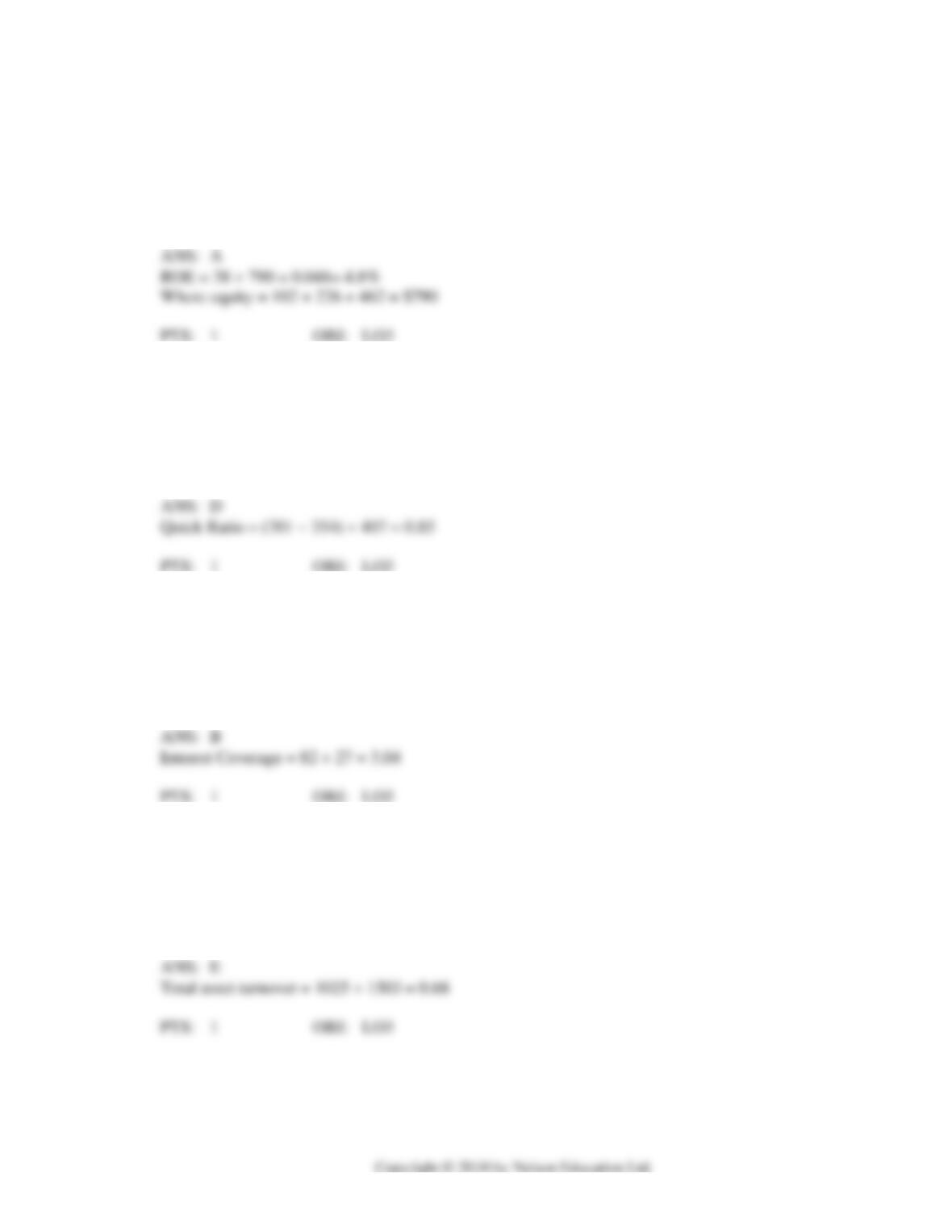
22. Refer to Exhibit 19-1. What was BMC’s return on equity in 2009?
a.
4.8%
b.
5.9%
c.
6.7%
d.
8.3%
e.
11.6%
23. Refer to Exhibit 19-1. What was BMC’s quick ratio for 2009?
a.
1.72
b.
1.37
c.
1.02
d.
0.85
e.
0.55
24. Refer to Exhibit 19-1. What was BMC’s interest coverage for 2009?
a.
6.82
b.
3.04
c.
2.74
d.
2.04
e.
1.41
25. Refer to Exhibit 19-1. What was BMC’s total asset turnover for 2009?
a.
0.23
b.
1.28
c.
1.46
d.
0.87
e.
0.68
9
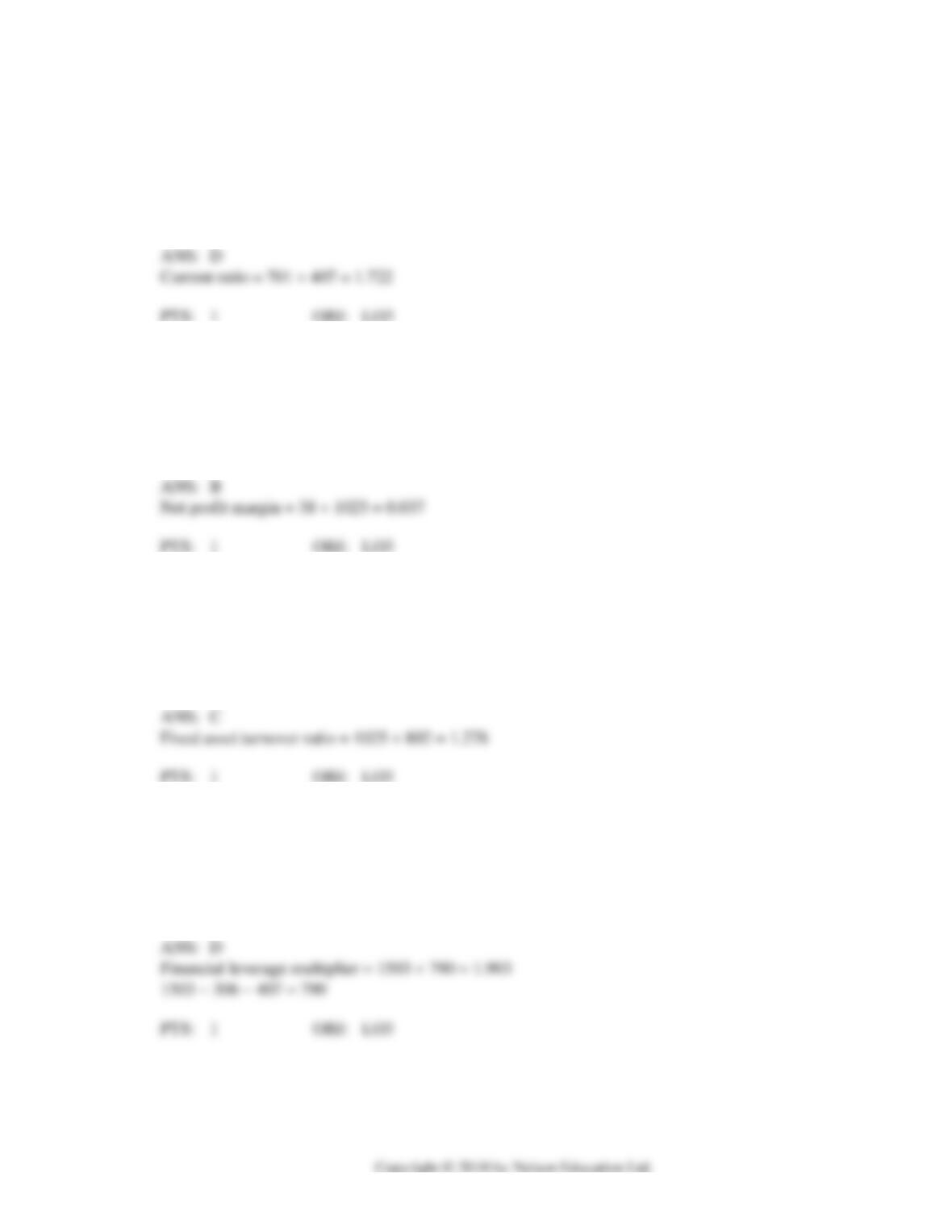
26. Refer to Exhibit 19-1. What was BMC’S current ratio at year-end 2009?
a.
0.852
b.
1.000
c.
1.368
d.
1.722
e.
1.943
27. Refer to Exhibit 19-1. What was BMC’s net profit margin?
a.
0.058
b.
0.037
c.
0.125
d.
0.015
e.
0.165
28. Refer to Exhibit 19-1. What was BMC’s fixed asset turnover ratio?
a.
0.680
b.
0.780
c.
1.278
d.
1.874
e.
8.220
29. Refer to Exhibit 19-1. What was the financial leverage multiplier used in the BMC system?
a.
2.058
b.
2.289
c.
3.014
d.
1.903
e.
0.904
10
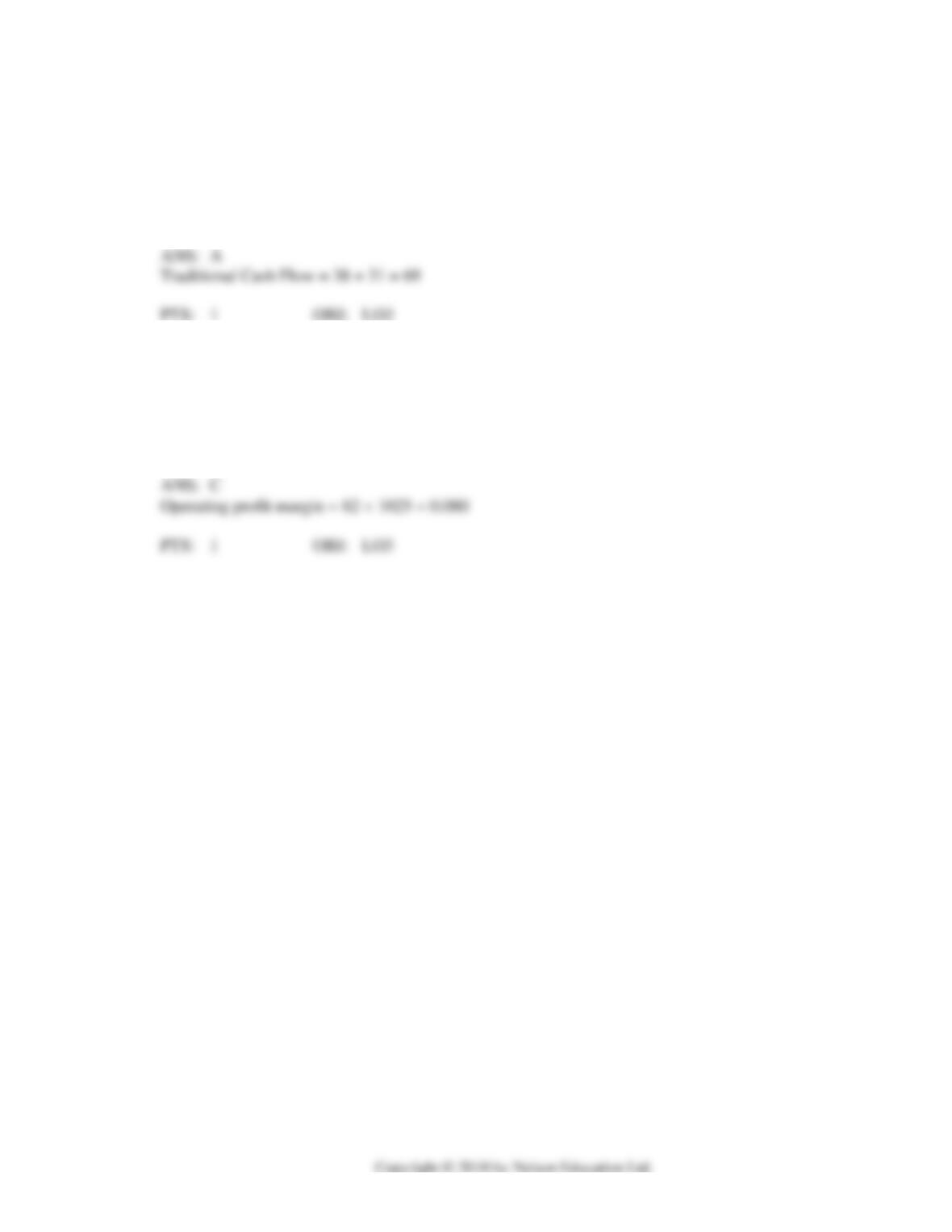
30. Refer to Exhibit 19-1. What is BMC’s traditional cash flow?
a.
69
b.
86
c.
38
d.
55
e.
701
31. Refer to Exhibit 19-1. What is BMC’s operating profit margin?
a.
0.800
b.
0.054
c.
0.080
d.
0.540
e.
5.480

11
Exhibit 19-2
USE THE FOLLOWING INFORMATION FOR THE NEXT PROBLEM(S)
STAR CORPORATION INCOME STATEMENT
FISCAL YEAR ENDING 12/31/2009
(DOLLARS IN THOUSANDS)
Net Sales
$1075
Cost of Goods Sold
706
Gross Profit Margin
369
Depreciation
30
Operating Expense
109
Administrative Expense
129
Operating Profit
101
Interest
29
Profit Before Tax
72
Taxes
21
Net Income
$ 51
STAR CORPORATION BALANCE SHEET
FISCAL YEAR ENDING 12/31/2009
(DOLLARS IN THOUSANDS)
ASSETS
LIABILITIES
Cash
$ 69
Notes payable
$ 231
Accounts receivable
233
Accounts payable
146
Inventory
348
Accruals
31
Total current assets
650
Total current liabilities
408
Net fixed assets
886
Long term debt
318
Common stock ($1.50 par)
111
Paid in surplus
190
Retained earnings
509
Total liabilities and
Total assets
$1536
Stockholders’ equity
$1536
32. Refer to Exhibit 19-2. What was Star’s return on equity in 2009?
a.
5.8%
b.
6.3%
c.
6.8%
d.
7.2%
e.
8.1%