
1. Contagious runs on bank deposits are directed at FIs, whether they are failing or healthy.
2. A run on a bank is not necessarily a bad occurrence.
3. The adverse effects of a contagious run include the restrictions on the ability of individuals to transfer wealth
through time and a negative impact on the level or rate of savings.
4. The Federal safety net to protect the integrity of the payments system consists of deposit insurance and social
welfare.
5. The number of bank failures in the period of 1933-79 was less than the number of failures from 1980-1989.
6. The average cost to the FDIC of each bank failure during the decade of the 1980s was larger than the total
cost of all bank failures during the period 1933-79.
7. During the financial crisis of 2008-2009, deposit balances at DIs increased.
8. Since its inception, the FDIC deposit insurance fund has never fallen to a negative balance.
9. After nearly failing, the FDIC’s Bank Insurance Fund (BIF) achieved record levels of reserves during the
1990s.

10. The Financial Institutions Reform, Recovery, and Enforcement Act (FIRREA) restructured the savings
association deposit insurance fund and transferred its management to the FDIC.
11. As a result of the Financial Institutions Reform, Recovery, and Enforcement Act (FIRREA), the deposit
insurance fund for the savings and loan industry has been combined with the deposit insurance fund for the
commercial banking industry.
12. A major cause of the FSLIC insolvency in the 1980s was the dramatic rise in interest rates in 1979-82 that
created extensive duration mismatches of assets and liabilities in the savings and loan industry.
13. A major reason for the deterioration of the deposit insurance funds in the 1980s was the downturn in the
technology, manufacturing, and real estate industries.
14. Deposit insurance is often blamed for the deterioration in depositor discipline that allowed FIs to accept
more risk in the asset selection process.
15. Moral hazard encourages the FI to take on more, rather than less, risk.
16. The risk of moral hazard increases when capital levels are low.
17. If regulators provide more protection against bank runs, the incidence of moral hazard is likely to increase.
18. Explicit deposit insurance premiums applied by regulators can involve restricting and more closely
monitoring the risky activities of banks.

19. Moral hazard provides an incentive for bank owners to accept greater asset risks because they have less to
lose, and potentially more to gain.
20. Pricing insurance premiums in an actuarially fair manner involves assessing the risk-taking profile of the
financial institution.
21. Because deposit insurance premiums were not priced in an actuarially fair manner during the period from
1933-1980s, instability was created in the credit and monetary system.
22. Currently in the U.S., deposit insurance premiums increase with the amount of risk of the institution.
23. Pricing deposit insurance premiums to reflect increases in risk-taking by financial institutions is one method
to reduce incentives to take risks.
24. The use of the option pricing model to determine the actuarially fair premium for deposit insurance indicates
that the cost of the insurance should rely on both the asset quality and level of leverage of the DI.
25. The use of the option pricing model to determine the actuarially fair premium is difficult to apply in practice
because the asset values and risks are difficult to determine.
26. The cost of insolvency of an FI to the FDIC is offset in part by the deposit insurance premiums paid by the
bank.

27. The Financial Institutions Reform, Recovery, and Enforcement Act (FIRREA) required the FDIC to
establish risk-based premiums for deposit insurance coverage at banks.
28. The initial risk-based deposit insurance program implemented on January 1, 1993 was based on capital
adequacy and supervisory judgments involving asset quality, loan underwriting standards and other operating
risks.
29. The improved financial health of the FDIC during the 1990s resulted in a considerable reduction in deposit
insurance premiums.
30. The Designated Reserve Ratio is a rule that stipulates that highly-rated DIs would not pay deposit insurance
premiums if this ratio was above 1.25 percent.
31. Statistical credit scoring models have been suggested for use in measuring the risk of DIs for the purpose of
assigning deposit insurance premiums.
32. Requiring higher capital ratios often is proposed as method to reduce the incentive to take excessive risk
because the moral-hazard risk-taking incentives are thought to decrease as the amount of net worth increases.
33. The regulatory practice of excessive capital forbearance is a method of reducing the short-run and long-run
costs to deposit insurance funds.
34. The policy of forbearance practiced by the FSLIC in the late 1980s allowed many commercial banks to
remain open even in the face of continuing losses and insolvency.

35. Risk-based capital supports risk-based deposit insurance premiums by increasing the cost of risk taking for
DI stockholders.
36. The prompt corrective action program of the FDIC Improvement Act allows a bank or thrift to be placed
into receivership when the book value of capital to assets falls below 2 percent.
37. The ability of the FDIC to place a bank into receivership even though the book value of capital remains
positive is an attempt to institute increased stockholder discipline.
38. The use of subordinated debt as a replacement for common stock has been proposed as a method of
increasing stockholder discipline.
39. One of the overall objectives in using subordinated debt in addition to common stock for a DI’s capital base
is to improve market discipline of a DI’s risk structure.
40. Critics of the current FDIC insurance programs often argue that only uninsured depositors have any
incentive to discipline riskier banks.
41. Insured depositors can be covered for more than $250,000 at any given FI under current FDIC regulations.
42. The employment of deposit brokers allows individual depositors to receive deposit insurance coverage on
total asset balances well in excess of $250,000 at any given bank.

43. During the 1980s, a high proportion of brokered deposits at a DI became an early warning signal of its risk
for failure.
44. The FIRREA prohibited all insured financial institutions from accepting brokered deposits or paying interest
rates that are significantly higher than existing market rates.
45. The “too big to fail” policy doctrine prevalent through the 1980s and most of the 1990s is remised on the
separation of small depositors who would receive deposit insurance and large depositors who would not receive
the benefits of deposit insurance.
46. The 1993 Depositor Protection legislation gives equal claim to the value of liquidated assets less the amount
of insured deposits to foreign uninsured depositors, domestic uninsured depositors, and the FDIC.
47. The insured depositor transfer method of least-cost bank failure resolution requires the FDIC to employ the
method that imposes the highest amount of failure costs on uninsured depositors.
48. FDICIA imposed additional regulatory discipline as a substitute for increased stockholder and depositor
discipline.
49. The introduction of prompt corrective action capital zones by FDICIA was an attempt to place greater
decision-making power at the discretion of regulators rather than on objective, measurable rules.
50. The discount window at the Federal Reserve is a suitable substitute for deposit insurance and a possible
method of preventing bank runs.

51. Interest rates charged to healthy banks that use the Federal Reserve discount window are typically set one
percent below the fed funds target interest rate.
52. By decreasing the use of the discount window as a source of funding for a DI, the Federal Reserve hopes to
reduce volatility in the fed funds market.
53. State guaranty funds for insurance companies are sponsored by state insurance regulators rather than by a
federal agency such as the FDIC.
54. The required contribution from surviving insurers to protect policyholders of failed insurance companies
usually is on a pro rata amount based on the relative asset size of the surviving company.
55. The FDIC deposit insurance program is also available to credit unions.
56. The National Credit Union Administration (NCUA) is an independent federal agency that insures credit
union deposits.
57. The deposit insurance programs of the National Credit Union Administration (NCUA) is modeled after the
programs offered by the FDIC.
58. The Pension Benefit Guaranty Corporation (PBGC) insures pension benefits against the under-funding of
pension plans by corporations.
59. The deficit realized by the PBGC in 1992 was a result of risk-taking by fund administrators.
60. Which of the following is NOT a social welfare effect of bank runs?
61. All of the following are associated with contagious runs EXCEPT
62. The contagion effect
63. What is the benefit of a regulatory guarantee or insurance program for liability holders of FIs?
65. Which of the following contributed the least to the collapse of the FSLIC/FDIC deposit insurance funds?
66. To address the decreasing balance of the FDIC deposit insurance fund during the financial crisis of
2007-2008
67. Which of the following methods was NOT a method used to replenish the FDIC’s deposit insurance reserve
fund during the most recent financial crisis?
68. From January 2008 to December 2009, there were a total of ____ FDIC insured bank failures, which cost
the FDIC approximately ____ billion to resolve.
69. Moral hazard at FIs may
70. How can the regulators reduce the effects of moral hazard in the absence of depositor discipline?
71. Which of the following refers to the regulators’ policy of allowing an FI to continue operating even when its
capital funds are fully depleted?
72. Which of the following refers to mandatory actions that have to be taken by regulators as a DI’s capital ratio
falls?
73. Bank risk taking can be controlled by increasing
74. The provision of deposit insurance by the FDIC is similar to having the FDIC ________ on the assets of the
bank that buys the deposit insurance.
75. The insured depositor transfer method of failure resolution
76. Subordinate debt (SD) has been proposed as a means of increasing the degree of overall market discipline at
a depository institution. Which of the following objectives is considered to be achievable when attempting to
increase market discipline?
77. What does a high proportion of brokered deposits indicate?
78. The system of flat deposit insurance premium formerly used in the U.S.
79. Which of the following is a drawback of charging flat deposit insurance premiums?
80. When risk-taking is not actuarially fairly priced into deposit insurance premiums
81. The least cost resolution strategy of FDICIA requires failure resolution alternatives for all banks to be
evaluated on a
82. How is the cost of a systemic risk exemption to the least-cost resolution of bank failures shared among
banks?
83. Discount window loans from the Federal Reserve are used as
84. Access to the discount window of the Federal Reserve is unlikely to deter bank runs because
85. The federal safety net to minimize bank failures includes all of the following EXCEPT
86. The insolvency of the FSLIC occurred because of
87. The FDICIA of 1991 strengthened the role of regulators to monitor bank asset quality by the following
measures EXCEPT
88. Which of the following is not a Least-Cost Resolution (LCR) requirement under FDICIA?
89. During the 1980s, which of the following was NOT a change in the financial environment that had an
inverse impact on U.S. banks and thrifts?
90. Deposit insurance contracts can be structured to reduce moral hazard behavior by
91. The FDIC establishes risk-based deposit insurance premiums by considering all of the following EXCEPT
92. Under the option pricing model of deposit insurance, the cost of the insurance
93. Which of the following considerations was not imposed by FDICIA in an attempt to increase regulatory
discipline?
94. Which of the following is NOT a differentiation between deposit insurance and state guaranty funds for the
insurance industry?
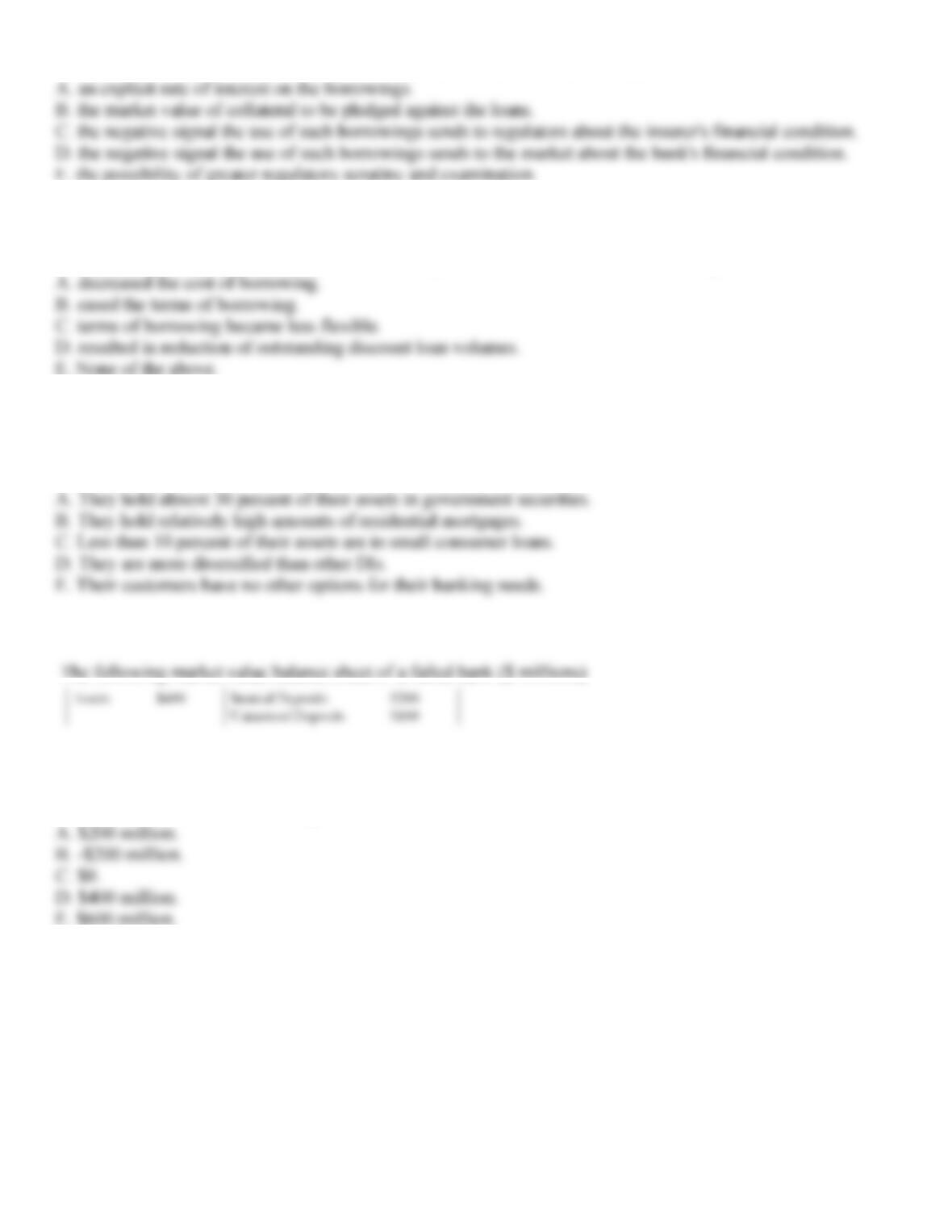
95. The costs to the bank of borrowing at the discount window do NOT include
96. The changes implemented by the Fed in January 2003 to its discount window lending
97. Why are credit unions less affected by financial crises experienced by other thrifts such as savings
associations?
98. What is the market value of capital?
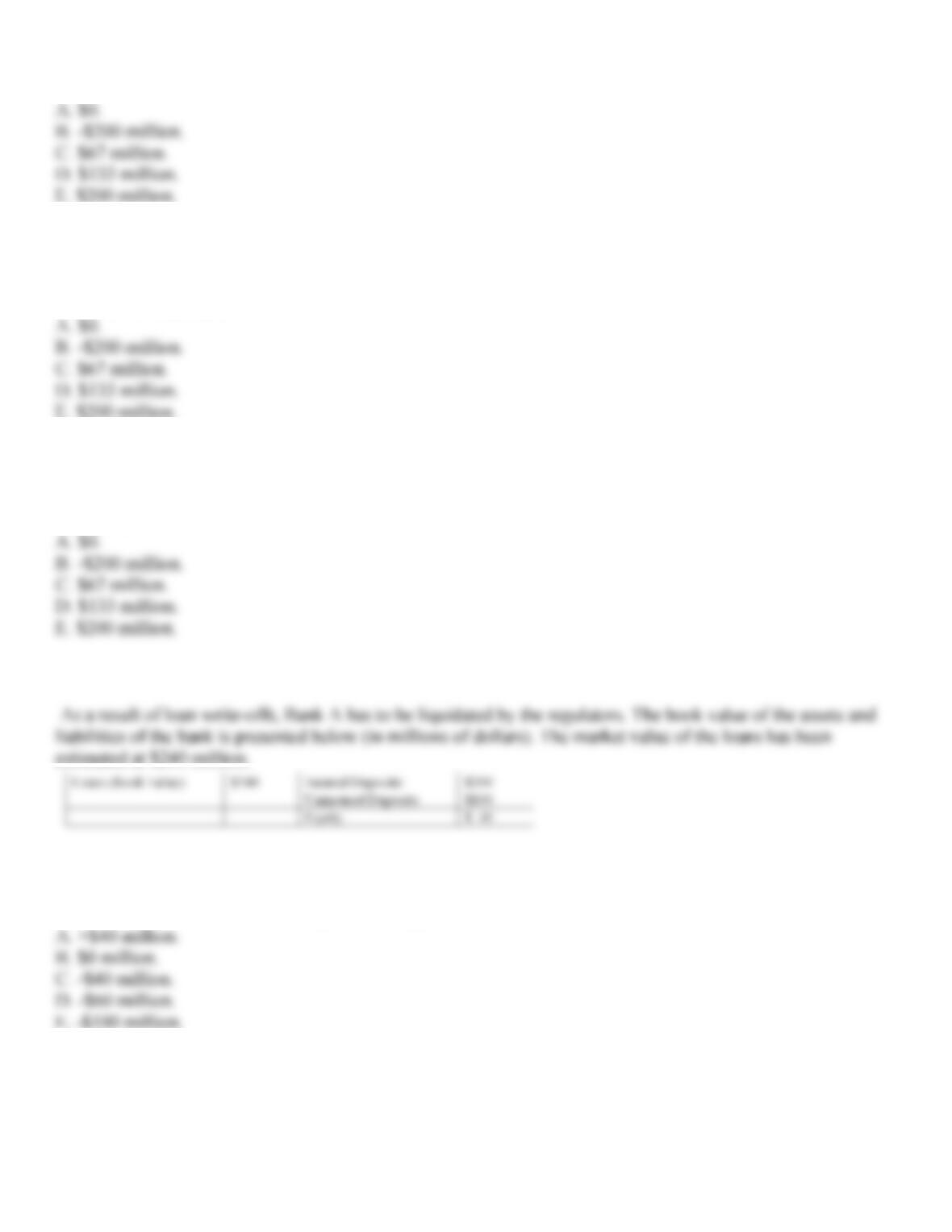
99. If the insured depositor transfer resolution method is utilized, what is the cost to insured depositors of bank
failure resolution?
100. If the insured depositor transfer resolution method is utilized, what is the cost to uninsured depositors of
bank failure resolution?
101. If the insured depositor transfer resolution method is utilized, what is the cost to the FDIC of bank failure
resolution?
102. What is the current net worth (market value) of the bank?

103. What is the cost to the insured depositors if the insured depositor transfer resolution method is used by the
regulators to resolve the bank failure?
104. What is the cost to the uninsured depositors if the insured depositor transfer resolution method is used by
the regulators to resolve the bank failure?
105. What is the cost to the FDIC if the insured depositor transfer resolution method is used by the regulators to
resolve the bank failure?

h19 Key
1. Contagious runs on bank deposits are directed at FIs, whether they are failing or healthy.
2. A run on a bank is not necessarily a bad occurrence.
3. The adverse effects of a contagious run include the restrictions on the ability of individuals to transfer wealth
through time and a negative impact on the level or rate of savings.
4. The Federal safety net to protect the integrity of the payments system consists of deposit insurance and social
welfare.
5. The number of bank failures in the period of 1933-79 was less than the number of failures from 1980-1989.
6. The average cost to the FDIC of each bank failure during the decade of the 1980s was larger than the total
cost of all bank failures during the period 1933-79.
7. During the financial crisis of 2008-2009, deposit balances at DIs increased.
8. Since its inception, the FDIC deposit insurance fund has never fallen to a negative balance.
9. After nearly failing, the FDIC’s Bank Insurance Fund (BIF) achieved record levels of reserves during the
1990s.
12. A major cause of the FSLIC insolvency in the 1980s was the dramatic rise in interest rates in 1979-82 that
created extensive duration mismatches of assets and liabilities in the savings and loan industry.

13. A major reason for the deterioration of the deposit insurance funds in the 1980s was the downturn in the
technology, manufacturing, and real estate industries.
14. Deposit insurance is often blamed for the deterioration in depositor discipline that allowed FIs to accept
more risk in the asset selection process.
15. Moral hazard encourages the FI to take on more, rather than less, risk.
16. The risk of moral hazard increases when capital levels are low.
17. If regulators provide more protection against bank runs, the incidence of moral hazard is likely to increase.
18. Explicit deposit insurance premiums applied by regulators can involve restricting and more closely
monitoring the risky activities of banks.