Chapter 18—Long-Term Debt Financing
1. If an MNC financed with a currency different from its invoice currency, it would prefer that the loan
be denominated in a currency that:
a.
exhibits a low interest rate and is expected to appreciate.
b.
exhibits a low interest rate and is expected to depreciate.
c.
exhibits a high interest rate and is expected to depreciate.
d.
exhibits a high interest rate and is expected to appreciate.
2. Floating-rate bonds are often issued with a floating coupon rate that is tied to LIBOR.
a. True
b. False
3. A U.S. firm could issue bonds denominated in euros and partially hedge against exchange rate risk by:
a.
invoicing its exports in U.S. dollars.
b.
requesting that any imports ordered by the firm be invoiced in U.S. dollars.
c.
invoicing its exports in euros.
d.
requesting that any imports ordered by the firm be invoiced in the currency denominating
the bonds.
4. Lantana Co. conducts pays for many imports denominated in Canadian dollars. It is a major exporter
to France, and invoices the exports in euros. It also has much business in U.S. dollars. It has no other
international business and does not hedge its transactions. It is about to obtain a small loan. It could
reduce its exchange rate risk if its loan is denominated in:
a.
U.S. dollars.
b.
euros.
c.
Canadian dollars
d.
none of the above
5. Simulation is useful in the bond-denomination decision since it can:
a.
precisely compute the cost of financing with bonds denominated in a single foreign
currency.
b.
precisely compute the cost of financing with bonds denominated in a portfolio of foreign
currencies.
c.
assess the probability that a bond denominated in a foreign currency will be less costly
than a bond denominated in the home currency.
d.
A and B
6. An interest rate swap between two firms of different countries enables the exchange of ____ for ____.
a.
fixed-rate payments; floating-rate payments
b.
stock; interest deductions on taxes
c.
interest payments on loans; ownership of debt of less developed countries
d.
interest payments on loans; stock
7. If U.S. firms issue bonds in ____, the dollar outflows to cover fixed coupon payments increase as the
dollar ____.
a.
a foreign currency; weakens
b.
dollars; strengthens
c.
a foreign currency; strengthens
d.
dollars; weakens
8. The yields offered on newly issued bonds tend to be:
a.
lower in less developed countries where labor costs are low.
b.
relatively high in countries such as Japan and the U.S. because the credit risk premium is
much higher there than in other countries.
c.
the same across countries at a give point in time.
d.
none of the above
9. When a U.S.-based MNC has a subsidiary in Mexico that needs financing, the MNC’s exposure to
exchange rate risk can be minimized if:
a.
the parent issues dollar-denominated equity and provides the proceeds to the subsidiary.
b.
the parent provides its retained earnings to the Mexican subsidiary.
c.
the subsidiary obtains a dollar-denominated loan from a financial institution.
d.
the subsidiary obtains a peso-denominated loan from a financial institution.
10. A U.S. firm has received a large amount of cash inflows periodically in Swiss francs as a result of
exporting goods to Switzerland. It has no other business outside the U.S. It could best reduce its
exposure to exchange rate risk by:
a.
issuing Swiss franc-denominated bonds.
b.
purchasing Swiss franc-denominated bonds.
c.
purchasing U.S. dollar-denominated bonds.
d.
issuing U.S. dollar-denominated bonds.
11. A U.S. firm has a Canadian subsidiary that remits a large amount of its earnings to the parent on an
annual basis. It also imports supplies from China, invoiced in Chinese yuan. The firm has no other
foreign business, and needs a small loan. The firm could best reduce its exposure to exchange rate risk
by borrowing:
a.
U.S. dollars.
b.
Canadian dollars.
c.
Chinese yuan.
d.
a combination of Canadian dollars and Chinese yuan.
12. If the currency denominating a foreign bond depreciates against the firm’s home currency, the funds
needed to make coupon payments will increase.
a. True
b. False
13. An interest rate swap is commonly used by an issuer of fixed-rate bonds to:
a.
convert to floating-rate debt.
b.
hedge exchange rate risk.
c.
lock in the interest payments on debt.
d.
remove the default risk of its debt.
14. A currency swap between two firms of different countries enables the exchange of ____ for ____ at
periodic intervals.
a.
stock; one currency
b.
stock; a portfolio of foreign currencies
c.
one currency; stock options
d.
one currency; another currency
15. Assume a U.S.-based subsidiary wants to raise $1,000,000 by issuing a bond denominated in Pakistani
rupees (PKR). The current exchange rate of the rupee is $.02. Thus, the MNC needs ____ rupees to
obtain the $1,000,000 needed.
a.
50,000,000
b.
20,000
c.
1,000,000
d.
none of the above
16. An MNC issues ten-year bonds denominated in 500,000 Philippines pesos (PHP) at par. The bonds
have a coupon rate of 15%. If the peso remains stable at its current level of $.025 over the lifetime of
the bonds and if the MNC holds the bonds until maturity, the financing cost to the MNC will be:
a.
10.0%.
b.
12.5%.
c.
15.0%.
d.
none of the above
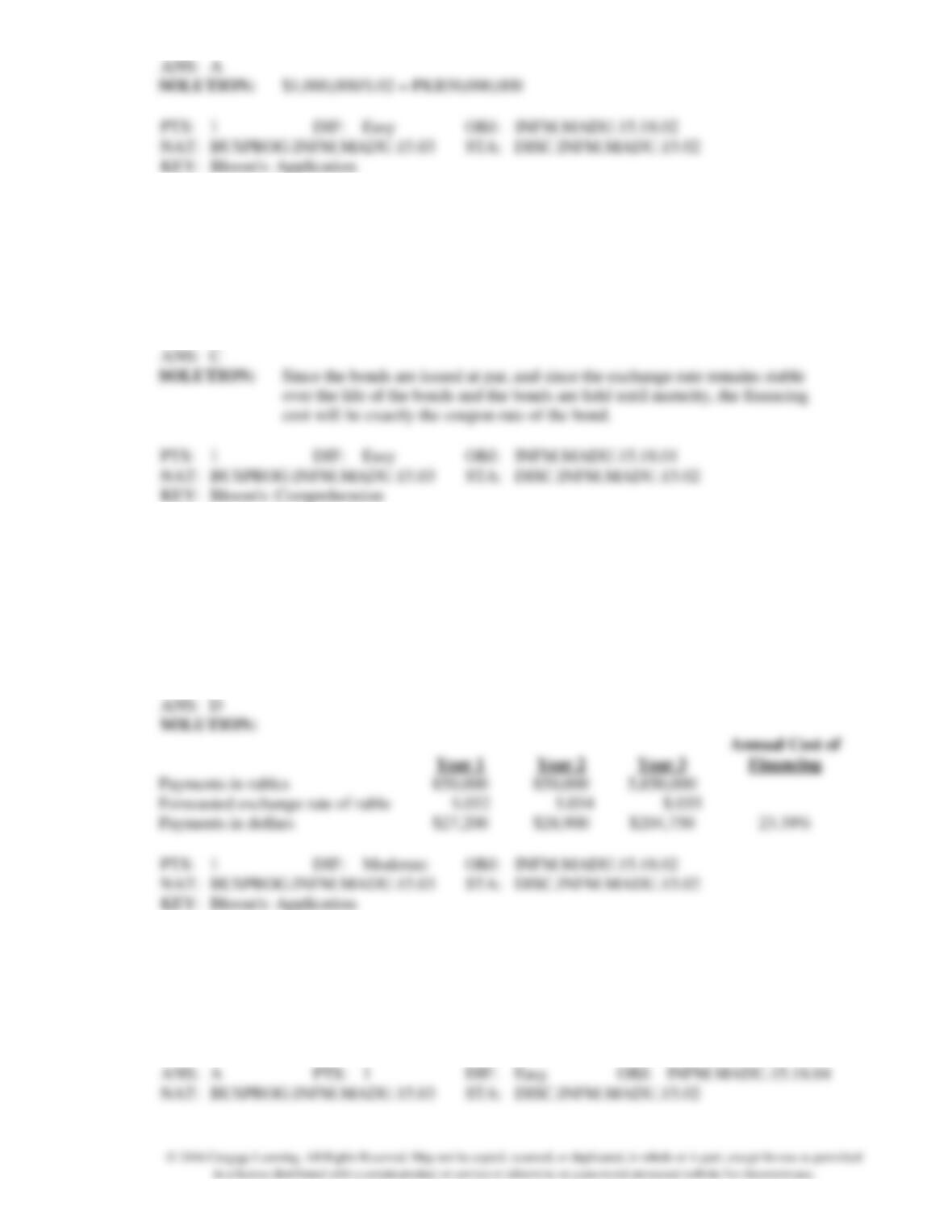
17. New Hampshire Corp. has decided to issue three-year bonds denominated in 5,000,000 Russian rubles
at par. The bonds have a coupon rate of 17%. If the ruble is expected to appreciate from its current
level of $.03 to $.032, $.034, and $.035 in years 1, 2,and 3, respectively, what is the financing cost of
these bonds?
a.
17%.
b.
23.18%.
c.
22.36%.
d.
23.39%.
18. In a(n) ____ swap, two parties agree to exchange payments associated with bonds; in a(n) ____ swap,
two parties agree to periodically exchange foreign currencies.
a.
interest rate; currency
b.
currency; interest rate
c.
interest rate; interest rate
d.
currency; currency
19. Good Company prefers variable to fixed rate debt. Bad Company prefers fixed to variable rate debt.
Assume the following information for Good and Bad Companies:
Fixed Rate Bond
Variable Rate Bond
Good Company
10%
LIBOR + 1%
Bad Company
12%
LIBOR + 1.5%
Given this information:
a.
an interest rate swap will probably not be advantageous to Good Company because it can
issue both fixed and variable debt at more attractive rates than Bad Company.
b.
an interest rate swap attractive to both parties could result if Good Company agreed to
provide Bad Company with variable rate payments at LIBOR + 1% in exchange for fixed
rate payments of 10.5%.
c.
an interest rate swap attractive to both parties could result if Bad Company agreed to
provide Good Company with variable rate payments at LIBOR + 1% in exchange for fixed
rate payments of 10.5%.
d.
none of the above
20. A callable swap gives the ____ payer the right to terminate the swap; the MNC would exercise this
right if interest rates ____ substantially.
a.
floating-rate; rise
b.
floating-rate; fall
c.
fixed-rate; rise
d.
fixed-rate; fall
e.
none of the above
21. When an MNC needs to finance a portion of a foreign project within the foreign country, the best
method to account for a foreign project’s risk is to:
a.
apply a required return that is based on the CAPM.
b.
apply a required return based on unsystematic risk.
c.
derive the net present value of the equity investment.
d.
apply the required return equal to the risk-free rate in the foreign country.
22. Assume that a yield curve’s shape is caused by liquidity. An MNC may be tempted to finance with a
maturity that is less than the expected life of the project when the yield curve is:
a.
flat.
b.
inverted.
c.
upward-sloping.
d.
downward sloping.
23. If the foreign currency that was borrowed appreciates over time, an MNC will need fewer funds to
cover the coupon or principal payments. [Assume the MNC has no other cash flows in that currency.]
a. True
b. False
24. U.S.-based MNCs whose foreign subsidiary generates large earnings may be able to offset exposure to
exchange rate risk by issuing bonds denominated in the subsidiary’s local currency.
a. True
b. False
25. Countries in emerging markets such as in Latin America tend to have ____ interest rates, and so the
yields offered on bonds issued in those countries is ____.
a.
low; high
b.
high; low
c.
high; high
d.
none of the above
26. MNCs can use ____ to reduce exchange rate risk. This occurs when two parties provide simultaneous
loans with an agreement to repay at a specified point in the future.
a.
forward contracts
b.
currency swaps
c.
parallel loans
d.
none of the above
27. An upward-sloping yield curve for a foreign country means that annualized yields there are ____ for
short-term debt than for long-term debt. The yield curve in this country reflects ____.
a.
higher; several periods
b.
lower; several periods
c.
higher; a specific point in time
d.
lower; a specific point in time
28. The ____ for a given country represents the annualized yield offered on debt for various maturities.
a.
LIBOR
b.
yield curve
c.
parallel loan
d.
interest rate swap
29. When an MNC finances with a floating-rate loan in a currency that matches its long-term cash inflows,
the MNC is exposed to ____ risk.
a.
short; interest rate
b.
long; interest rate
c.
short; exchange rate
d.
none of the above
30. Some MNCs use a country’s yield curve to compare annualized rates among debt maturities, so that
they can choose a maturity that has a relatively low rate.
a. True
b. False
31. As a(n) ____ to an interest rate swap, a financial institution simply arranges a swap between two
parties.
a.
ultraparty
b.
broker
c.
counterparty
d.
none of the above
32. In general, the ____ rate payer in a plain vanilla swap believes interest rates are going to ____.
a.
fixed; decline
b.
floating; decline
c.
floating; increase
d.
none of the above
33. In a(n) ____ swap, the fixed rate payer has the right to terminate the swap.
a.
callable
b.
putable
c.
amortizing
d.
zero-coupon
34. In a(n) ____ swap, the notional value is increased over time.
a.
amortizing
b.
basis
c.
zero-coupon
d.
accretion
35. A ____ gives its owner the right to enter into a swap.
a.
basis swap
b.
swaption
c.
callable swap
d.
putable swap
36. Foreign subsidiaries of U.S. MNCs can finance projects with dollars in order to avoid exchange rate
risk.
a. True
b. False
37. The actual financing cost of a U.S. corporation issuing a bond denominated in euros is affected by the
euro’s value relative to the U.S. dollar during the financing period.
a. True
b. False
38. A floating coupon rate is an advantage to the bond issuer during periods of increasing interest rates.
a. True
b. False
39. An MNC issuing pound-denominated bonds may be completely insulated from exchange rate risk
associated with the bond if its foreign subsidiary makes the coupon and principal payments of the bond
with its pound receivables.
a. True
b. False
40. If an MNC uses a long-term forward contract to hedge the exchange rate risk associated with a bond
denominated in euros, it would sell euros forward.
a. True
b. False
41. Currency swaps, whereby two parties exchange currencies at a specified point in time for a specified
price, are often used by MNCs to hedge against interest rate risk.
a. True
b. False
42. A limitation of interest rate swaps is that there is a risk to each swap participant that the
counterparticipant could default on his payments.
a. True
b. False
43. Many MNCs simultaneously swap interest payments and currencies.
a. True
b. False
44. A parallel loan represents simultaneous loans provided by two parties with an agreement to repay at a
specified point in the future.
a. True
b. False
45. Since yield curves are identical across countries, MNCs rarely consider them when deciding on the
maturity of bonds denominated in a foreign currency.
a. True
b. False
46. Fixed-rate loans have interest rates that are fixed for each year but adjust at the end of each year in
response to prevailing interest rates.
a. True
b. False
47. If the currency denominating a foreign bond depreciates against the firm’s home currency over the
lifetime of the bond, the funds needed to make coupon payments will increase.
a. True
b. False
48. Even if the interest rate associated with a foreign country is higher than the domestic interest rate, the
financing costs of a foreign bond will always be lower than the financing rate of a domestic bond as
long as the currency depreciates over the lifetime of a bond.
a. True
b. False
49. If the currency of a foreign currency-denominated bond ____, the funds needed to make coupon
payments will ____.
a.
appreciates; increase
b.
depreciates; decrease
c.
appreciates; decrease
d.
depreciates; increase
e.
A and B
50. Generally, the financing costs associated with a foreign currency-denominated bond will be ____
volatile than the financing costs of a domestic bond because of ____.
a.
more; exchange rate movements
b.
less; exchange rate movements
c.
less; global economic conditions
d.
none of the above
51. ____ swaps are often used by companies to hedge against ____ rate risk.
a.
Currency; interest
b.
Interest; interest
c.
Interest; exchange
d.
Currency; exchange
e.
B and D
52. ____ are commonly used to hedge interest rate risk.
a.
Currency swaps
b.
Parallel loans
c.
Interest rate swaps
d.
Forward contracts
e.
None of the above
53. In a(n) ____ swap, the notional value is reduced over time.
a.
accretion
b.
amortizing
c.
forward
d.
zero-coupon
e.
putable
54. A(n) ____ swap is entered into today, but the swap payments start at a specific future point in time.
a.
accretion
b.
amortizing
c.
forward
d.
zero-coupon
e.
putable