
Name:
Class:
Date:
chapter 18
Indicate whether the statement is true or false.
1. Lean Six Sigma focuses on real dollar savings and has the ability to make significant financial impacts on an
organization.
a. True
b. False
2. In the context of Kanban systems, a withdrawal Kanban authorizes the gateway workstation to produce parts.
a. True
b. False
3. Long setup times enable a manufacturer to have frequent changeovers and move toward single-piece flow, thus
achieving high flexibility and product variety.
a. True
b. False
4. Any activity, material, or operation that does not add value in an organization is considered waste.
a. True
b. False
5. Kanban is a Japanese word that means elimination of waste.
a. True
b. False
6. Total productive maintenance (TPM) seeks to reduce worker ownership of production equipment by excluding
employees from maintenance activities.
a. True
b. False
7. Lean operating systems value idle stock and extra storage because it eliminates wait times to replenish stock.
a. True
b. False
8. In the Timken company’s bootcamp, employees and managers try to solve problems, such as removing non-value-
added steps from processes to try to eliminate waste.
a. True
b. False
Indicate the answer choice that best completes the statement or answers the question.
9. In the context of the 5S principles, _____ means to arrange materials and equipment so that they are easy to find and
use.
a. shine
b. standardize
c. sustain to produce

Name:
Class:
Date:
chapter 18
d. set in order
10. Which of the following is true of a push manufacturing system?
a. It leads to high work-in-process inventories and high levels of indirect labor and overhead.
b. In this system, just enough new parts are procured to replace those withdrawn.
c. In this system, finished goods are made to coincide with the actual rate of demand.
d. It leads to minimal inventories and maximum responsiveness.
11. In the context of lean tools and approaches, _____, one of the components of the 5S principles, refers to a clean work
area.
a. shine
b. standardize
c. sort
d. sustain
12. A _____ is a flag or a piece of paper that contains all relevant information for an order, such as part number,
description, process area used, time of delivery, quantity available, quantity delivered, production quantity, and so on.
a. Kaikaku
b. Jidoka
c. Kaizen
d. Kanban
13. In the context of the Toyota Motor Company’s seven categories of waste, the result of not performing work correctly
the first time is an example of _____.
a. production defects
b. processing
c. inventory
d. overproduction
14. Which of the following is an example of waste in organizations?
a. Short order-cycle time
b. Routing a job
c. Planned product obsolescence
d. High product variety
15. _____ is one in which employees at a given operation go to the source of required parts, such as machining or
subassembly, and withdraw the units as they need them.
a. A classic base-stock system
b. A push system
c. A materials requirement planning system
d. A pull system
16. In the context of the 5S principles, _____ refers to ensuring that each item in a workplace is in its proper place or
identified as unnecessary and removed.
a. sort
b. sustain

Name:
Class:
Date:
chapter 18
c. standardize
d. set in order
17. A company is using a Kanban system with 2 containers, each holding 50 parts, between a downstream (using) and an
upstream (producing) work center. The using work center can handle 250 jobs per day. The average elapsed time for the
entire cycle is currently 0.25 days. The company is concerned about the safety factor for the operation. Which of the
following is the safety factor (α) of the current operation?
a. 20 percent
b. 60 percent
c. 80 percent
d. 40 percent
18. In the context of lean tools and approaches, _____ are indicators for operating activities that are placed in plain sight
of all employees so that everyone can quickly and easily understand the status and performance of the work system.
a. Kanban cards
b. push systems
c. pull systems
d. visual controls
19. Which of the following is not true about lean principles?
a. Lean manufacturing plants look significantly different from traditional plants.
b. They are always transferable to front-office services that involve high customer contact.
c. Lean manufacturing plants use multi-skilled workers who perform both direct and indirect work.
d. In the airline industry, idle time is the largest form of waste.
20. Create & Sell Manufacturing Inc. uses a Kanban system for a component. The daily demand is 175 units. Each
container has a combined waiting and processing time of 0.20 days. If the container size is 10 brackets and the safety
factor is 11 percent, how many Kanban card sets should be authorized?
a. 2
b. 4
c. 6
d. 7
21. In the context of the 5S principles, _____ means to keep a process going through training, communication, and
organizational structures.
a. shine
b. sort
c. sustain
d. standardize
22. Drive-in-Style Motors follows a traditional manufacturing system. It produces a fixed number of cars every month. It
is now planning to switch to a system of manufacturing where workers go to the source of required parts and withdraw
them based on requirements. In this scenario, which of the following is most likely to occur if Drive-in–Style Motors
implements this plan?
a. Its inventory levels will increase significantly when the demand is low.
b. Its component parts and subassemblies will be replenished only when needed.
c. Its finished goods inventory will decrease, but raw materials and work-in-process inventories will increase.

Name:
Class:
Date:
chapter 18
d. Its workers, at any given process, will produce units before they are needed.
23. Which of the following is a similarity between lean production and Six Sigma?
a. Both solely address visible problems in processes.
b. Both focus on efficiency by reducing waste and improving process flow.
c. Both are driven by customer requirements.
d. Both focus on problems related to variation in performance.
24. A _____ system produces finished-goods inventory in advance of customer demand using a forecast of sales.
a. just-in-time
b. push
c. Kanban
d. pull
25. Which of the following is a difference between lean production and Six Sigma?
a. The lean production technique can be used in nonmanufacturing environments, whereas Six Sigma cannot be used
in nonmanufacturing environments.
b. Lean production addresses less visible problems in processes, whereas Six Sigma is more concerned with visible
problems.
c. Lean production is focused on effectiveness by reducing errors and defects, whereas Six Sigma is focused on
efficiency by reducing waste and improving process flow.
d. Lean production tools are more intuitive and easier to apply by anybody in the workplace, whereas many Six
Sigma tools require advanced training and expertise of specialists.
26. Quickly changing tooling and fixtures to reduce setup time and achieve higher flexibility and productivity is the
principle of _____.
a. Kanban
b. andon
c. the 5Ss
d. SMED
27. A manufacturer of automobile engines is designing a new Kanban system for engine #321. The demand for #321 is 75
parts per day, and the container can hold 8 parts at a time. The total processing and waiting time is 3 days. The manager
wants a safety factor (α) of 2 or 200 percent. How many Kanbans are required in this system?
a. 85
b. 90
c. 100
d. 115
28. In the context of the major categories of waste classified by the Toyota Motor Company, which of the following is
true of overproduction?
a. It ties up production facilities, and the resulting excess inventory simply sits idle.
b. It is waste associated with the expense of idle stock and extra storage.
c. It allows queues to build up between operations, resulting in longer lead times.
d. It is a result of inefficient workplace design and location of tools and materials.
Name:
Class:
Date:
chapter 18
29. In the airline industry, short setup and turnaround time translates into _____.
a. idle time
b. fewer service encounters
c. overproduction
d. higher asset utilization
30. _____ is focused on ensuring that operating systems will perform their intended function reliably.
a. Total productive maintenance
b. A just-in-time system
c. An intermittent production system
d. Total quality management
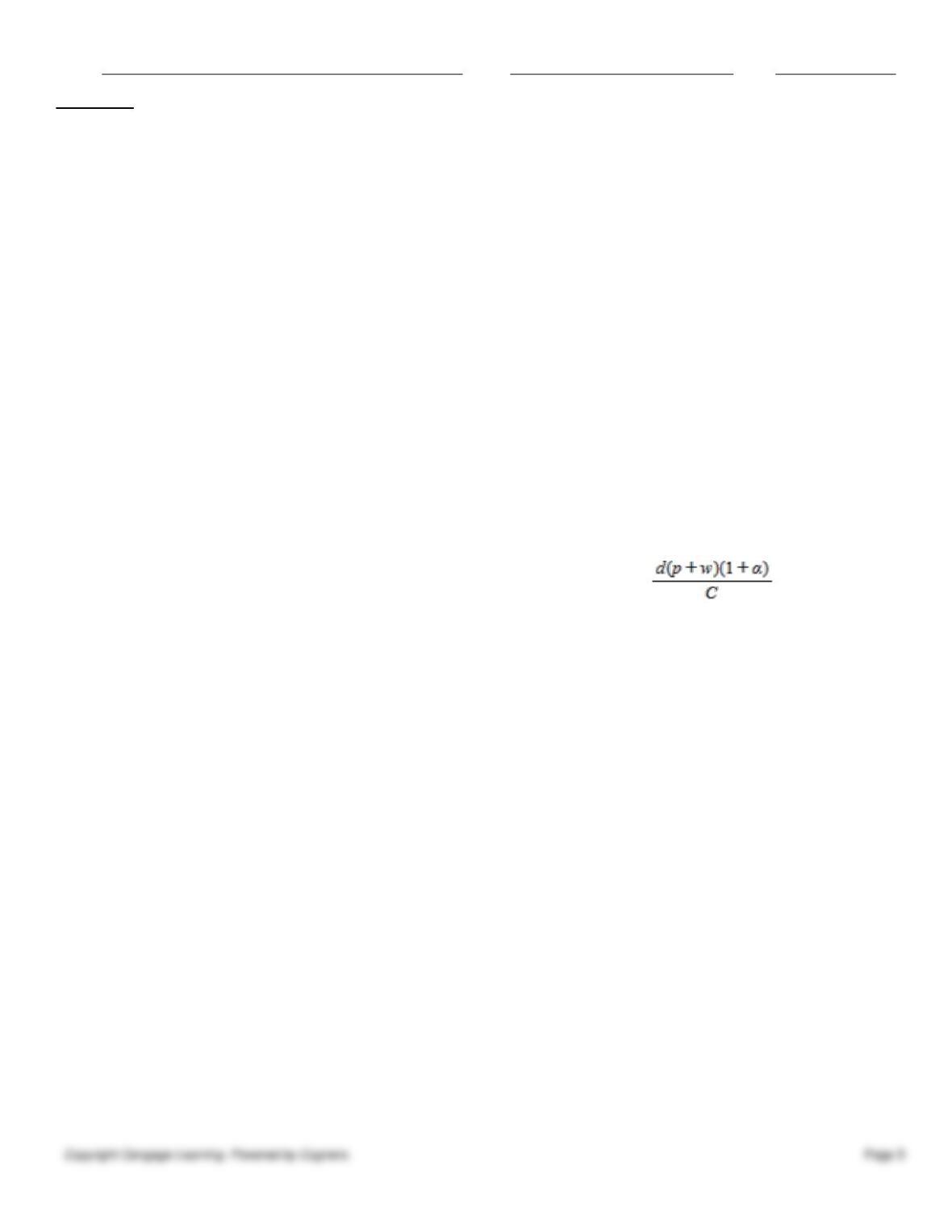
31. A hinge manufacturing company employs a Kanban system for a component part. The daily demand is 900 hinges.
Each container has a waiting time of 0.05 days and a processing time of 0.37 days. The container size is 60 hinges, and the
safety factor (α) is 10 percent. Given this data, the number of Kanbans necessary for the system is:
a. less than 4 Kanbans.
b. more than 4 but less than or equal to 8 Kanbans.
c. more than 8 but less than or equal to 12 Kanbans.
d. more than 12 but less than or equal to 16 Kanbans.
32. The equation used to calculate the number of Kanban cards required in a system is , where α denotes
_____.
a. the demand during lead time
b. a form of safety stock
c. capacity utilization
d. the reorder point
Name:
Class:
Date:
chapter 18
Answer Key
Name:
Class:
Date:
chapter 18