64. What is the impact of a 50 basis point increase in interest rates on the net asset value of an open-end bond
mutual fund holding a seven year, $100 million par value 7 percent annual coupon bond? The fund has 10
million shares.
65. In the event of financial distress, open-ended mutual fund investors
66. The surrender value of an insurance policy is
67. Which intermediation function results in an FI’s exposure to liquidity risk?
68. How does liability management affect profitability?
69. When comparing banks and mutual funds,
70. Which of the following is NOT a primary source of liquidity?
71. Which of the following is NOT a method of measuring liquidity?
72. What information does the net liquidity statement provide?
73. Which of the following is a measure of the potential losses an FI could suffer as the result of fire-sale
disposal of assets?
74. A DI has two assets: 50 percent in one-month Treasury bills and 50 percent in real estate loans. If the DI
must liquidate its T-bills today, it receives $98 per $100 of face value; if it can wait to liquidate them on
maturity (in one month’s time), it will receive $100 per $100 of face value. If the DI has to liquidate its real
estate loans today, it receives $90 per $100 of face value liquidation at the end of one month will produce $92
per $100 of face value. The one-month liquidity index value for this DI’s asset portfolio is
75. What does a high ratio of loans to deposits indicate?
76. In terms of liquidity risk measurement, the financing gap is defined as
77. In terms of liquidity risk measurement, the financing requirement is defined as
78. In a crisis, which of the following are more likely to withdraw funds quickly from banks and thrifts?
79. In a crisis, which of the following are relatively less likely to withdraw funds quickly from banks and
thrifts?
80. Which of the following observations concerning the Fed’s discount window is true?
81. What are the two major liquidity risk insulation devices available?
82. What is the drawback of deposit insurance facility?
83. Which of the following is NOT a component of liquidity planning?
84. A liquidity plan will include
85. Which of the following statements is true?
86. Consider a mutual fund with 100 shareholders who each invested $10 for a total of $1,000. If the assets of
the mutual fund are worth $900, what is the net asset value for each one of the mutual fund shares?
87. The price at which an open-end investment fund stands ready to redeem existing shares is the
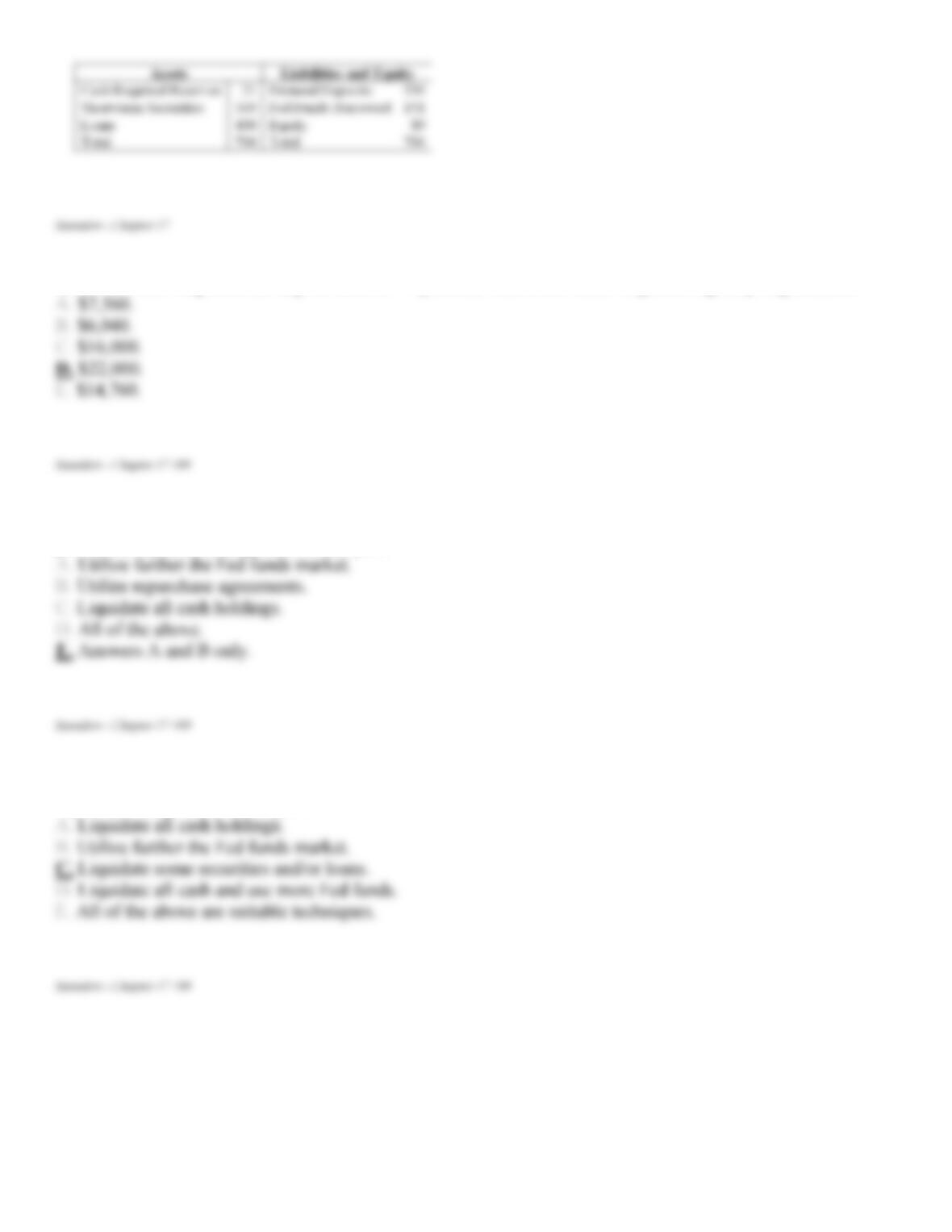
88. If the bank’s expected net deposit drain is +4 percent, what is the bank’s expected liquidity requirement?
89. What are the possible ways that the bank can meet an expected net deposit drain of +4 percent using
purchased liquidity management techniques?
90. What are the possible ways that the bank can meet an expected net deposit drain of +4 percent using stored
liquidity management techniques?
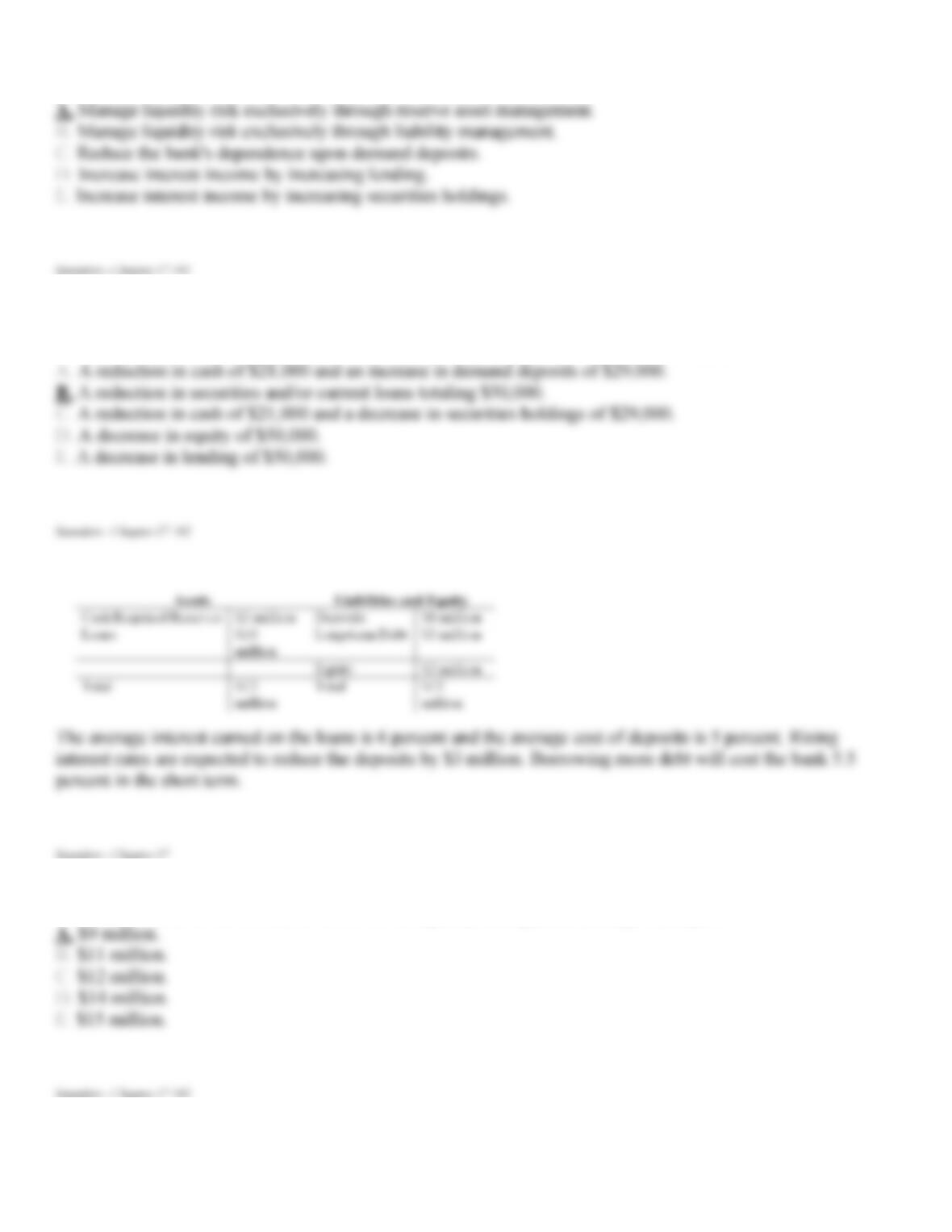
91. If the bank decides to cut down on interest expenses by reducing its dependence upon borrowed funds, what
policy must the bank follow?
92. If the bank experiences a $50,000 sudden liquidity drain caused by a loan commitment draw down, what
will be the impact on the balance sheet if stored liquidity management techniques are used?
93. What will be the size of the bank if a stored liquidity management strategy is adopted?
94. What will be the cost of using a strategy of reducing its asset base to meet the expected decline in deposits?
Assume that the bank intends to keep $2 million in cash as a liquidity precaution.
95. What will be the cost of using a strategy of purchased liquidity management to meet the expected decline in
deposits? Assume that the bank intends to keep $2 million in cash as liquidity precaution.
96. What will be the size of the bank if a purchased liquidity management strategy is adopted?

97. What are the bank’s total available sources of liquidity?
98. What are the bank’s current total uses of liquidity?
99. What is the net liquidity of the bank?
100. Assume that the T-Bills can only be sold at a 10 percent discount, what is the net liquidity of the bank
given this information?