
Chapter 17 – Markov Processes
True / False
1. Markov processes use historical probabilities.
a. True
b. False
2. All entries in a matrix of transition probabilities sum to 1.
a. True
b. False
3. All Markov chain transition matrices have the same number of rows as columns.
a. True
b. False
4. A unique matrix of transition probabilities should be developed for each customer.
a. True
b. False
5. The probability that the system is in state 2 in the 5th period is π5(2).
a. True
b. False
6. The fundamental matrix is used to calculate the probability of the process moving into each absorbing state.
a. True
b. False
7. Steady state probabilities are independent of initial state.
a. True
b. False
Chapter 17 – Markov Processes
8. A Markov chain cannot consist of all absorbing states.
a. True
b. False
9. If an absorbing state exists, then the probability that a unit will ultimately move into the absorbing state is given by the
steady state probability.
a. True
b. False
10. All Markov chains have steady-state probabilities.
a. True
b. False
11. All entries in a row of a matrix of transition probabilities sum to 1.
a. True
b. False
12. A state i is a transient state if there exists a state j that is reachable from i, but the state i is not reachable from state j.
a. True
b. False
13. A state i is an absorbing state if pii = 0.
a. True
b. False
14. When absorbing states are present, each row of the transition matrix corresponding to an absorbing state will have a
single 1 and all other probabilities will be 0.
Chapter 17 – Markov Processes
a. True
b. False
15. For Markov processes having the memoryless property, the prior states of the system must be considered in order to
predict the future behavior of the system.
a. True
b. False
16. The sum of the probabilities in a transition matrix equals the number of rows in the matrix.
a. True
b. False
17. Transition probabilities are conditional probabilities.
a. True
b. False
18. A state, i, is an absorbing state if, when i = j, pij = 1.
a. True
b. False
19. If a Markov chain has at least one absorbing state, steady-state probabilities cannot be calculated.
a. True
b. False
20. State j is an absorbing state if pij = 1.
a. True
b. False
Chapter 17 – Markov Processes
Multiple Choice
21. In Markov analysis, we are concerned with the probability that the
a. state is part of a system.
b. system is in a particular state at a given time.
c. time has reached a steady state.
d. transition will occur.
22. For a situation with weekly dining at either an Italian or Mexican restaurant,
a. the weekly visit is the trial and the restaurant is the state.
b. the weekly visit is the state and the restaurant is the trial.
c. the weekly visit is the trend and the restaurant is the transition.
d. the weekly visit is the transition and the restaurant is the trend.
23. A transition probability describes
a. the probability of a success in repeated, independent trials.
b. the probability a system in a particular state now will be in a specific state next period.
c. the probability of reaching an absorbing state.
d. None of the alternatives is correct.
24. The probability of going from state 1 in period 2 to state 4 in period 3 is
a. p12
b. p23
c. p14
d. p43
25. The probability that a system is in a particular state after a large number of periods is
a. independent of the beginning state of the system.
b. dependent on the beginning state of the system.
c. equal to one half.
d. the same for every ending system.
Chapter 17 – Markov Processes
26. At steady state
a. π1(n+1) > π1(n)
b. π1 = π2
c. π1 + π2 ≥ 1
d. π1(n+1) = π1
27. Analysis of a Markov process
a. describes future behavior of the system.
b. optimizes the system.
c. leads to higher order decision making.
d. All of the alternatives are true.
28. If the probability of making a transition from a state is 0, then that state is called a(n)
a. steady state.
b. final state.
c. origin state.
d. absorbing state.
29. Absorbing state probabilities are the same as
a. steady state probabilities.
b. transition probabilities.
c. fundamental probabilities.
d. None of the alternatives is true.
30. The probability of reaching an absorbing state is given by the
a. R matrix.
b. NR matrix.
c. Q matrix.
d. (I − Q)−1 matrix
Subjective Short Answer
Chapter 17 – Markov Processes
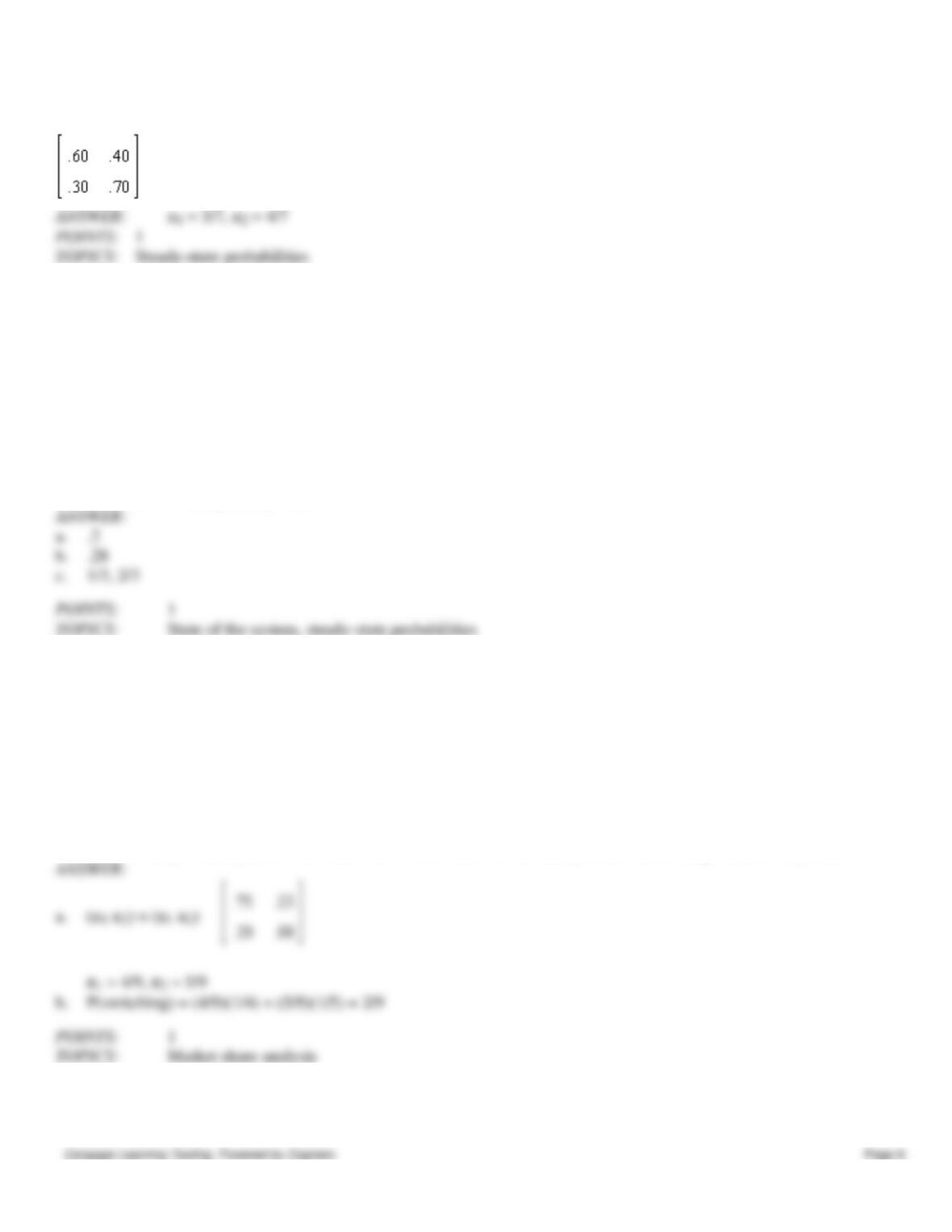
31. Calculate the steady state probabilities for this transition matrix.
32. Two airlines offer conveniently scheduled flights to the airport nearest your corporate headquarters. Historically,
flights have been scheduled as reflected in this transition matrix.
Current Next Flight
Flight Airline A Airline B
Airline A .6 .4
Airline B .2 .8
a. If your last flight was on B, what is the probability your next flight will be on A?
b. If your last flight was on B, what is the probability your second next flight will be on A?
c. What are the steady state probabilities?
33. The matrix of transition probabilities below deals with brand loyalty to Bark Bits and Canine Chow dog food.
Current
Purchase Next Purchase
Bark Bits Canine Chow
Bark Bits .75 .25
Canine Chow .20 .80
a. What are the steady state probabilities?
b. What is the probability that a customer will switch brands on the next purchase after a large number of periods?
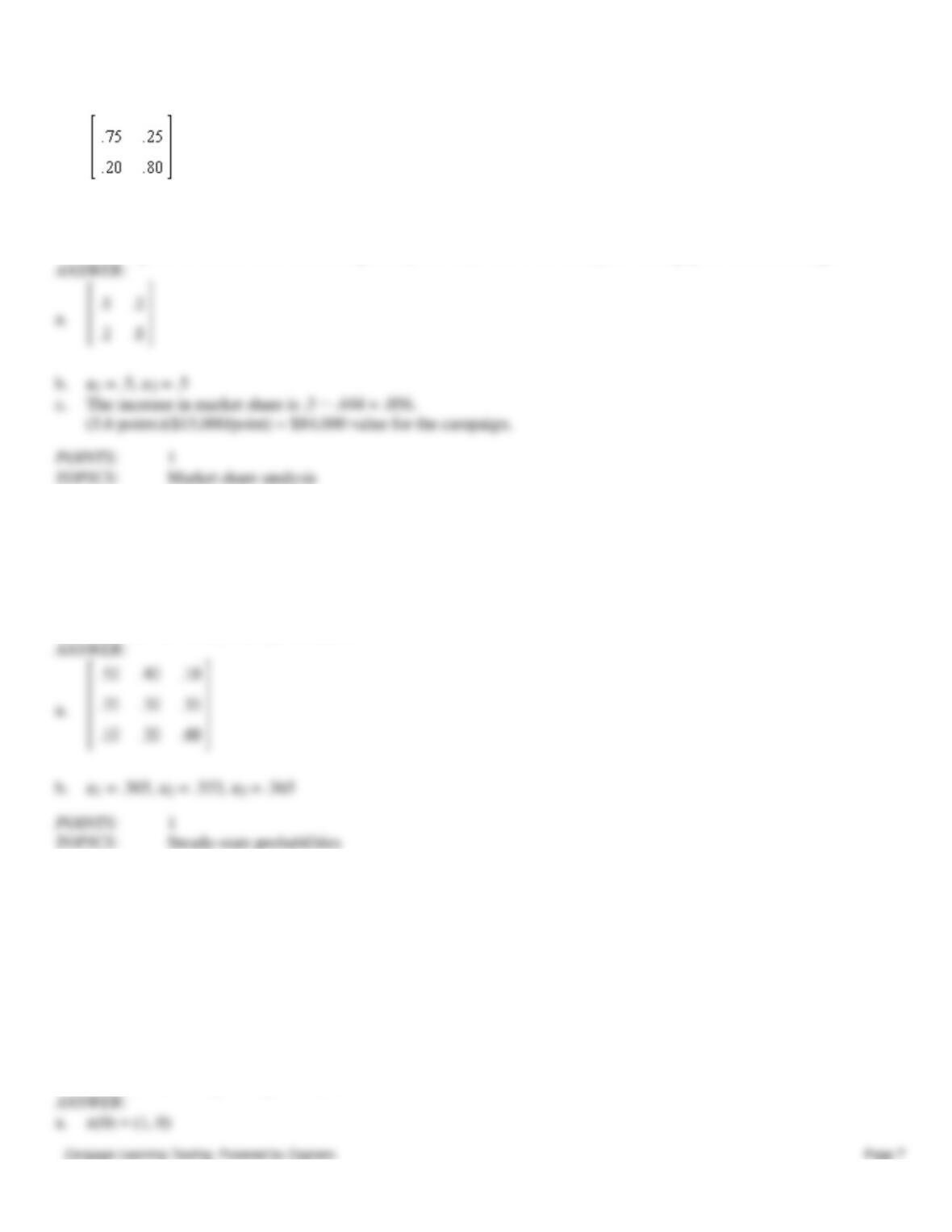
34. Bark Bits Company is planning an advertising campaign to raise the brand loyalty of its customers to .80.
a. The former transition matrix is
Chapter 17 – Markov Processes
What is the new one?
b. What are the new steady state probabilities?
c. If each point of market share increases profit by $15000, what is the most you would pay for the advertising?
35. The daily price of a farm commodity is up, down, or unchanged from the day before. Analysts predict that if the last
price was down, there is a .5 probability the next will be down, and a .4 probability the price will be unchanged. If the last
price was unchanged, there is a .35 probability it will be down and a .35 probability it will be up. For prices whose last
movement was up, the probabilities of down, unchanged, and up are .1, .3, and .6.
a. Construct the matrix of transition probabilities.
b. Calculate the steady state probabilities.
36. Appointments in a medical office are scheduled every 15 minutes. Throughout the day, appointments will be running
on time or late, depending on the previous appointment only, according to the following matrix of transition probabilities:
Previous
Appointment Next Appointment
On Time Late
On Time .75 .25
Late .30 .70
a. The day begins with the first appointment on time. What are the state probabilities for periods 1, 2, 3 and 4?
b. What are the steady state probabilities?
Chapter 17 – Markov Processes
37. A city is served by three cable TV companies: Xcellent Cable, Your Cable, and Zephyr Cable. A survey of 1000 cable
subscribers shows this breakdown of customers from the beginning to the end of August.
Company on
August 1 Company on August 31
Xcellent Your Zephyr
Xcellent 300 50 50
Your 10 200 40
Zephyr 40 80 230
a. Construct the transition matrix.
b. What was each company’s share of the market at the beginning and the end of the month?
c. If the current trend continues what will the market shares be?
38. A television ratings company surveys 100 viewers on March 1 and April 1 to find what was being watched at 6:00
p.m. — the local NBC affiliate’s local news, the CBS affiliate’s local news, or “Other” which includes all other channels
and not watching TV. The results show
March 1
Choice Record of Switches During March to
Number NBC CBS Other
NBC 30 — 5 10
CBS 40 15 — 5
Other 30 5 5 —
a. What are the numbers in each choice for April 1?
b. What is the transition matrix?
c. What ratings percentages do you predict for May 1?
Chapter 17 – Markov Processes
39. Accounts receivable have been grouped into the following states:
State 1: Paid
State 2: Bad debt
State 3: 0-30 days old
State 4: 31-60 days old
Sixty percent of all new bills are paid before they are 30 days old. The remainder of these go to state 4. Seventy percent of
all 30 day old bills are paid before they become 60 days old. If not paid, they are permanently classified as bad debts.
a. Set up the one month Markov transition matrix.
b. What is the probability that an account in state 3 will be paid?
40. The medical prognosis for a patient with a certain disease is to recover, to die, to exhibit symptom 1, or to exhibit
symptom 2. The matrix of transition probabilities is
Recover Die S1 S2
Recover 1 0 0 0
Die 0 1 0 0
S1 1/4 1/4 1/3 1/6
S2 1/4 1/8 1/8 1/2
Chapter 17 – Markov Processes
a. What are the absorbing states?
b. What is the probability that a patient with symptom 2 will recover?
41. Rent-To-Keep rents household furnishings by the month. At the end of a rental month a customer can: a) rent the item
for another month, b) buy the item, or c) return the item. The matrix below describes the month-to–month transition
probabilities for 32-inch stereo televisions the shop stocks.
This
Month Next Month
Rent Buy Return
Rent .72 .10 .18
Buy 0 1 0
Return 0 0 1
What is the probability that a customer who rented a TV this month will eventually buy it?
42. A recent study done by an economist for the Small Business Administration investigated failures of small business.
Failures were either classified as due to poor financing, poor management, or a poor product. The failure rates differed for
new businesses (under one year old) versus established businesses (over one year old.)
As the result of the economist’s study, the following probabilities were determined. For new businesses the probability of
failure due to financing was .15, due to management .20, and due to product .05. The corresponding probabilities for
established businesses were .10, .06, and .03 respectively.
a.
Determine a five-state Markov Chain transition matrix with states for new, established, and each of the three failure
states. Write it in the form of I, O, R, and Q submatrices.
b. Determine the probability that a new business will survive during the next three years.
c. What proportion of new businesses eventually fail due to:
(1) poor financing? (2) poor management? (3) poor product?
Chapter 17 – Markov Processes
43. On any particular day an individual can take one of two routes to work. Route A has a 25% chance of being
congested, whereas route B has a 40% chance of being congested.
The probability of the individual taking a particular route depends on his previous day’s experience. If one day he takes
route A and it is not congested, he will take route A again the next day with probability .8. If it is congested, he will take
route B the next day with probability .7.
On the other hand, if on a day he takes route B and it is not congested, he will take route B again the next day with
probability .9. Similarly if route B is congested, he will take route A the next day with probability .6.
a. Construct the transition matrix for this problem. (HINT: There are 4 states corresponding to the route taken and the
congestion. The transition probabilities are products of the independent probabilities of congestion and next day choice.)
b. What is the long-run proportion of time that route A is taken?
44. Henry, a persistent salesman, calls North’s Hardware Store once a week hoping to speak with the store’s buying agent,
Shirley. If Shirley does not accept Henry’s call this week, the probability she will do the same next week is .35. On the
other hand, if she accepts Henry’s call this week, the probability she will not do so next week is .20.
a. Construct the transition matrix for this problem.
b. How many times per year can Henry expect to talk to Shirley?
c. What is the probability Shirley will accept Henry’s next two calls if she does not accept his call this week?
d. What is the probability of Shirley accepting exactly one of Henry’s next two calls if she accepts his call this week?
45. Rent-To-Keep rents household furnishings by the month. At the end of a rental month a customer can: a) rent the item
for another month, b) buy the item, or c) return the item. The matrix below describes the month-to-month transition
Chapter 17 – Markov Processes
probabilities for 32-inch stereo televisions the shop stocks.
Next Month
Rent Buy Return
Rent .72 .10 .18
This Month Buy 0 1 0
Return 0 0 1
What is the probability that a customer who rented a TV this month will eventually buy it?
46. Joe Ferris, a stock trader at the brokerage firm of Smith, Jones, Johnson, and Thomas, Inc. has noticed that price
changes in the shares of Dollar Department Stores at each trade are dependent upon the previous trade’s price change. His
observations can be summarized by the following transition matrix.
Current Next Price Change
Price Change +1/8 0 -1/8
+1/8 .7 .2 .1
0 .3 .4 .3
-1/8 .2 .1 .7
a. What is the long-run average change in the value of a share of Dollar Department Stores’ stock per trade?
b. If the shares of Dollar Department Stores are currently traded at $18 and the last trade was at 17 7/8, what is the
probability the shares will sell at 18 in two trades?
Chapter 17 – Markov Processes
47. Joe Isley, the owner of Big I HiFi, believes that the store’s inventory can be modeled as a Markov process. If items are
either classified as in stock, out of stock, discontinued from stock or put on clearance sale, then the following transition
matrix has been estimated:
Next Month
This Month In Stock Out of Stock Discontinued Clearance Sale
In Stock .67 .20 .05 .08
Out of Stock .48 .42 .10 0
Discontinued 0 0 1 0
Clearance Sale 0 0 0 1
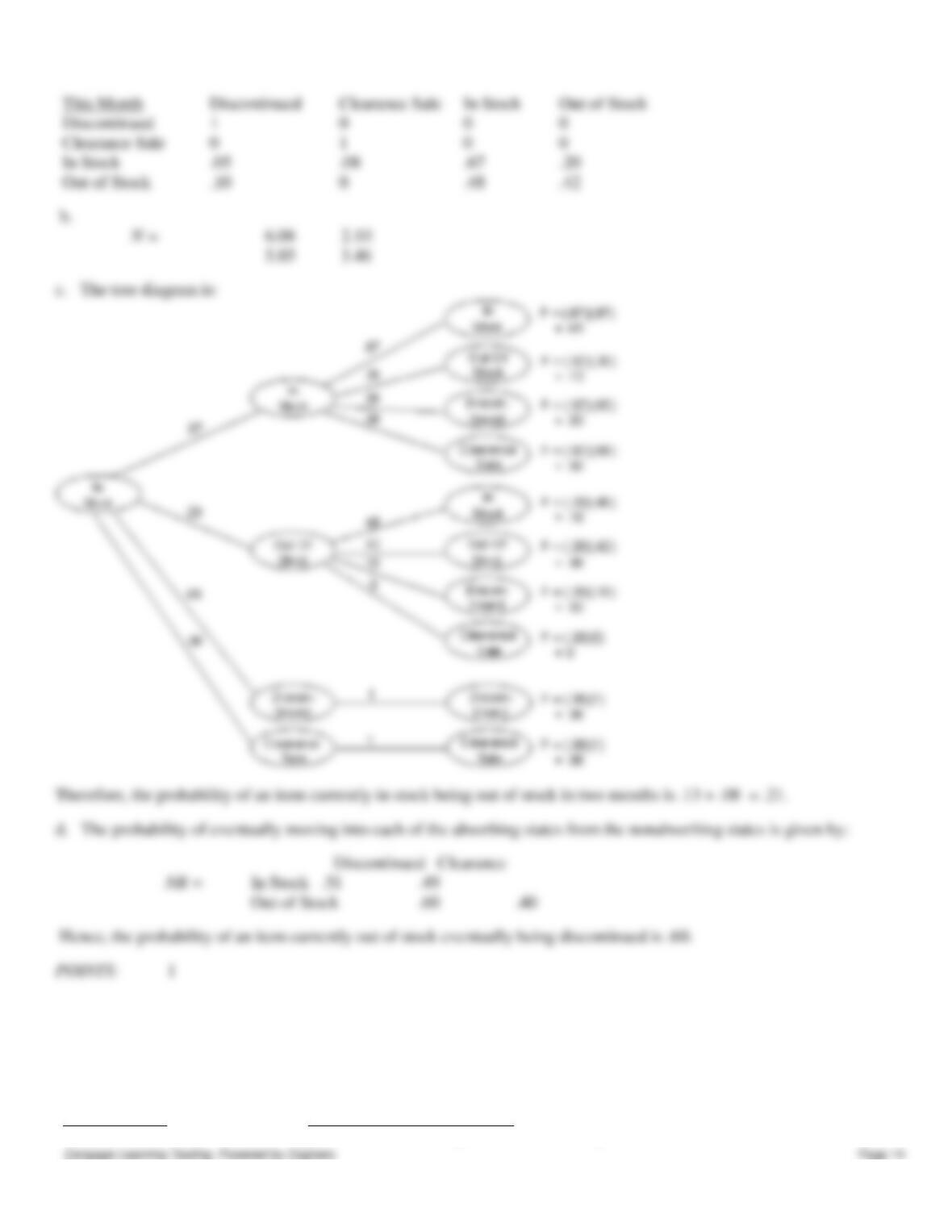
a. Rewrite the transition matrix for the problem in the form of I, O, R, and Q submatrices.
b. Compute the fundamental matrix for this problem.
c. What is the probability of an item currently in stock being out of stock in two months?
d. What is the probability of an item currently out of stock eventually being discontinued from stock?
Chapter 17 – Markov Processes
48. The evening television news broadcast that individuals view on one evening is influenced by which broadcast they
viewed previously. An executive at the C network has determined the following transition probability matrix describing
this phenomenon.
Current Network
News Watched Next Network News Watched
A C N
Chapter 17 – Markov Processes
A .80 .12 .08
C .08 .85 .07
N .08 .09 .83
a. Which network has the most loyal viewers?
b. What are the three networks’ long-run market shares?
c. Suppose each of the three networks earns $1,250 in daily profit from advertising revenue for each 1,000,000 viewers it
has. If on the average 40,000,000 people watch the evening television news, compute the long run average daily profit
each network generates from its evening news broadcast.
49. Precision Craft, Inc. manufactures ornate pedestal sinks. On any day, the status of a given sink is either: a) somewhere
in the normal manufacturing process, b) being reworked because of a detected flaw, c) finished successfully, or d)
scrapped because a flaw could not be corrected. The transition matrix is:
Tomorrow’s Status
Today‘s Status In-Process Rework Finished Scrapped
In-Process .30 .15 .50 .05
Rework .40 .10 .30 .20
Finished 0 0 1 0
Scrapped 0 0 0 1
a. What is the probability of a sink eventually being finished if it is currently in process?
b. What is the probability of a sink eventually being scrapped if it is currently in rework?
c. What is the probability that a sink currently in rework will have a “finished” status either tomorrow or the next day?
(HINT: there are three ways this can happen.)
50. Southside College has modeled its student loan program as a Markov process. Each year a student with a prior loan
borrows again, defers repayment for a year, makes payments, pays the loan balance in full, or defaults on repayment. The
transition matrix is as follows:
Next Year
This Year Borrowing Deferring Paying Paid-Off Default
Borrowing .60 .30 0 .10 0
Deferring .15 0 .65 .10 .10
Paying 0 0 .75 .15 .10
Paid-Off 0 0 0 1 0
Defaulted 0 0 0 0 1
a. If currently a student is making payments on his/her loan, what is the probability the loan will be paid in full
eventually?
Chapter 17 – Markov Processes
b. Is the probability of eventually defaulting greater for a student who is currently borrowing more or a student who is
making payments?
c. What is the probability a student who is borrowing this year will repay the loan balance in full in two years or less?
Essay
51. Explain the concept of memorylessness.
52. Where is a fundamental matrix, N, used? How is N computed?
53. Why is a computer necessary for some Markov analyses?
54. What assumptions are necessary for a Markov process to have stationary transition probabilities?
55. Give two examples of how Markov analysis can aid decision making.
56. Discuss three types of information provided by analysis of a Markov process.