CHAPTER 16—BOND PORTFOLIO MANAGEMENT STRATEGIES
TRUE/FALSE
1. A bond portfolio is immunized from interest rate risk if the modified duration of the portfolio is always
equal to the desired investment horizon.
2. Interest rate anticipation is the most conservative management strategy.
3. In valuation analysis, undervalued bonds are bonds where the expected YTMs are lower than the
prevailing YTM.
4. A bond swap involves liquidating a current bond position, and later investing in a similar issue under
more favorable conditions.
5. A pure yield pickup swap involves a switch from a low-coupon bond to a higher-coupon bond of
similar quality and maturity.
6. A substitution swap relies heavily on interest rate expectations.
7. When applying active management techniques to a global portfolio the additional concern is
expectations regarding exchange rates between countries.
8. The bond management strategy intended to eliminate interest rate risk is immunization.
9. A portfolio of bonds is immunized from interest rate risk if the duration of the portfolio is always
equal to the desired investment horizon.
10. The duration of a perpetual bond is always equal to its term to maturity.
2
11. In a buy-and-hold strategy, bonds are purchased in light of the investor’s objectives and constraints and
then held until maturity.
12. Indexing is an active portfolio management strategy that seeks to copy the composition and
performance of a selected market index.
13. Interest rate anticipation is one of the matched funding techniques that matches anticipated interest
rates with the required rates on a portfolio.
14. In a ladder strategy, funds are invested equally among a wide range of maturities.
15. Credit analysis and core-plus management are examples of active bond portfolio management.
16. A manager following an interest rate anticipation strategy would shorten portfolio duration if interest
rates were expected to increase.
17. When applying active management techniques to a global portfolio the additional concern is
expectations regarding exchange rates between countries.
18. With a matched funding technique portfolio managers try to match specific liability obligations due at
specific times to a portfolio of bonds that minimize the portfolio’s interest rate risk.
19. Investment horizon is the future time when an investor must begin an investment program to generate
the required funds for a future liability.
20. The components of interest rate risk are: price risk and maturity risk.
21. Altman-Nammacher (1987) created a modified Z-score model using a multiple regression analysis
technique.

3
22. The substitution swap is generally long term and relies heavily on interest rate expectations.
MULTIPLE CHOICE
1. Which of the following is a passive bond portfolio strategy?
a.
Indexing
b.
Buy-and-Hold
c.
Classical immunization
d.
Choices a and b
e.
None of the above
2. The active strategies for bond management include all of the following, except
a.
Interest rate anticipation.
b.
Credit analysis.
c.
Spread analysis.
d.
Classical immunization.
e.
Bond swaps.
3. Which of the following is a matched funding technique?
a.
Classical immunization
b.
Contingent immunization
c.
Bond swaps
d.
Valuation analysis
e.
Interest rate anticipation
4. For a bond investor selecting a buy-and-hold strategy, which of the following would be the least
important consideration?
a.
Term to maturity
b.
Indenture provisions
c.
Coupon levels
d.
Liquidity
e.
Quality
5. Junk bonds are high yield bond bonds rated below
a.
Rating BBB.
b.
Rating BB.
c.
Rating B.
d.
Rating CCC.
e.
Rating CC.

4
6. Contingent immunization strategies:
a.
Provide the bond portfolio manager to engage in various active portfolio strategies if the
client is willing to accept a floor value.
b.
Insures that the modified duration of the portfolio is always equal to the desired
investment horizon.
c.
Guarantees that the end of the holding period wealth will not be impacted by interest rate
changes.
d.
All of the above statements are true.
e.
None of the above statements are true.
7. Which of the following would not normally be a reason for a bond swap?
a.
Increasing current yield
b.
Improving the quality of the portfolio
c.
Taking advantage of interest rate shifts
d.
Tax savings
e.
Realigning the portfolio’s duration
8. If an investor swaps identical issues to establish a loss, the loss is disallowed and the transaction is
known as a
a.
Switch sale.
b.
Wash sale.
c.
Green shoe.
d.
Flashback.
e.
White knight.
9. The term dedication, used to describe portfolio management techniques, is referring to servicing a
prescribed set of
a.
Interest payments.
b.
Assets.
c.
Liabilities.
d.
Pensioners.
e.
Sinking fund payments.
10. Coupon reinvestment risk arises because the yield to maturity computation implicitly assumes that all
coupon flows will be reinvested at the
a.
Coupon rate.
b.
Effective rate of interest.
c.
Realized yield to maturity.
d.
Promised yield to maturity.
e.
Existing yield as the coupons are paid.

5
11. Assuming no change in interest rates the duration of a coupon bond
a.
Stays constant.
b.
Declines more slowly than the term to maturity.
c.
Declines more quickly than the term to maturity
d.
Increases at a slower rate than the term to maturity.
e.
Changes in line with the term to maturity.
12. In core-plus bond management
a.
Seventy five percent of the portfolio is allocated to an equity index, and the balance to a
bond index.
b.
Seventy five percent of the portfolio is allocated to a bond index, and the balance to an
equity index.
c.
Seventy five percent of the portfolio is allocated to a bond index, and the balance to
actively managed bond sectors.
d.
Seventy five percent of the portfolio is allocated to actively managed bond sectors, and the
balance to a bond index.
e.
None of the above.
13. A tax swap involves swapping out of a
a.
Bond to realize capital losses, into a comparable bond.
b.
Low coupon bond, into a comparable high coupon bond.
c.
High coupon bond, into a comparable low coupon bond.
d.
Bond that is underpriced, into a comparable bond that is overpriced.
e.
Bond that is overpriced, into a comparable bond that is underpriced.
14. A substitution pickup swap involves swapping out of a
a.
Bond to realize capital losses, into a comparable bond.
b.
Low coupon bond, into a comparable high coupon bond.
c.
High coupon bond, into a comparable low coupon bond.
d.
Bond that is underpriced, into a comparable bond that is overpriced.
e.
Bond that is overpriced, into a comparable bond that is underpriced.
15. A pure yield pickup swap involves swapping out of a
a.
Bond to realize capital losses, into a comparable bond.
b.
Low coupon bond, into a comparable high coupon bond.
c.
High coupon bond, into a comparable low coupon bond.
d.
Bond that is underpriced, into a comparable bond that is overpriced.
e.
Bond that is overpriced, into a comparable bond that is underpriced.

6
16. In a barbell strategy
a.
One half of funds are invested in short duration bonds and the test in long duration bonds.
b.
Seventy five percent of funds are invested in short duration bonds and the test in long
duration bonds.
c.
Twenty five percent of funds are invested in short duration bonds and the test in long
duration bonds.
d.
An equal amount of funds are invested in a wide range of maturities.
e.
None of the above.
17. In a ladder strategy
a.
One half of funds are invested in short duration bonds and the test in long duration bonds.
b.
Seventy five percent of funds are invested in short duration bonds and the test in long
duration bonds.
c.
Twenty five percent of funds are invested in short duration bonds and the test in long
duration bonds.
d.
An equal amount of funds are invested in a wide range of maturities.
e.
None of the above.
18. An example of an active strategy for bond management would be
a.
Buy and hold.
b.
Credit analysis.
c.
Indexing.
d.
Classical immunization.
e.
Horizon matching.
19. A portfolio manager that attempts to select bonds based on their intrinsic value would be carrying out
a.
Credit analysis
b.
Valuation analysis
c.
Yield-spread analysis
d.
Horizon-matching analysis
e.
Interest-rate analysis
20. Which factors indicate that in-depth credit analysis of high-yield bonds is important.
a.
The large number of high-yield issues.
b.
The overall decline in quality of these bonds.
c.
The wide range of quality among these bonds.
d.
The growing complexity of these bonds.
e.
All of the above.

7
21. In classical immunization, the effect of a change in interest rates is effectively neutralized because
a.
Price risk and reinvestment risk offset each other.
b.
Price risk and maturity risk offset each other.
c.
Reinvestment risk and credit risk offset each other.
d.
Reinvestment risk and maturity risk offset each other.
e.
None of the above.
22. Horizon matching is a combination of
a.
Immunization and valuation.
b.
Cash matching and immunization.
c.
Valuation and cash matching.
d.
All of the above.
e.
None of the above.
23. Interest rate risk is comprised of which of the following risks?
a.
Price risk.
b.
Coupon reinvestment risk.
c.
Default risk.
d.
Choices a and b.
e.
All of the above.
24. Which of the following statements is true?
a.
If Duration > Investment Horizon, the investor faces Net Reinvestment Risk.
b.
If Duration < Investment Horizon, the investor faces Net Price Risk.
c.
If Duration = Investment Horizon, the investor is immunized.
d.
All of the above statements are true.
e.
None of the above statements are true.
25. Horizon matching is a combination of
a.
Cash-matching dedication and interest rates swaps.
b.
Cash-matching dedication and immunization.
c.
Interest rate swaps and immunization.
d.
Enhanced indexing and immunization.
e.
Enhanced indexing and interest rate swaps.
8
Exhibit 16-1
USE THE FOLLOWING INFORMATION FOR THE NEXT PROBLEM(S)
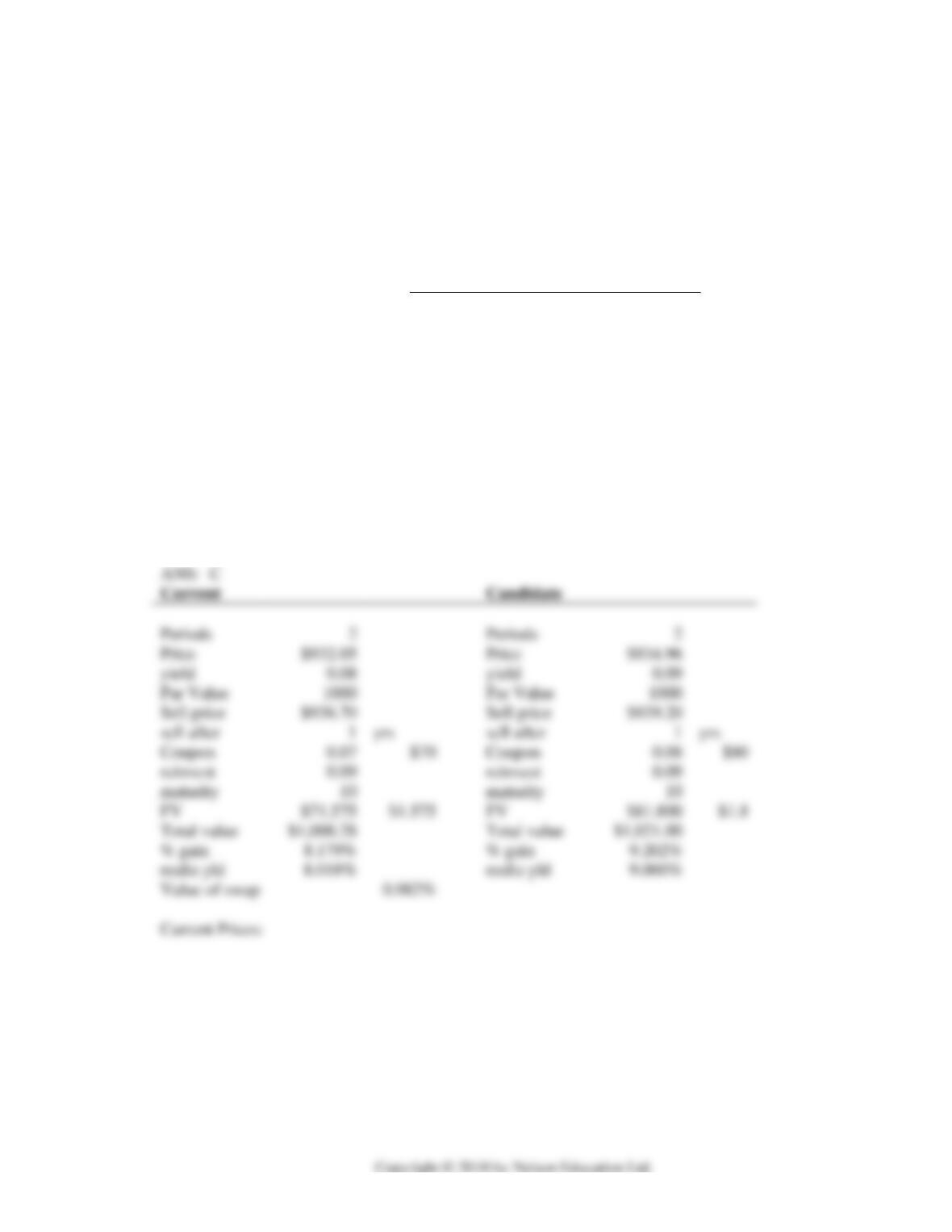
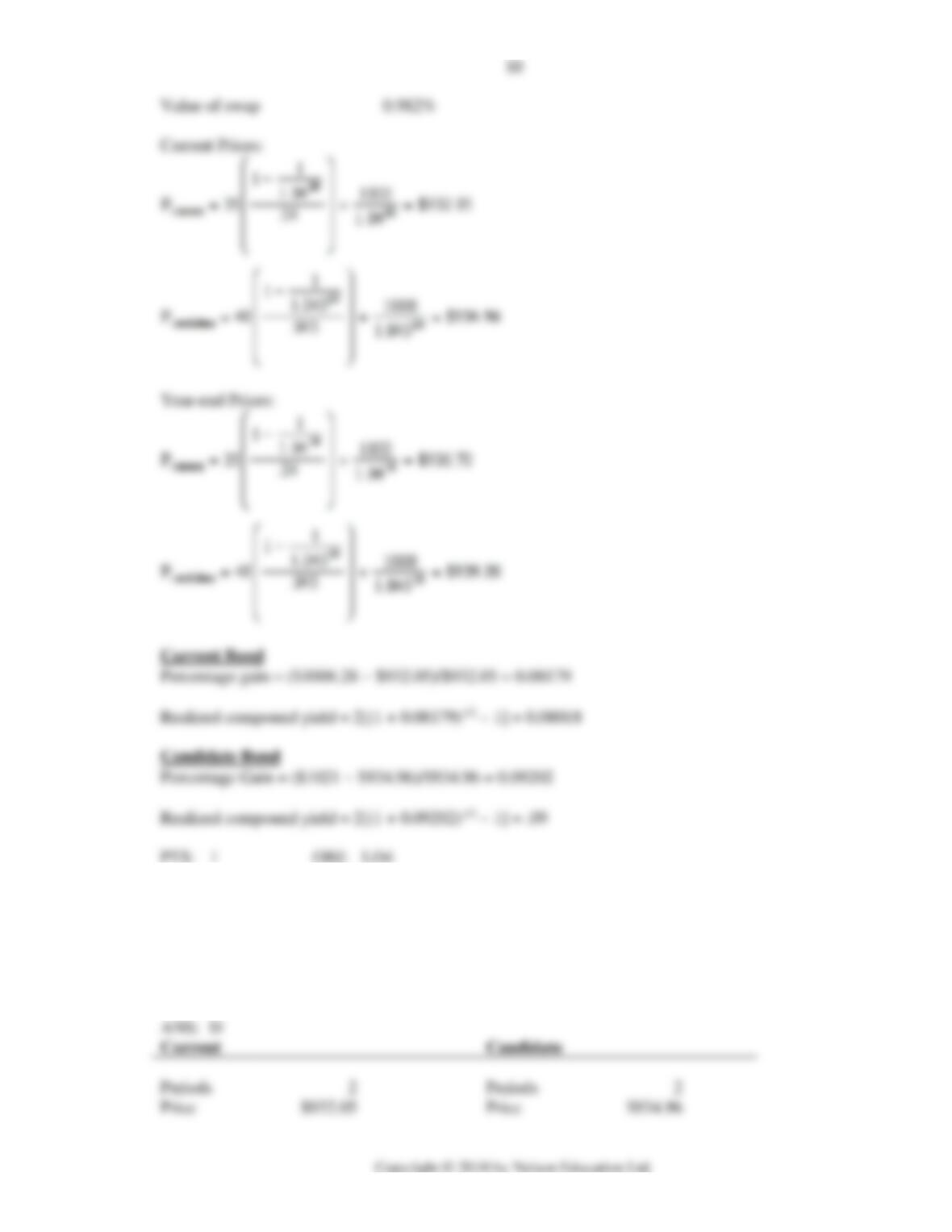
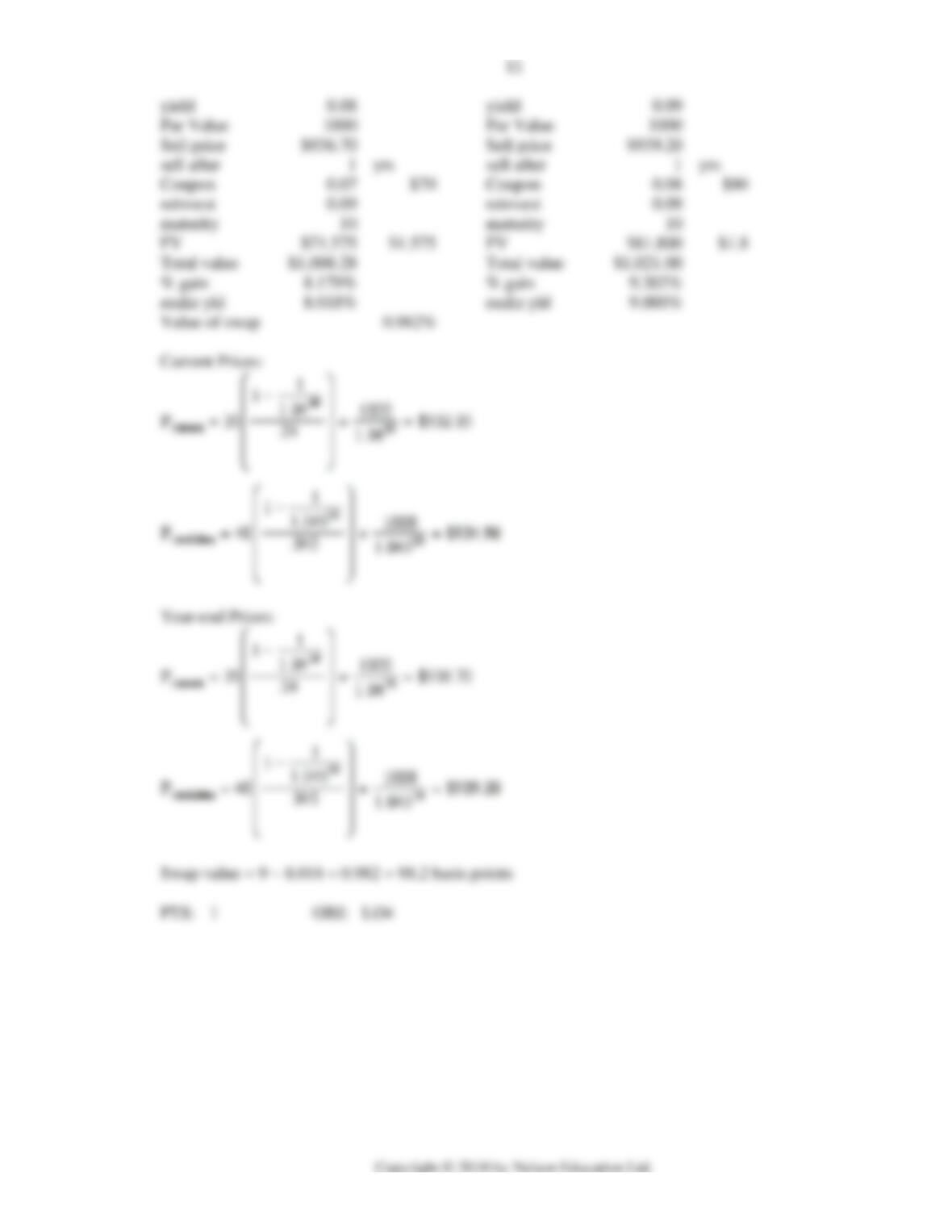
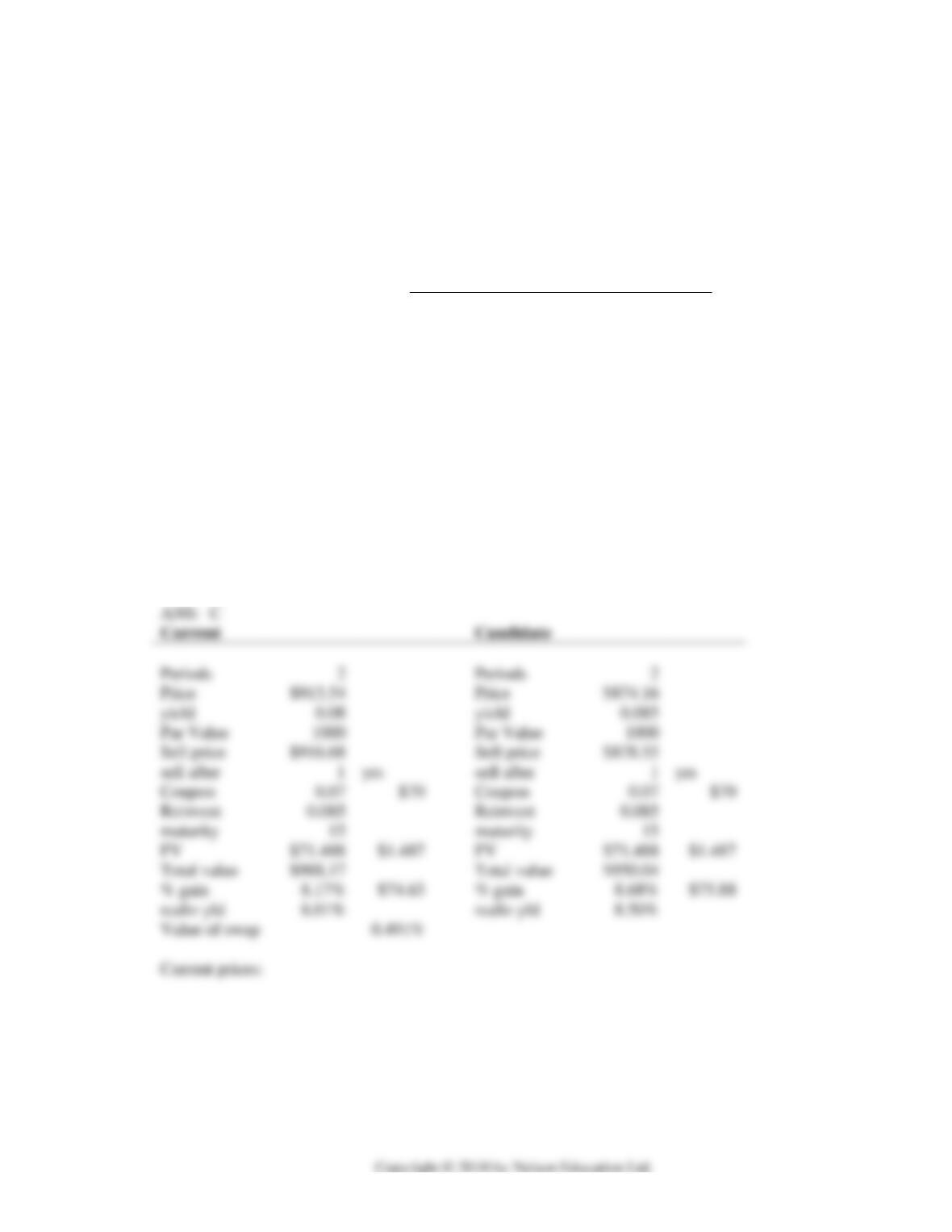
The following information is given concerning a pure yield pick-up swap: You currently hold a 10
year, 7% coupon bond priced to yield 8%. As a swap candidate you are considering a 10 year, 8%
coupon bond priced to yield 9%. Assume a reinvestment at 9%, semiannual compounding, and a
one-year workout period.
Current Bond
Candidate Bond
Dollar Investment
$932.05
$934.96
Coupon
$70.00
$80.00
i on One Coupon
$1.575
?
Principal Value at Year End
$936.70
?
Total Accrued
$1008.28
?
Realized Compound Yield
8.018%
?
26. Refer to Exhibit 16-1. The interest on one coupon for the candidate bond is
a.
$2.97
b.
$2.03
c.
$1.80
d.
$1.37
e.
$3.49
Periods
Periods
Price
Price
yield
yield
Par Value
Par Value
Sell price
Sell price
sell after
yrs
sell after
yrs
Coupon
Coupon
reinvest
reinvest
maturity
10
maturity
10
Total value
Total value
% gain
8.179%
% gain
9.202%
realiz yld
8.018%
realiz yld
9.000%
Value of swap
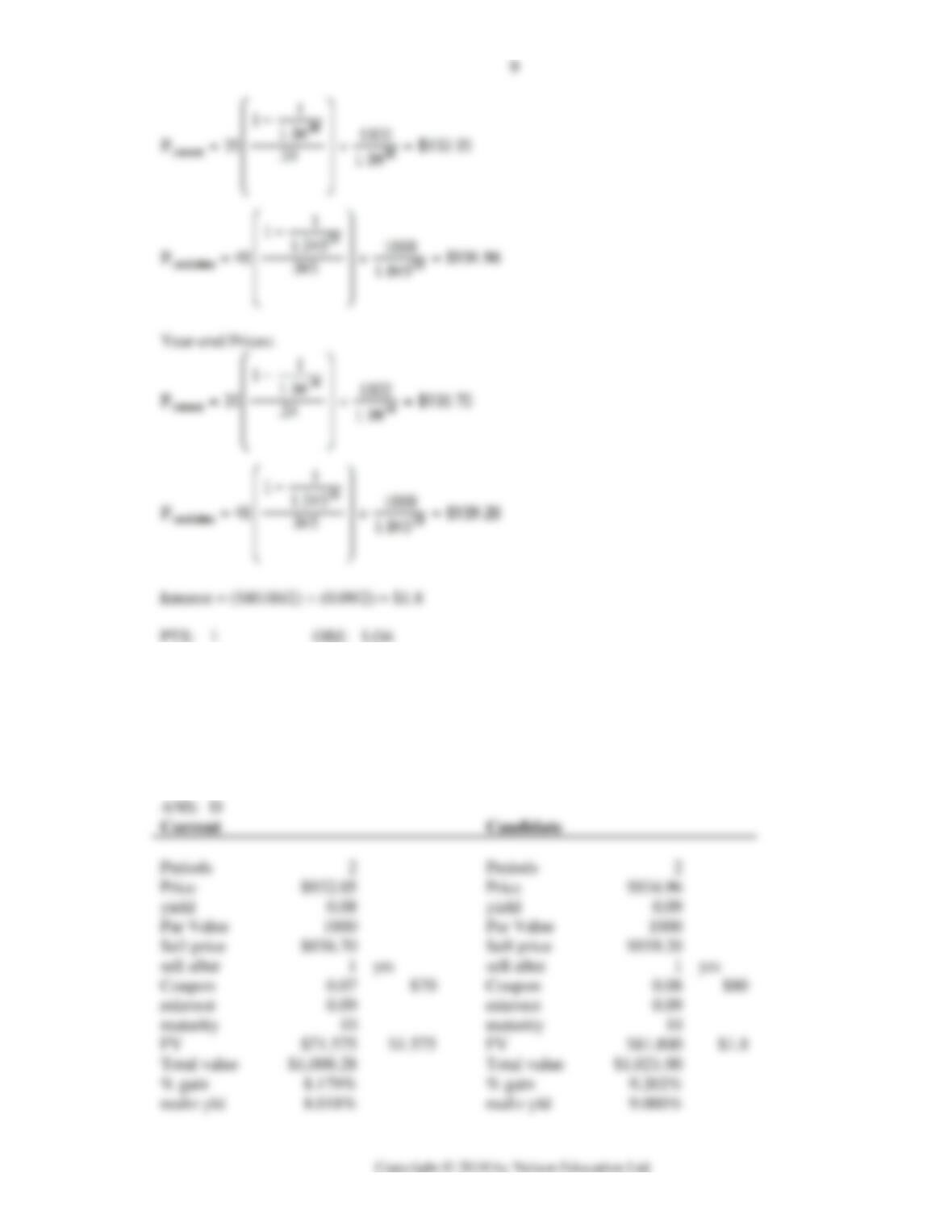
27. Refer to Exhibit 16-1. The realized compound yield on the candidate bond is
a.
7.0%
b.
11.0%
c.
10.0%
d.
9.0%
e.
12.0%
28. Refer to Exhibit 16-1. The value of the swap is ____ basis points in one year.
a.
32.3
b.
48.7
c.
75.8
d.
98.2
e.
104.3
12
Exhibit 16-2
USE THE FOLLOWING INFORMATION FOR THE NEXT PROBLEM(S)
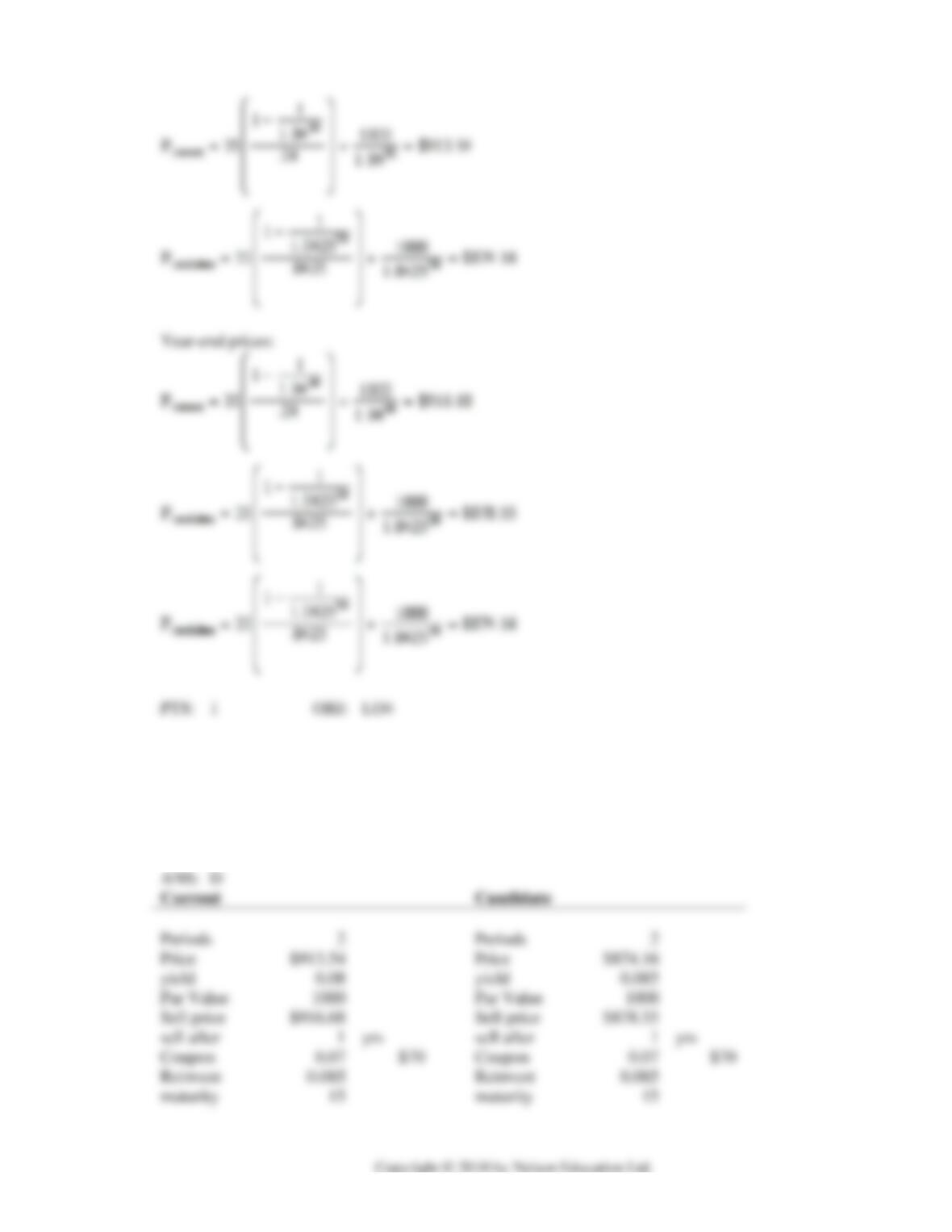
The following information is given concerning a substitution swap: You currently hold a 15 year, 7%
coupon bond priced to yield 8%. As a swap candidate you are considering a 15 year, 7% coupon bond
priced to yield 8.5%. Assume a reinvestment rate of 8.5%, semiannual compounding, and a one-year
workout period.
Current Bond
Candidate Bond
Dollar Investment
$913.54
?
Coupon
70.00
70.00
i on One Coupon
1.487
1.487
Principal Value at Year End
916.68
878.55
Total Accrued
988.17
950.04
Total Gain
74.63
?
Gain per Invested Dollar
?
?
Realized Compound Yield
?
?
29. Refer to Exhibit 16-2. The dollar investment in the candidate bond is
a.
$812.57
b.
$803.22
c.
$874.16
d.
$746.83
e.
$700.01
Periods
Periods
Price
Price
yield
yield
Par Value
Par Value
Sell price
Sell price
sell after
yrs
sell after
yrs
Coupon
Coupon
Reinvest
Reinvest
maturity
maturity
Total value
Total value
% gain
% gain
realiz yld
realiz yld
Value of swap
13
30. Refer to Exhibit 16-2. The realized compound yield on the current bond is
a.
15.50%
b.
11.03%
c.
10.30%
d.
8.01%
e.
9.00%
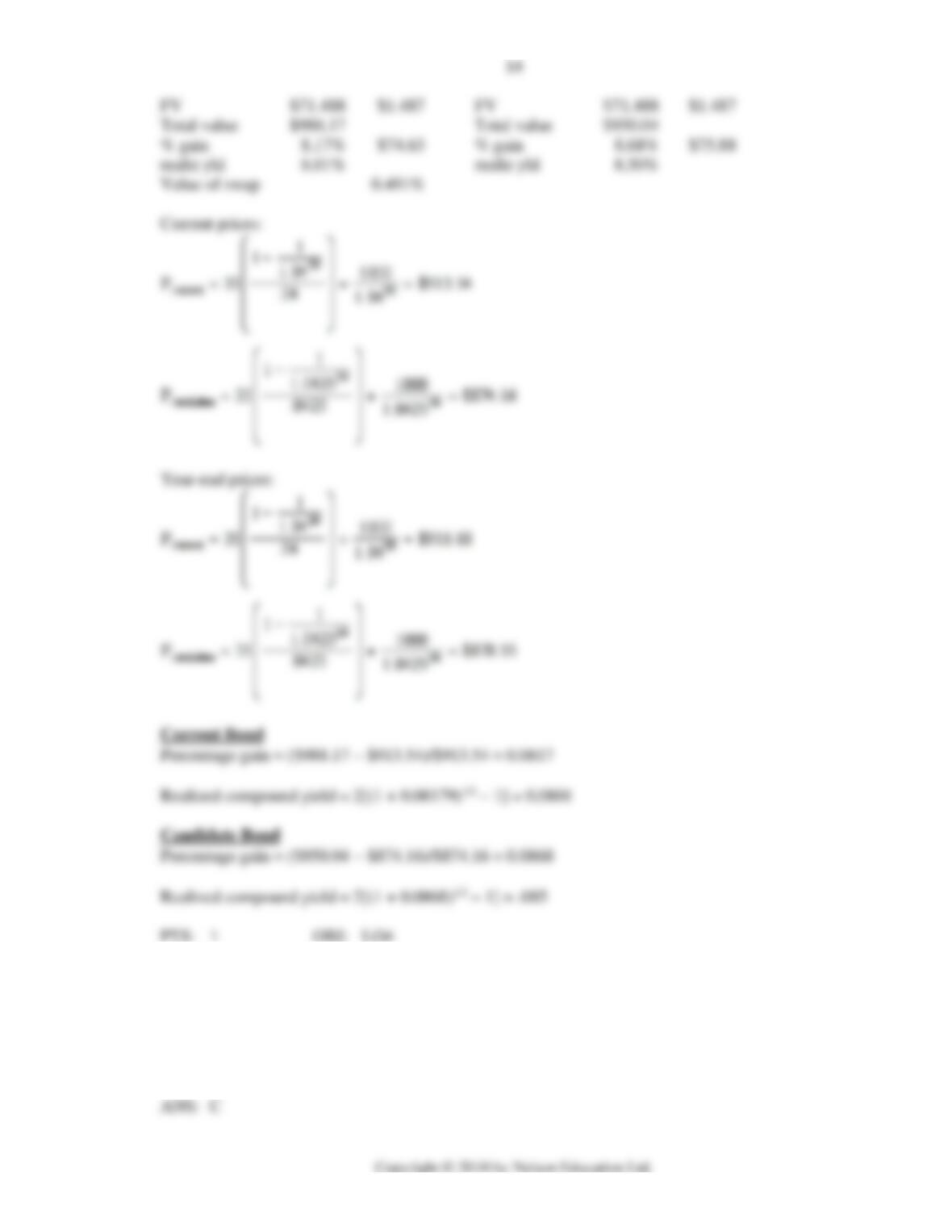
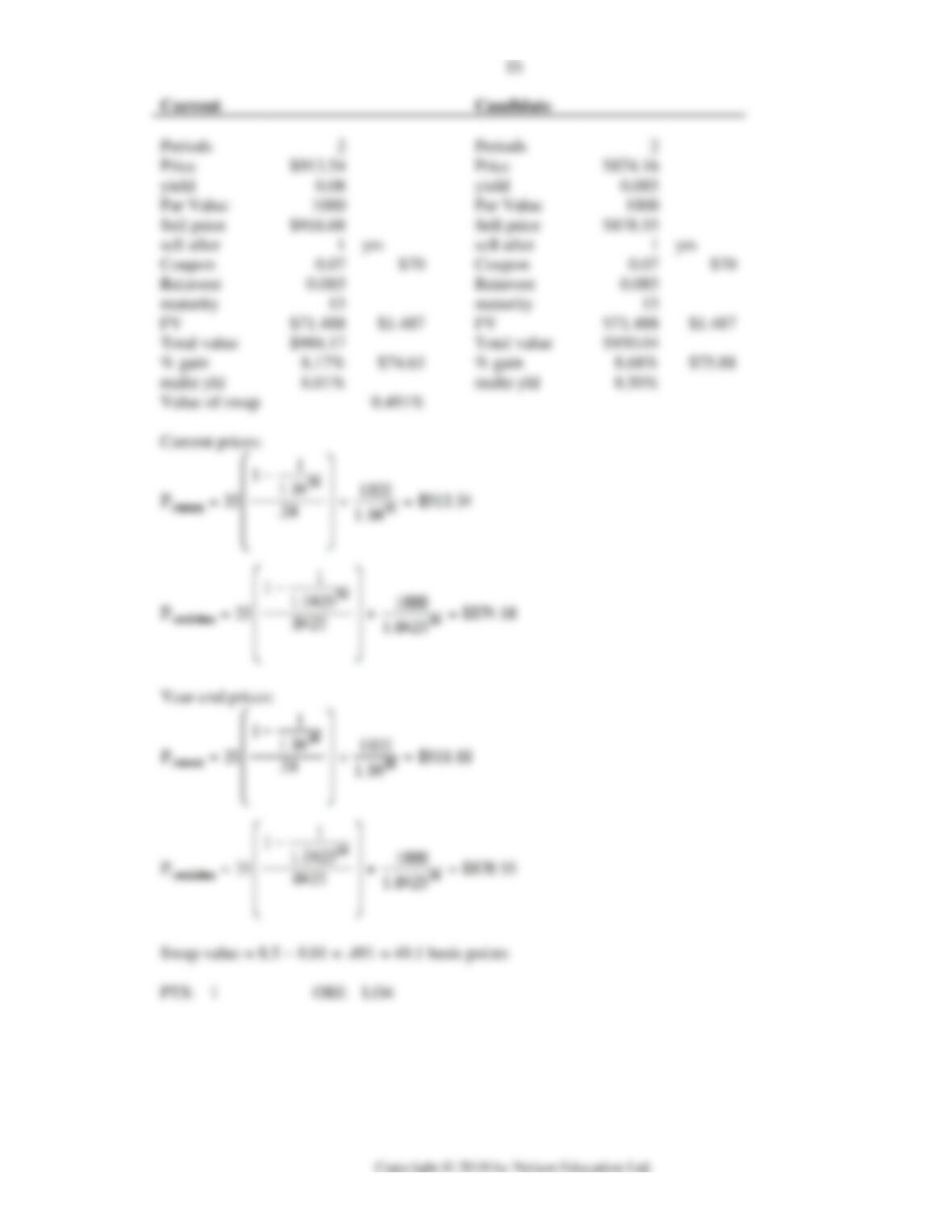
31. Refer to Exhibit 16-2. The value of the swap is ____ basis points in one year.
a.
18.4
b.
23.3
c.
49.1
d.
46.5
e.
46.8
16
Exhibit 16-3
USE THE FOLLOWING INFORMATION FOR THE NEXT PROBLEM(S)
The following information is given concerning a pure yield pick-up swap: You currently hold a 20
year, Aa 8% coupon bond priced to yield 10%. As a swap candidate you are considering a 20 year, Aa
10% coupon bond priced to yield 10.75%. Assume a reinvestment rate of 12.00%, semiannual
compounding, and a one-year workout period.
Current Bond
Candidate Bond
Dollar Investment
$828.41
$938.83
Coupon
80.00
100.00
i on One Coupon
2.4
?
Principal Value at Year End
831.32
?
Total Accrued
913.72
?
Realized Compound Yield
10.5547
?
32. Refer to Exhibit 16-3. The interest on one coupon for the candidate bond is
a.
$2.40
b.
$2.75
c.
$9.60
d.
$11.00
e.
$50.00
Dollar Investment
Coupon
i on One Coupon
Principal Value at Year End
831.32
Total Accrued
Realized Compound Yield
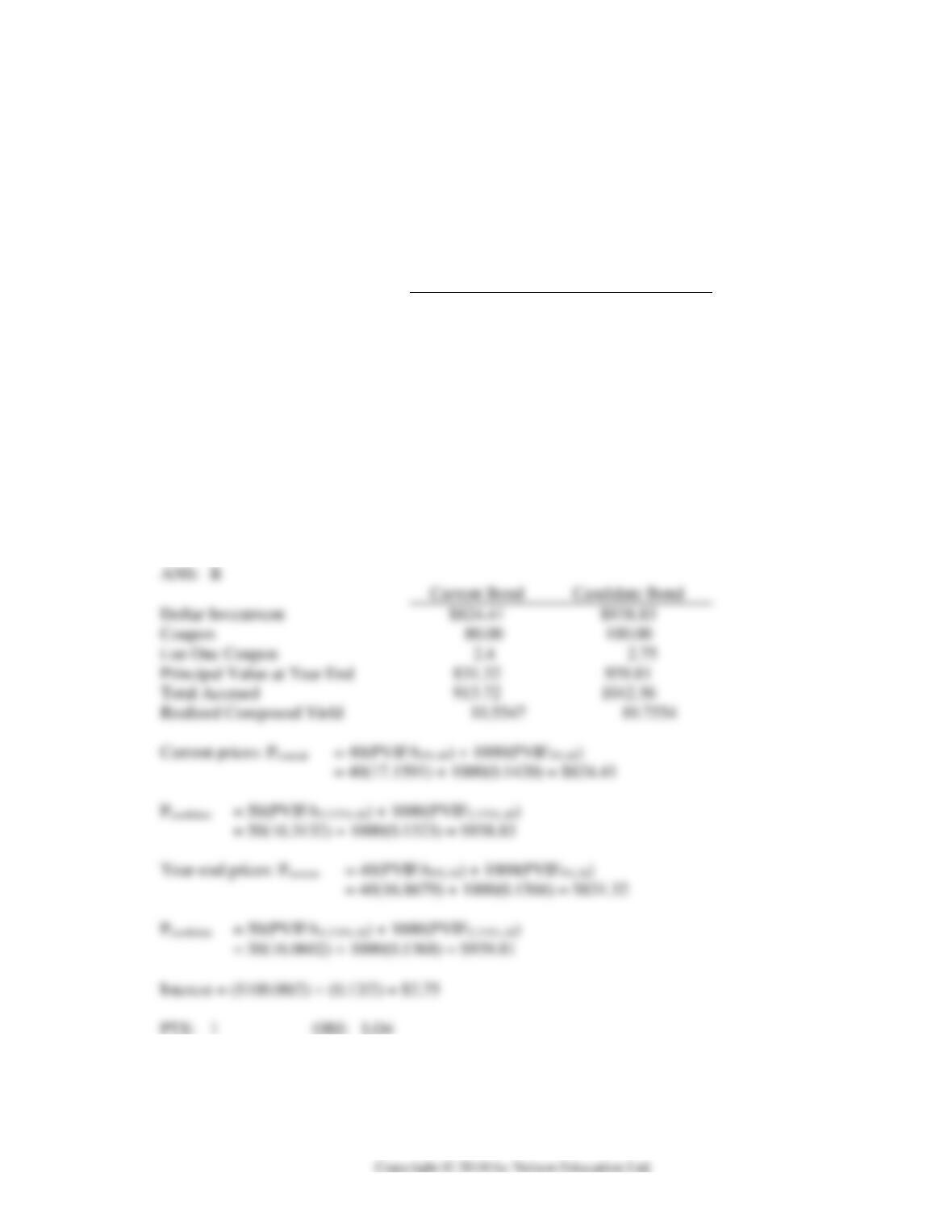
Current prices: Pcurrent
= 40(PVIFA5%,40) + 1000(PVIF5%,40)
= 40(17.1591) + 1000(0.1420) = $824.41
= 50(PVIFA5.375%,40) + 1000(PVIF5.375%,40)
= 50(16.3132) + 1000(0.1323) = $938.83
Year-end prices: Pcurrent
= 40(PVIFA5%,38) + 1000(PVIF5%,38)
= 40(16.8679) + 1000(0.1566) = $831.32
= 50(PVIFA5.375%,38) + 1000(PVIF5.375%,38)
= 50(16.0602) + 1000(0.1368) = $939.81