Chapter 16 – Scheduling
106. What is the result of the row and column reductions?
107. Can an optimum assignment be made after the row and column reductions?
108. What is the result of modifying the row and column reductions table?
Chapter 16 – Scheduling
109. Can an optimum assignment be made after the first modification of the row and column
reductions table?
110. What is the optimum assignment of jobs to machines?
111. What are the total costs for the optimum assignment of jobs to machines?
Chapter 16 – Scheduling
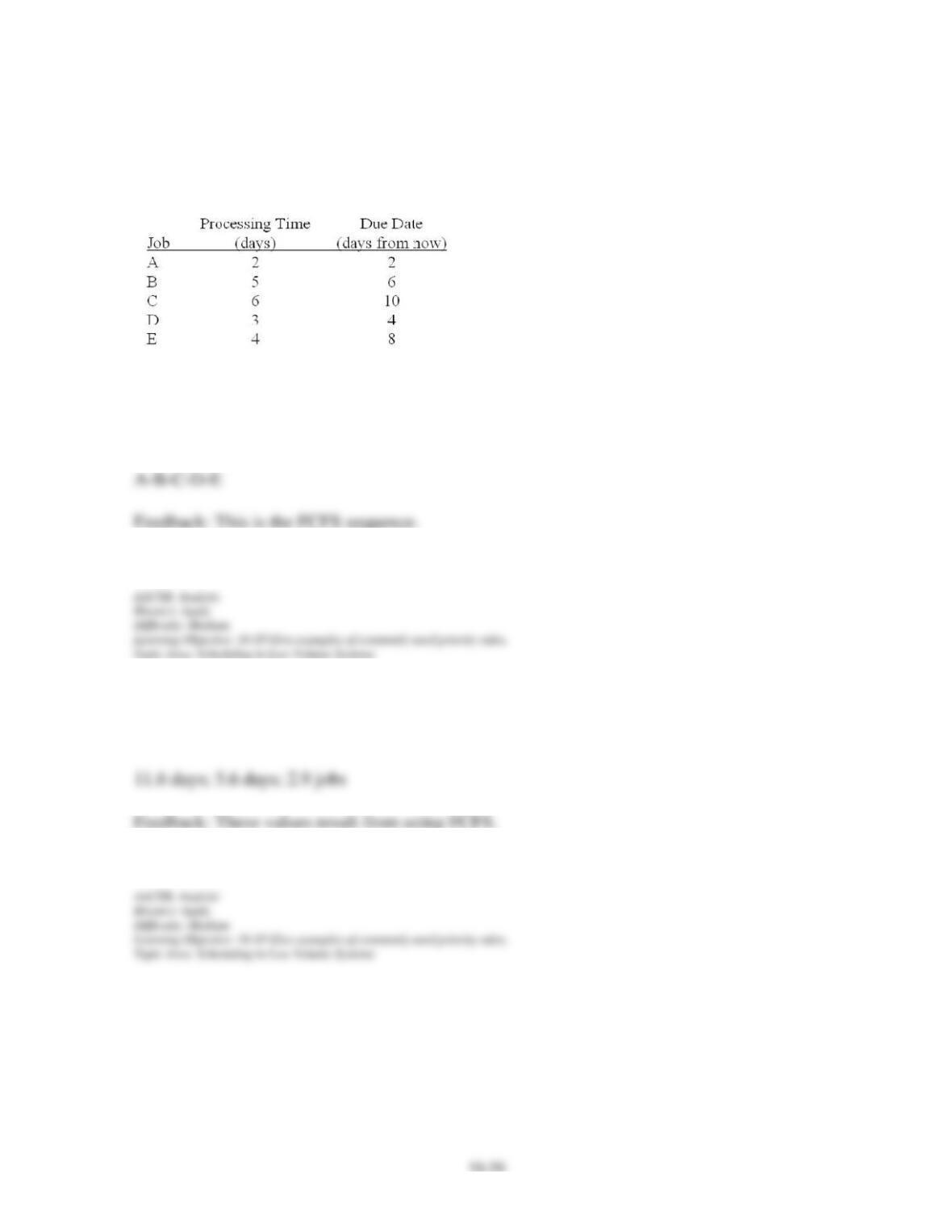
Refer to the following data for jobs waiting to be processed at a single work center (jobs are
shown in order of arrival):
112. What is the schedule sequence using the first come, first served (FCFS) priority rule?
113. What is the average completion time for the first come, first served (FCFS) priority rule
schedule? Average job tardiness? Average number of jobs at the center?
Chapter 16 – Scheduling
114. What is the schedule sequence using the earliest due date (EDD) priority rule?
115. What is the average completion time for the earliest due date (EDD) priority rule
schedule? Average job tardiness? Average number of jobs at the center?
116. If jobs A, B, and C require two operations each, while jobs D and E require one
operation each, what is the schedule sequence using the slack per operation (S/O) priority
rule?
Chapter 16 – Scheduling
117. What is the average completion time for the slack per operation (S/O) priority rule
schedule? Average job tardiness? Average number of jobs at the center?
118. What is the schedule sequence using the shortest processing time (SPT) priority rule?
119. What is the average completion time for the shortest processing time (SPT) priority rule?
Average job tardiness? Average number of jobs at the center?
Chapter 16 – Scheduling
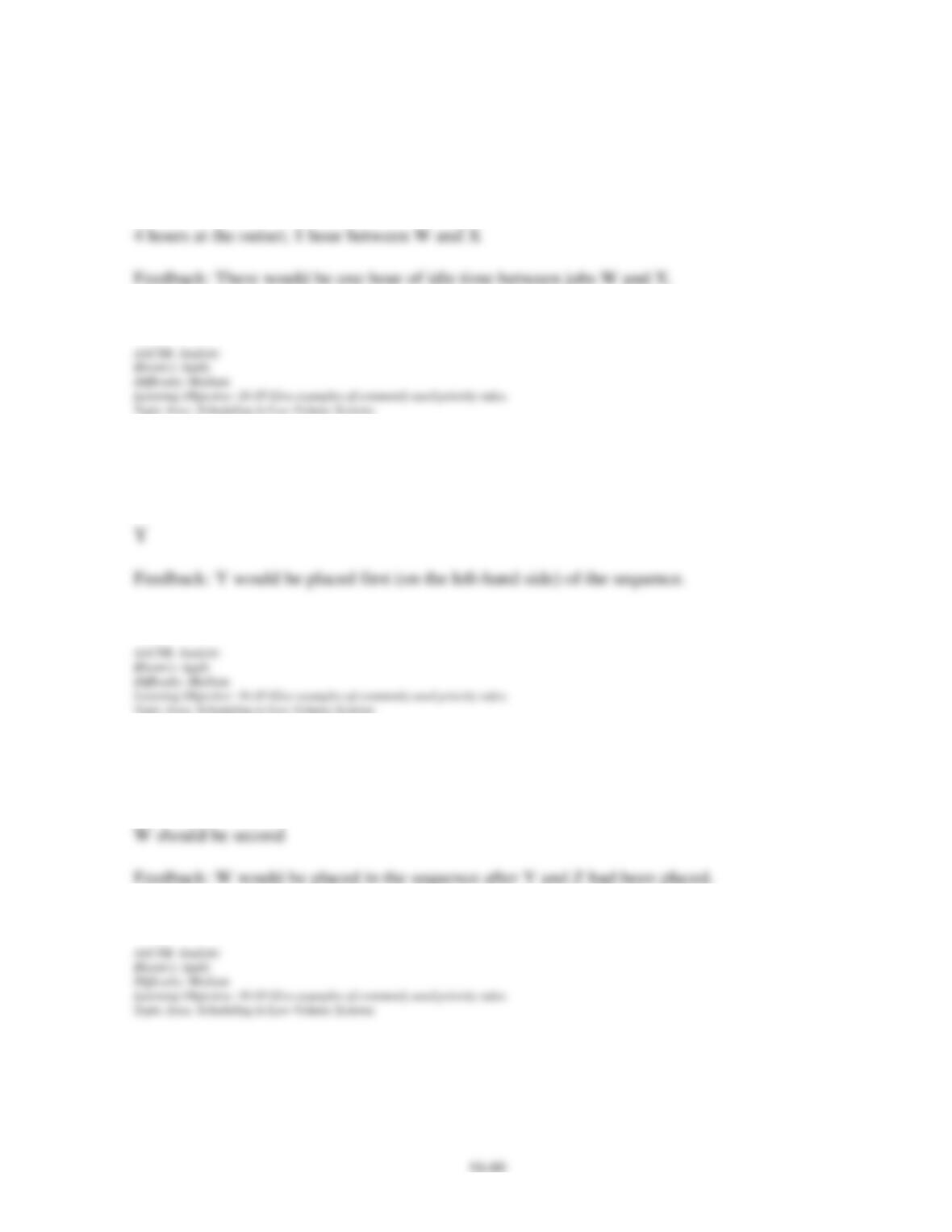
Given the following data for jobs awaiting processing at a manufacturing cell in which jobs
are first processed by machine A, then by Machine B:
120. If these jobs were scheduled in the sequence shown, what would be the throughput
time?
121. If these jobs were scheduled in the sequence shown, what would be the idle time at
machine B?
Chapter 16 – Scheduling
122. If these jobs were scheduled in the sequence shown, when would idle time occur at
machine B?
123. In developing the sequence which will minimize throughput time, what is the initial job
to be placed in the schedule sequence?
124. In developing the sequence that will minimize throughput time, where in the schedule
sequence should job W be placed?
Chapter 16 – Scheduling
125. In developing the sequence which will minimize throughput time, where should job X be
placed?
126. What is the sequence which will minimize throughput time?
127. What is the throughput time for the optimum schedule?
Chapter 16 – Scheduling
128. What is the idle time at machine B for the optimum schedule?
129. When does idle time occur at machine B for the optimum schedule?
Chapter 16 – Scheduling
130. Job X, which has a duration of four days, is due by the close of business on Friday,
December 23. Without looking at the work already scheduled on X’s required resource, the
scheduler schedules X to be begun on the morning of Tuesday, December 20. This is an
example of __________.
131. Job X, which has a duration of four days, is due by the close of business on Friday,
December 23. Without looking at the work already at X’s required resource, the scheduler
schedules X to be begun immediately and assumes that X will be done four days from now.
This is an example of ___________.
Chapter 16 – Scheduling
132. Job X arrived at work center Q at noon. At 2 p.m. that same day X was begun. X left
work center Q at 3:15 p.m. that same day. X’s flow time, in minutes, was __________.
133. Which of the following is critical to effective yield management?
Chapter 16 – Scheduling
134. Which of the following is least likely to be a consideration when scheduling a high–
volume system?