
1. Two important input factors in financial intermediation are capital and labor.
2. Technological efficiency focuses exclusively on the cost side of financial intermediation.
3. According to Hitachi Data Systems, recovery time from system failures averages 12 hours.
4. As of the first quarter 2009, non-interest expense was 250 percent larger than interest expense for all FDIC
insured banks.
5. Noninterest expense has increased faster than interest expense for all U.S. insured commercial banks in
recent years.
6. The U.S. Treasury has recently proposed that banks carry a capital cushion against losses resulting from
operational risk.

7. Bernie Madoff and his infamous Ponzi scheme is an example of external operational risk to the hedge funds
he managed.
8. In recent years, U.S. banks have alone spent $20 billion per year in technology related expenditures.
9. The initial steps of cross selling financial products can easily occur with computer technology.
10. Wholesale cash management services allow corporate customers to minimize cash balances and to monitor
quickly cash transactions and balances.
11. Controlled disbursement accounts are designed to reduce the delay in check clearing.
12. Appropriate technology may allow an FI to achieve lower-cost funding.
13. Cash management services include the collection, disbursement, and transfer of funds.

14. Account reconciliation redirects funds from accounts in a large number of different banks to a few
centralized accounts at one bank.
15. Retail banking services and products in recent years have moved strongly toward electronic payment
technology.
16. New retail products and services based heavily on technology often are risky because of the high usage rate
necessary to make them positive net present value projects.
17. The success in technologically related innovation often is dependent on changes in regulations and
regulatory procedures.
18. Cross-market selling of financial products requires production of the products within the same branch or
bank office.
19. Increases in the rate of innovation of new financial products, whether successful or not, is often credited to
advances in technology.

20. The increased use of technology may have positive and negative effects on the perceived service quality
provided to retail customers.
21. According to economic theory involving economies of scale, larger and more cost-efficient Is should prevail
over smaller, less cost-efficient FIs.
22. If ACX+Y < ACX + ACY, where AC is average production cost and X and Y are products, economies of
scope are present.
23. An increase in the cost of the joint production of services as compared to the production of those services
independently is an example of diseconomies of scale.
24. Recent evidence suggests that economies of scale may exist for banks up to the $10 billion to $25 billion
range.
25. Recent evidence strongly suggests that economies of scope exist for both asset and liability products, but not
for off-balance-sheet products.

26. Banks in given size classes tend to have very little difference in cost structures.
27. In the U.S., electronic methods of payment account for a larger number of transactions, but a lower
aggregate dollar value than nonelectronic methods of payment.
28. Compared to the United States, the use of electronic methods of payment is lower in other major developed
countries.
29. As of August 2009, credit cards used in either a credit or debit function accounted for over 50 percent of the
number of payments made in the U.S.
30. As of August 2009, credit cards used in either a credit or debit function accounted for less than 5 percent of
the dollar value of payments made in the U.S.
31. Fedwire is a wire transfer network operated through the Federal Reserve System to assist banks in making
financial transactions among themselves, on behalf of themselves and customers.

32. Fedwire is a wire transfer network of over 6,300 international FIs with the Federal Reserve System.
33. Daily Fedwire and CHIPS transaction volume never exceeds the amount of bank reserves.
34. As of 2009, the combined value of payments sent over Fedwire and CHIPS often exceeded $4.5 trillion a
day.
35. Funds transferred on CHIPS are settled at the end of the day.
36. Funds transferred on the Fedwire are settled immediately.
37. Daylight overdraft risk occurs because banks often provide immediate credit to customers for deposits, even
though the funds may not arrive until later in the day or the next day.
38. CHIPS guarantees that any wire transfer is final at the time it is made.

39. The Fed has begun to charge either a fee or an interest rate for daylight overdrafts.
40. Regulation F requires financial institutions to develop internal procedures to limit settlement exposures to
correspondent banks.
41. The use of ATMs in European countries has grown at a slower rate than in the U.S.
42. The increased use of wire transfers as a replacement for check and cash payments has increased the risk of
fraud.
43. Delaware and South Dakota have become leading states in the distribution of some financial services
because of liberal regulations.
44. Usury ceilings placing ceilings on interest rates that FIs can charge on certain types of loans are always
established by federal regulatory authorities.
45. The U.S. tax burden faced by domestic FIs has been minimized, in part, by the ability to use international
wire networks for the transfer of funds.
46. The operational risk faced by an FI includes sources other than technology.
47. Regulators have proposed that operational risk should be measured for the purpose of meeting overall
capital adequacy.
48. How can operating income of an FI be increased by improved technological efficiency?
49. How can operating expenses of an FI be reduced by improved technological efficiency?
50. How can interest expense of an FI be reduced by improved technological efficiency?
51. How can interest income of an FI be increased by improved technological efficiency?
52. Which of the following is NOT a source of operational risk for an FI?
53. Which of the following are potential benefits of technology for an FI?
54. Which of the following occur when managers undertake growth-oriented investments to increase an FI’s size
that may be inconsistent with stockholders’ value-maximizing objectives?
55. The dollar amount of which of the following items has been increasing in the U.S. banking industry in
recent years?
56. What is float?
57. Which of the following is a centralized collection service for corporate payments that helps reduce the
float?
58. Which of the following wholesale services offered by FIs allows businesses to transfer and transact
invoices, purchase orders, and shipping notices automatically?
59. Which of the following wholesale services offered by FIs to businesses allows the FI to combine the e-mail
capabilities of the Internet with the FIs ability to process payments electronically through the interbank payment
networks?
60. Which of the following partially explains why cash management services have not attracted customers in
Europe to the degree that they have in the US?
61. Which of the following explains why ATM networks have grown relatively slowly in countries such as
Sweden and Singapore?
62. Which of the following implies reduced unit costs as size or volume of assets increases?
63. Which of the following implies reduced unit costs as the range of products offered increases inputs in
producing multiple products?
64. Large-scale investment projects that lead to excess capacity and integration problems that create cost
overruns and control problems are examples of
65. Which of the following implies that small FIs are more cost efficient than large FIs, and that in a freely
competitive environment for financial services, small FIs may outperform their larger counterparts?
66. Which of the following occurs if the costs of joint production of FI services are higher than they would be if
they were produced independently?
67. According to studies, which of the following may better explain cost differences and operating cost
efficiencies among FIs?
68. Which of the following best describes economies of scope?
69. Which of the following best describes X-inefficiencies?
70. Which of the following best describe economies of scale?
71. Which of the following are the two basic approaches to analyzing the cost functions of FIs?
72. Which of the following observations concerning the production approach is true?
73. Which of the following observations concerning the intermediation approach is true?
74. Which of the following statements is NOT true?
75. As of August 2009, which of the following represented the highest percent of the dollar value of noncash
transactions in the United States?
76. As of August 2009, which of the following accounts for the highest volume of noncash transactions in the
United States?
77. As of August 2009, which of the following represented the highest percent of the dollar value of noncash
transactions worldwide?
78. As of August 2009, which of the following accounts for the highest volume of noncash transactions
worldwide?
79. Which of the following observations concerning e-money is NOT true?
80. Which of the following observations is NOT true?
81. Settlement risk is important because
82. Daylight overdrafts occur when
83. Daylight overdraft
84. Suppose that the doubling of a bank’s deposit funding allows the bank to triple its loan output. What can you
conclude about the bank’s production technology?
85. Why has empirical evidence on economies of scale and scope been so contradictory?
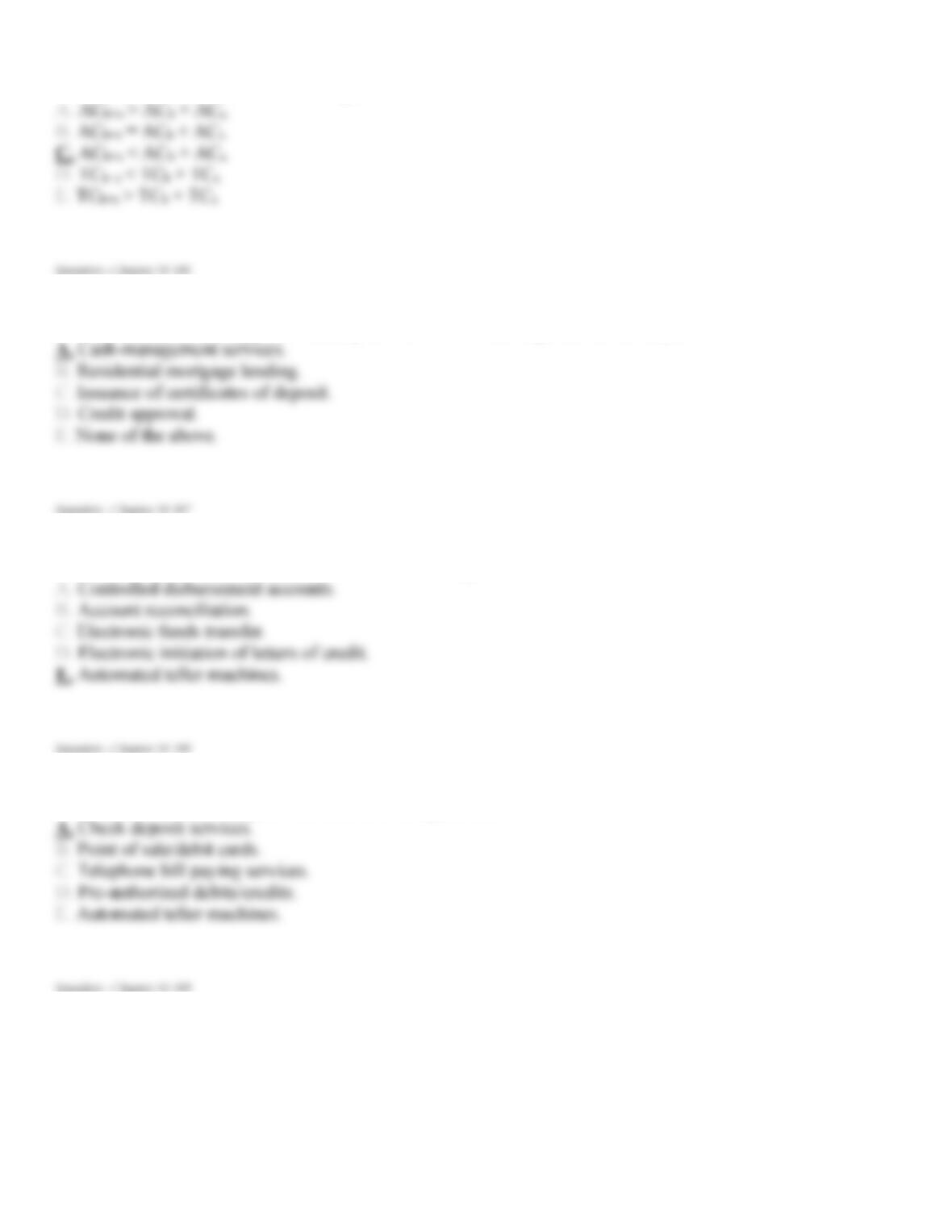
86. Which of the following is consistent with economies of scope? The subscript “b” refers to a banking firm,
“s” for a securities firm, “AC” is average costs and “TC” is total costs.
87. Which is the most important banking area in which technology has had an impact?
88. Which of the following is NOT a wholesale banking service?
89. Which of the following is NOT a retail banking service?
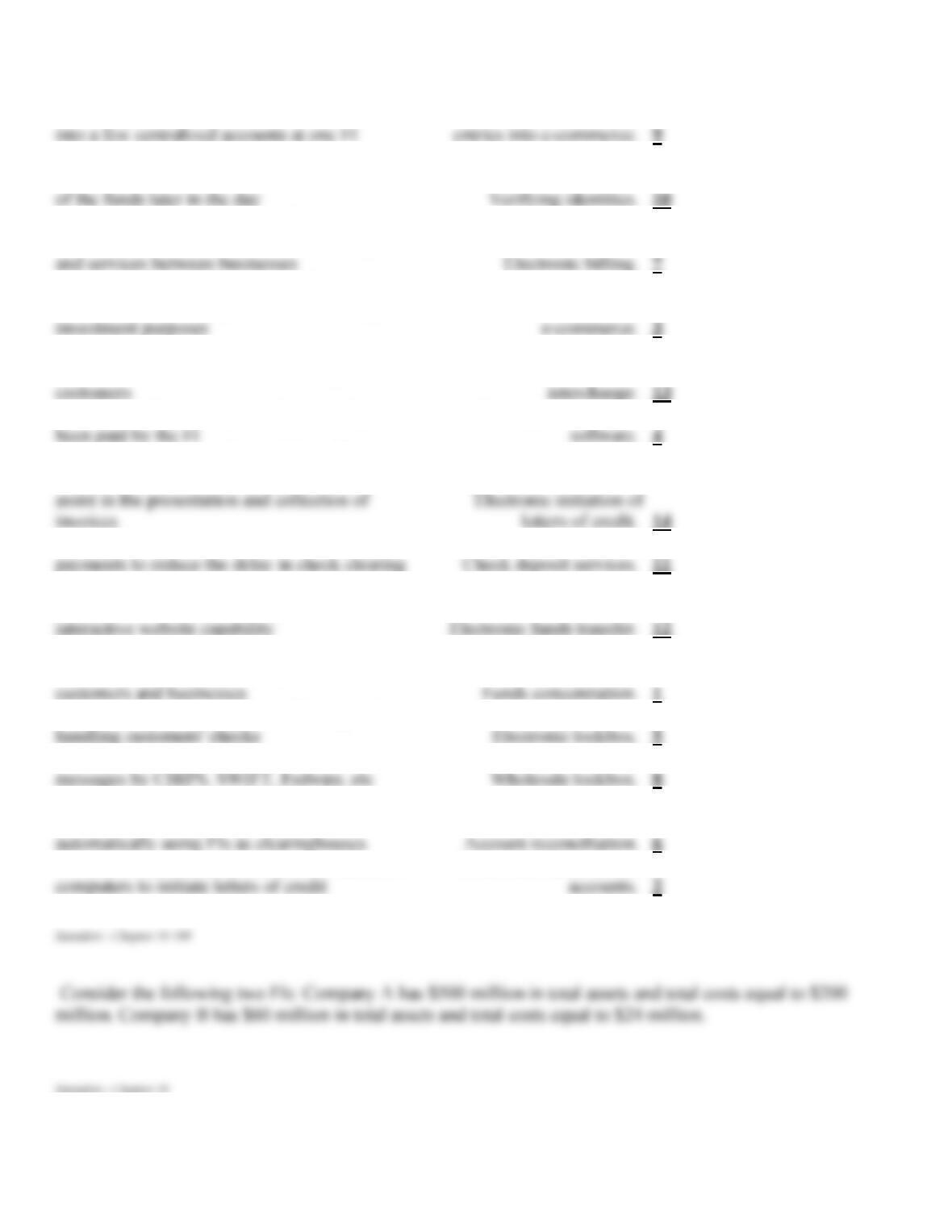
90. Choose among the following services provided by modern FIs to answer questions 90 to 103.
1. Moving funds from accounts in several FIs
Assisting small business
2. Coordinating the need for funds early in the
day with a wire transfer to allow disbursement
3. Automating the information flow associated
with the procurement and distribution of goods
4. Allows efficient management of multiple
currency and security portfolios for trading and
Facilitating
business-to-business
5. A centralized collection service where the
payments are received on-line for corporate
Electronic data
6. A feature that records which checks have
Treasury management
7. Combining the e-mail capability of the
Internet and the interbank payment networks to
assist in the presentation and collection of
8. A centralized collection service for corporate
9. Helping small firms set up electronic
infrastructure for payment capabilities and
10. Using encryption technology to assist in the
electronic transaction of business between
11. Encoding, endorsing, microfilming, and
12. The transmission of payments and payment
13. Providing for the transmission of invoices,
purchase orders, and shipping notices
14. Allows customers in a network to access FI
Controlled disbursement
91. What are average costs for each FI?
92. What can you conclude about the cost structure of the market consisting of the two FIs?
93. Assume a third FI (company C) operates in the same market with two FIs, and it has $800 million in assets
and total costs of $420 million. What can you conclude about the cost structure of the FIs in this market?