
Chapter 16 – Simulation
True / False
1. Simulation is an excellent technique to use when a situation is too complicated to use standard analytical procedures.
a. True
b. False
2. Simulation is a trial-and-error approach to problem solving.
a. True
b. False
3. The degree of risk is associated with the probability or magnitude of loss.
a. True
b. False
4. To use Excel to generate a normally distributed random variable, you must know the mean and standard deviation of
the distribution and have a random number between 0 and 1.
a. True
b. False
5. Trials of a simulation show what would happen when values of the probabilistic input change.
a. True
b. False
6. In a Monte Carlo simulation, each simulation trial is dependent upon the result of a previous trial.
a. True
b. False
7. Verification is the process of ensuring that the simulation model provides an accurate representation of the real system.
a. True
b. False
Chapter 16 – Simulation
8. In comparing different policies using simulation, one should use the same set of random numbers whenever possible.
a. True
b. False
9. Validation determines that the computer procedure is operating as it is intended to operate.
a. True
b. False
10. A discrete-event simulation reviews the status of the system periodically, whether or not an event occurs.
a. True
b. False
11. A static simulation model is used in situations where the state of the system affects how the system changes or evolves
over time.
a. True
b. False
12. For any waiting line system, (Average number of units in waiting line) = (Total waiting time) divided by (Total time
of simulation).
a. True
b. False
13. The parameters of a simulation model are the controllable inputs.
a. True
b. False
Chapter 16 – Simulation
14. Using simulation to perform risk analysis is like playing out many what-if scenarios by randomly generating values
for the probabilistic inputs.
a. True
b. False
15. Computer-generated random numbers are normally distributed over the interval from 0 to 1.
a. True
b. False
16. Computer-generated random numbers are not technically random.
a. True
b. False
17. Simulation is an optimization technique.
a. True
b. False
18. Simulation models that must take into account how the system changes or evolves over time are referred to as
dynamic simulation models.
a. True
b. False
19. Computer-generated random numbers are normally distributed.
a. True
b. False
20. Each simulation run provides only a sample of how the real system will operate.
a. True
b. False
Chapter 16 – Simulation
21. One disadvantage of simulation is that it is limited in the variety of probability distributions that can be used in
modeling a system.
a. True
b. False
22. A simulation model provides a convenient experimental laboratory for the real system.
a. True
b. False
23. Simulation allows the user to specify certain desired results (for example, profit or service level values), and then the
necessary model parameters and operating policies are determined.
a. True
Multiple Choice
24. A simulation model uses the mathematical expressions and logical relationships of the
a. real system.
b. computer model.
c. performance measures.
d. estimated inferences.
25. Values for the probabilistic inputs to a simulation
a. are selected by the decision maker.
b. are controlled by the decision maker.
c. are randomly generated based on historical information.
d. are calculated by fixed mathematical formulas.
26. A quantity that is difficult to measure with certainty is called a
a. risk analysis.
b. project determinant.
Chapter 16 – Simulation
c. probabilistic input.
d. profit/loss process.
27. A value for probabilistic input from a discrete probability distribution
a. is the value given by the RAND() function.
b. is given by matching the probabilistic input with an interval of random numbers.
c. is between 0 and 1.
d. must be non-negative.
28. The number of units expected to be sold is uniformly distributed between 300 and 500. If r is a random number
between 0 and 1, then the proper expression for sales is
a. 200(r)
b. r + 300
c. 300 + 500(r)
d. 300 + r(200)
29. When events occur at discrete points in time
a. a simulation clock is required.
b. the simulation advances to the next event.
c. the model is a discrete-event simulation.
d. All of the alternatives are correct.
30. If customer 2 has a service time of 1.6, and if customer 3 has an interarrival time of 1.1 and a service time of 2.3,
when will customer 3’s service be completed?
a. 5.0
b. 3.9
c. 3.4
d. There is not enough information to answer.
31. Common features of simulations—generating values from probability distributions, maintaining records, recording data
and summarizing results—led to the development of
a. Excel and Lotus.
b. BASIC, FORTRAN, PASCAL, and C.
c. GPSS, SIMSCRIPT, SLAM, and Arena
Chapter 16 – Simulation
d. LINDO and The Management Scientist
32. In order to verify a simulation model
a. compare results from several simulation languages.
b. be sure that the procedures for calculations are logically correct.
c. confirm that the model accurately represents the real system.
d. run the model long enough to overcome initial start-up results.
33. Simulation
a. does not guarantee optimality.
b. is flexible and does not require the assumptions of theoretical models.
c. allows testing of the system without affecting the real system.
d. All of the alternatives are correct.
34. A simulation model used in situations where the state of the system at one point in time does not affect the state of the
system at future points in time is called a
a. dynamic simulation model.
b. static simulation model.
c. steady-state simulation model.
d. discrete-event simulation model.
35. The process of determining that the computer procedure that performs the simulation calculations is logically correct
is called
a. implementation.
b. validation.
c. verification.
d. repetition.
36. Numerical values that appear in the mathematical relationships of a model and are considered known and remain
constant over all trials of a simulation are
a. parameters.
b. probabilistic input.
c. controllable input.
d. events.
Chapter 16 – Simulation
37. Which of the following statements is INCORRECT regarding the disadvantages of simulation?
a. Each simulation run only provides a sample of how the real system will operate.
b. The summary of the simulation data only provides estimates about the real system.
c. The process of developing a simulation model of a complex system can be time-consuming.
d. The larger the number of probabilistic inputs a system has, the less likely a simulation will provide the best
approach for studying the system.
38. Which of the following statements is INCORRECT regarding the advantages of simulation?
a. Simulation is relatively easy to explain and understand.
b. Simulation guarantees an optimal solution.
c. Simulation models are flexible.
d. A simulation model provides a convenient experimental laboratory for the real system.
39. The word “uniform” in the term “uniform random numbers” means
a. all the numbers have the same number of digits.
b. if one number is, say, 10 units above the mean, the next number will be 10 units below the mean.
c. all the numbers are odd or all are even.
d. each number has an equal probability of being drawn.
40. A table of uniformly distributed random numbers should be read
a. from left to right.
b. from top to bottom.
c. diagonally, starting from the top left corner and moving to the bottom right.
d. in any consistent sequence.
41. The process of generating probabilistic inputs and computing the value of the output is called
a. simulation.
b. verification.
c. validation.
d. implementation.
Chapter 16 – Simulation
42. A graphical tool that helps describe the logic of the simulation model is a
a. Gantt chart.
b. histogram.
c. flowchart.
d. stem-and-leaf display.
43. The process of ensuring that the simulation model provides an accurate representation of a real system is called
a. risk analysis
b. verification
c. validation
d. static modeling
44. The term Monte Carlo simulation refers to any simulation that involves
a. what-if analysis
b. discrete-event modeling
c. the comparison of worst-case and best-case scenarios
d. randomly generating values for the probabilistic inputs
Subjective Short Answer
45. For the past 50 days, daily sales of laundry detergent in a large grocery store have been recorded (to the nearest 10).
Units Sold Number of Times
30 8
40 12
50 15
60 10
70 5
a. Determine the relative frequency for each number of units sold.
b. Suppose that the following random numbers were obtained using Excel:
.12 .96 .53 .80 .95 .10 .40 .45 .77 .29
Use these random numbers to simulate 10 days of sales.
Chapter 16 – Simulation
46. The drying rate in an industrial process is dependent on many factors and varies according to the following
distribution.
Minutes Relative Frequency
3 .14
4 .30
5 .27
6 .18
7 .11
a. Compute the mean drying time.
b. Using these random numbers, simulate the drying time for 12 processes.
.33 .09 .19 .81 .12 .88 .53 .95 .77 .61 .91 .47
c. What is the average drying time for the 10 processes you simulated?
Chapter 16 – Simulation
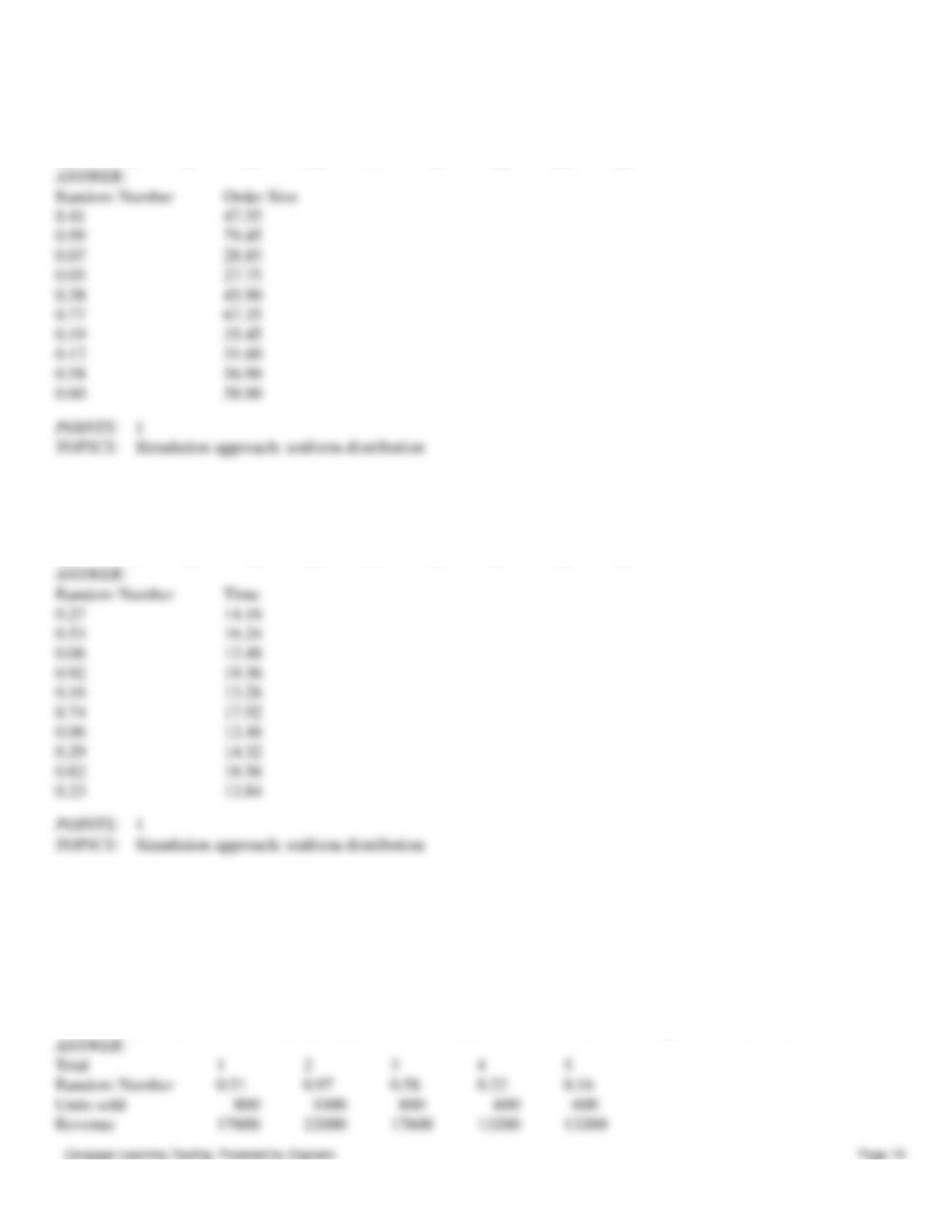
47. Greenfields is a mail order seed and plant business. The size of orders is uniformly distributed over the interval from
$25 to $80. Use the following random numbers to generate the size of 10 orders.
.41 .99 .07 .05 .38 .77 .19 .12 .58 .60
48. The time required to set up lighting for a portrait studio is uniformly distributed between 12 and 20 minutes. Use the
following random numbers to generate the setup time for 10 customers.
.27 .53 .06 .92 .16 .74 .06 .29 .82 .23
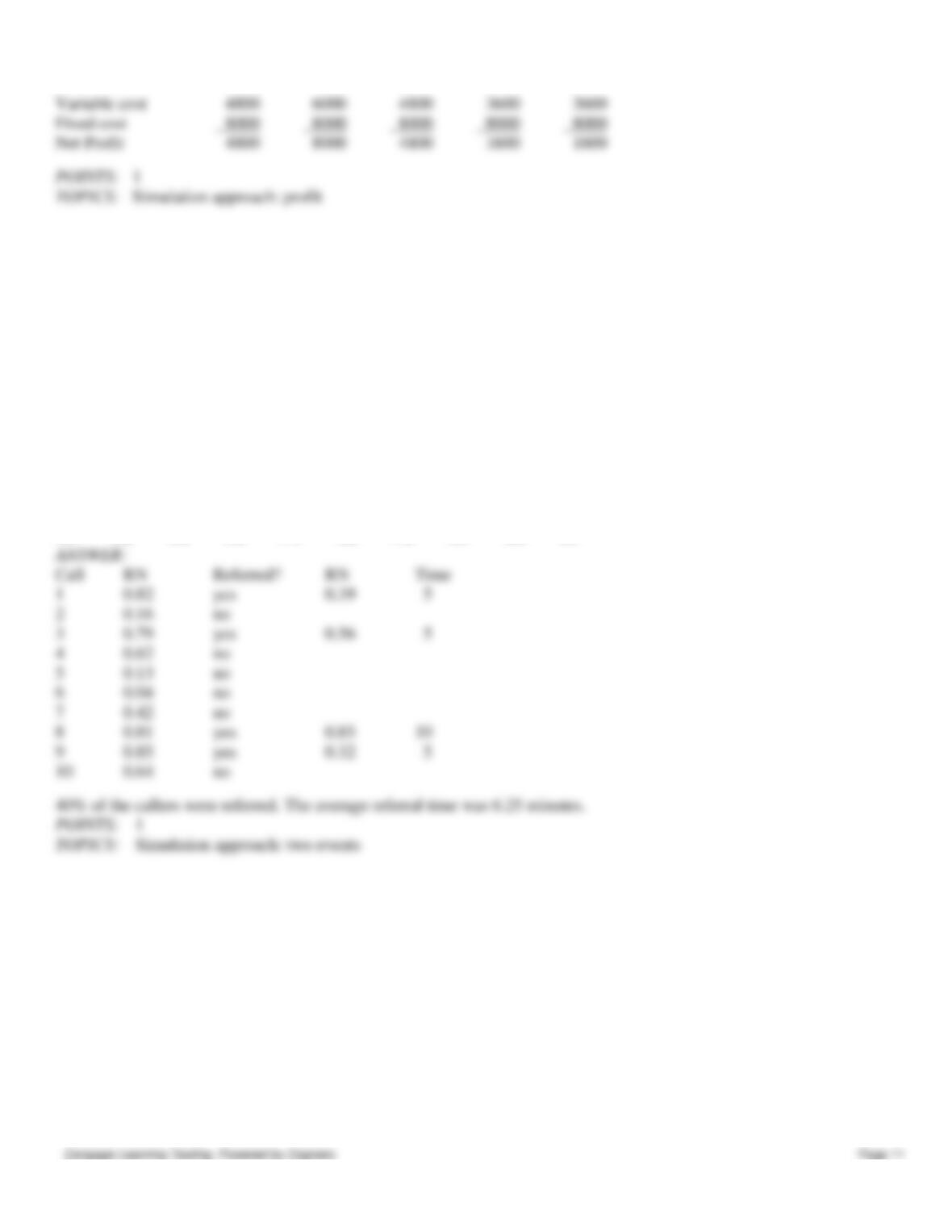
49. Estimates of the financial information for a new product show the following information:
Units Sold Probability Fixed cost $8,000
600 .35 Variable cost $6 / unit
800 .45 Revenue $22 / unit
1000 .20
Use the random numbers .51, .97, .58, .22, and .16 to simulate five trials. What is the net profit for each trial?
Chapter 16 – Simulation
50. Seventy-five percent of calls arriving at a help line can be handled by the person who answers the phone, but the
remaining 25% of them will need to be referred to someone else. Assume that every call requires one minute of attention
by the person who answers the phone (either to answer the question or to figure out how the referral should be handled).
Calls that are referred need an additional amount of time, as given in the table below.
Time Required Probability
3 minutes .25
5 minutes .35
10 minutes .40
Callers are served on a first come, first served basis, and are put on hold until the line is free. Use the random numbers to
simulate what happens to 10 callers. (Use the random numbers in order – from left to right, first row first – as you need
them.) What percentage of your callers needs to be referred? Of those who had to be referred, what is the average referral
time?
.82 .39 .16 .79 .56 .62 .13 .04 .42 .81
51. An airline reservation system first asks customers whether they want to schedule a domestic or an international flight.
Sixty-five percent of the reservations are for domestic flights. The time distribution of advance sales is also important, and
it is given below.
Domestic Flights International Flights
Make Reservations Rel. Freq. RN Range Make Reservations Rel. Freq. RN Range
Less than 1 week
in advance .25 Less than 1 week
in advance .12
1 week to 2 months
in advance .35 1 week to 2 months
in advance .35