164
LEAN PRODUCTION
CHAPTER 15
ANSWERS TO PROBLEMS
15.4
A: 500/100=
5
165
15.5
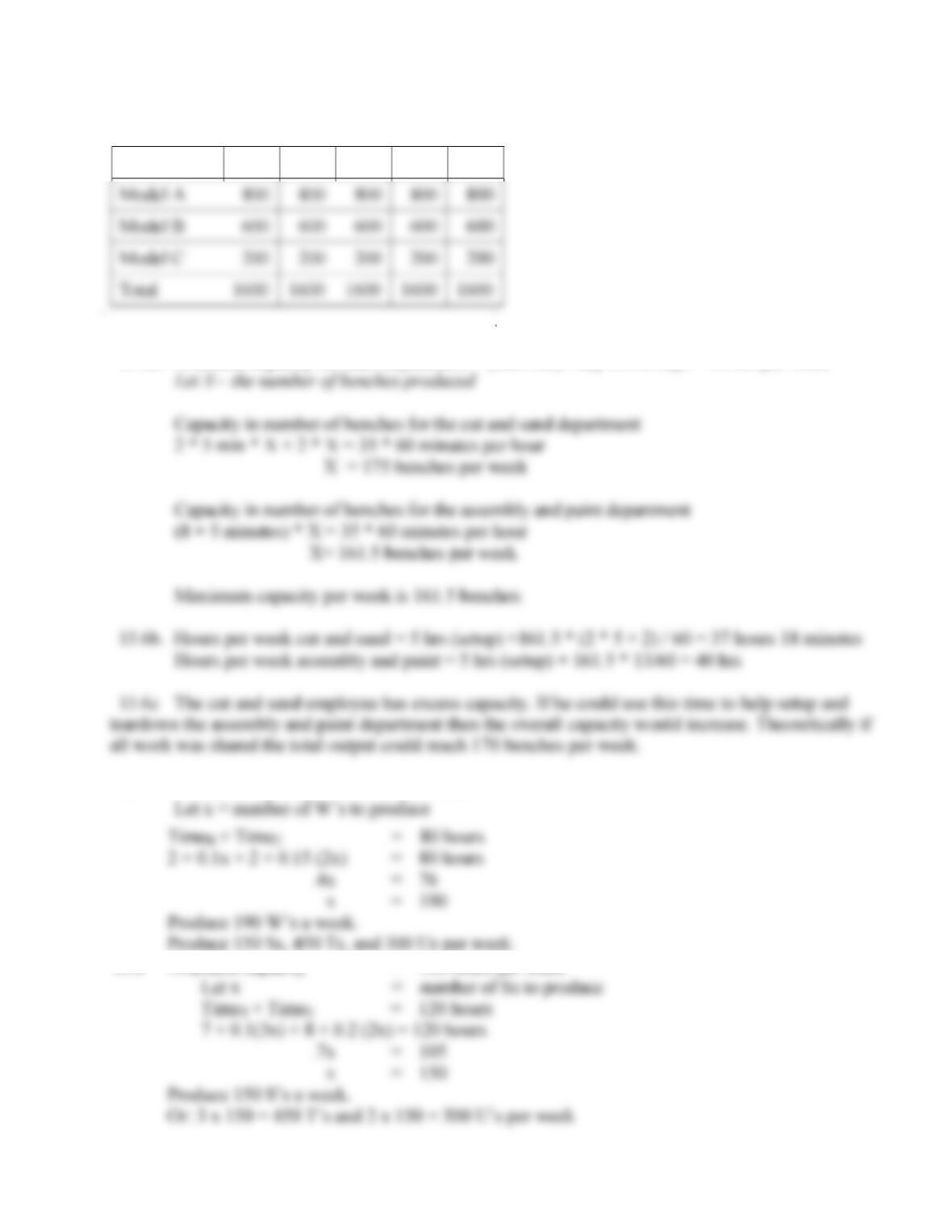
Week 1 2 3 4 5
15.6a
. Available capacity for each department = (8hrs-1hr) / day x five days = 35 hrs per week
15.7
Available capacity
=
80 hours per week
15.8
Available capacity = 120 hours per week
166
MULTIPLE CHOICE QUESTIONS
1
. Which of the following statements is best regarding lean production?
I
. It is a philosophy that relates to the way in which a manufacturing company
organizes and operates its business.
II
. It is a set of techniques to make manufacturing more productive.
III
. It is concerned with adding value to the product.
a
. all the above are true
b. I and II are best
c
. I and III are best
d
. II and III are best
e
. I only is best
2
. Which of the following statements is true?
I
. Value starts in the marketplace.
II
. Cost and value are the same thing.
III
. Counting and storing add value to the product.
a
. I and II
b
. I and III
c
. II and III
d
.
I
e
. III
3
. If a company standardizes on the components that are used in different models it will:
a
. reduce waste
b
. reduce the variety of options offered to the customer
c
. reduce the length of production runs
d
. require the use of general-purpose machinery
4
. The ideal product is one that:
I
. Meets or exceeds the needs of the customer.
II
. Makes the best use of material.
III
. Can be manufactured at least cost.
a
. all the above
b
. I and II only
c
. II and III only
d
. I only
5
. Overproduction causes waste by:
a
. consuming unneeded raw materials and labor
b
. creating excess inventory
c
. causing confusion and hiding problems
d
. a and b
e
. all the above
167
6
. Which of the following are advantages of reducing inventory?
I
. Engineering changes can be made sooner.
II. Quality can be improved.
III
. Less space is needed in manufacturing.
IV. Lead time will be shorter.
a
. all the above
b
. only I, II and III
c
. only I, II and IV
d. only II, III and IV
e
. only III and IV
7
. Which of the following is NOT an advantage of work cells?
a
. queue and lead time are reduced
b
. production activity control is simplified
c
. need for floor space is reduced
d
. immediate feedback
e
. maximum machine utilization
8
. Which of the following contribute to machine flexibility?
a
. small general-purpose machinery
b
. mobility of machines
c
. automated high-capacity machines
d
. a and b above
e
. b and c above
9
. Reduced setup has which of the following advantages?
I
. Reduced lot sizes.
II
. Reduce lead time and queue.
III
. Improved quality.
a
. all the above
b
. I and II only
c
. I and III only
d
. II and III only
e
. I only
10
. Which of the following statements is best about quality?
I. Quality can be inspected into a product.
II
. Poor quality has no effect on work flow.
III
. The process must be capable of producing the required quality consistently.
IV
. Machinery must be maintained in excellent condition.
a
. all the above
b
. I and II only
c
. II and III only
d
. III and IV only
e
. I and IV only
168
11
. Which of the following concepts is needed to achieve uninterrupted material flow?
a
. uniform plant loading
b
. pull system
c
. valid schedules
d
. all the above are needed
e
. a and b only are needed
12
. Linearity in a lean environment means:
a
. produce small lot sizes
b
. plan level schedules
c
. each day achieve the plan, no more or less
d
. eliminate all idle time
e
. statistical process control
13
. The buyer expects that a supplier will provide each of the following EXCEPT:
a
. the quality needed at all times
b
. information on competitors
c
. frequent deliveries
d
. improved quality and cost
14
. Employee involvement in a lean environment means:
I
. Operators must take responsibility for improving the process.
II
. Management must take more of a leadership role.
III
. Staff must be trainers and assist line people.
a
. all the above
b
. I and II only
c
. I and III only
d
. II and III only
e
. none of the above
15
. Which of the following statements is best?
I
. Lean and manufacturing planning and control cannot work together.
II
. The lean philosophy simplifies and reduces manufacturing planning and control
problems.
III
. Lean requires a very good planning and control system.
a
. all the above are true
b
. I and II
c
. I and III
d
. II and III
e
. none of the above
169
16
. Lean production will influence master production scheduling by:
a
. reducing time fences and making the MPS more responsive to customer demand
b. making it possible to use daily time buckets
c
. making the MPS more unstable
d
. a and b only
e
. b and c only
17
. Lean practices will change the material requirements planning process by:
a
. reducing the number of levels in the bill of material
b
. making the bill of material more complex
c
. increasing the need for offsetting
d
. increasing the need for netting
e
. eliminating the need for MRP
18
. Which of the following is a benefit to the purchaser in supplier partnerships?
a
. frequent deliveries on a just-in-time basis
b
. better quality
c
. improved performance and cost
d
. all the above
e
. a and b above only
19
. A pull system is developed to provide which of the following?
a
. an alternative to a classic MRP system
b
. to provide only what is needed and when it is needed
c
. only used when demand is constant and known
d
. only used when demand is unknown
20. An example of using the poka-yoke technique in process design is
a. Reducing the number and type of fasteners
b. Using standardized tooling
c. Using tooling to prevent a part from being inserted upside down
d. Eliminating bill of material levels
21
. Bills of material used for MRP planning in a lean environment are likely to have which of
the following characteristics?
a
. fewer “phantom” or “blow-through” assemblies
b
. increased complexity with regard to options
c
. weekly time buckets
d
. no need for where-used references
e
. fewer levels in product structures
22
. The term that describes eliminating waste throughout a company is:
a
.
Kaizen
b
. Lean Production
c
. Theory of Constraints
d
. Process Control

170
23. Which of the following techniques reduces the cost of processing transactions?
a. Backflushing
b. Pareto analysis
c. Mean absolute deviation
d. SMED
24. Which of the following terms refers to a pull system in which signals are used to
withdraw parts from feeding operations or suppliers?
a. Andon
b. Kanban
c. Dispatching
d. Poka-yoke
25. Employee participation in small, incremental improvements is known as:
a. Value stream mapping
b. Drum-buffer-rope
c. Kaizen
d. Motion economy
26. Matching the pace of production to match the rate of customer demand is known as:
a. Poka-yoke
b. Drum-buffer-rope
c. Bullwhip
d. Takt time
27. Which of the following define the 5S approach to housekeeping?
a. Sort, Straighten, Safety, Schedule, Source
b. Straighten, Shine, Standardize, Source, Smooth
c. Sort, Straighten, Shine, Standardize, Sustain
d. Shine, Standardize, Sustain, Schedule, Smooth
Answers.