CHAPTER 14—DERIVATIVES: ANALYSIS AND VALUATION
TRUE/FALSE
1. The Chicago Board Options Exchange has the largest share of stock option trading.
2. Index options are settled by delivery of the stocks that make up the index.
3. In index options, the aggregate market takes the place of the individual stock issues being traded, as in
stock options.
4. Risk management is the driving force behind the futures options market.
5. The longer the time to expiration, the greater the value of a call option.
6. There is an inverse relationship between the market interest rate and the value of a call option.
7. Credit risk in the options market is only a concern to the option seller.
8. The standardization of option contracts and the creation of the Options Clearing Corporation are two
important results of the opening of the Chicago Board of Options Exchange.
9. Stock options expire on the Sunday following the third Saturday of the designated month.
10. Index options can only be settled in cash.
11. Unlike stock options, futures options require the holder to enter into a futures contract.

2
12. It is a violation of the securities laws to combine option contracts to achieve a customized payoff.
13. European options can only be exercised on the expiration date.
14. The owner of a call option on a futures contract has the obligation to buy the futures contract at a
predetermined strike price during a specified time period.
15. Options on futures expire at the same time the futures contract expires.
16. The underlying stock price and the value of the put option are factors that impact the value of an
American call option.
17. The binomial option pricing model approximates the price of an option obtained using the
Black-Scholes option pricing model as the number of subintervals increases.
18. Investors should purchase market index put options if they anticipate an increase in the index value.
19. The Options Clearing Corporation (OCC) acts as the guarantor of each Chicago Board Options
Exchange (CBOE) traded contract.
20. It is always theoretically possible to use options as a perfect hedge against fluctuations in value of the
underlying asset.
21. The most important input the investor must provide in determining option values is the strike price.
22. The binomial model is a continuous method for valuing options.
3
23. A warrant is an option to buy a stated number of shares of common stock at a specified price at any
time during the life of the warrant.
24. A major difference between a call option and a warrant is that call options are issued by the company
so that any proceeds from the sale of stock go to the issuing firm.
25. Risk management strategies involving interest rate agreements can be classified as forward-based or
option-based.
26. Forward rate agreements usually require substantial collateral.
27. The forward rate agreement is the most complicated of the OTC interest rate contracts.
28. If interest rates fall, an interest rate cap would expire unexercised.
29. In an interest rate swap, the fixed rate payer profits if interest rates fall.
30. While LIBOR is usually used with forward rate agreements it is rarely used with other interest rate
agreements.
31. The issuance of convertibles will ultimately lead to greater dilution than an initial issue of stock.
32. Convertibles provide the upside potential of common stock and the downside protection of a bond.
33. A warrant is an option to buy a stated number of shares of common stock at a specified price at any
time during the life of the warrant.

4
34. A major difference between a call option and a warrant is that call options are issued by the company
so that any proceeds from the sale of stock go to the issuing firm.
35. The intrinsic value of a warrant = (Market price of common stock + Warrant exercise price) Number
of shares specified by warrant.
36. By attaching a convertible feature to a bond issue a firm can often get a lower rate of interest on its
debt.
37. The investment value of a convertible bond is the price which it would be expected to sell as a straight
debt instrument.
38. The conversion parity price is equal to the par value of a convertible bond divided by the number of
shares into which it can be converted.
39. In a forward rate agreement (FRA) two parties agree today to a future exchange of cash flows based on
two different interest rates.
MULTIPLE CHOICE
1. Which of the following is not true about interest rate swaps?
a.
Payments are based on a notional principal.
b.
Floating rate payers profit if interest rates fall.
c.
Payments can be quarterly as well as semi-annually.
d.
Parities exchange debt obligations.
e.
Default risk is a possibility in the swaps market.
2. A ____ contract can be viewed as a prepackaged series of forward rate agreements to buy or sell
LIBOR at the same fixed rate.
a.
Swap
b.
Cap
c.
Floor
d.
Collar
e.
None of the above.

5
3. A pay-fixed interest rate swap can be viewed as equivalent to
a.
A long position in a par valued FRN and a long position in a par valued fixed rate note.
b.
A long position in a par valued FRN and a short position in a par valued fixed rate note.
c.
A short position in a par valued FRN and a long position in a par valued fixed rate note.
d.
A short position in a par valued FRN and a short position in a par valued fixed rate note.
e.
None of the above.
4. The creation of the CBOE led to all the following innovations in options except
a.
The creation of a central marketplace.
b.
The introduction of a clearing corporation.
c.
The standardization of expiration dates.
d.
The creation of a primary market.
e.
The creation of a secondary market.
5. Which of the following is not a factor needed to calculate the value of an American call option?
a.
The stock price
b.
The exercise price
c.
The exchange on which the option is listed
d.
The volatility of the underlying stock
e.
The interest rate
6. In the Black-Scholes option pricing model, an increase in security price (S) will cause
a.
An increase in call value and an increase in put value
b.
An increase in call value and a decrease in put value
c.
An decrease in call value and an increase in put value
d.
An decrease in call value and a decrease in put value
e.
An increase in call value and an increase or decrease in put value
7. In the Black-Scholes option pricing model, an increase in exercise price (X) will cause
a.
An increase in call value and an increase in put value
b.
An increase in call value and a decrease in put value
c.
An decrease in call value and an increase in put value
d.
An decrease in call value and a decrease in put value
e.
An increase in call value and an increase or decrease in put value
8. In the Black-Scholes option pricing model, an increase in time to expiration (T) will cause
a.
An increase in call value and an increase in put value
b.
An increase in call value and a decrease in put value
c.
An decrease in call value and an increase in put value
d.
An decrease in call value and a decrease in put value
e.
An increase in call value and an increase or decrease in put value

6
9. In the Black-Scholes option pricing model, an increase in the risk free rate (RFR) will cause
a.
An increase in call value and an increase in put value
b.
An increase in call value and a decrease in put value
c.
An decrease in call value and an increase in put value
d.
An decrease in call value and a decrease in put value
e.
An increase in call value and an increase or decrease in put value
10. In the Black-Scholes option pricing model, an increase in security volatility () will cause
a.
An increase in call value and an increase in put value
b.
An increase in call value and a decrease in put value
c.
An decrease in call value and an increase in put value
d.
An decrease in call value and a decrease in put value
e.
An increase in call value and an increase or decrease in put value
11. The value of a call option is positively related to:
a.
Underlying stock price.
b.
Time to expiration
c.
Exercise price.
d.
Choices a and b.
e.
Choices b and c.
12. The value of a call option is inversely related to:
a.
Underlying stock price.
b.
Time to expiration
c.
Exercise price.
d.
Choices a and b.
e.
Choices b and c.
13. If the hedge ratio is 0.50, this indicates that the portfolio should hold
a.
Two shares of stock for every call option written.
b.
One share of stock for every two call options written.
c.
Two shares of stock for every call option purchased.
d.
One share of stock for every two call options purchased.
e.
Two call options for every put option written.
14. Options can be used to
a.
Modify an equity portfolio’s systematic risk.
b.
Modify an equity portfolio’s unsystematic risk.
c.
Manage currency exposures in international equity portfolios.
d.
Change a portfolio’s exposure to a particular asset
e.
All of the above

7
15. The Black-Scholes model assumes that stock price movements can be described by
a.
Geometric moving averages.
b.
Arithmetic moving averages.
c.
Regression towards the mean.
d.
Geometric Brownian motion.
e.
Stochastic time lags.
16. Which of the following is not a variable required to determine an option’s value in the Black-Scholes
valuation model?
a.
Future security price.
b.
Exercise price.
c.
Time to expiration.
d.
Risk-free rate.
e.
Security price volatility.
17. What does N(d1) represent in the Black-Scholes model?
a.
Hedge ratio.
b.
Partial derivative of the call‘s value with respect to the stock price.
c.
Change in the option’s value given a one dollar change in the underlying security’s price.
d.
Option’s delta.
e.
All of the above.
18. The calculation of a weighted average of the implied volatility estimates from options on the Standard
& Poor’s 500 index using a wide range of exercise prices is known as
a.
Spider.
b.
QQQ.
c.
VIX.
d.
CIN.
e.
VOL.
8
Exhibit 14-1
THE FOLLOWING INFORMATION IS FOR THE NEXT PROBLEM(S)
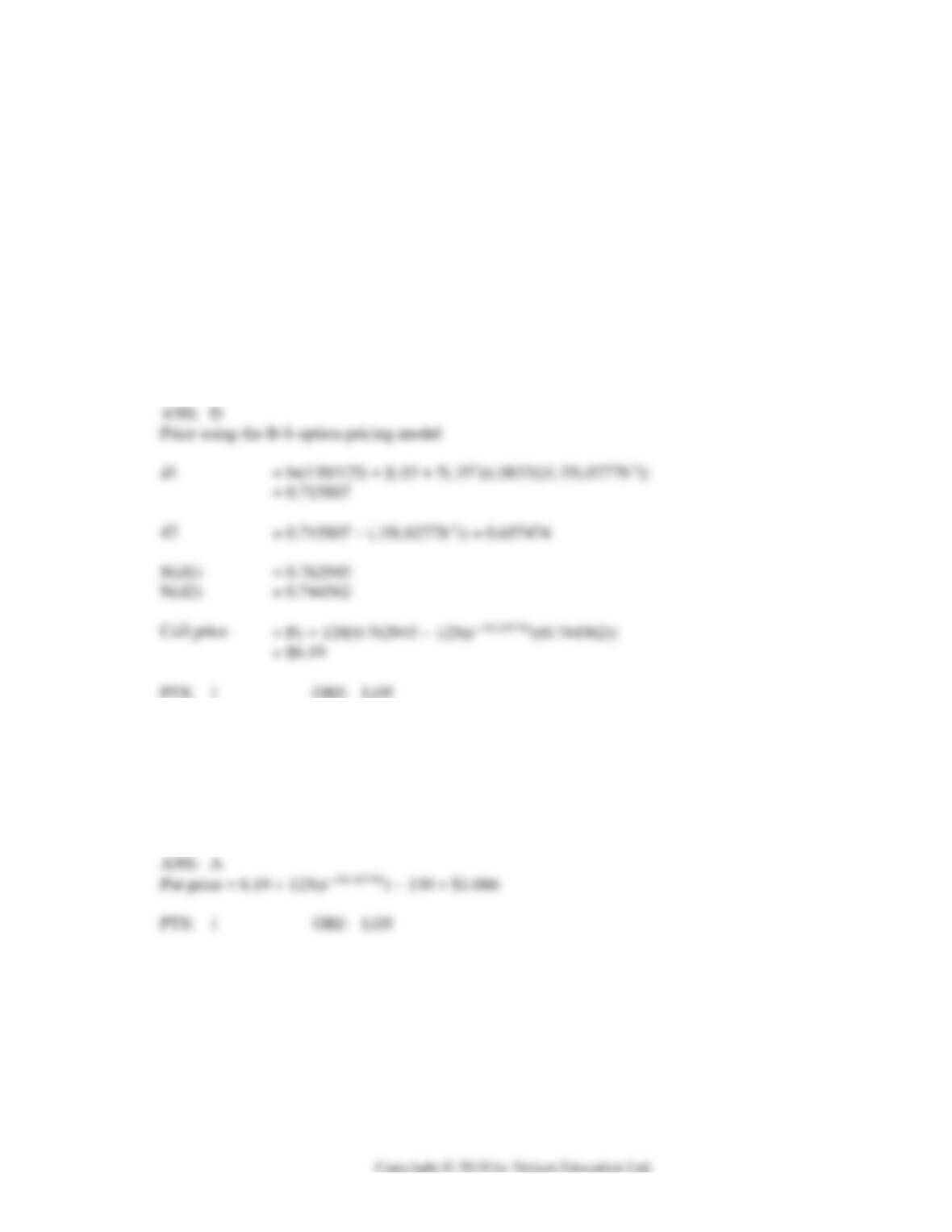
A stock currently trades for $130 per share. Options on the stock are available with a strike price of
$125. The options expire in 10 days. The risk free rate is 3% over this time period, and the expected
volatility is 0.35.
19. Refer to Exhibit 14-1. Use the Black-Scholes option pricing model to calculate the price of a call
option.
a.
$5.19
b.
$4.35
c.
$3.93
d.
$6.19
e.
$8.17
20. Refer to Exhibit 14-1. Calculate the price of the put option.
a.
$1.086
b.
$0.862
c.
$6.234
d.
$0.623
e.
$2.317
9
Exhibit 14-2
USE THE FOLLOWING INFORMATION TO ANSWER THE NEXT QUESTION(S)
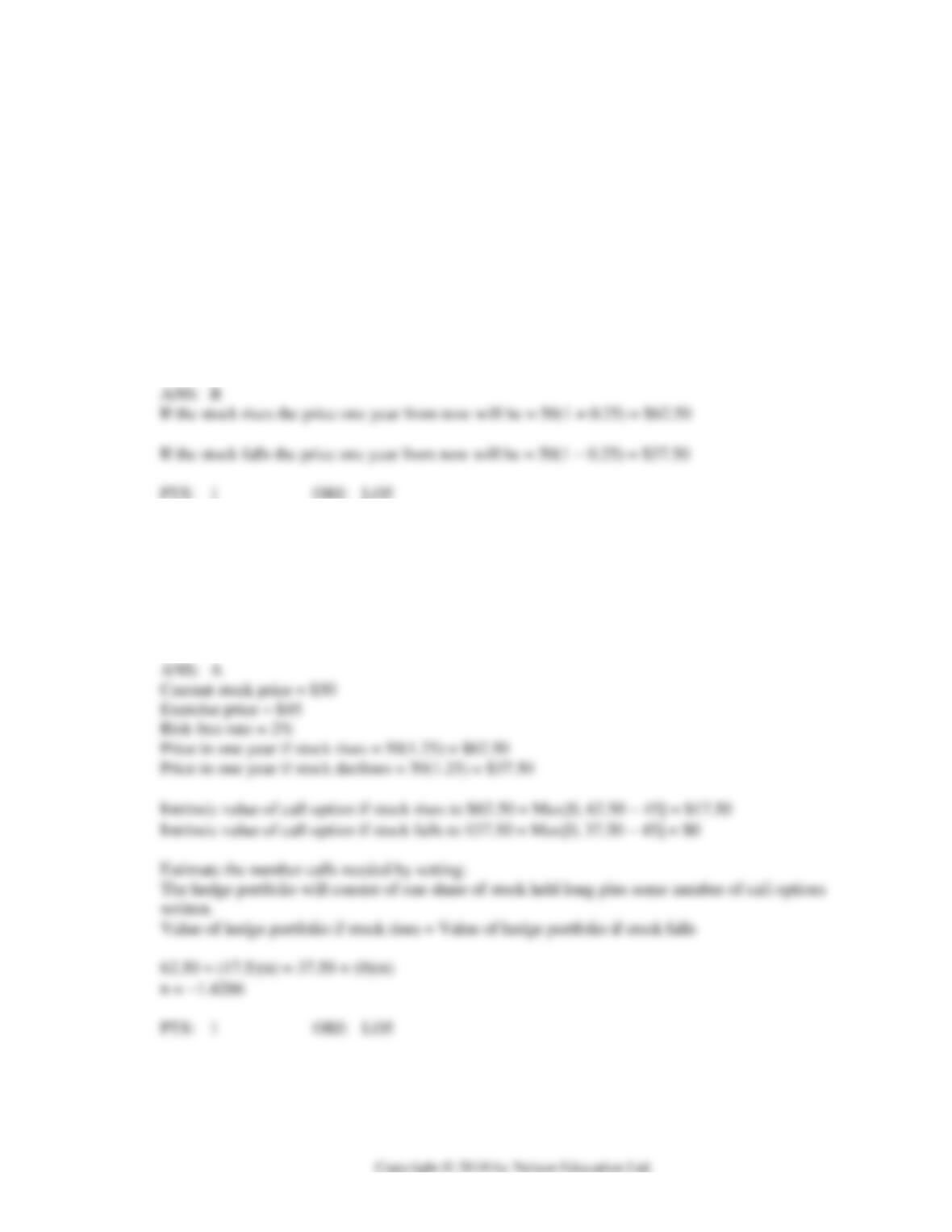
The information provided is relevant in the context of a one period (one year) binomial option pricing
model. A stock currently trades at $50 per share, a call option on the stock has an exercise price of
$45. The stock is equally likely to rise by 25% or fall by 25%. The one-year risk free rate is 2%.
21. Refer to Exhibit 14-2. Calculate the possible prices of the stock one year from today.
a.
$37.50 or $17.50.
b.
$62.50 or $37.50.
c.
$62.50 or $17.50.
d.
$50 or $45.
e.
None of the above.
22. Refer to Exhibit 14-2. Estimate n, the number of call options that must be written.
a.
−1.4286
b.
−2.9286
c.
−2.8571
d.
−2.5714
e.
−1.1111
10
23. Refer to Exhibit 14-2. Calculate the price of the call option today (C0).
a.
$7.56
b.
$17.48
c.
$9.26
d.
$5.0
e.
$17.15
Exhibit 14-3
USE THE FOLLOWING INFORMATION TO ANSWER THE NEXT QUESTION(S)
The following information is provided in the context of a two period (two six month periods) binomial
option pricing model. A stock currently trades at $60 per share, a call option on the stock has an
exercise price of $65. The stock is equally likely to rise by 15% or fall by 15% during each six month
period. The one-year risk free rate is 3%.
24. Refer to Exhibit 14-3. Calculate the possible prices of the stock at the end of one year.
a.
$69, $51, $79.35
b.
$51, $79.35, $58.65
c.
$79.35, $58.65, $43.35
d.
$58.65, $43.35, $14.35
e.
None of the above
25. Refer to Exhibit 14-3. Calculate the price of the call option after the stock price has already moved up
in value once (Cu).
a.
$7.77
b.
$14.35
c.
$0
d.
$4.21
e.
$6.44
11
26. Refer to Exhibit 14-3. Calculate the price of the call option after the stock price has already moved
down in value once (Cd).
a.
$7.77
b.
$14.35
c.
$0
d.
$4.21
e.
$6.44
27. Refer to Exhibit 14-3. Calculate the price of the call option today (C0).
a.
$7.77
b.
$14.35
c.
$0
d.
$4.21
e.
$6.44

28. Which of the following is not a characteristic of warrants?
a.
They are sweeteners added to other security issues.
b.
After the initial sale, warrants are detachable.
c.
They pay no dividends.
d.
They provide no voting rights.
e.
No dilution protection is offered in the event of stock dividends or stock splits.
29. An investor considering investment in warrants as part of an overall program, should consider which
of the following?
a.
Diversification
b.
Cutting losses short, and letting profits run
c.
A low intrinsic value
d.
Viewing warrant selection as a portion of the total investment process
e.
All of the above.
30. Which of the following is not a normal characteristic of a convertible bond?
a.
Conversion at the option of the issuer.
b.
Conversion into a fixed number of shares of common stock.
c.
A conversion price initially above the market price of the common stock.
d.
An interest rate lower than that on straight debentures.
e.
Subordination.
31. Which of the following is not a typical characteristic of a convertible preferred stock?
a.
They are cumulative but not participating.
b.
The conversion privilege normally expires before maturity.
c.
They have no sinking fund or purchase fund.
d.
They have a fixed conversion rate.
e.
There is generally no waiting period before conversion can take place.
32. ____ are debt instruments that have their principal or coupon payments tied to some other underlying
variable.
a.
Structured notes
b.
Variable rate notes
c.
Systematic notes
d.
Embedded notes
e.
PC bonds

13
33. ____ has coupons denominated in a currency other than that of their principal.
a.
Eurodollar bonds
b.
Dual currency bonds
c.
Euromarket bonds
d.
Bi-currency bonds
e.
Forward currency bonds
34. Which of the following is an example of a commodity-linked fixed income security?
a.
Cap and floor note.
b.
Cash and debit.
c.
Commodity debenture.
d.
Bull and bear note.
e.
Derivative commodity note.
35. A(n) _______ contract is an arrangement whereby the coupon rate on a note moves in the opposite
direction of some variable rate index.
a.
Inverse floating rate
b.
Reverse floating rate
c.
Backward floating rate
d.
Opposing floating rate
e.
Defensive floating rate
36. Consider a pension fund manager that wishes to convert $10 million from notes paying LIBOR to
stocks, using an equity swap. The equity swap should be structured so that
a.
Pension fund receives LIBOR and pays an equity return based on notional principal of $5
million.
b.
Pension fund pays LIBOR and receives an equity return based on notional principal of $5
million.
c.
Pension fund receives LIBOR and pays an equity return based on notional principal of $10
million.
d.
Pension fund pays LIBOR and receives an equity return based on notional principal of $10
million.
e.
None of the above.
37. A real option is a reference to
a.
Options on physical assets.
b.
Options on commodity futures.
c.
The value of flexibility embedded in a real asset.
d.
Choices a and b.
e.
Choices b and c.

14
38. The intrinsic value of a warrant is calculated as:
a.
(Market price of common stock + Warrant exercise price) Number of shares specified by
warrant.
b.
(Market price of common stock − Warrant exercise price) Number of shares specified by
warrant.
c.
(Market price of common stock + Warrant exercise price) / Number of shares specified by
warrant.
d.
(Market price of common stock − Warrant exercise price) / Number of shares specified by
warrant.
e.
None of the above.
39. An advantage of convertible bonds is
a.
Investors get the upside potential of a bond.
b.
Investors get the upside potential of a stock.
c.
Issuing firms can get a lower rate of interest on its debt.
d.
Choices a and b.
e.
Choices b and c.
40. Warrants differ from options in a number of ways. Which of the following statements about warrants
and options is false?
a.
When originally issued, the life of a warrant is usually much longer than that of a call
option.
b.
Warrants are usually issued by the company on whose stock the warrant is written.
c.
Warrants are often used by companies as sweeteners to make new issues of debt or equity
more attractive.
d.
Warrant holders have voting rights while option holders do not.
e.
None of the above (that is, all statements are true)
41. All of the following are normal characteristics of a convertible bond, except
a.
Conversion at the option of the issuer.
b.
Conversion into a fixed number of shares of common stock.
c.
A conversion price initially above the market price of the common stock.
d.
An interest rate lower than that on straight debentures.
e.
Subordination.
42. The minimum price of a convertible bond is
a.
Min (Bond Value, Conversion Value).
b.
Max (Bond Value, Conversion Value).
c.
Min (Stock Value, Conversion Value).
d.
Max (Stock Value, Conversion Value).
e.
None of the above.

15
43. The conversion premium for a convertible bond is calculated as:
a.
(Market Price + Minimum Value) / Minimum Value.
b.
(Market Price / Minimum Value) Minimum Value.
c.
(Market Price + Minimum Value) Minimum Value.
d.
(Market Price − Minimum Value) / Minimum Value.
e.
(Market Price Minimum Value) / Minimum Value.
44. The conversion price parity for a convertible bond is defined as:
a.
Market Price of Convertible Bond / Conversion Ration.
b.
Market Price of Convertible Bond Conversion Ration.
c.
Market Price of Convertible Bond − Conversion Ration.
d.
Market Price of Convertible Bond + Conversion Ration.
e.
None of the above.
45. An equity call option issued directly by the company whose stock serves as the underlying asset is
known as a
a.
Collar.
b.
Cap.
c.
Floor.
d.
Warrant.
e.
Swap.
46. The payment of any compensation for loss is contingent on the actual occurrence of a credit-related
event under a
a.
Total return swap.
b.
Credit default swap.
c.
Collar.
d.
Forward rate agreement.
e.
swap agreement.
47. Options embedded in real assets owned by firms are known as
a.
Asset options.
b.
Binomial options.
c.
Company options.
d.
Warrant options.
e.
Real options.