155
PRODUCTS AND PROCESSES
CHAPTER 14
ANSWERS TO PROBLEMS
14.1
14.3
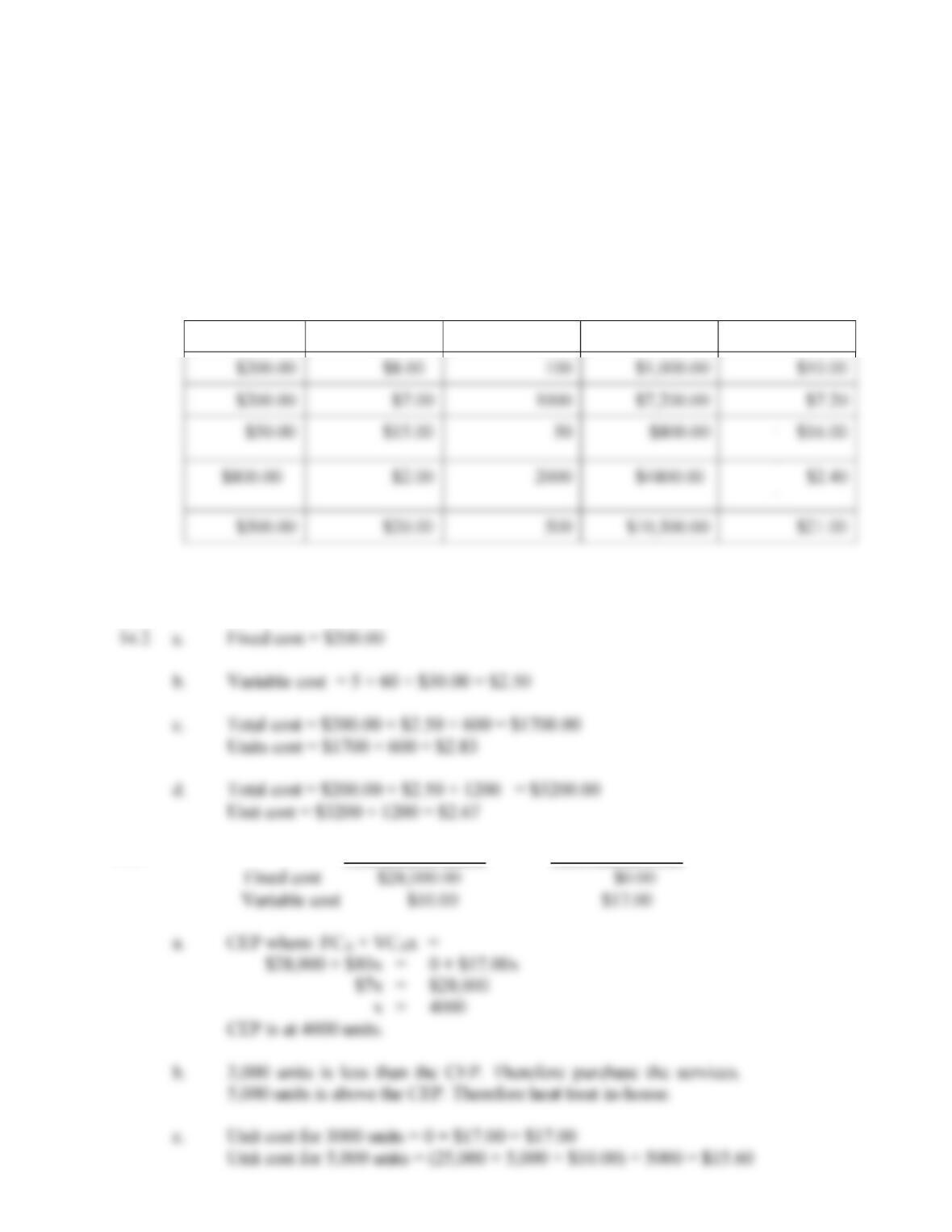
Heat treat in-house Purchase services
Fixed cost Variable cost Volume (units) Total cost Unit cost
156
14.4
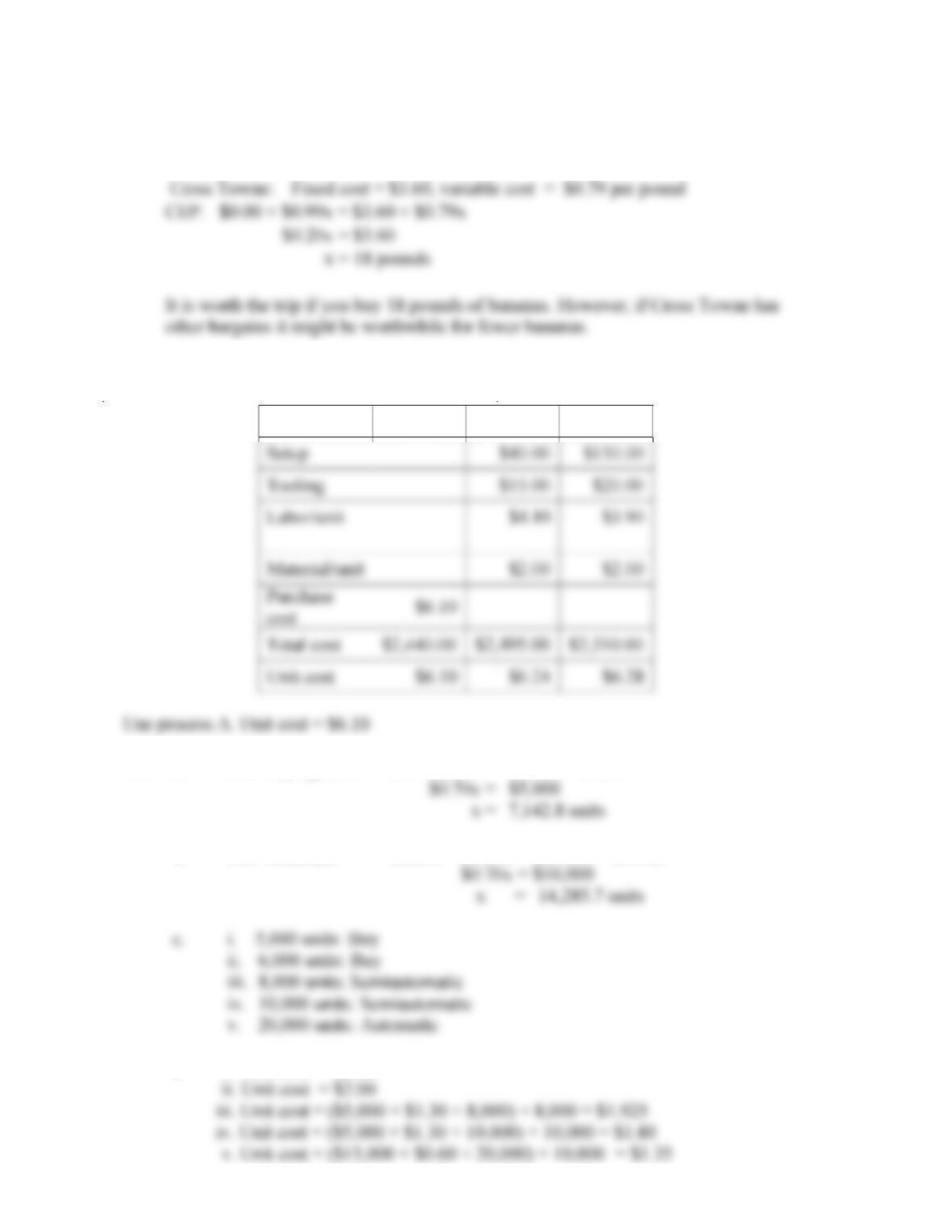
Corner store: Fixed cost =
$0.00,
variable cost = $0.99 per pound
14.5
14.6
a
. CEP buying/semi. $0 + $2.00x = $5,000 + $1.30x
b
. CEP semi/auto $5,000 + $1.30x = $15,000 + $0.60x
d
i
. Unit cost
=
$2.00
Buy
Process A
Process B
157
14.7
14.8
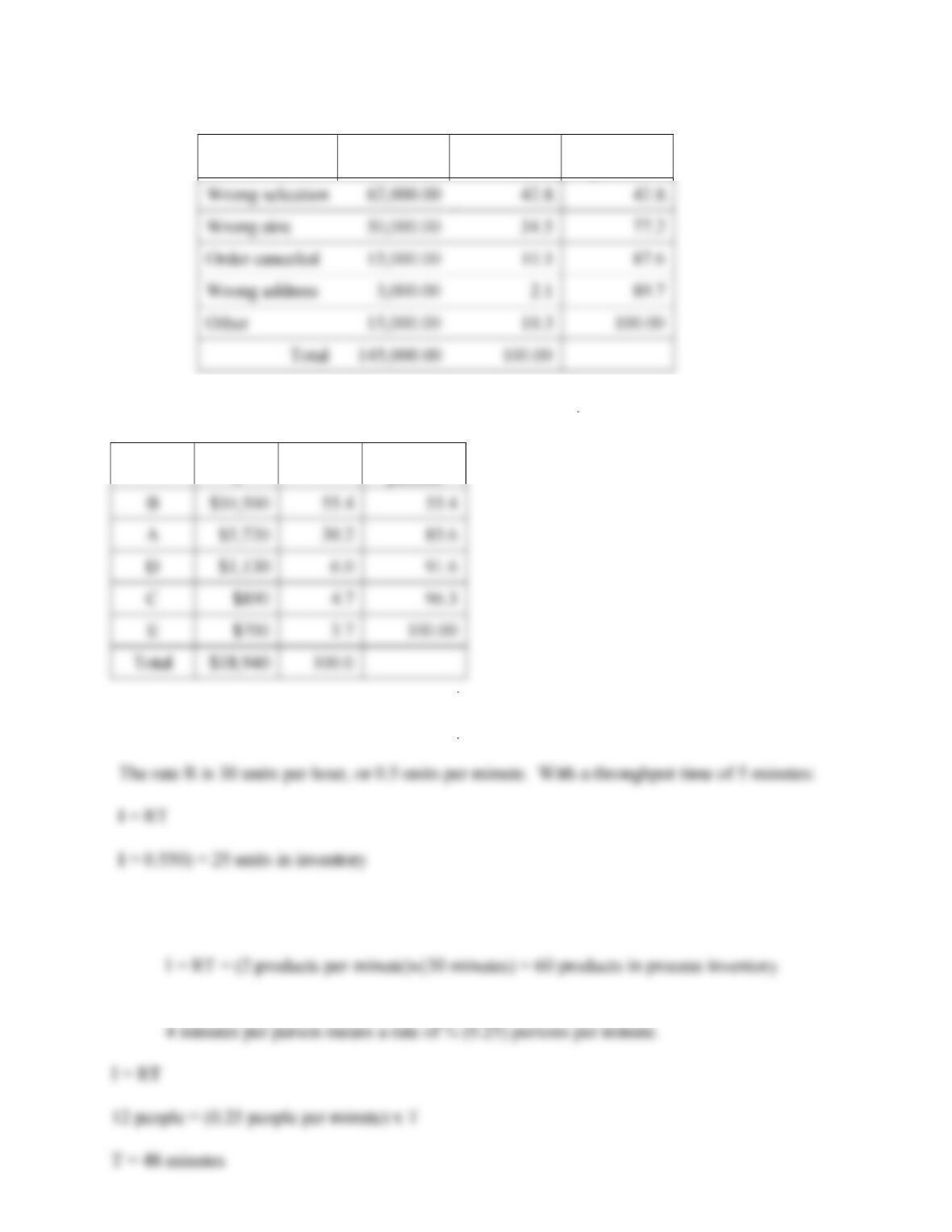
Part Number
$
Percent Cumulative
percent
14.9
14.13
14.14
Reason Number Percent Cumulative
percent
158
MULTIPLE CHOICE QUESTIONS
1
. The process of making something less complex or less difficult is called:
a:
standardization
b:
simplification
c:
specialization
d:
any of the above
e:
none of the above
2
. Which of the following statements regarding standardization is true?
I
. All products made to a given specification will be interchangeable.
II
. A range of standard specifications can be established so that the range covers the
majority of uses for the item.
III
. Standardization results in a larger variety of parts.
a: I and II are true
b:
II and III are true
c:
I and III are true
d:
I, II and III are true
e:
none of the above is true
3
. The establishment of a common size for electric light sockets is an example of:
a: simplification
b:
diversification
c:
standardization
d:
product focus
e:
none of the above
4
. The concentration of effort in a given field of endeavor is called:
a: simplification
b:
concentration
c:
standardization
d:
specialization
5
. Specialization increases output and decreases costs by:
a:
enabling labor to develop speed and dexterity
b:
reducing setup time for each part
c:
allowing a company to make a wide variety of different products
d:
a and b above only
e:
none of the above
159
6. During which phase of the product life cycle does the unit cost of the product decrease?
a. Introduction
b. Growth
c. Maturity
d. Decline
7
. Standardization can reduce costs by:
a:
reducing inventories
b:
increasing lot sizes
c:
allowing the use of general purpose equipment
d:
all the above
e:
a and b only
8
. Which of the following statements is true?
I
. Serving similar customers with similar demand characteristics is an example of
market focus.
II
. A company specializing in assembling cars is an example of process focus.
III
. A focused factory specializes in a wide product mix.
a:
I only is true
b:
I and II only are true
c:
I and III only are true
d:
II and III only are true
e: all the above are true.
9
. Which of the following is an objective of product design?
a: to design a product that will function as expected in the marketplace
b:
to design a product for minimum processing cost
c: to design a product that will have minimum design costs
d:
all the above
e:
a and b above
10. During which phase of the product life cycle do profits start to decline?
a. Introduction
b. Growth
c. Maturity
d. Decline
11
. Which of the following are advantages of simultaneous engineering?
I
. Time to market is reduced.
II
. Avoids the need for marketing and design to work together.
III
. Less communication is necessary.
a:
I only is true
b:
I and II only are true
c:
I and III only are true
d:
II and III only are true
e:
all the above are true
160
12
. Which of the following statements is/are true?
a:
product design is a major factor in determining the cost of a product
b:
product design is a major factor in the quality of a product
c:
product design is a trial and error process
d:
a and b above only
e:
all the above are true
13
. General-purpose equipment:
a:
is designed for maximum flexibility
b:
is used extensively in intermittent manufacturing
c:
is designed and used to produce one or a few specific parts
d:
a and b only are true
e:
none of the above are true
14
. Which of the following is a characteristic of special-purpose machinery?
a:
it can perform a variety of operations on a variety of work pieces
b:
capital costs are low compared to general purpose machinery
c:
it generally produces better quality than general purpose machinery
d:
all the above
e:
none of the above
15
. In designing a process, which of the following needs to be considered?
a:
the volume to be produced
b:
the degree of customer involvement
c:
the desired quality level
d:
all the above
e:
none of the above
16
. Which of the following statements is best about flow manufacturing?
I
. Work stations are located in the sequence needed to make the product.
II
. Work flows at a relatively constant rate.
III
. They can produce a wide variety of different products.
IV
. There is little buildup of inventory.
a
. all the above
b
. I, II and III are true
c
. I, II and IV are true
d
. II, III and IV are true
e
. I, III and IV are true
17. Which product design principle permits the practice of postponement?
a. Simplification
b. Standardization
c. Modularization
d. Specialization

161
18
. In a particular process, the fixed costs are calculated at $40,000 and the variable costs at $1.50 per unit.
If 10,000 units are to be produced, what is the average cost per unit?
a:
$1.50
b:
$2.00
c:
$4.00
d:
$5.50
e:
none of the above
19
. Which of the following are reasons a firm would buy a product rather than make it in its factory?
a:
secrecy of design
b:
utilizing idle workforce
c:
providing known and competitive prices
d:
all the above
e:
a and b only
20. A plant specializing on a limited, concise, manageable set of products, technologies, volumes, and
markets is known as a:
a. Focused factory
b. 3PL
c. Job shop
d. Work cell
21
. What is the Cost Equalization Point for the two processes shown?
Process A Process B
Fixed cost
$30.00
$120.00
Variable cost
$3.00
$2.00
a:
$90.00
b:
90 units
c:
100 units
d:
120 units
e:
none of the above
22
. Intermittent manufacturing:
a:
is particularly suited to the production of low-volume items
b:
processes items in lots or batch
c:
generally uses general purpose machinery
d:
all the above
e:
none of the above
23
. The cost equalization point:
a:
is used to show the potential profit of a process
b:
shows the lot size where costs are minimized
c: is used to select the lowest cost of two or more alternative processes
d:
is the point where unit cost of a process are at a minimum
e: uses all the above
162
24
. Some purposes of continuous process improvement are:
a:
the reduction of worker fatigue and effort without reduction of levels of output
b:
the improvement of production processes and procedure
c:
the improvement of factory, department, and work-station layout to improve
work flows
d:
improvement of levels of worker safety
e:
all the above
25
. In selecting a process for continuous improvement study, which of the following factors should be
considered?
a:
human
b:
economic
c:
marketing
d:
all the above
e
. a and b only
26
. Which of the following steps in a continuous improvement study ensures all elements of a job are
studied?
a: install
b:
select
c:
record
d:
examine
e:
none of the above
27. An analysis for ranking problems from most significant to least significant is called a:
a. Pareto
b. Cause-and-effect
c. Flow chart
d. Mass customization
28. A diagram used to illustrate the main causes and sub-causes leading to a problem or symptom is a:
a. Pareto
b. Cause-and-effect
c. Root cause
d. Flow chart
29. A management style that enables workers to make improvements in their workplace is:
a. Cross-training
b. Employee empowerment
c. Management by objective
d. Human resource enrichment
30. A graphical representation of the steps and operations in a process is a:
a. Pareto
b. Cause-and-effect
c. Root cause
d. Flow chart

163
Answers.