
Introduction to Operations and Supply Chain Management, 4e (Bozarth/Handfield)
Chapter 14 Managing Projects
Learning Objective 14-1
1) A project is a temporary undertaking designed to achieve a particular organizational goal.
2) In what way are projects and typical business activities similar?
A) For most companies, projects and typical business activities can be described as routine.
B) Both projects and typical business activities have a defined ending point at which time they
are complete.
C) Projects and routine business activities require significant levels of cross-functional and
interorganizational coordination.
D) The successful completion of projects and business activities is essential to a firm’s
competitive position.
3) In what ways are projects distinct from typical business activities?

4) Discuss the recent business trends that have increased the attention and interest in project
management skills.
Learning Objective 14-2
1) In the project definition phase, project planners identify, among other tasks, how to
accomplish the work and how to organize for the project.
2) Performance or time targets for each major group of activities in a project are set during the
planning phase of a project.

3) Key points in a project, such as when a major activity or phase should be completed, are
referred to as lodestones.
4) There are more resources required during the performance phase of a project than the project
definition phase.
5) One of the primary characteristics of projects as a form of work is the movement of personnel
from project to project.
6) Project planners develop a broad definition of what the project is and what its scope will be
during the:
A) concept phase.
B) project definition phase.
C) planning phase.
D) performance phase.

7) The budget estimates made during the concept phase are usually accurate to within:
A) 20 percent.
B) 30 percent.
C) 40 percent.
D) 50 percent.
8) An expectation that a new building’s foundation would be poured and cured by the end of the
year is an example of a(n):
A) activity.
B) scope.
C) milestone.
D) precedence.
9) Work on a project’s constituent activities begins in the project’s:
A) planning phase.
B) concept phase.
C) post-completion phase.
D) performance phase.
10) During the ________, project planners identify how to accomplish the work, how to organize
for the project, and the key personnel and resources needed.

11) A performance or time target for each major group of activities in a project is a(n) ________.
12) The actual work gets done during the ________ phase of a project.
13) What are the phases of a project and the activities within each?
Learning Objective 14-3
1) The best use of a Gantt chart is used to show precedence requirements for a project’s
constituent activities.
2) Program evaluation and review technique, PERT, is a network-based technique in which there
are multiple time estimates for each activity.
3) A critical path is composed entirely of critical activities.
4) A forward pass through a network is used to determine the earliest start times and earliest
finish times for each project activity.
5) The earliest finish time of an activity is always later than its latest start time.
6) The earliest start time of an activity is dependent on the earliest finish time of its immediate
predecessors.
7) The earliest finish time is calculated by adding the activity’s duration to the predecessor’s
earliest finish time.
8) Activities on the critical path may have positive or negative slack as long as the overall slack
time of the critical path is zero.
9) Crashing a project refers to the technique that minimizes completion time of the project.
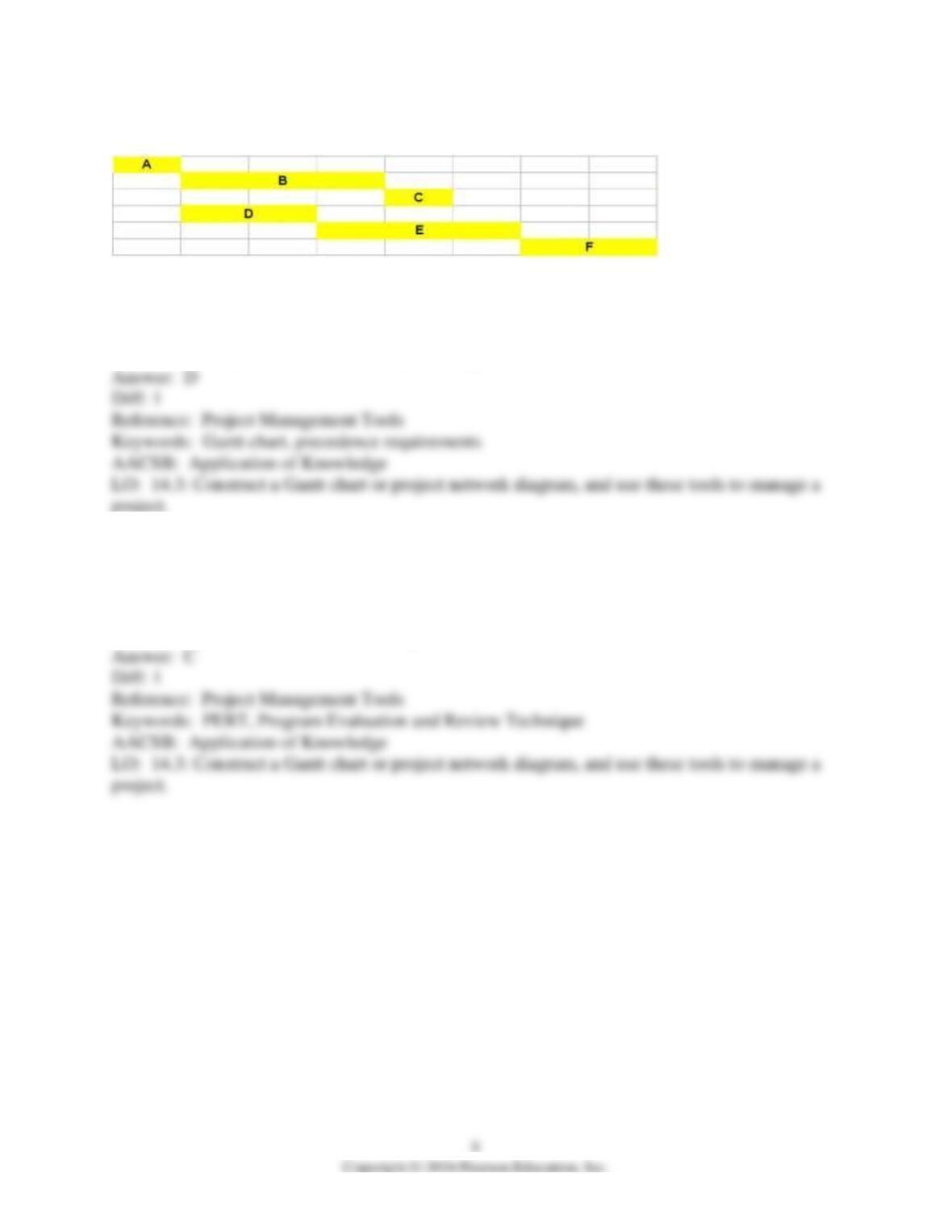
10) This Gantt chart can be used to show:
A) activity D must come before activity C.
B) activity F can be done at the same time as D.
C) activity E can begin as soon as activity A is complete.
D) activities D and B can be done simultaneously.
11) PERT is an acronym meaning:
A) Project Evaluation and Review Technique.
B) Project Execution and Review Technique.
C) Program Evaluation and Review Technique.
D) Plan Estimation and Review Technique.
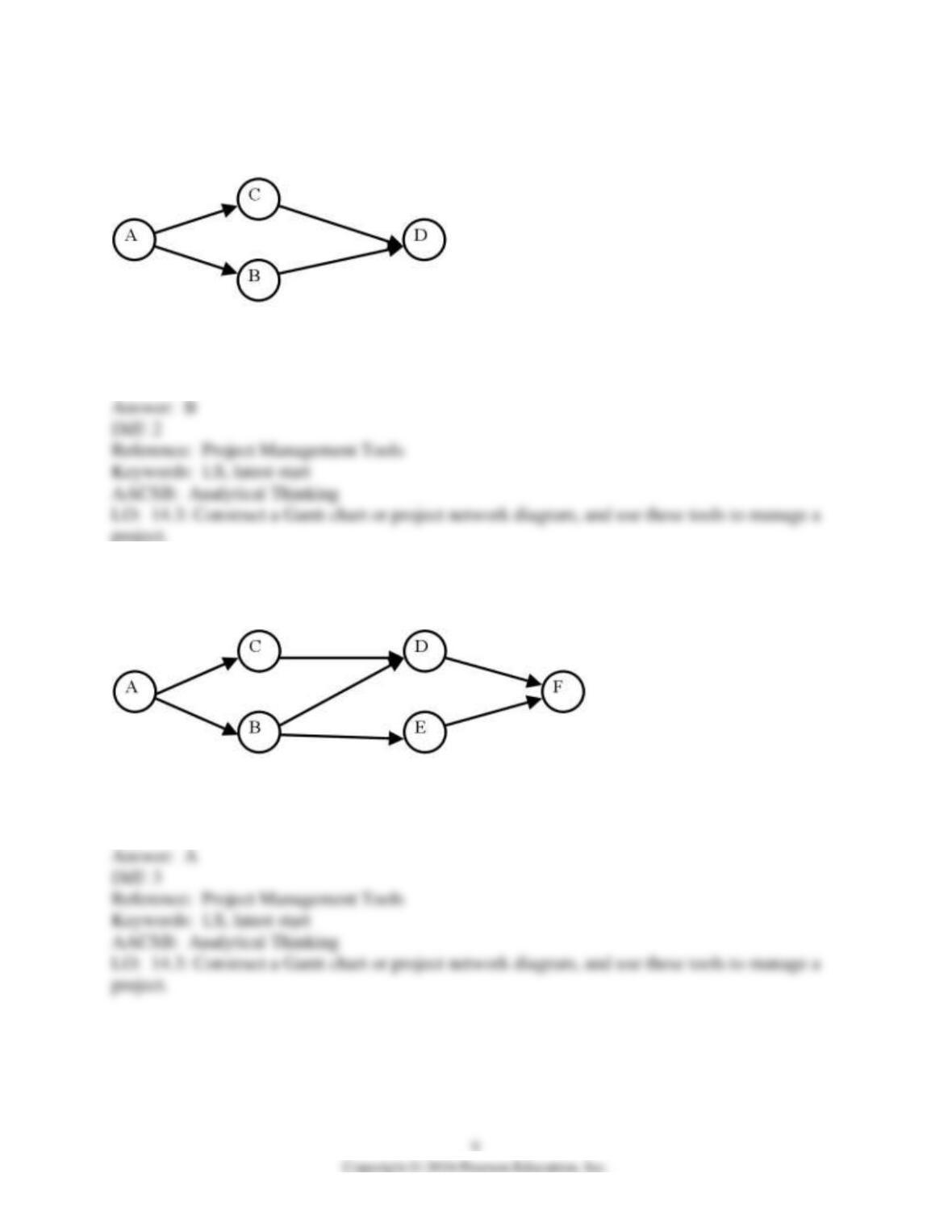
12) What is the latest that activity B can start if A lasts 35 days, B lasts 5, days C lasts 6 days,
and D lasts 7 days?
A) 35
B) 36
C) 40
D) 41
13) What is the latest that activity D can start if A lasts 5 days, B lasts 7 days, C lasts 4 days, D
lasts 5 days, E lasts 7 days, and F is 6 days long?
A) 14
B) 15
C) 16
D) 17
14) What is the fastest completion time of the project with activity lengths (in days) and
precedence requirements as shown in the table?
Activity
Length
Predecessor
A
15
—
B
7
A
C
4
A
D
8
B, C
A) 22
B) 25
C) 27
D) 30
15) A project is composed of 6 activities that have durations and precedence requirements shown
in the table. Which of these activities is NOT on the critical path?
Activity
Length
Predecessor
A
5
—
B
7
A
C
4
A
D
7
B,C
E
7
B
F
6
D, E
A) A
B) B
C) C
D) D
The tablet unearthed by the archaeologist revealed an ancient culture’s project plan. However, the
sands of time had erased much of the information that the table once contained. Use this
fragmentary record to unlock the ancient project’s secrets and answer the following questions.
Activity
Predecessors
Time
ES
EF
LS
LF
A
—
7
12
B
—
8
C
A
13
20
D
A
11
12
E
B
14
17
F
B
11
G
D, E
6
H
C
20
K
F
29
L
G, H, K
9
16) Refer to the scenario above. The project’s duration is:
A) 32 weeks.
B) 33 weeks.
C) 36 weeks.
D) 38 weeks.
17) Refer to the scenario above. What is the earliest start time for activity H?
A) Week 14
B) Week 15
C) Week 16
D) Week 17
18) Refer to the scenario above. What is the latest start time for activity K?
A) Week 20
B) Week 19
C) Week 18
D) Week 17
19) Refer to the scenario above. What is the duration of activity H?
A) 7 weeks
B) 8 weeks
C) 9 weeks
D) 10 weeks
20) Refer to the scenario above. What is the earliest finish time for activity G?
A) Week 21
B) Week 22
C) Week 23
D) Week 24
Construction of the cattery could be distilled to eight distinct steps, from the official
groundbreaking ceremony to the cutting of the litterbox ribbon. The activities, their durations
and predecessors are shown in the table below. Use this scenario to answer the following
questions.
Activity
Predecessors
Time (weeks)
A
—
10
B
A
8
C
A
7
D
C
11
E
D
12
F
B
11
G
E, F
6
H
E, F
9
21) Refer to the scenario above. The fastest the project can be completed is:
A) 49 weeks.
B) 46 weeks.
C) 38 weeks.
D) 35 weeks.
22) Refer to the scenario above. What is the slack for activity G?
A) 4 weeks.
B) 3 weeks.
C) 2 weeks.
D) 1 week.
23) Refer to the scenario above. Suppose the duration of only one activity could be halved.
Which activity should be halved to have the greatest impact on project completion time?
A) F
B) B
C) E
D) D
24) Refer to the scenario above. One activity has identical earliest finish and latest start times.
What is the common number for this unusual activity?
A) 17
B) 18
C) 21
D) 29
25) Refer to the scenario above. Which of these activities has the least slack?
A) E
B) B
C) G
D) F
A hatmaker, fresh off a very successful showing at Lidzapalooza is excited about the prospects
of providing the finest chapeaus to meet the needs of his energized customer base in the coming
year. He and his space designer have identified seven activities that are necessary to expand his
small shop. For the sake of simplicity, and to avoid giving away any trade secrets, the activities
have been identified by letters A-G. The activities, their time estimates, and the precedence
requirements are listed in the table immediately below. Use this scenario to answer the following
questions.
Activity
Predecessors
Time (weeks)
A
—
7
B
A
6
C
A
10
D
C
12
E
B, C
5
F
D, E
11
G
D, F
8
26) Refer to the scenario above. Which of these statements is BEST?
A) Only four of these activities have zero slack.
B) The late finish of D minus the late finish of C is less than the slack of B.
C) B’s latest start plus its slack equals F’s late finish.
D) The sum of the latest start times for activities A through E is less than the sum of the latest
start times for F and G.
27) Refer to the scenario above. Which of these activities has slack?
A) G
B) E
C) F
D) D
28) Which of the activities in this project has the greatest amount of slack?
Activity
Length
Predecessor
A
7
—
B
4
A
C
8
A
D
3
B, C
E
2
B
F
8
D, E
A) B
B) C
C) D
D) E
29) A seven activity project has the activity durations (in weeks) and costs shown in the table. It
is possible to speed up every one of the activities by paying a little more. What is the least
expensive 30-week project?
Activity
Predecessor
Normal
Duration
Normal Cost
Crash
Duration
Crash Cost
A
—
7
$2000
5
$3000
B
—
8
$1500
6
$2000
C
A
12
$2500
10
$2900
D
B
13
$3000
10
$4200
E
B
15
$4000
12
$5500
F
C, E
10
$3200
8
$4000
G
D
7
$1800
6
$2200
A) $18,900
B) $19,200
C) $19,500
D) $19,800
30) A seven activity project has the activity durations (in weeks) and costs shown in the table.
The project manager has an overall budget of $20,000, what is the fastest completion time
possible?
Activity
Predecessor
Normal
Duration
Normal Cost
Crash
Duration
Crash Cost
A
—
7
$2000
5
$3000
B
—
8
$1500
6
$2000
C
A
12
$2500
10
$2900
D
B
13
$3000
10
$4200
E
B
15
$4000
12
$5500
F
C, E
10
$3200
8
$4000
G
D
7
$1800
6
$2200
A) 29 weeks
B) 28 weeks
C) 27 weeks
D) 26 weeks