33. {LSAT Scores Narrative} Use Fisher’s LSD method with
= 0.05 to determine which school’s means
differ.
ANS:
34. {LSAT Scores Narrative} Use Tukey’s method with
= 0.05 to determine which population means
differ.
35. The average cost of remodeling one room in a house was compared for four different remodeling
companies. A random sample of 10 rooms remodeled by each company were selected all with the
same square footage, and cost of remodeling each room was recorded. (Rooms were randomly chosen
from different houses.) The data are shown below. An F-test using ANOVA concluded that average
costs differ for at least two of the remodeling companies.
Remodeling Company
1
2
3
4
610
404
599
272
354
663
426
405
234
521
429
197
399
518
621
363
278
499
426
297
358
374
414
538
379
562
322
181
548
505
460
318
196
375
494
412
444
438
637
499
Use Tukey’s and LSD multiple comparison methods to determine which remodeling companies differ
in their average cost. Compare the results and discuss. (Keep the experimentwise Type I error at or
close to 5%.)
36. A randomized block experiment having five treatments and six blocks produced the following values:
SST = 252, SS(Total) = 1,545, SSE = 198. The value of SSB must be 1095.
37. A randomized block design with 4 treatments and 5 blocks produced the following sum of squares
values: SS(Total) = 2000, SST = 400, SSE = 200. The value of MSB must be 350.
38. In employing the randomized block design, the primary interest lies in reducing sum of squares for
blocks (SSB).
39. When the problem objective is to compare more than two populations, the experimental design that is
the counterpart of the matched pairs experiment is called the randomized block design.
40. One example of a blocking variable is the dosage level that each subject is assigned to in a randomized
experiment.
41. The F-test of the randomized block design of the analysis of variance has the same requirements as the
independent samples design; that is, the random variable must be normally distributed and the
population variances must be equal.
42. The purpose of designing a randomized block experiment is to reduce the between-treatments variation
(SST) to more easily detect differences between the treatment means.
43. When the variation associated with blocks is removed from the data, SSE increases.
44. SSE in the independent samples design is equal to the sum of SSB and SSE in the randomized block
design.
45. In the randomized block design for ANOVA, where k is the number of treatments and b is the number
of blocks, the number of degrees of freedom for error is:
a.
k − b
b.
kb − 1
c.
n − k − b + 1
d.
None of these choices.
46. Which of the following statements is true?
a.
A fixed-effects ANOVA refers to the analysis which includes all possible levels of a
factor.
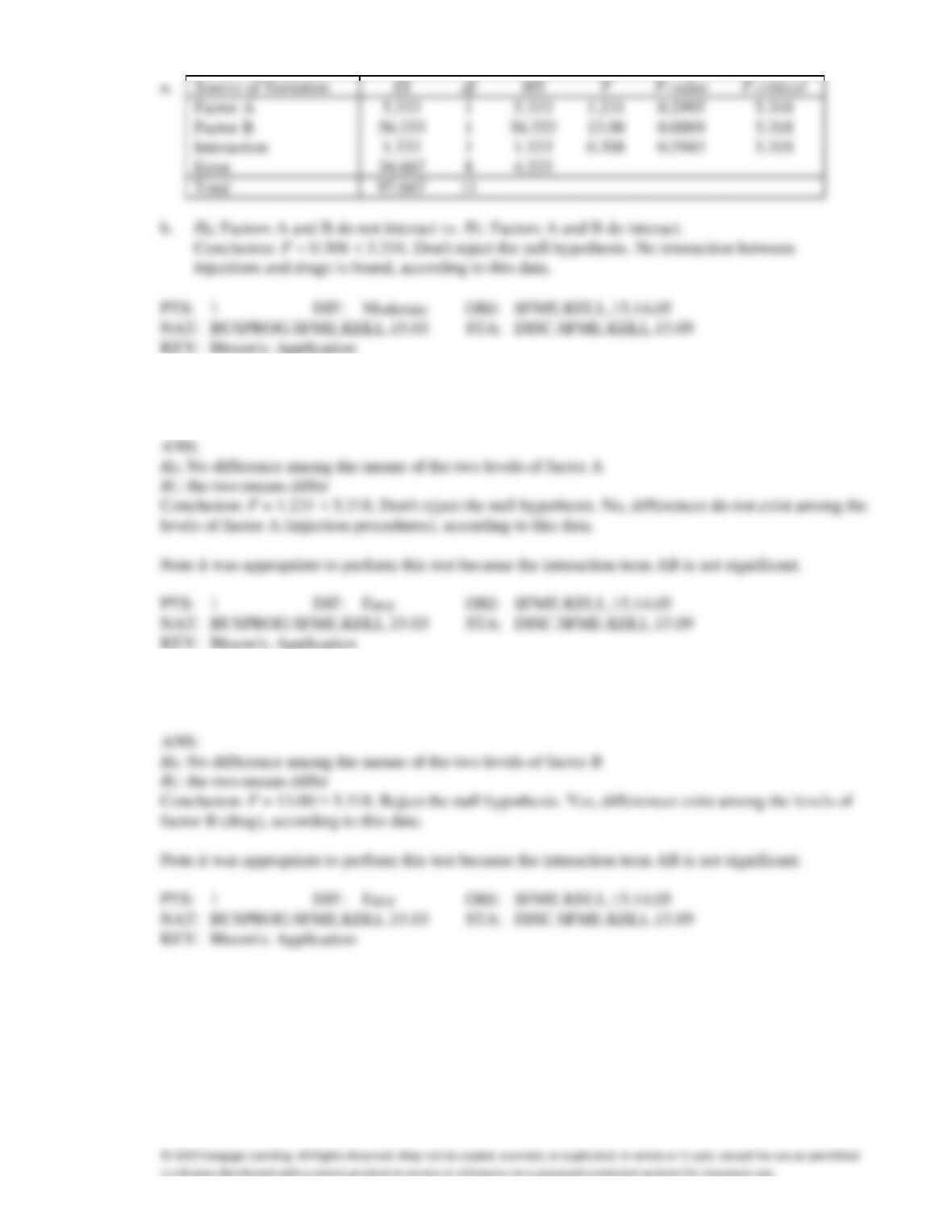
b.
A random-effects ANOVA refers to the analysis where the levels included in the study
represent a random sample of all levels that exist.
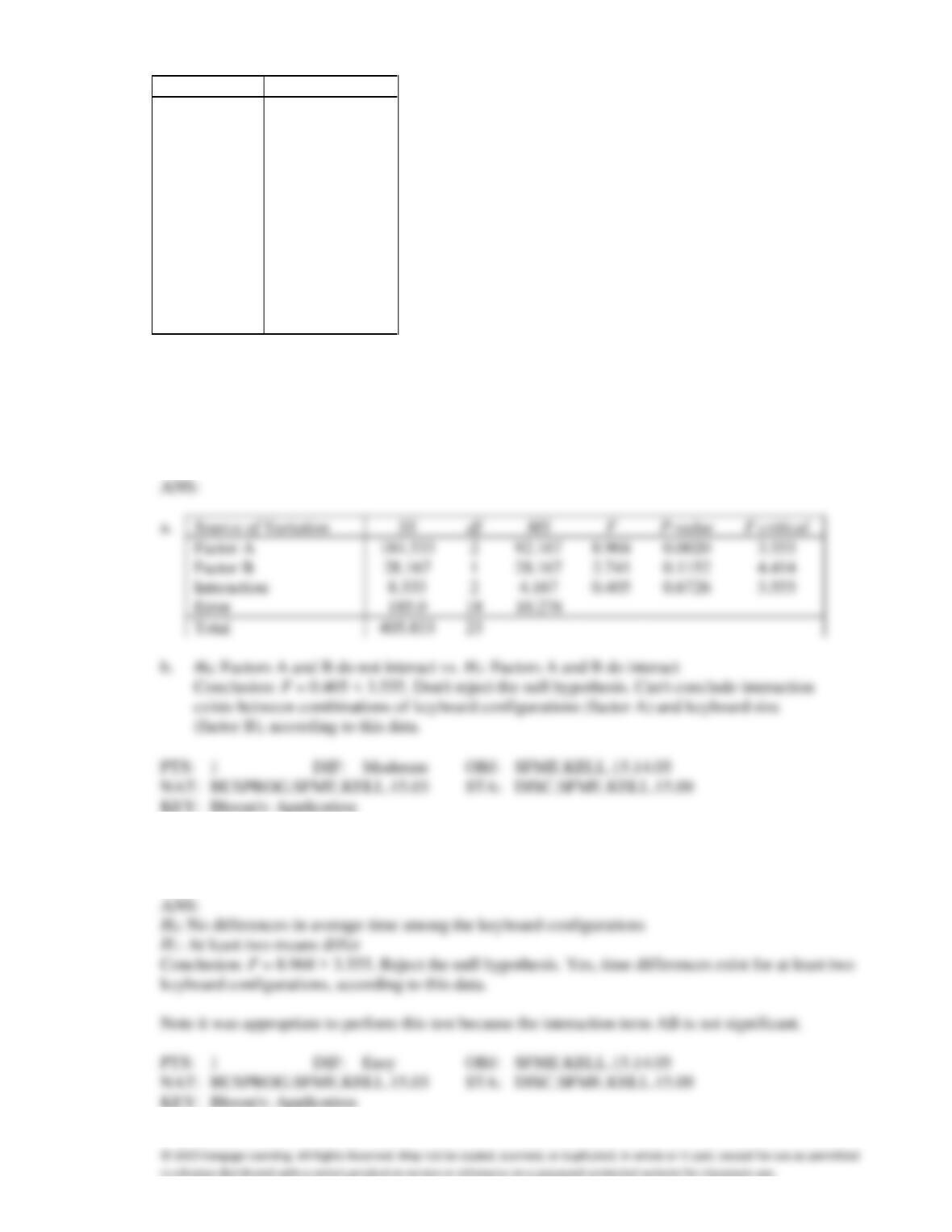
c.
A multifactor experiment is one where there are two or more factors that define the
treatments.
d.
All of these choices are true.
47. In the randomized block design ANOVA, the sum of squares for error equals:
a.
SS(Total) − SST
b.
SS(Total) − SSB
c.
SS(Total) − SST − SSB
d.
None of these choices.
48. When the objective is to compare more than two populations, the experimental design that is the
counterpart of the matched pairs experiment is called a:
a.
completely randomized design.
b.
one-way ANOVA design.
c.
randomized block design.
d.
None of these choices.
49. The primary interest of designing a randomized block experiment is to:
a.
reduce the within-treatments variation to more easily detect differences among the
treatment means.
b.
increase the between-treatments variation to more easily detect differences among the
treatment means.
c.
reduce the variation among blocks.
d.
None of these choices.
50. The randomized block design with exactly two treatments is equivalent to a two-tail:
a.
independent samples z-test.
b.
independent samples equal-variances t-test.
c.
independent samples unequal-variances t-test.
d.
matched pairs t–test.
51. Which of the following is true regarding SSB?
a.
SSB stands for sum of squares for blocks.
b.
SSB can help to reduce SSE.
c.
SSB can help make it easier to determine whether differences exist between the treatment
means.
d.
All of these choices are true.
52. A randomized block design with 4 treatments and 5 blocks produced the following sum of squares
values: SS(Total) = 1,951, SST = 349, SSE = 188 . The value of SSB must be:
a.
537
b.
1,763
c.
1,414
d.
1,602
53. The F-test of a randomized block design of the analysis of variance has the same requirements as the
independent samples design; that is, the random variable must be ____________________ distributed
and the population ____________________ must be equal.
54. SSE in the independent samples design is equal to the sum of SS____________________ and
SS____________________ in the randomized block design.
55. In employing the randomized block design, the primary interest lies in reducing sum of squares for
____________________.
56. When the problem objective is to compare more than two populations, the experimental design that is
the counterpart of the matched pairs experiment is called the randomized ____________________
design.
57. When we perform a blocked experiment by using the same subject for each treatment, this is called
a(n) ____________________ design.
58. If our analysis includes all possible levels of a factor, the technique for analyzing the data is called a(n)
____________________-effects ANOVA.
59. The test of whether the block means differ uses an F-test whose test statistic is
____________________ divided by ____________________.
60. A randomized block design experiment produced the following data.
Treatment
Block
1
2
3
1
25
27
25
2
19
18
17
3
15
20
16
4
23
27
20
5
30
31
28
a.
Set up the ANOVA Table. Use
= 0.05 to determine the critical values.
b.
Test to determine whether the treatment means differ. (Use
= 0.05.)
c.
Test to determine whether the block means differ. (Use
= 0.05.)
Treatments
Blocks
Error
Total
b.
this data.
c.
data.
Motorcycle Repair Cost
Motorcycle insurance appraisers examine motorcycles that have been involved in accidental collisions
and estimate the cost of repairs. An insurance executive claims that there are significant differences in
the estimates from different appraisers. To support his claim he takes a random sample of six
motorcycles that have recently been damaged in accidents. Three appraisers then estimate the repair
costs of all six motorcycles. The data are shown below.
Estimated Repair Cost
Motorcycles
Appraiser 1
Appraiser 2
Appraiser 3
1
650
600
750
2
930
910
1010
3
440
450
500
4
750
710
810
5
1190
1050
1250
6
1560
1270
1450
61. {Motorcycle Repair Cost Narrative} Set up the ANOVA Table. Use
= 0.05 to determine the critical
values.
Source of Variation
Treatments
Blocks
Error
Total
62. {Motorcycle Repair Cost Narrative} Can we infer at the 5% significance level that the executive’s
claim is true?
Food Irradiation
In recent years the irradiation of food to reduce bacteria and preserve the food longer has become more
common. A company that performs this service has developed four different methods of irradiating
food. To determine which is best, it conducts an experiment where different foods are irradiated and
the bacteria count is measured. As part of the experiment the following foods are irradiated: meat,
poultry, veal, tuna, and yogurt. The results are shown below.
Bacteria Count
Food
Method 1
Method 2
Method 3
Method 4
Meat
47
53
36
68
Poultry
53
61
48
75
Veal
68
85
55
45
Tuna
25
24
20
27
Yogurt
44
48
38
46
63. {Food Irradiation Narrative} Set up the ANOVA Table. Use
= 0.01 to determine the critical values.
Source of Variation
Treatments
Blocks
64. {Food Irradiation Narrative} Can the company infer at the 1% significance level that differences in the
bacteria count exist among the four irradiation methods?
Acid Reflux
A partial ANOVA table in a randomized block design is shown below, where the treatments refer to
different acid reflux medicines, and the blocks refer to groups of men with similar levels of stomach
acid.
Source of Variation
SS
df
MS
F
Treatments
*
4
*
*
Blocks
3,120
6
*
*
Error
*
*
115
Total
12,600
34
65. {Acid Reflux Narrative} Fill in the missing values (identified by asterisks) in the above ANOVA
Table.
Treatments
6,720
4
Blocks
6
520
4.5217
Error
2,760
24
Total
66. {Acid Reflux Narrative} Can we infer at the 5% significance level that the treatment means differ?
67. {Acid Reflux Narrative} Can we infer at the 5% significance level that the block means differ?
68. In a two-factor ANOVA, there are 4 levels for factor A and 5 levels for factor B, and two observations
within each cell. The number of treatments in this experiment is 40.
69. In a two-factor ANOVA, always test for interaction last.
70. In a two-factor ANOVA, there are 5 levels for factor A, 4 levels for factor B, and 3 observations for
each combination of factor A and factor B levels. The number of treatments in this experiment equals
20.
71. A complete factorial experiment is an experiment in which the number of replicates is the same for
each treatment on which data is collected.
72. Number of observation for a particular combination of treatments is called a replicate.
73. In a two-factor ANOVA, the sum of squares due to both factors, the interaction sum of squares, and
the error sum of squares must all add up to the total sum of squares.
74. If there is enough evidence to conclude that there is interaction in a two-factor ANOVA, do not
proceed to conduct the F-tests for each factor individually.
75. A balanced experiment requires that the sample size for each treatment be equal.
76. In the two-factor ANOVA where a is the number of factor A levels, b is the number of factor B levels,
and r is the number of replicates, the number of degrees of freedom for interaction is:
a.
(a − 1)(b − 1)
b.
abr − 1
c.
(a − 1)(r − 1)
d.
n − ab
77. When the effect of a level for one factor depends on which level of another factor is present, the most
appropriate ANOVA design to use in this situation is the:
a.
One-way ANOVA with 2 treatments.
b.
Two-factor ANOVA with interaction.
c.
Two-factor ANOVA with no interaction.
d.
None of these choices.
78. In the two-factor ANOVA where a is the number of factor A levels, b is the number of factor B levels,
r is the number of replicates, and n is the total number of observations, the number of degrees of
freedom for error is:
a.
(a − 1)(b − 1)
b.
abr − 1
c.
r(a − 1)(b − 1)
d.
n − ab
79. In a two-factor ANOVA, there are 4 levels for factor A, 5 levels for factor B, and 3 observations for
each combination of factor A and factor B levels. The number of treatments in this experiment equals:
a.
16
b.
20
c.
25
d.
60
80. In a two-factor ANOVA, there are 4 levels for factor A, 5 levels for factor B, and 3 observations for
each combination of factor A and factor B levels. The total number of observations in this experiment
equals:
a.
60
b.
25
c.
20
d.
16
81. In a two-factor ANOVA, where a is the number of factor A levels and b is the number of factor B
levels, the number of degrees of freedom for the interaction term is
a.
(a − 1)(b − 1)
b.
ab − 1
c.
(a − 1) + (b − 1)
d.
Unknown; need to know the number of replicates.
82. The equation: SS(Total) = SS(A) + SS(B) + SS(AB) + SSE applies to which ANOVA model?
a.
One-way ANOVA with 2 treatments.
b.
Two-factor ANOVA with interaction.
c.
Two-factor ANOVA with no interaction.
d.
None of these choices.
83. A complete 3 2 factorial experiment is called balanced if:
a.
data is collected at all three levels of factor A.
b.
data is collected at both levels of factor B.
c.
the number of replicates is the same for each of the 6 treatments.
d.
None of these choices.
84. Number of observation for particular combination of treatments is called a(n) ________________.
85. A(n) ____________________ experiment requires that the sample size for each treatment be equal.
86. In a two-factor ANOVA, always test for ____________________ first.
87. In a(n) ____________________ factorial experiment, data for all possible combinations of the levels
of the factors are gathered.
88. The required conditions for a two-factor ANOVA are that the distribution of the response is
____________________ distributed; the variance for each treatment is ____________________; and
the samples are ____________________.
89. In a two-factor ANOVA, the total sum of squares is broken down into the sum of SS(A) + SS(B) +
SSE + SS(____________________).
90. To test for interaction between factors A and B in a two-factor ANOVA, you use the F statistic that
equals ____________________ divided by ____________________.
Migraine Treatments
The following data were generated from a 2 2 factorial experiment with 3 replicates, where factor A
levels represent two different injection procedures of an anesthetic to the occipital nerve (located in the
back of the neck), and factor B levels represent two different drugs, which physicians recommend to
increase the effectiveness of the injections. Three migraine patients were randomly selected for each
combination of injection and drug.
Factor B
Factor A
1
2
1
7
13
10
11
8
12
2
10
16
11
15
6
11
91. {Migraine Treatments Narrative} Test at the 5% significance level to determine if differences exist
among the four treatment means.
Treatments
Error
Total
92. {Migraine Treatments Narrative}
a.
Create the ANOVA table.
b.
Test at the 5% significance level to determine if factors A and B interact.
ANS:
93. {Migraine Treatments Narrative} Test at the 5% significance level to determine if differences exist
among the levels of factor A.
94. {Migraine Treatments Narrative} Test at the 5% significance level to determine if differences exist
among the levels of factor B.
Keyboard Configuration and Size
The data shown below were taken from a 2 3 factorial experiment to examine the effects of factor A
(keyboard configuration, 3 levels) and factor B (keyboard size, 2 levels) on typing speed. Each cell
consists of the times needed for each of 4 randomly assigned keyboardists to type a standard document
under each set of conditions (in minutes).
Factor B
Factor A
1
2
1
26
24
19
21
20
20
21
23
2
30
33
24
27
25
31
29
29
3
26
31
22
23
27
24
17
26
95. {Keyboard Configuration and Size Narrative}
a.
Create the ANOVA table.
b.
Is there sufficient evidence at the 5% significance level to infer that factors A and B
interact?
Factor A
Factor B
Interaction
Error
Total
b.
96. {Keyboard Configuration and Size Narrative} Test at the 5% significance level to determine if time
differences exist among the different keyboard configurations.
97. {Keyboard Configuration and Size Narrative} Test at the 5% significance level to determine if time
differences exist among the keyboard sizes.