60. What is the FI’s net exposure in the Japanese yen?
61. What is the FI’s net exposure in the Swiss franc?
62. How would you characterize the FI’s risk exposure to fluctuations in the British pound to dollar exchange
rate?
63. How would you characterize the FI’s risk exposure to fluctuations in the yen/dollar exchange rate?
64. How would you characterize the FI’s risk exposure to fluctuations in the Swiss franc/dollar exchange rate?
65. What is the FI’s total FX investment?
66. How would you characterize the FI’s risk exposure to fluctuations in the Euro to dollar exchange rate?
67. What is the portfolio weight of the Euro in this FI‘s portfolio of foreign currency?
68. How would you characterize the FI’s risk exposure to fluctuations in the yen/dollar exchange rate?
69. What is the portfolio weight of the Japanese yen in this FI’s portfolio of foreign currency?
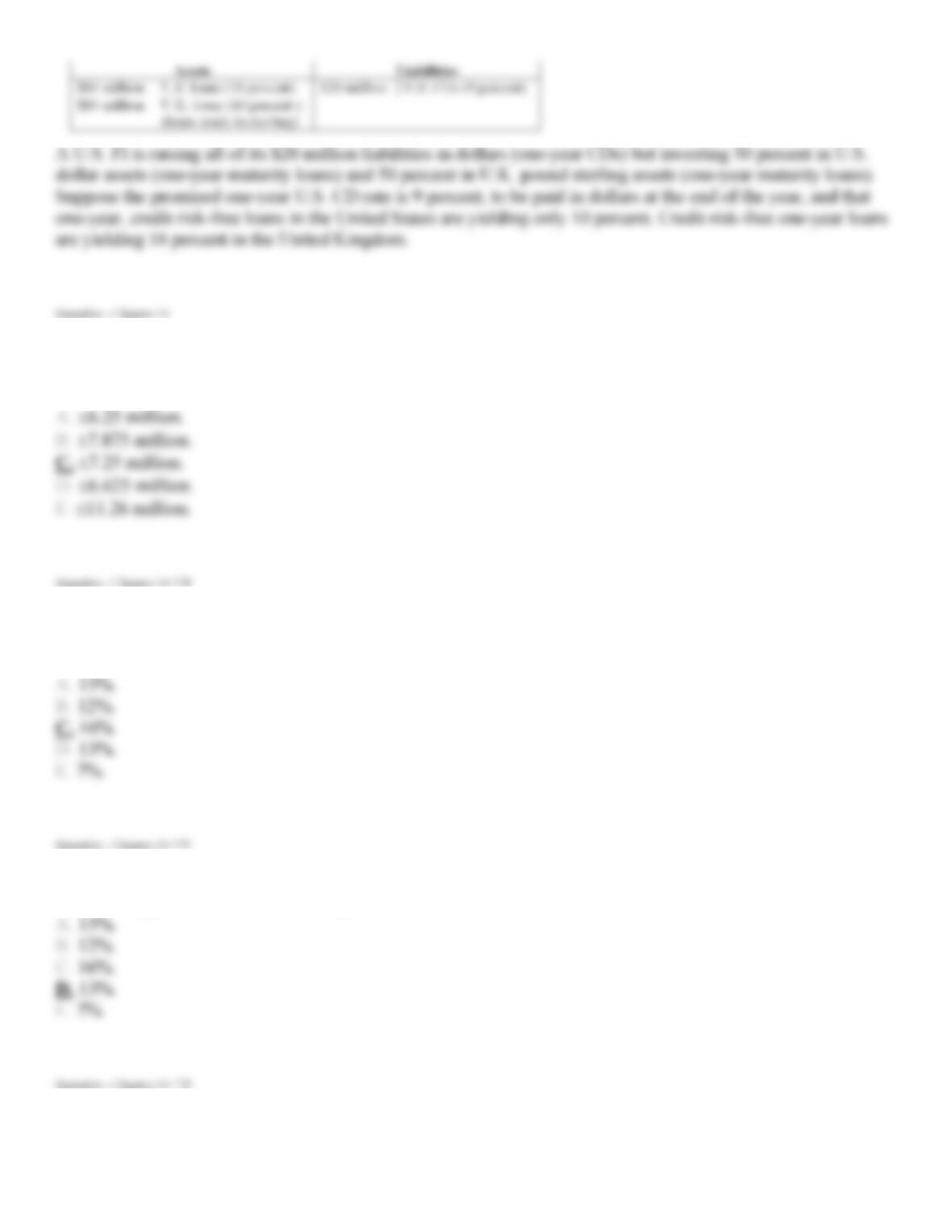
70. If the exchange rate remains constant at $1.60 to 1 throughout the year, sterling revenue from U.K. loans
will be
71. If the spot foreign exchange rate remains constant at $1.60 to 1 throughout the year, the return from the
U.K. investment will be
72. The weighted return on the bank’s portfolio of investments would be
73. If the exchange rate had fallen from $1.60/1 at the beginning of the year to $1.50/1 at the end of the year
when the FI needed to repatriate the principal and interest on the loan. What would be the dollar loan revenues
at the end of the year?
74. If the exchange rate had fallen from $1.60/1 at the beginning of the year to $1.50/1 at the end of the year
when the FI needed to repatriate the principal and interest on the loan. What would the dollar loan revenues at
the end of the year be as a return on the original dollar investment?
75. If the exchange rate had fallen from $1.60/1 at the beginning of the year to $1.50/1 at the end of the year,
the weighted return on the FI’s asset portfolio would be
76. If the exchange rate had fallen from $1.60/1 at the beginning of the year to $1.50/1 at the end of the year,
the net interest margin for the FI on its balance sheet investments is
77. Your position is exposed to
78. If you wanted to hedge your bank’s risk exposure, what hedge position would you take?
79. If in one year there is no change to either interest rates or exchange rates, what is the end-of-year profit or
loss for the bank? (Hint: Annual interest is paid on both the Canadian bonds and the CD on the date of
liquidation in exactly one year.)
80. What is the end-of-year profit or loss to the bank if in one year the exchange rate falls to US$0.765 per
Canadian dollar? (Assume that there is no change in interest rates.)
81. What is the end-of-year profit or loss to the bank if in one year Canadian bond rates increase to 7.5 percent?
(Assume no change in either current U.S. interest rates or current exchange rates.)
82. What is the end of year profit or loss on the bank’s cash position if in one year both Canadian bond rates
increase to 7.5 percent and the exchange rate falls to US$0.765 per Canadian dollar? (Assume no change in U.S.
interest rates.)
83. If the bank receives a quote of $0.1975/€ for one-year forward rates for the Euro (to buy and to sell), what is
the arbitrage profit for the bank if it uses either $1,000,000 as the notional amount?
84. What should be the one-year forward rate in order to prevent any arbitrage?
85. What should be the spot rate in order for no arbitrage to take place, assuming the one-year forward rate is
$0.1975/€?
86. According to PPP, the 8 percent rise in the price of Russian goods relative to the 3 percent rise in the price
of U.S. goods results in a(n)
87. According to PPP, the new exchange rate of Russian rubles to U.S. dollars is
88. What is the spread earned by the bank at the end of the year if the exchange rate remains at €1.75/$?
89. What is the spread earned by the bank if the end-of-year exchange rate is €1.77/$?
90. What is the spread earned if the bank can sell one-year forward Euros at €1.755/$?
91. At what one-year forward rate will the bank earn a 1 percent spread?
92. Error! Hyperlink reference not valid.
93. Assume that instead of investing in Euro bonds at a fixed rate of 6.5 percent, the FI invests them in variable
rates of LIBOR + 1.5 percent, reset every six months. The current LIBOR rate is 5 percent. Assume both
interest and principal will be reinvested in six months. Assume the exchange rate remains at €1.75/$ at the end
of the year. What should be the LIBOR rates in six months in order for the bank to earn a 1 percent spread?
94. Assume that instead of investing in Euro bonds at a fixed rate of 6.5 percent, the FI invests them in variable
rates of LIBOR + 1.5 percent, reset every six months. The current LIBOR rate is 5 percent. LIBOR at the end of
six months is 5.5 percent. Assume both interest and principal will be reinvested in six months. Assume the
exchange rate remains at €1.75/$ at the end of the year. What should be the one-year forward rate in order for
the bank to earn a spread of 1 percent?
95. What must be the forward exchange rate to eliminate the preference for the yen loans?
96. What must be the spot exchange rate to eliminate the preference for the yen loans?