11) In a two-card kanban system:
A) the production card signals when a move card should be moved to the next process step.
B) the move card signals when a container of parts should be produced.
C) the production card signals when a container that held parts should be returned to inventory.
D) the move card signals when a container of parts should move to the next process step.
12) In a two-card kanban system:
A) each box of finished goods has a move card so it can be sent to the next step.
B) each box of raw material has a production card so it can be made into finished goods.
C) a downstream station pulls finished material out of a production area.
D) demand for more raw materials pushes finished goods to the finished goods area.
13) In a single-card kanban system:
A) the single card is the production card.
B) the empty container serves as the production card.
C) the single card is the move signal.
D) None of the above is correct in a single-card system.
14) Liversuch Industries uses a kanban system to manage production of the J-15 subassembly.
They have an hourly demand for 250 units and use containers that can hold 50 units each. It
takes 90 minutes to fill and move a container of parts to the right place on the J-15 line that is
currently rated at a 20% safety factor. How many production cards are needed?
A) 540
B) 100
C) 9
D) 1.5
15) Livermore Industries uses a kanban system to manage production of the KR-9 subassembly.
In a ten-hour day, they use 1500 units and use containers that can hold 50 units each. It takes 45
minutes to fill and move a container of parts to the right place on the KR-9 line that is currently
rated at a 15% safety factor. How many production cards are needed?
A) 3
B) 26
C) 82
D) 155
16) Livernonions Industries uses a kanban system to manage production of the BR-549
subassembly. In an eight-hour day, they use 900 units and use containers that can hold 30 units
each. It takes 120 minutes to fill and move a container of parts to the right place on the BR-549
line that is currently rated at a 15% safety factor. How many production hours of inventory are
needed?
A) 18.4
B) 7.6
C) 4.3
D) 2.4
17) Olivia has had enough of the theoretical equations and rejects the higher math needed to
calculate the number of kanbans for her system. One approach that some organizations take in
lieu of the kanban equation is to:
A) start with one kanban and operate as fast as they can with the one, before adding more
kanbans to bring them up to speed.
B) start with too many kanbans and gradually remove them until a problem arises.
C) fully load their system with inventory and produce until they cannot build product.
D) eliminate all inventory from the system and add material and parts until they can fill a
customer order.
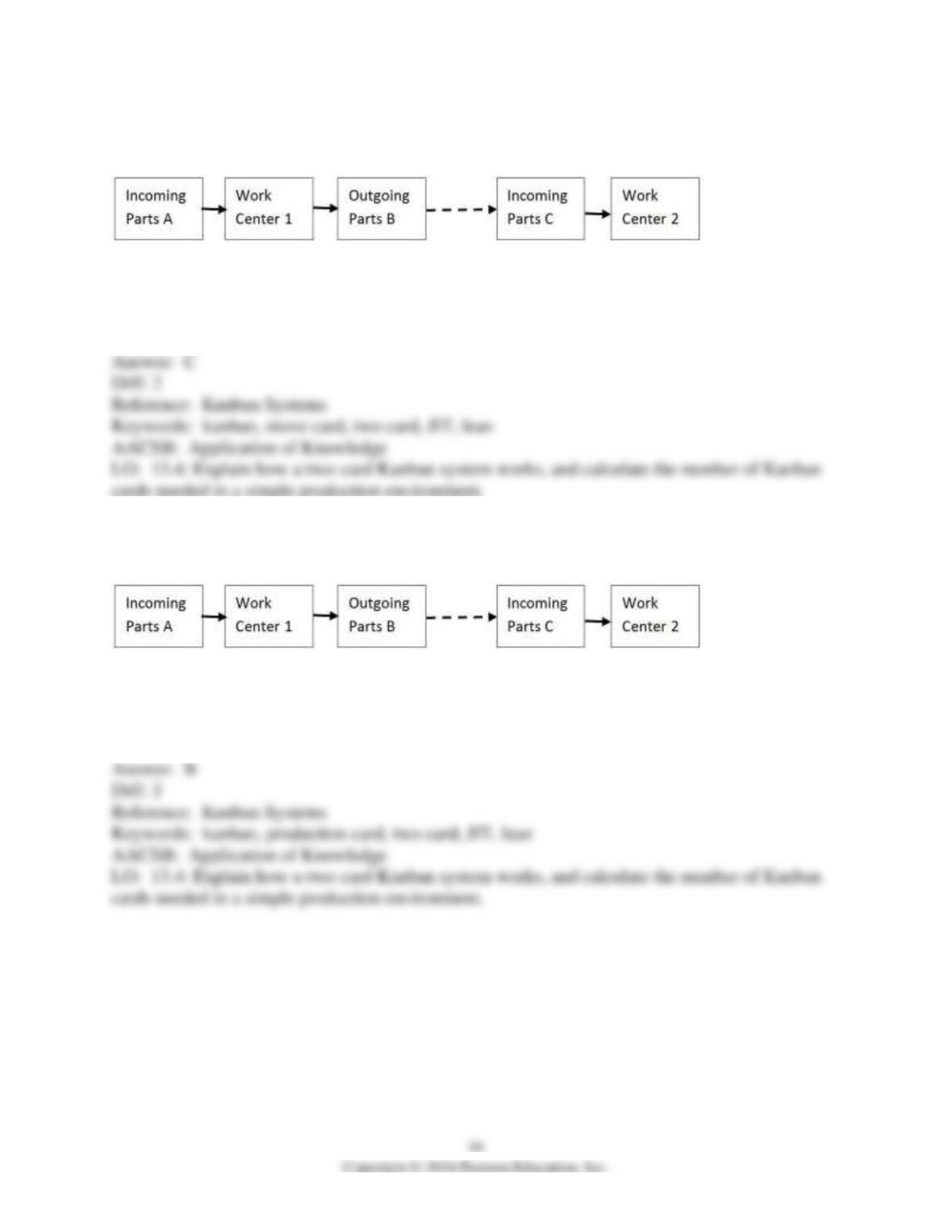
18) Consider the adjacent work stations in this two card Kanban system. There is a move card
located:
A) in box A.
B) in box B.
C) both in box A and box C.
D) in box C.
19) Consider the adjacent work stations in this two card Kanban system. There is a production
card located:
A) in box A.
B) in box B.
C) at work center 1 and work center 2.
D) in box C.
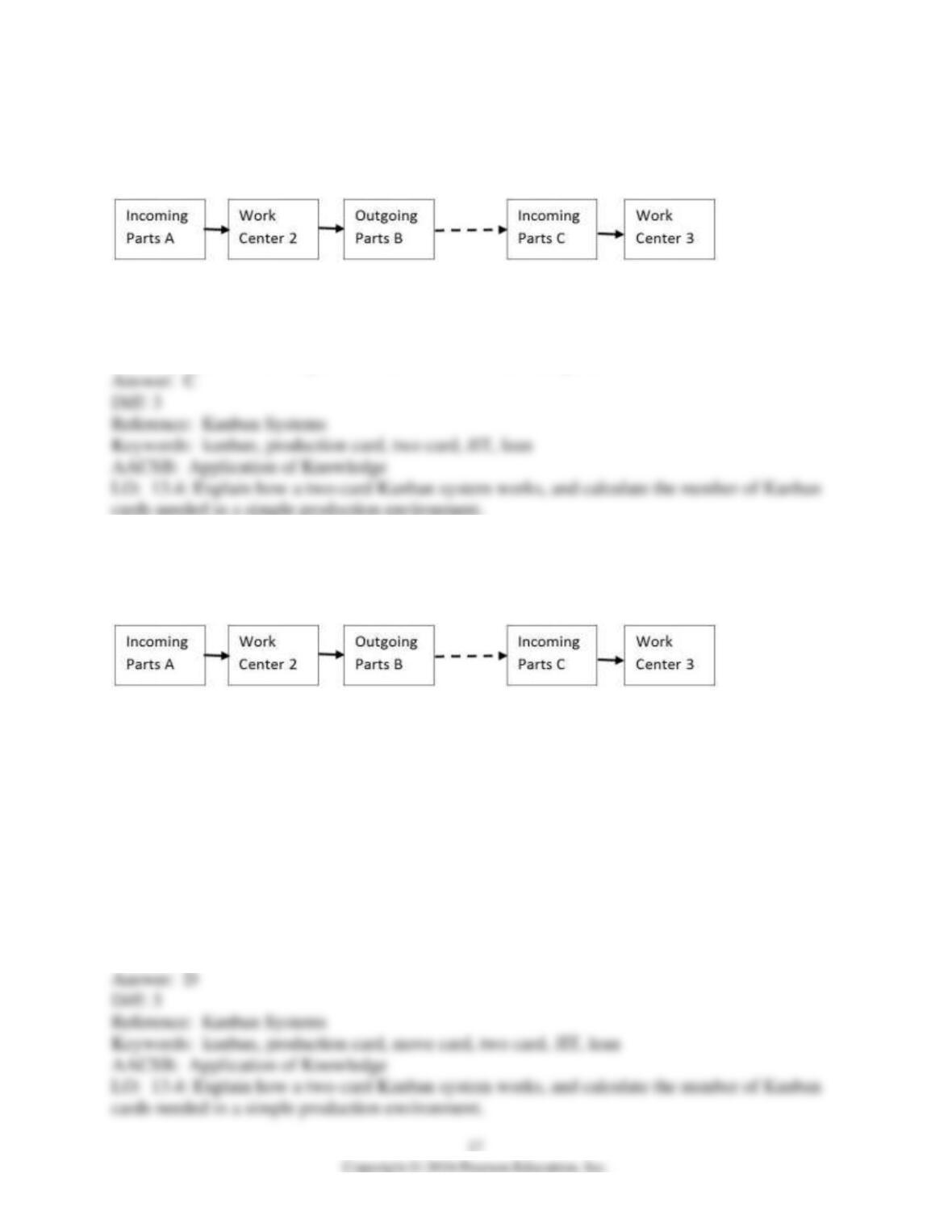
20) Consider the adjacent work stations in this two card Kanban system. There is a production
card located in the box labeled Outgoing Parts B. Work Center 3 pulls the parts from Work
Center 2. Where does the production card go?
A) The production card remains in the same box.
B) The production card is placed at Work Center 3.
C) The production card is placed at Work Center 2.
D) The production card is placed in the box labeled Incoming Parts A.
21) Consider the adjacent work stations in this two card Kanban system. Work Center 3 has just
pulled the Incoming Parts C box to their work station. What happens to the cards in the Incoming
Parts C box and at the work station?
A) The move card at their station goes in the Incoming Parts C box and the production card is
pulled from the Incoming Parts C box to signal the worker at Work Center 2 that there is a need
to produce material.
B) The production card at the station is passed back to Work Center 2 as a signal to produce
more material and the move card is left at Work Center 3 to signal that they are ready to accept
materials when they are complete at Work Center 2.
C) The move card at their station goes in the box they will send downstream to Work Center 4
and the production card is placed at the Work Center 3 station while they are working on this
batch of material.
D) The production card at their station goes in the Incoming Parts C box and the move card is
pulled from the Incoming Parts C box to signal the worker at Work Center 2 that there is a need
to move material.
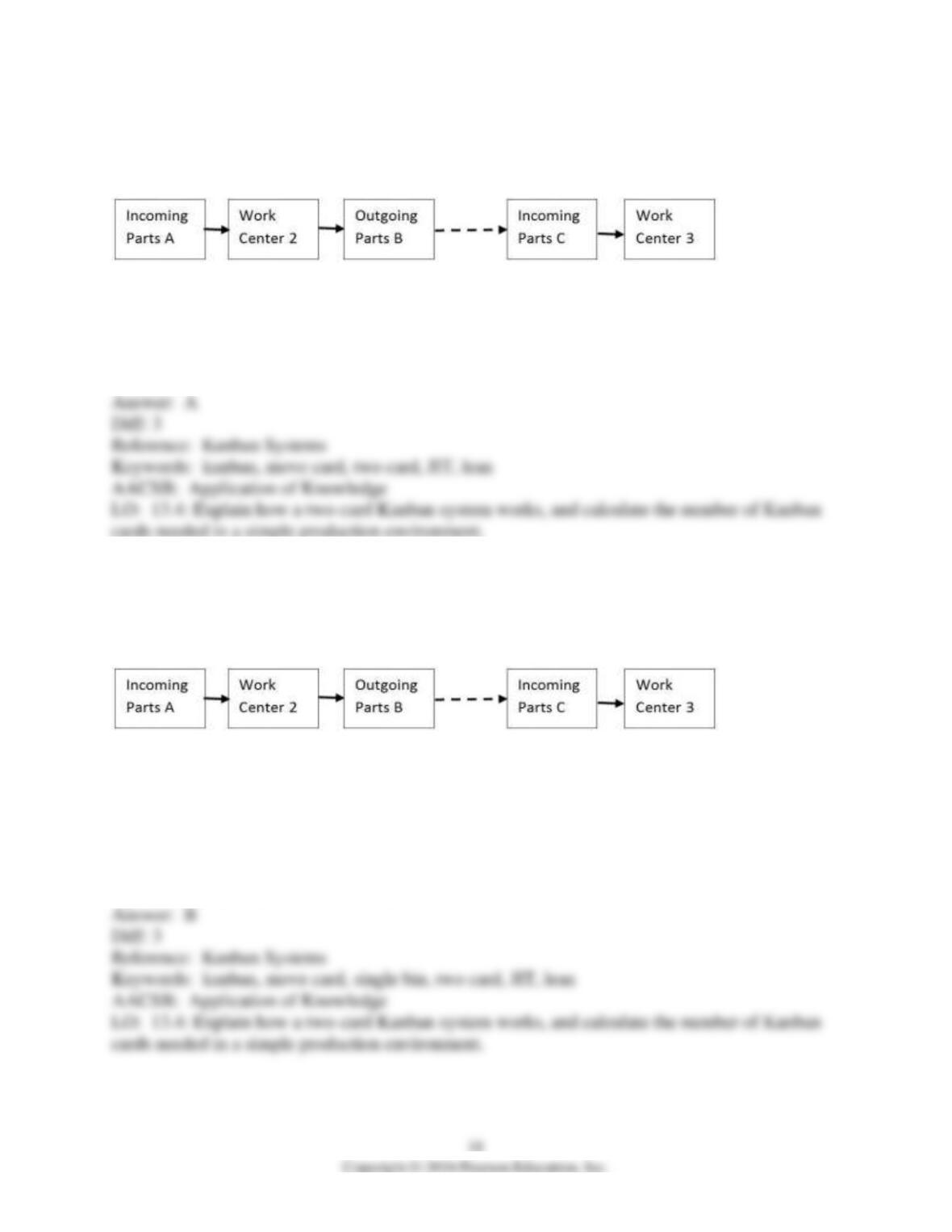
22) Consider the adjacent work stations in this two card Kanban system. Work Center 3 has just
pulled the Incoming Parts C box to their work station. Which of these statements is best?
A) The move card will move backward from Work Center 3 to Work Center 2.
B) The production card will move backward from Work Center 3 to Work Center 2.
C) The move card will move forward from Work Center 3 to Work Center 4.
D) Despite its name, the move card doesn’t actually move from one station to the next, it will
simply reside at Work Center 3 until the next box is finished.
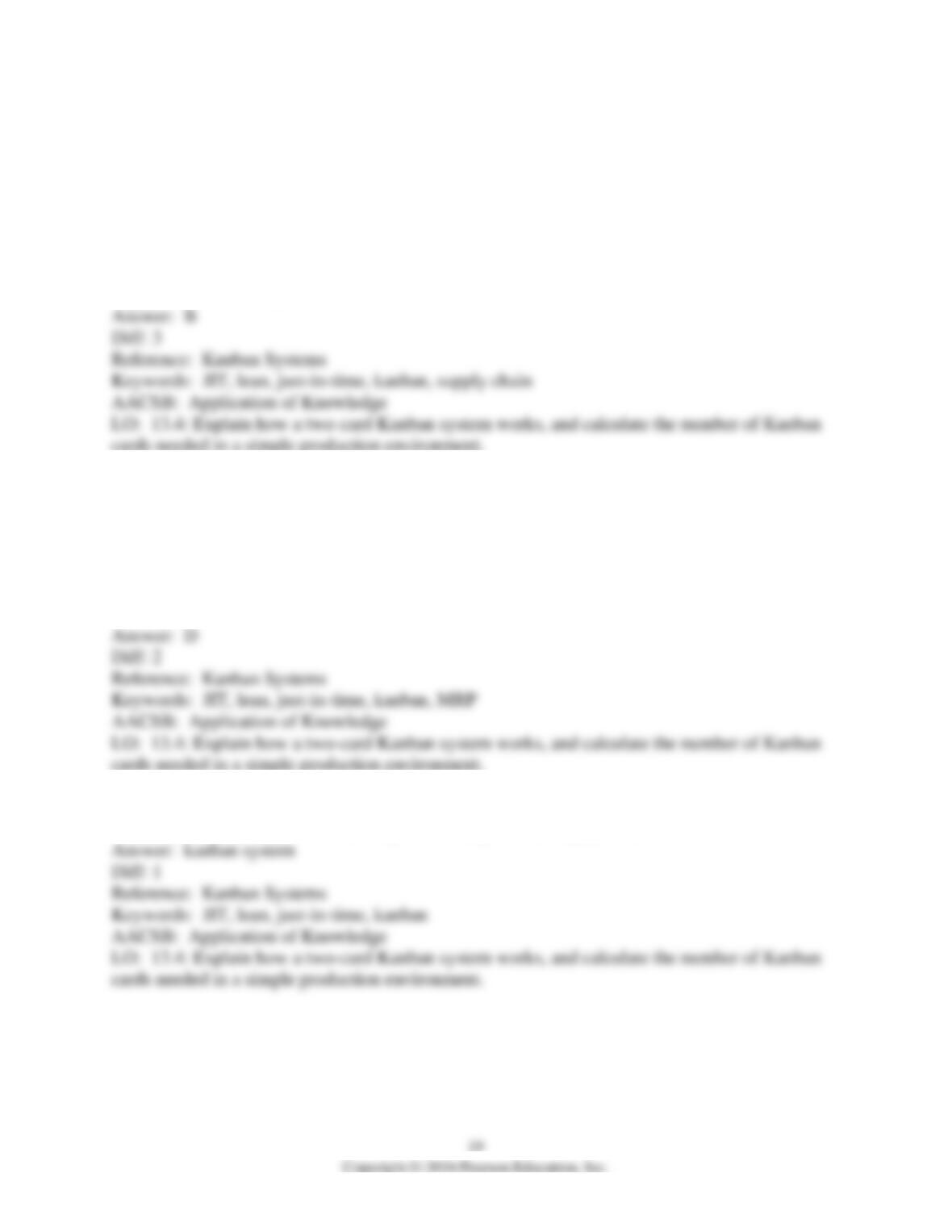
23) Consider the adjacent work stations in this two card Kanban system. Work Center 3 has just
pulled the Incoming Parts C box to their work station. Plant manager Taichi Ohno grabs the
microphone for the company PA system and announces that effective immediately, the company
will switch to a one card system. Which of these actions is appropriate?
A) The production card will be discarded and the empty container will function as a production
signal.
B) The move card will be discarded and the empty container will function as a move signal.
C) Both the move and production cards will be discarded in favor of a combined
move/production card.
D) The production card will be discarded as production will be implied and the move cards will
signal when items are needed downstream.
24) Which of the following statements regarding supply chain synchronization using kanbans is
BEST?
A) An interruption in the flow of goods within a supplier’s assembly operations will have no
effect on final assembly downstream in the supply chain.
B) For the system to work properly, demand rates must be relatively stable and interruptions
must be minimized.
C) If final assembly demand doubles, there is no need to change kanbans at each of the suppliers.
D) Final assembly demand may rise or fall, but the sum of the kanbans among all suppliers in the
supply chain will remain constant.
25) When using MRP and kanban together:
A) the control capabilities of MRP are used instead of those from kanban.
B) the planning capabilities of kanban are used instead of those from MRP.
C) the demand rate should be variable in order to derive the greatest benefit from the MRP
portion of the system.
D) the number of kanbans is recalculated from the MRP system’s order changes throughout the
horizon.
26) A(n) ________ is a production control approach that uses containers, cards, or visual cues to
control production and movement of goods throughout the supply chain.
27) Under two-card kanban system rules, each box of raw material must have a(n) ________,
while each box of finished goods must have a(n) ________.
28) A manufacturer waits to produce until they have an order from a customer. This type of
production system is called ________.
29) The number of kanbans in a production system is inversely related to the ________.
30) Companies that use MRP and kanban together use the ________ of MRP and the ________
of kanban.
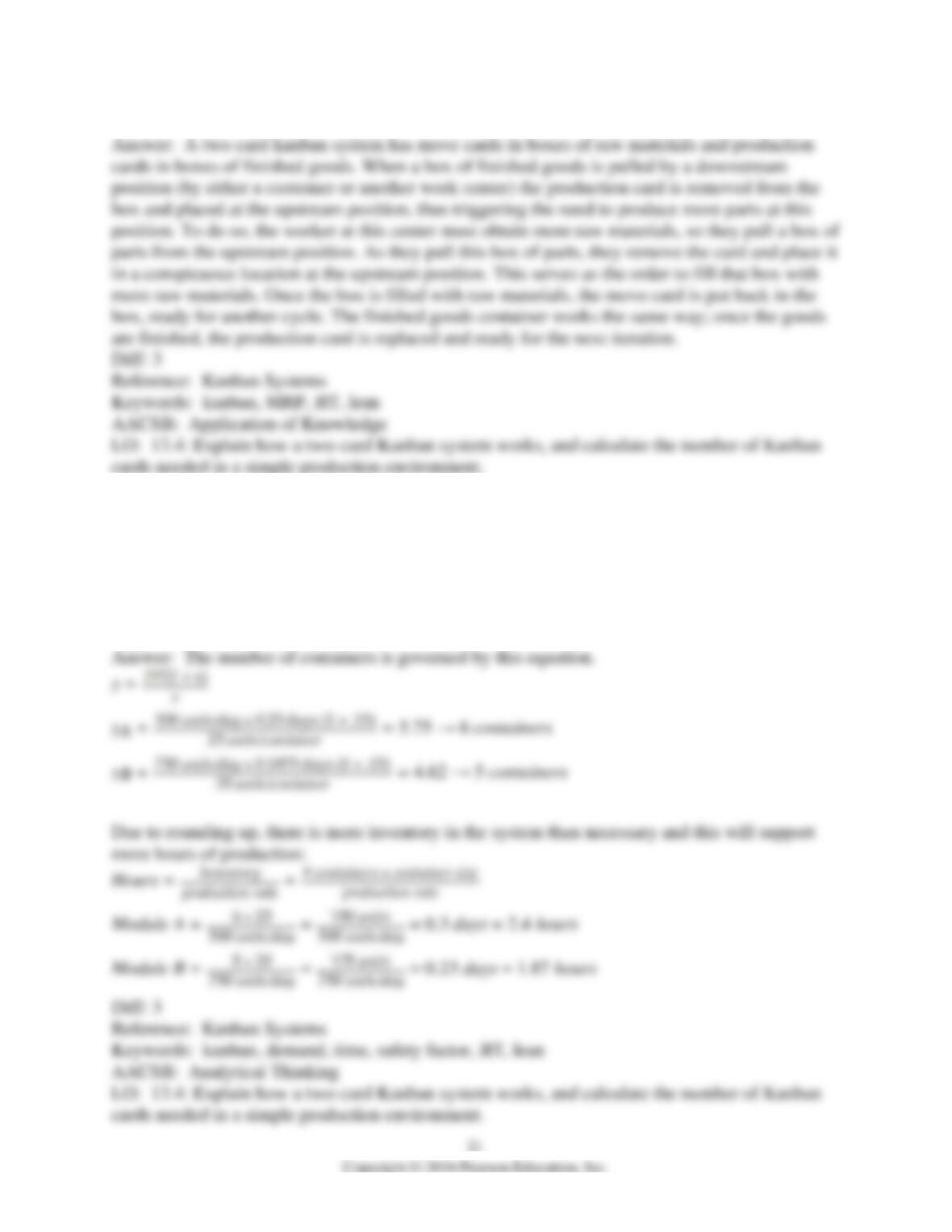
31) Describe the movements of parts and kanbans in a two-card kanban system.
32) Two modules are used to feed the final assembly station on an assembly line. The final
assembly station must produce 250 units in an eight-hour day. Each finished unit needs two
module A’s and 3 module B’s. The factory uses a standard sized container that can hold 25
module A’s or 35 module B’s. It takes 2 hours to fill and move a container of module A’s, but
only 90 minutes to fill and move a container of module B’s. If both module assembly processes
have safety factors of 15%, how many containers should be used for each? How many hours of
demand will this satisfy?
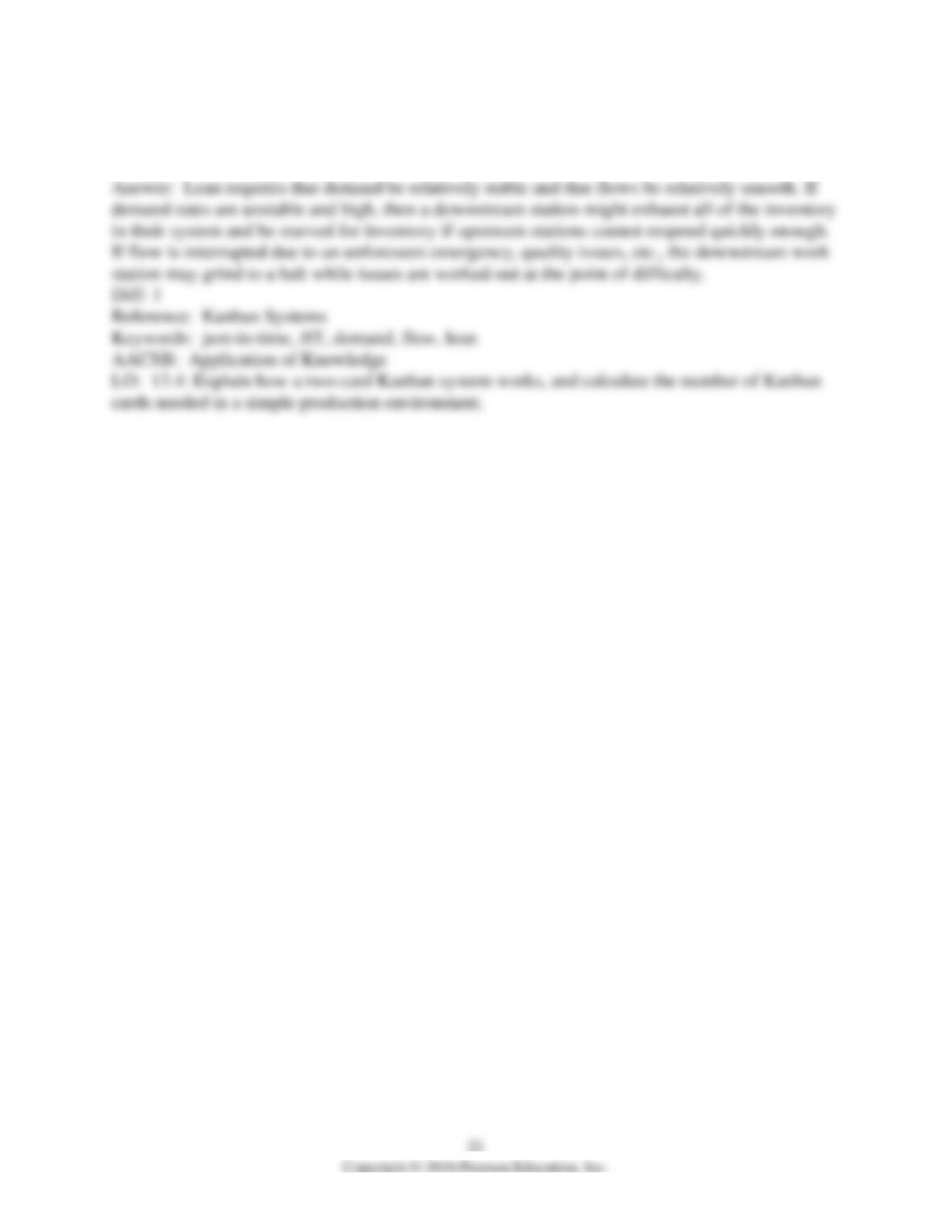
33) What are the consequences of unstable demand and interrupted flows on a supply chain
managed with a lean philosophy?
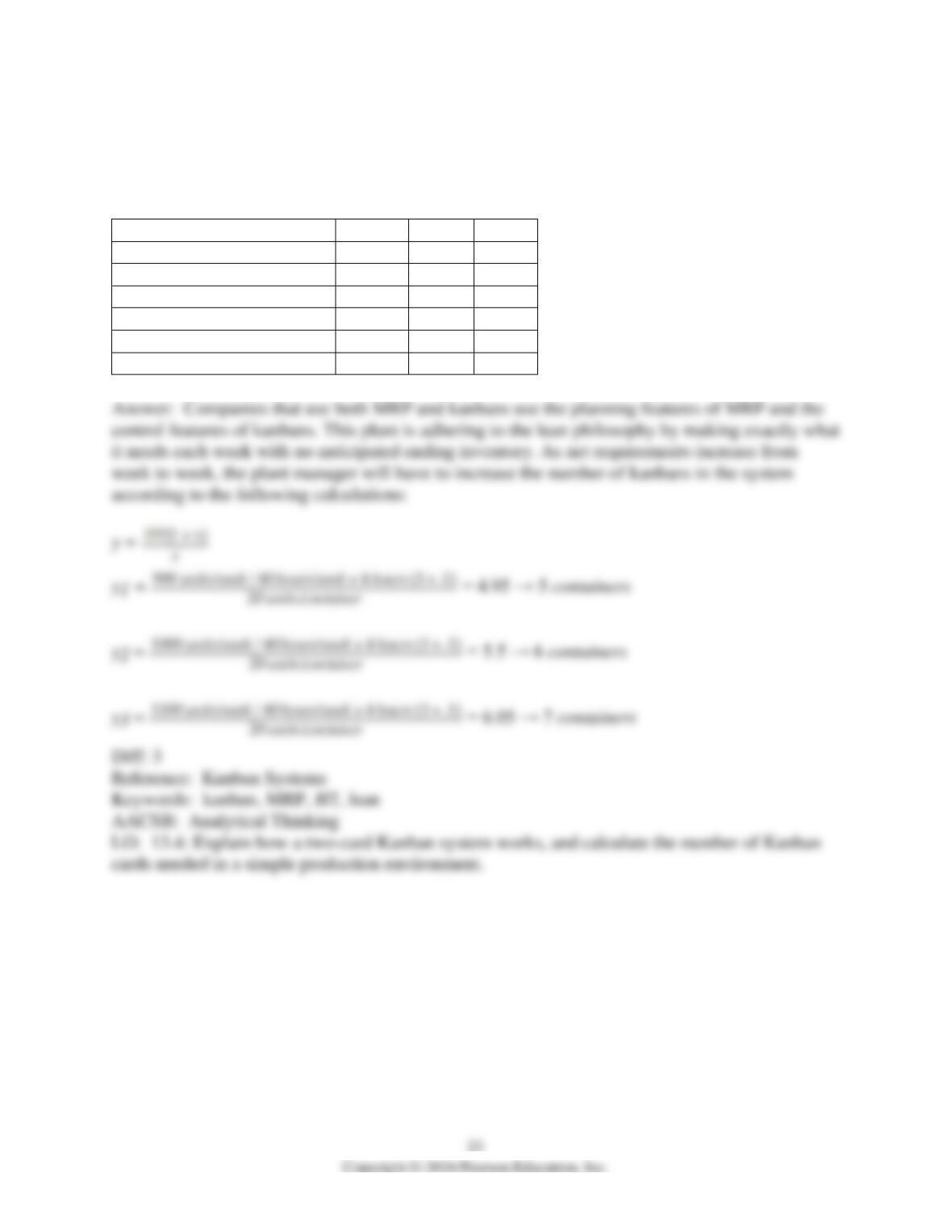
34) Use this material requirements planning record to explain how kanbans and MRP can be
used together. This plant operates on a 40-hour week, and uses a 10% safety factor on a
container size of 20 units with a half-day turnaround time on a container. What features of each
system should be used and for what purposes?
Week
1
2
3
Gross Requirement
900
1000
1100
Scheduled Receipts
0
0
0
Projected Ending Inventory
0
0
0
Net Requirements
900
1000
1100
Planned Receipts
900
1000
1100
Planned Orders
900
1000
1100