2010
2011
Accounts receivable
$ 60,000
$ 68,000
Inventory
230,000
210,000
Prepaid insurance
15,000
13,000
Accounts payable
20,000
30,000
Net income for 2011 was $750,000 and depreciation expense was $40,000. All sales and all purchases
are on account. Gregson uses the indirect method for preparing the statement of cash flows.
Net cash flows from operating activities for 2011 would be:
a.
$814,000
b.
$774,000
c.
$786,000
d.
$766,000
47. Atlantic Inc. had the following noncash current asset and current liabilities balances at the end of 2010
and 2011:
2010
2011
Accounts receivable
$ 50,000
$ 42,000
Inventory
190,000
160,000
Prepaid insurance
10,000
6,000
Accounts payable
25,000
30,000
Net income for 2011 was $940,000 and depreciation expense was $25,000. All sales and all purchases
are on account. Atlantic uses the indirect method for preparing the statement of cash flows.
Net cash flows from operating activities for 2011 would be:
a.
$ 918,000
b.
$1,012,000
c.
$1,002,000
d.
$ 987,000
48. Crenshaw Inc. had the following information related to last year’s purchases:
Cost of goods purchased
$510,000
Accounts payable – beginning
35,000
Accounts payable – ending
18,000
What amount would be reported as “cash outflows for purchases” on the statement of cash flows using
the direct method?
a.
$527,000
b.
$493,000
c.
$475,000
d.
$457,000
49. Haley Inc. had the following information related to last year’s purchases:
Cost of goods purchased
$85,000
Accounts payable – beginning
3,000
Accounts payable – ending
5,000
What amount would be reported as “cash outflows for purchases” on the statement of cash flows using
the direct method?
a.
$93,000
b.
$87,000
c.
$77,000
d.
$83,000
50. Caldwell Corp.’s cost of goods purchased amounts to $900,000 for 2011. From the beginning until the
end of 2011, their accounts payable decreased by a net amount of $95,000. How much “cash outflows
for purchases” should Caldwell report for 2011 on their statement of cash flows?
a.
$ 95,000
b.
$900,000
c.
$995,000
d.
$805,000
SHORT ANSWER
1. What is the purpose of a statement of cash flows?
2. Why can’t a decision-maker use sales revenue and expense information provided on the income
statement as a measure of cash inflows and outflows from operating activities?
3. The statement of cash flows divides all transactions that affect a company’s cash into three types of
activities. List and briefly describe each of these activities.
4. What is a cash equivalent? Provide one example of a cash equivalent.
5. Why are noncash transactions included on the statement of cash flows? Provide an example of a
noncash transaction that would be reported on the statement of cash flows.
6. How do the direct and indirect methods of preparing the statement of cash flows differ?
7. For each of the following activities, indicate whether they would be classified as operating (O),
investing (I), or financing (F) activities for purposes of the statement of cash flows:
a.
Cash paid for interest on debt.
b.
Cash paid to purchase property, plant, and equipment.
c.
Cash received from customers.
d.
Cash received from a bank for a long-term note payable.
e.
Cash received for the issuance of capital stock.
f.
Cash paid for advertising.
g.
Cash paid for inventory purchases.
h.
Cash paid to stockholders as a dividend.
8. For each of the following activities, indicate whether they would be classified as operating (O),
investing (I), or financing (F) activities for purposes of the statement of cash flows:
a.
Cash received from the sale of property, plant, and equipment.
b.
Cash received from a customer.
c.
Cash received from stockholders for the issuance of capital stock.
d.
Cash received from a bank on a one-year note payable.
e.
Cash paid for insurance.
f.
Cash paid for inventory purchases.
g.
Cash paid to employees.
h.
Cash paid towards the principal portion of a note payable.
a.
I
b.
O
c.
F
d.
F
e.
O
f.
O
g.
O
h.
F
9. For each of the following asset and liability balance changes from the beginning to the end of the year,
indicate whether the change should be added to (+) or subtracted from (−) net income for purposes of
preparing the operating activity section of the statement of cash flows using the indirect method.
a.
Increase in accounts payable
a.
O
b.
I
d.
F
e.
F
f.
O
g.
O
h.
F
b.
Decrease in accounts receivable
c.
Increase in inventory
d.
Decrease in salaries payable
e.
Increase in prepaid insurance
10. For each of the following asset and liability balance changes from the beginning to the end of the year,
indicate whether the change should be added to (+) or subtracted from (−) net income for purposes of
preparing the operating activity section of the statement of cash flows using the indirect method.
a.
Decrease in prepaid insurance
b.
Decrease in inventory
c.
Decrease in accounts payable
d.
Increase in salaries payable
e.
Increase in accounts receivable
a.
+
b.
+
d.
+
PROBLEM
1. Vargas Inc. had the following information related to last year’s sales:
Cash sales
$ 90,000
Credit sales
210,000
Accounts receivable – beginning
28,000
Accounts receivable – ending
40,000
Required: Compute the amount that would be reported as “cash collections from customers” on the
statement of cash flows using the direct method.
a.
+
b.
+
2. Poindexter Inc. had the following information related to last year’s sales:
Cash sales
$310,000
Credit sales
400,000
Accounts receivable – beginning
118,000
Accounts receivable – ending
140,000
Required: Compute the amount that would be reported as “cash collections from customers” on the
statement of cash flows using the direct method.
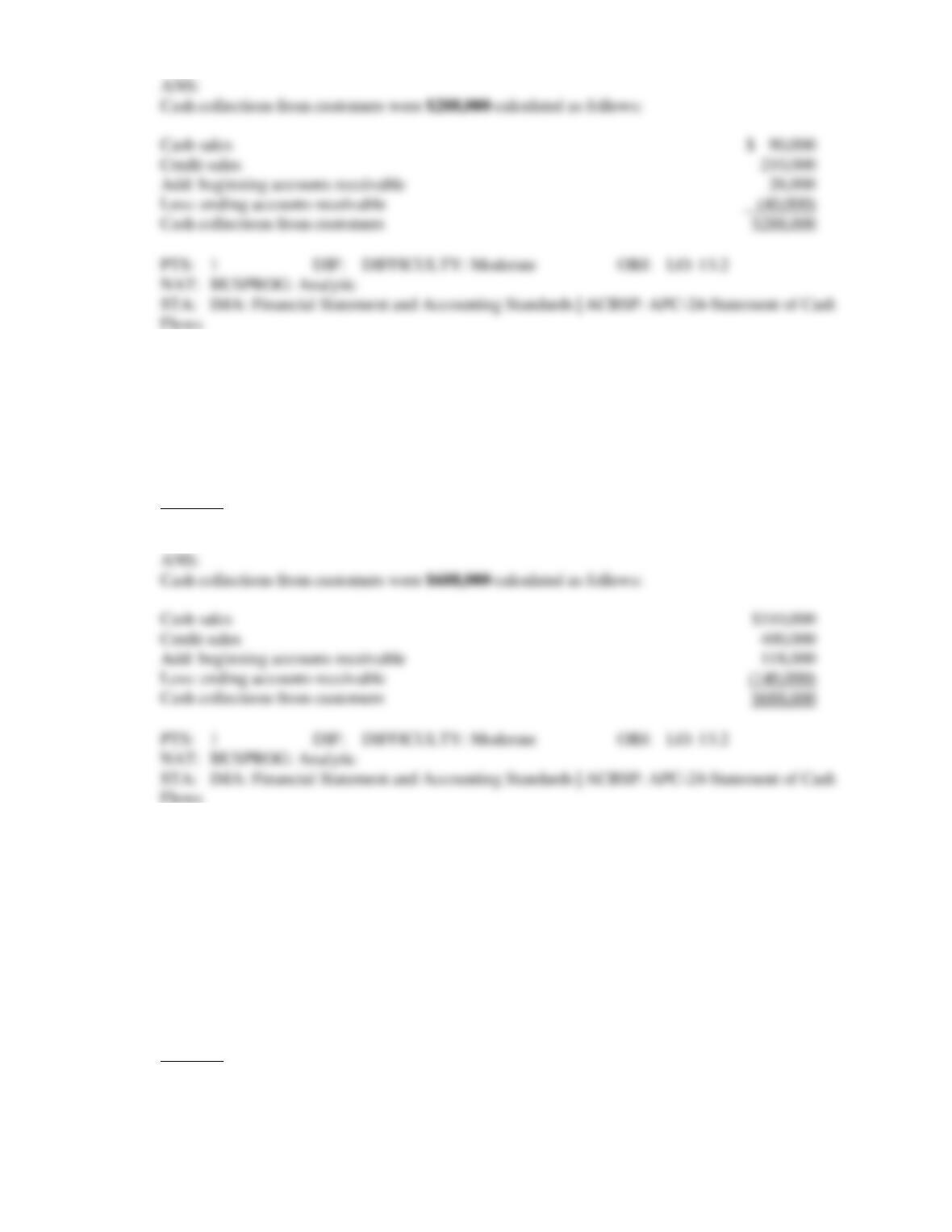
Cash sales
$310,000
Credit sales
400,000
Add: beginning accounts receivable
118,000
Less: ending accounts receivable
Cash collections from customers
$688,000
3. The following information relates to Finnegan Inc.:
Cost of goods sold
$850,000
Accounts payable – beginning
15,000
Accounts payable – ending
35,000
Inventory – beginning
100,000
Inventory – ending
60,000
Finnegan’s accounts payable balances are composed solely of amounts due to suppliers for inventory
purchases.
Required: Compute the amount that would be reported as “cash paid for purchases” on the statement of
cash flows using the direct method.
Cash sales
Credit sales
210,000
Add: beginning accounts receivable
28,000
Less: ending accounts receivable
4. The following information relates O’Hara Products Inc.:
Cost of goods sold
$425,000
Accounts payable – beginning
15,000
Accounts payable – ending
8,000
Inventory – beginning
30,000
Inventory – ending
55,000
O’Hara’s accounts payable balances are composed solely of amounts due to suppliers for inventory
purchases.
Required: Compute the amount that would be reported as “cash paid for purchases” on the statement of
cash flows using the direct method.
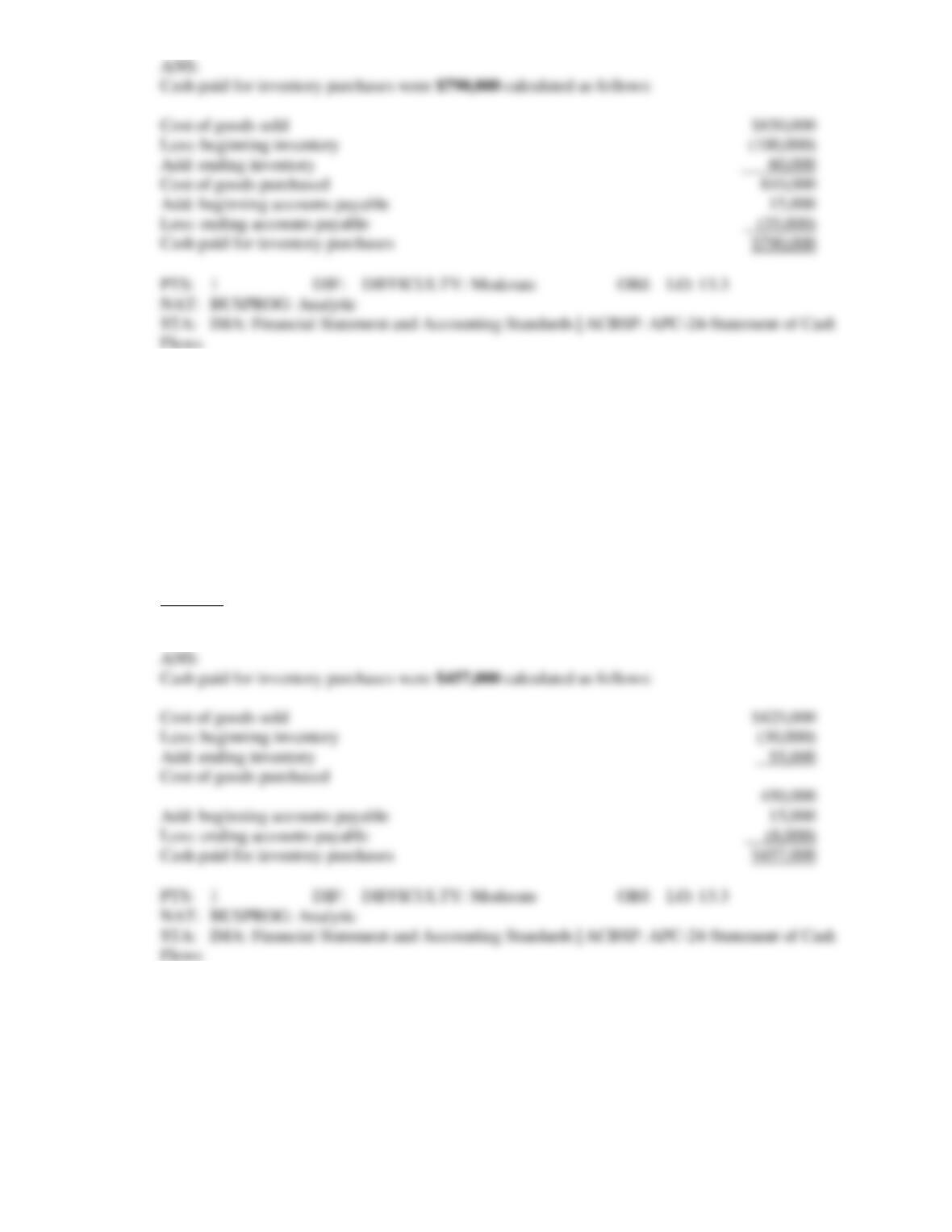
Cost of goods sold
$425,000
Less: beginning inventory
Add: ending inventory
Add: beginning accounts payable
Less: ending accounts payable
Cash paid for inventory purchases
$457,000
5. MTM Inc. had the following information available from its 2011 balance sheet and income statement:
Insurance expense
$70,000
Prepaid insurance – beginning
8,000
Prepaid insurance – ending
12,000
Cost of goods sold
$850,000
Less: beginning inventory
Add: ending inventory
Cost of goods purchased
810,000
Add: beginning accounts payable
15,000
Less: ending accounts payable
Cash paid for inventory purchases
$790,000
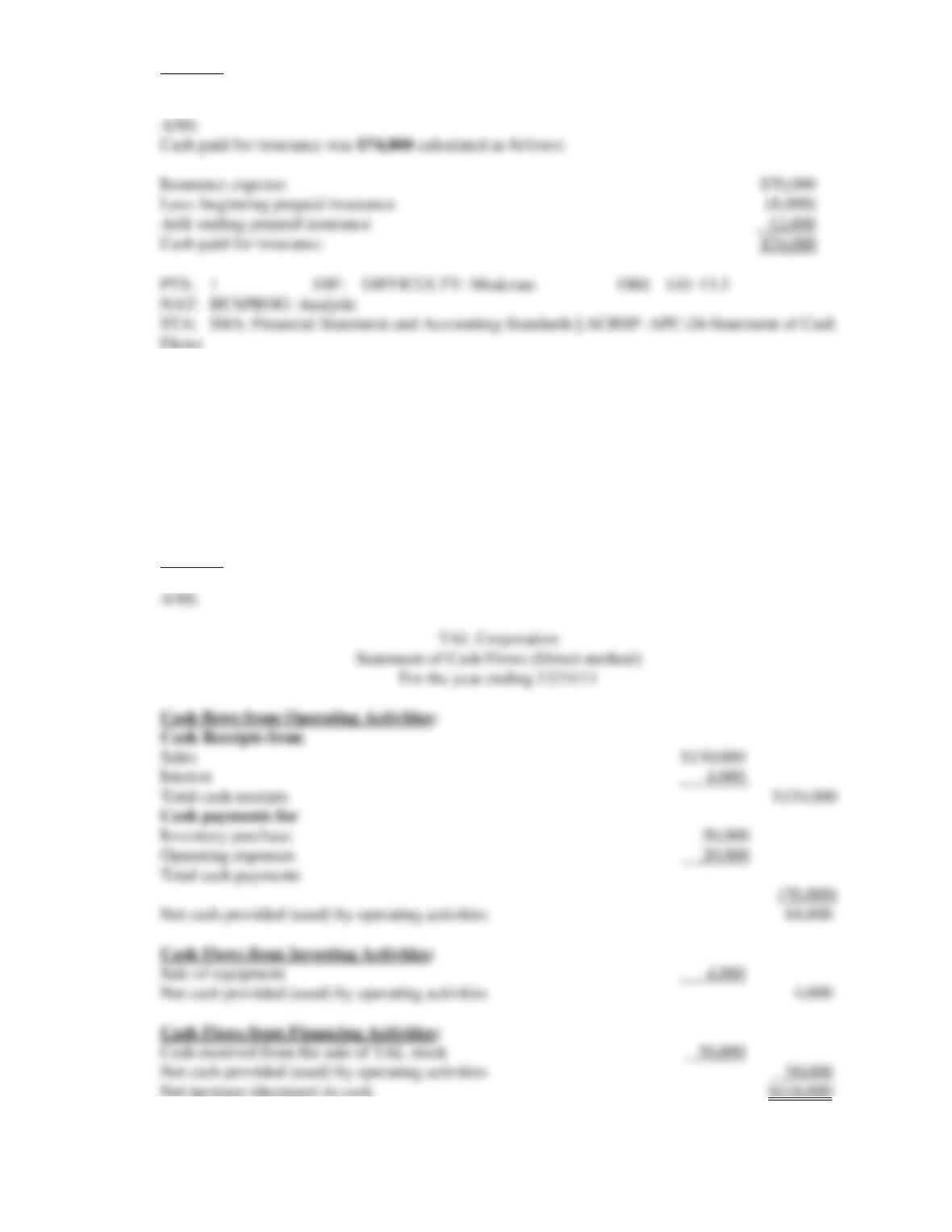
Required: Compute the amount that would be reported as “cash paid for insurance” on the statement of
cash flows using the direct method.
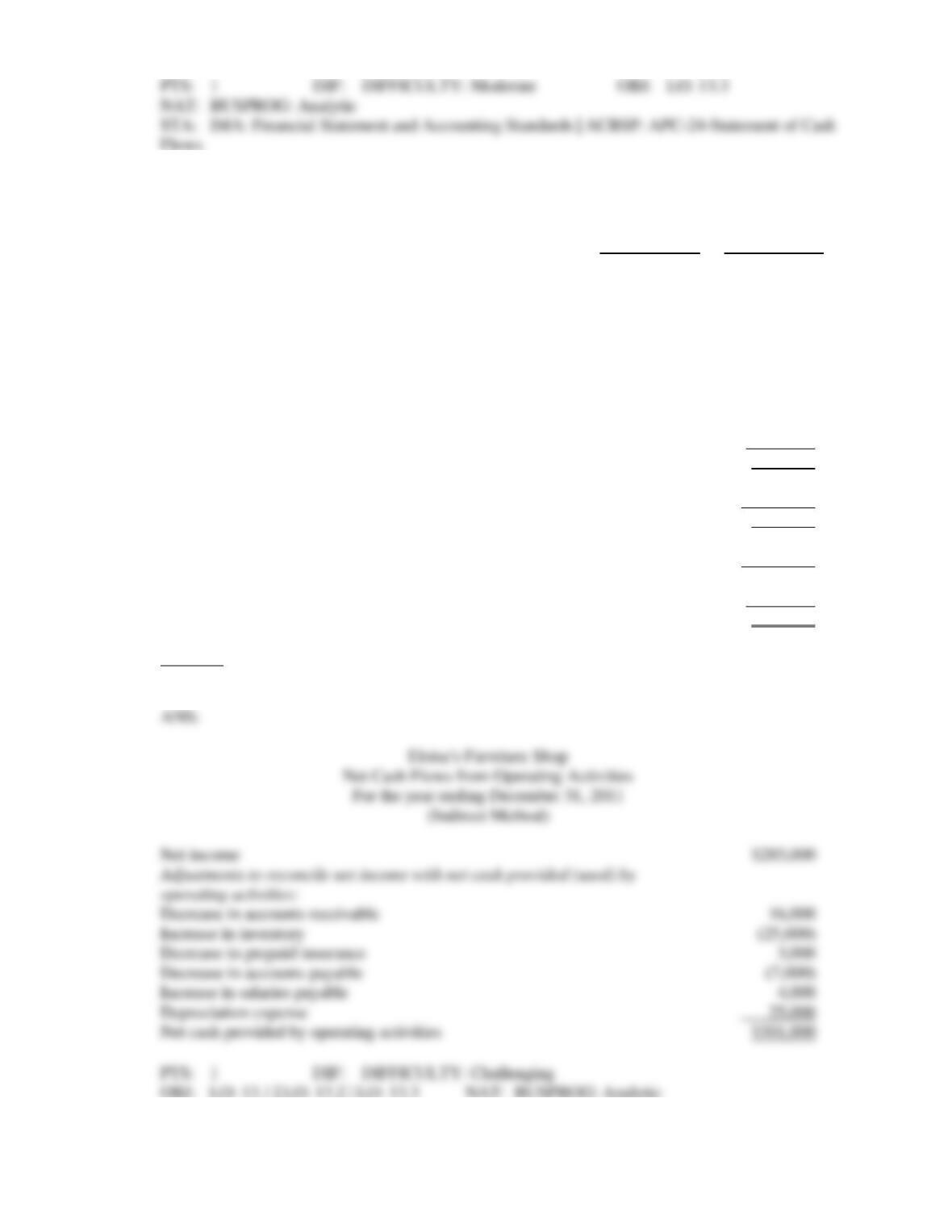
6. You are given the following transaction information for the TAL Corporation for 2011:
Cash from sales to customers
$130,000
Cash received from issuance of TAL stock
50,000
Cash received from the sale of equipment
4,000
Cash received from interest earned
4,000
Cash purchases of inventory
50,000
Cash payments for operating expenses
20,000
Required: Prepare a statement of cash flows using the direct method for TAL Corporation for 2011.
Sales
Interest
Total cash receipts
Inventory purchase
Operating expenses
Net cash provided (used) by operating activities
64,000
Sale of equipment
Net cash provided (used) by operating activities
Cash received from the sale of TAL stock
Net cash provided (used) by operating activities
Net increase (decrease) in cash
Insurance expense
Less: beginning prepaid insurance
Add: ending prepaid insurance
Cash paid for insurance
7. The following account balances are for the noncash current assets and current liabilities of Eloise’s
Furniture Shop for 2010 and 2011:
2010
2011
Accounts receivable
$ 30,000
$ 14,000
Inventory
100,000
125,000
Prepaid insurance
4,000
1,000
Accounts payable
19,000
12,000
Salaries payable
6,000
10,000
In addition, the income statement for 2011 is as follows:
Sales revenue
$950,000
Cost of goods sold
400,000
Gross profit
$550,000
General and administrative expenses
80,000
Depreciation expense
25,000
Total operating expenses
$105,000
Income before interest and taxes
$445,000
Interest expense
40,000
Income before tax
$405,000
Income tax expense
120,000
Net income
$285,000
Required: Prepare the operating activities section of the statement of cash flows using the indirect
method.
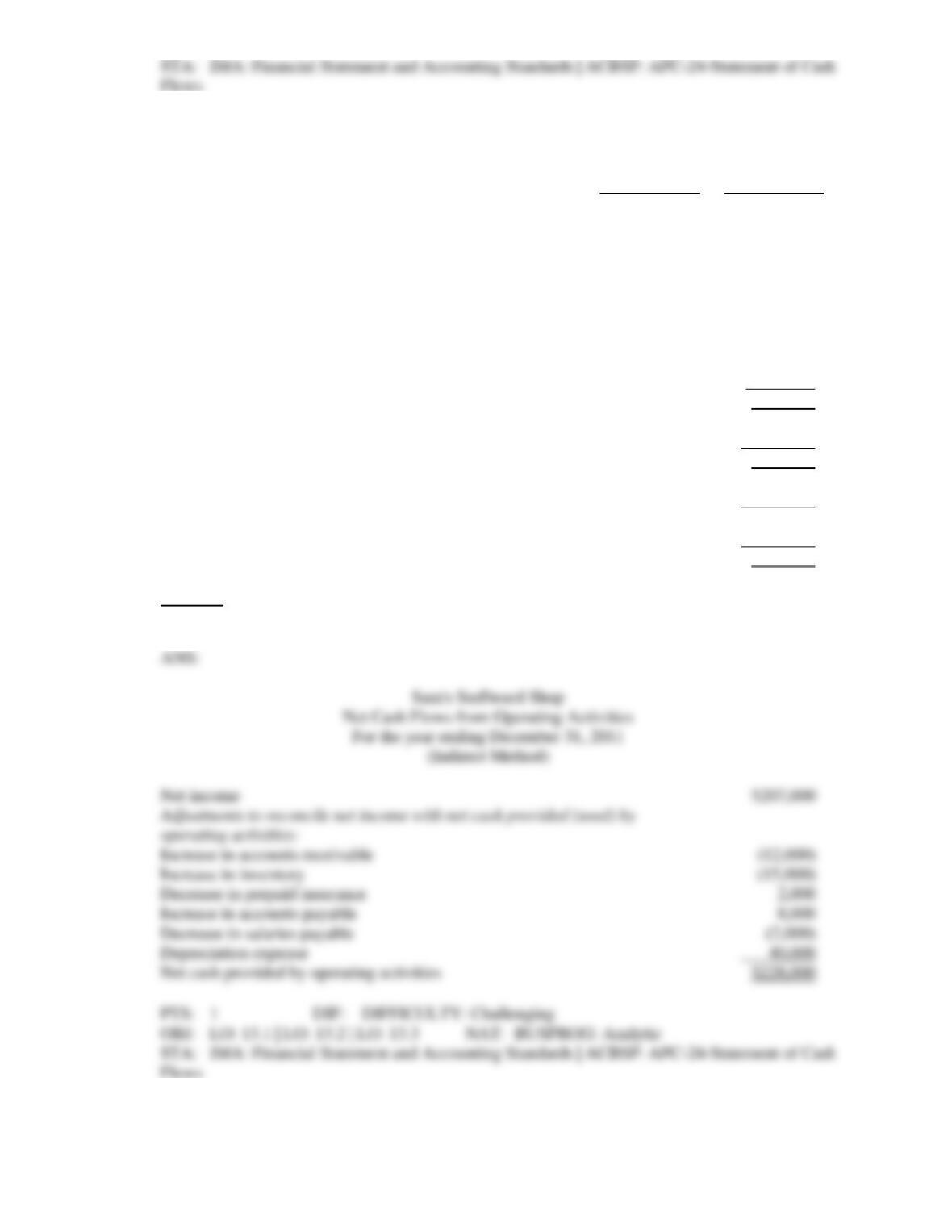
Net income
Decrease in accounts receivable
Increase in inventory
(25,000)
Decrease in prepaid insurance
Decrease in accounts payable
(7,000)
Increase in salaries payable
Depreciation expense
25,000
Net cash provided by operating activities
8. The following account balances are for the noncash current assets and current liabilities of Sam’s
Surfboard Shop for 2010 and 2011:
2010
2011
Accounts receivable
$ 8,000
$20,000
Inventory
55,000
70,000
Prepaid insurance
3,000
1,000
Accounts payable
14,000
22,000
Salaries payable
4,000
2,000
In addition, the income statement for 2011 is as follows:
Sales revenue
$800,000
Cost of goods sold
380,000
Gross profit
$420,000
General and administrative expenses
60,000
Depreciation expense
40,000
Total operating expenses
$100,000
Income before interest and taxes
$320,000
Interest expense
25,000
Income before tax
$295,000
Income tax expense
88,000
Net income
$207,000
Required: Prepare the operating activities section of the statement of cash flows using the indirect
method.
Net income
Increase in accounts receivable
(12,000)
Increase in inventory
(15,000)
Decrease in prepaid insurance
Increase in accounts payable
Decrease in salaries payable
(2,000)
Depreciation expense
40,000
Net cash provided by operating activities