
Chapter 13 Contingency Theories of Leadership Answer Key
True / False Questions
1.
(p. 525)
Leader-member exchange has not changed in the last twenty years.
2.
(p. 527)
The normative decision model has been established as an all-encompassing theory.
3.
(p. 529)
According to the normative decision model, acceptance of a decision is not always critical
for implementation.
4.
(p. 533)
The normative decision model shifts focus away from the situation and the followers to
the leader.

Type: Knowledge
5.
(p. 536)
Type: Vocabulary
With Situational Leadership, follower readiness refers to a follower’s ability and
willingness to accomplish a particular task.
6.
(p. 537)
Type: Knowledge
With Situational Leadership, developmental interventions are intended to increase
follower readiness levels and help followers in their development.
7.
(p. 538)
Type: Knowledge
The positive effects of Situational Leadership in the workplace are significantly
documented with published research, which partially explains the theory’s appeal to both
leadership practitioners and organizations.
8.
(p. 539)
Situational Leadership is a useful way for getting leaders to think about how leadership
effectiveness may depend on being flexible with different subordinates.
Type: Knowledge

9.
(p. 539)
The contingency model of leadership maintains that leaders are flexible in their behavior.
10.
(p. 540)
In the context of contingency theory, the least preferred co-worker (LPC) score is intended
to represent follower behaviors and situational factors.
11.
(p. 540)
Low-LPC leaders will focus on improving their relationships with followers after they are
assured that assigned tasks are being satisfactorily accomplished.
12.
(p. 542)
The highest levels of situational favorability occur when leader-member relations are
good, the task is structured, and the position power is high.

13.
(p. 544)
According to Fiedler’s contingency model, the content of leadership training should
emphasize behavioral flexibility in leaders rather than situational engineering.
14.
(p. 544)
Position power is not a characteristic of leaders but of the situations that leaders finds
themselves in.
15.
(p. 546)
The path-goal theory assumes that leaders use the same styles with different
subordinates.
16.
(p. 547)
According to path-goal theory, followers will actively support a leader as long as they view
the leader’s actions as a means for increasing their own levels of satisfaction.

17.
(p. 548)
According to the path-goal theory, follower satisfaction is directly related to the degree of
participative behaviors manifested by the leader.
18.
(p. 549)
Path-goal theory considers three situational factors that moderate the effects of leader
behavior on follower behavior.
19.
(p. 549)
Both leader behaviors and follower characteristics are important in determining outcomes
in path-goal theory.
20.
(p. 550)
According to the path-goal theory, a leader should assess the situation before choosing an
appropriate leadership behavior.
Multiple Choice Questions
21.
(p. 524)
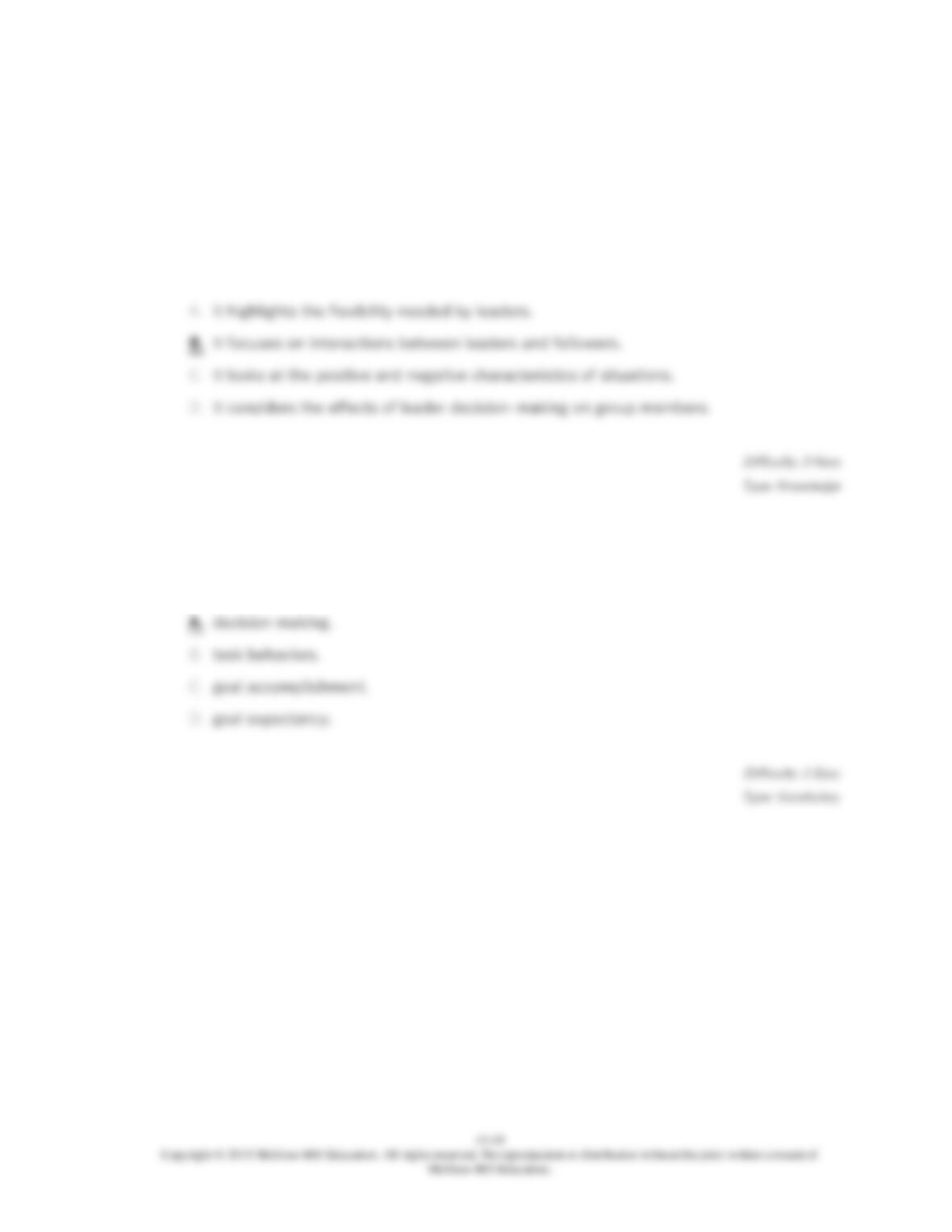
Which statement best summarizes the leader-member exchange (LMX) theory?
22.
(p. 527)
The normative decision model is limited only to:
23.
(p. 528)
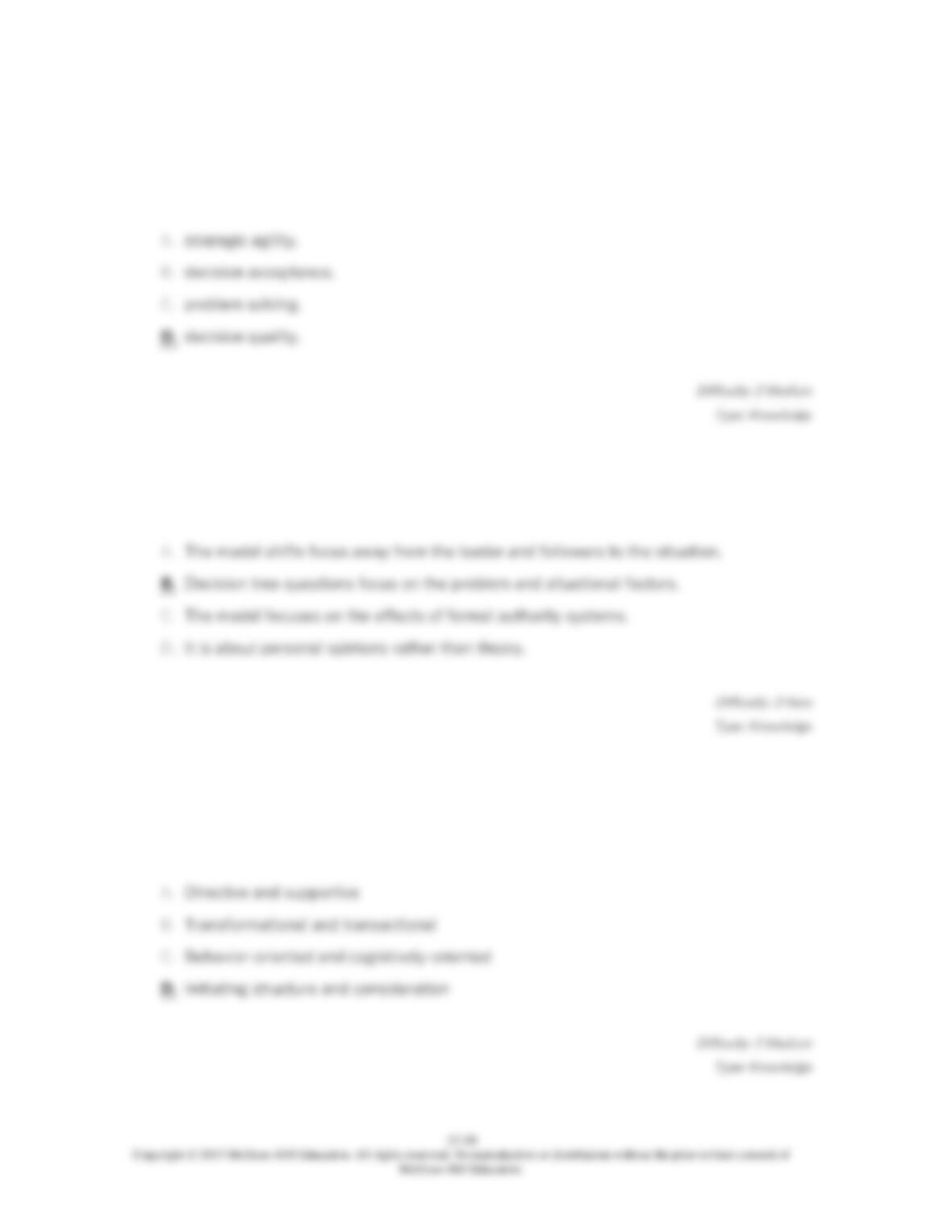
If a decision has a rational or objectively determinable “better or worse” alternative, the
leader should select the better alternative. This most likely refers to:
24.
(p. 530)
Which of the following statements about the normative decision model is true?
25.
(p. 534)
Which two broad categories of leader behaviors did the situational leadership model
originally identify?
26.
(p. 535)
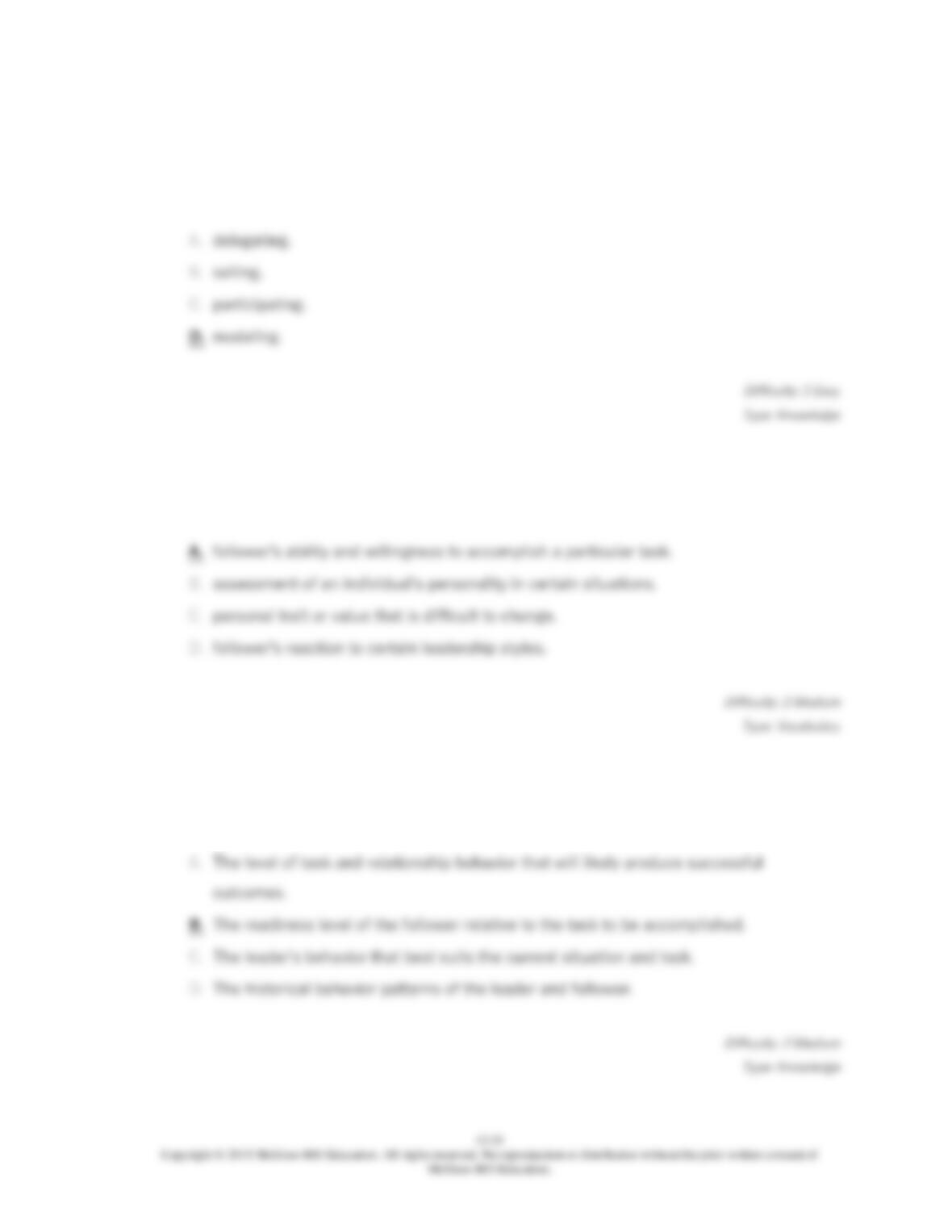
According to the situational leadership theory, four types of leadership behavior can be
identified. They include all of the following EXCEPT:
27.
(p. 536)
Follower readiness refers to a(n):
28.
(p. 536)
What should leaders first assess in order to apply the situational leadership model?
29.
(p. 538)
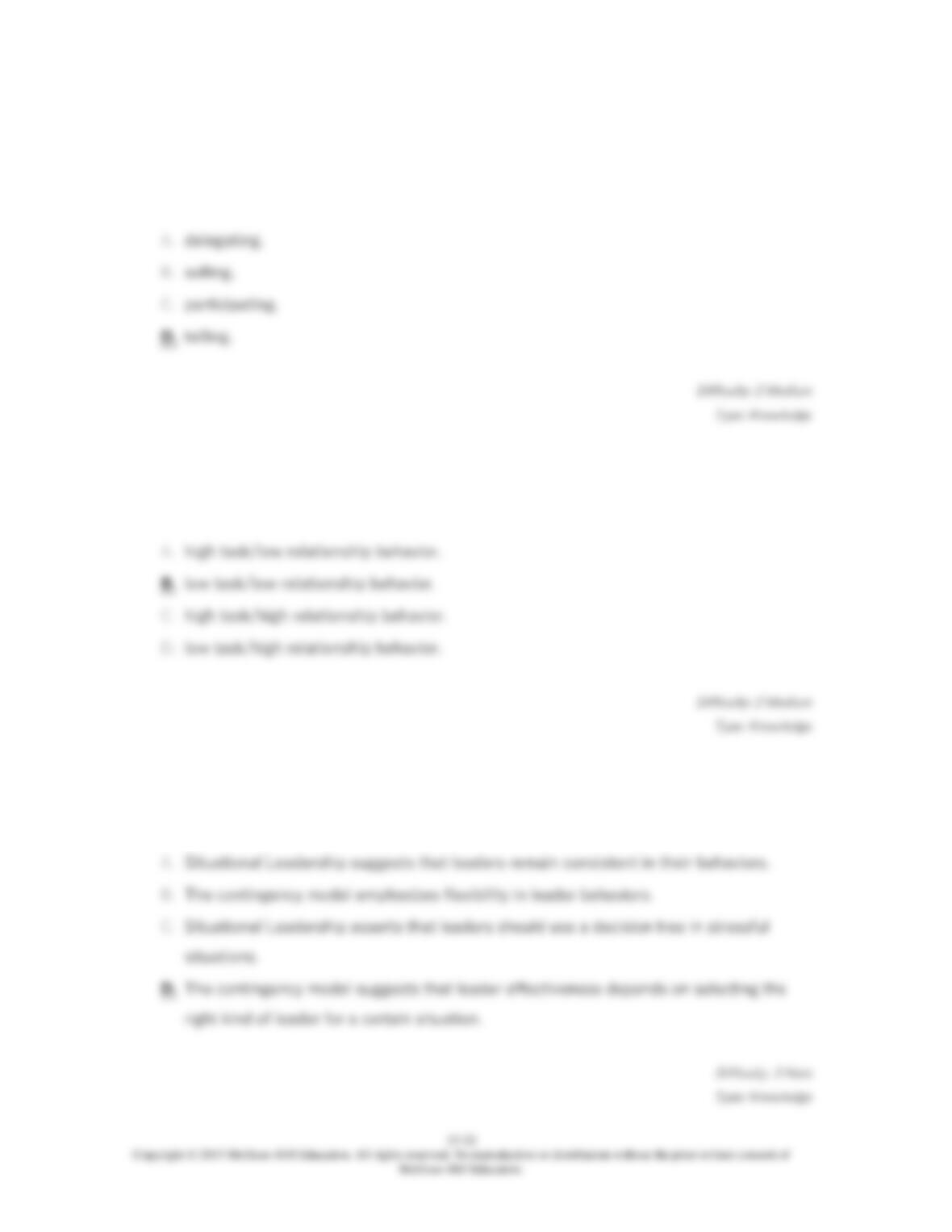
In terms of the four leadership styles of situational leadership, a high task/low relationship
behavior is referred to as:
30.
(p. 538)
The delegating leadership style has:
31.
(p. 539)
Which of the following statements is most likely true of the leadership theories?
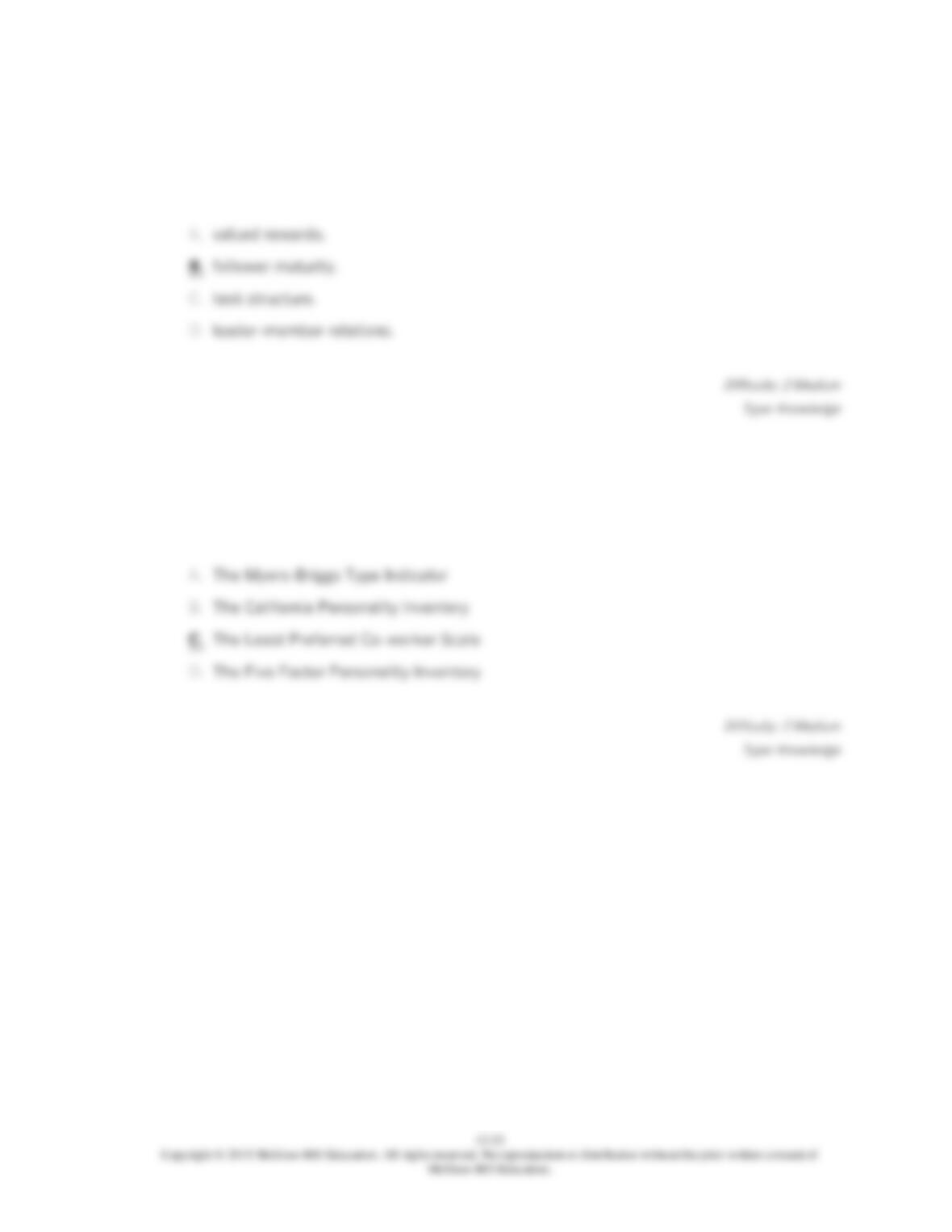
32.
(p. 539)
Situational Leadership suggests that effective leaders base behavior upon:
33.
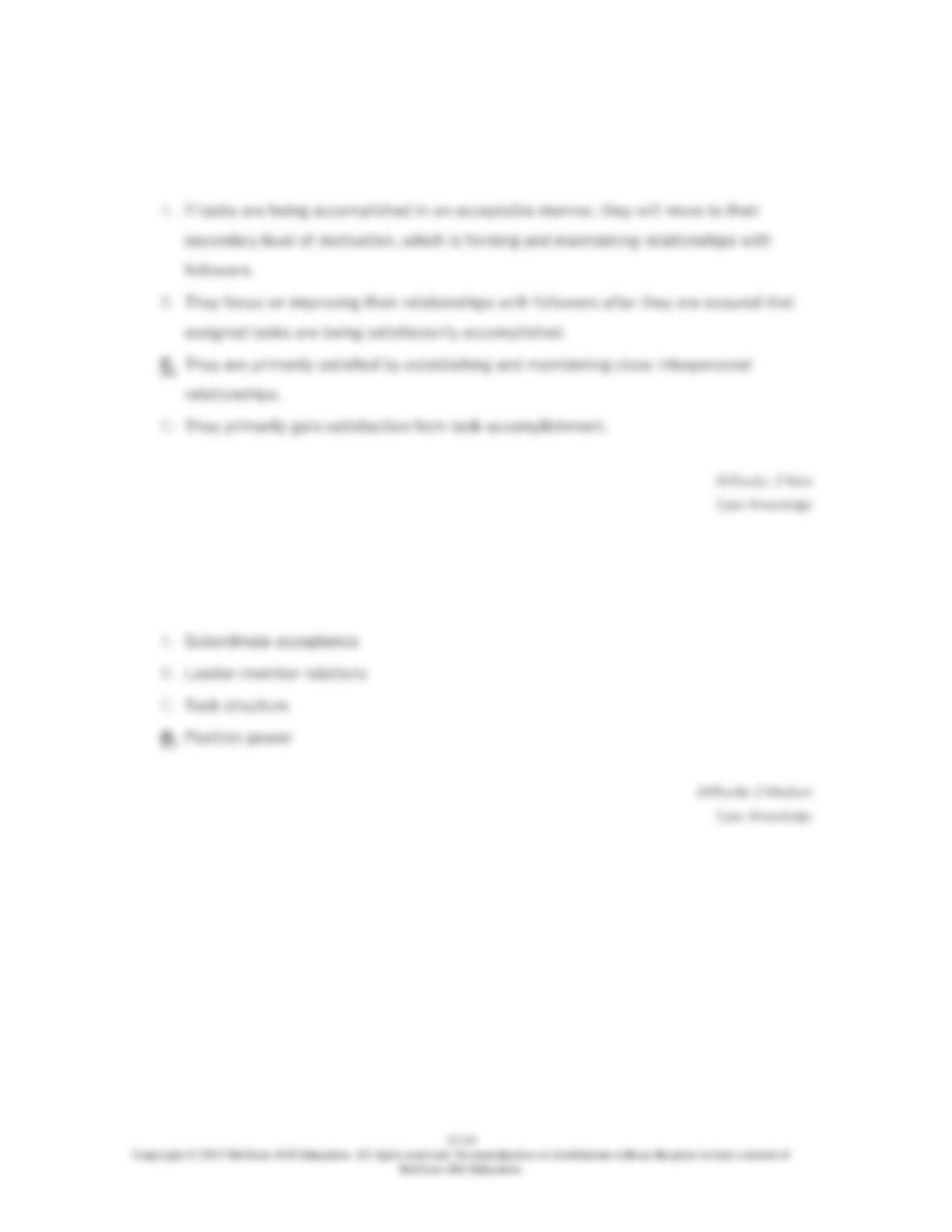
(p. 539)
Which of the following instruments does Fiedler’s contingency theory use to determine the
relevant characteristic of the leader?
34.
(p. 540)
Which of the following statements about high-LPC leaders is most likely true?
35.
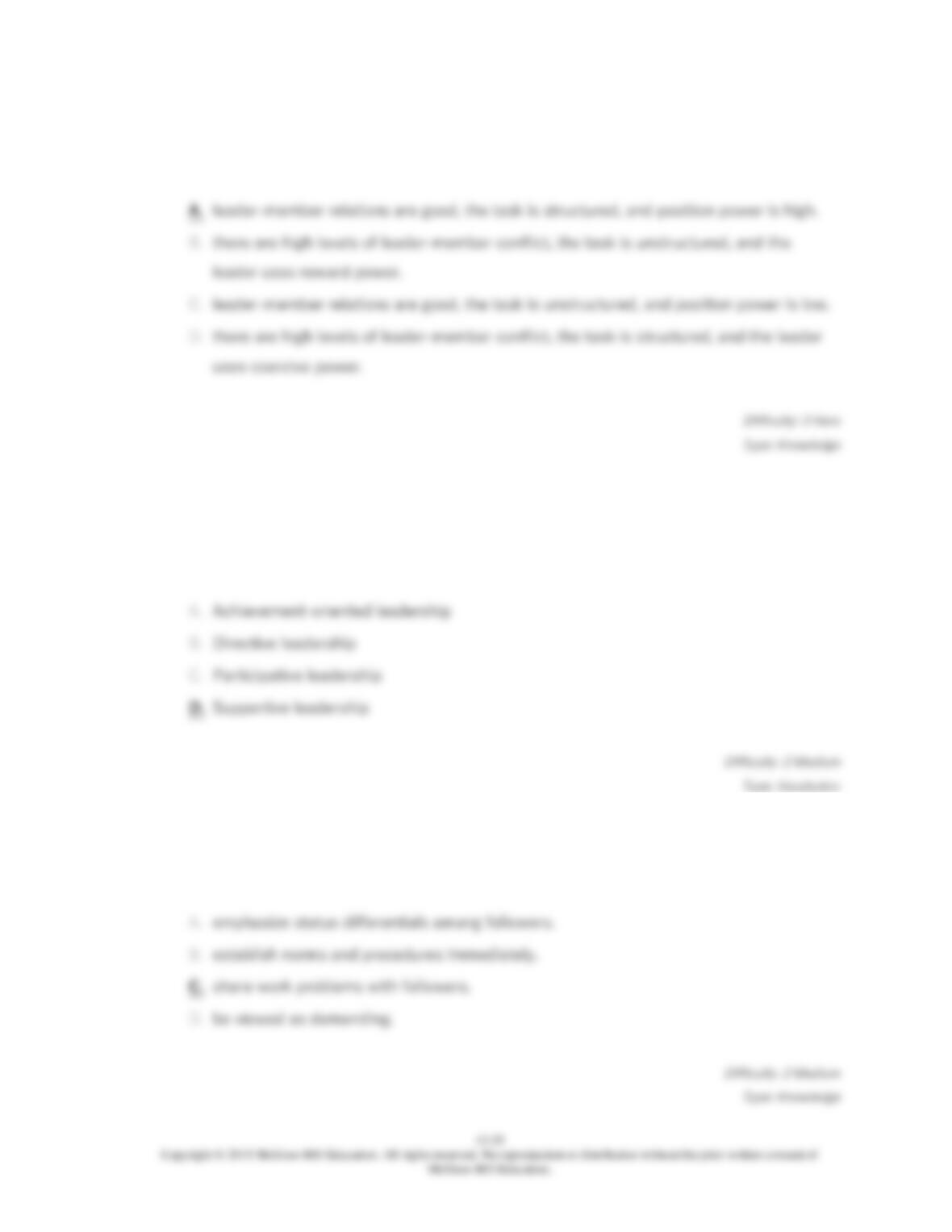
(p. 541)
What is the weakest element of situational favorability?
36.
(p. 542)
The highest levels of situational favorability most likely occur when:
37.
(p. 547)
According to the path-goal theory, which leader behavior is most likely characterized by
remaining open and approachable to followers?
38.
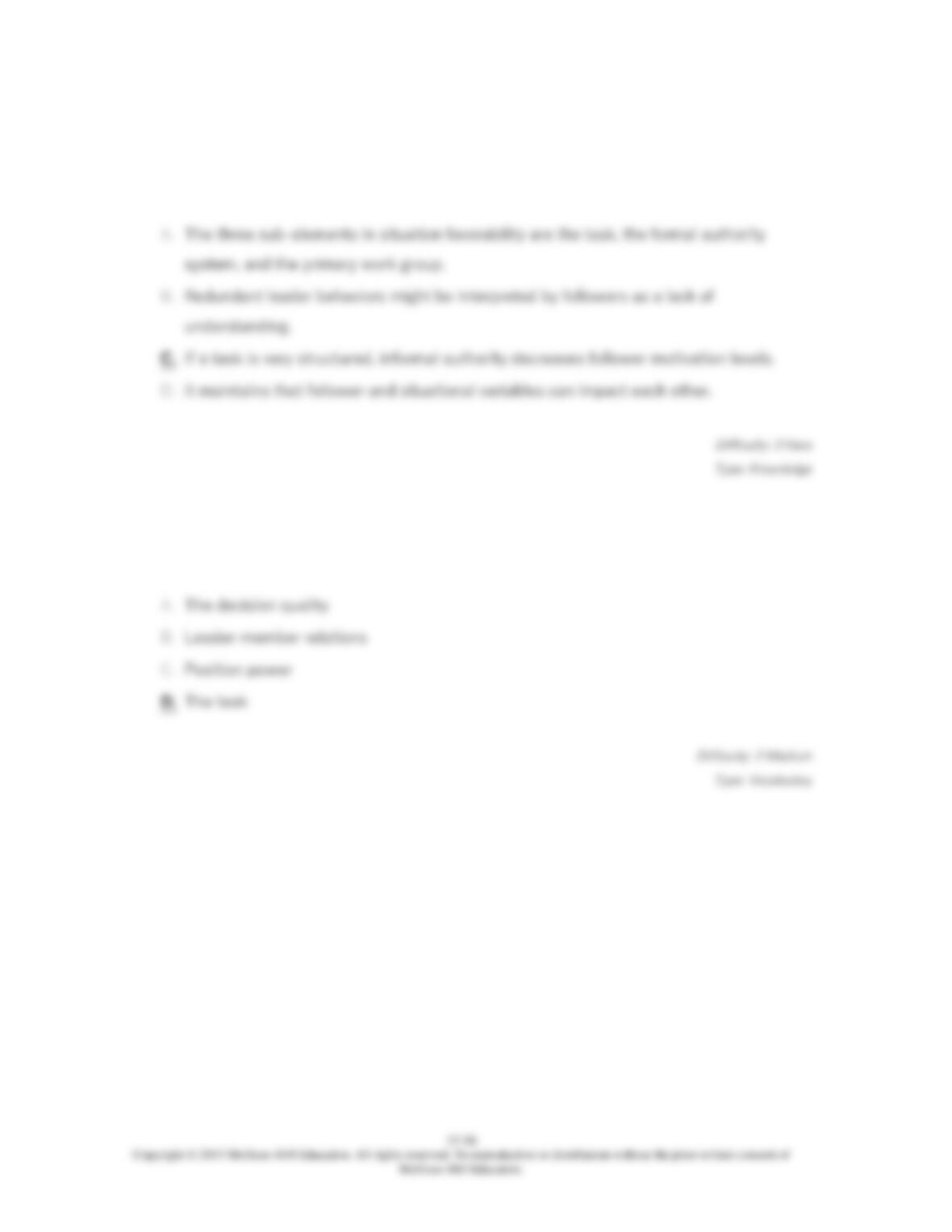
(p. 547)
Leaders exhibiting participative leadership are most likely to:
39.
(p. 549)
Which of the following statements about the path-goal theory is most likely FALSE?
40.
(p. 549)
In terms of the path-goal theory, which of the following is considered a situational factor?
Essay Questions
41.
(p. 526)
Discuss how the Leader-Member Exchange (LMX) theory has changed in the last 20
years.
42.
(p. 527-
532)
Describe how the Vroom and Yetton normative decision model incorporates quality,
acceptance, time, and subordinate development.
43.
(p. 533)
What are some of the problems with the normative decision model?
44.
(p. 534)
Differentiate between task behaviors and relationship behaviors in the Situational
Leadership model. Provide examples of each.
45.
(p. 536)
What is follower readiness? Provide an example.
46.
(p. 539)
What is the least preferred co-worker scale? What can be learned from LPC scores?
47.
(p. 543)
Describe the primary difference between Fiedler’s contingency model and the other
contingency theories presented. What are the implications of this difference in an
organizational setting?
48.
(p. 545)
Why have researchers criticized the contingency model?
49.
(p. 549)
Describe a situation where the variables from path-goal theory would make certain leader
behaviors redundant.
50.
(p. 550)
Illustrate how a leader might use path-goal theory to improve leadership effectiveness.