Chapter 13 – Inventory Management
127. At what point should he reorder Stein beer?
128. If he were to order 16 cases of Stein beer at a time, what would be the length of an order
cycle?
Chapter 13 – Inventory Management
129. If he were to order 16 cases of Stein beer at a time, what would be the average inventory
level?
130. If he were to order 16 cases of Stein beer at a time, what would be the daily total
inventory costs, EXCLUDING the cost of the beer?
Chapter 13 – Inventory Management
131. What is the economic order quantity for Stein beer?
Ann Chovies, owner of the Perfect Pasta Pizza Parlor, uses 20 pounds of pepperoni each day
in preparing pizzas. Order costs for pepperoni are $10.00 per order, and carrying costs are 4
cents per pound per day. Lead time for each order is 3 days, and the pepperoni itself costs
$3.00 per pound.
132. At what point should she reorder pepperoni?
Chapter 13 – Inventory Management
133. If she were to order 80 pounds of pepperoni at a time, what would be the length of an
order cycle?
134. If she were to order 80 pounds of pepperoni at a time, what would be the average
inventory level?
Chapter 13 – Inventory Management
13–64
135. If she were to order 80 pounds of pepperoni at a time, what would be the total daily
costs, including the cost of the pepperoni?
136. What is the economic order quantity for pepperoni?
The Operations Manager for Shadyside Savings & Loan orders cash from her home office for
her very popular “BIG BUCKS” automated teller machine, which only dispenses $100 bills.
She estimates that this machine dispenses an average of 12,500 bills per month, and that
carrying a bill in inventory costs 10 percent of its value annually. She knows that each order
for these bills costs $300 for clerical and armored car delivery costs, and that order lead time
is six days.
Chapter 13 – Inventory Management
137. Assuming a thirty-day month, at what point should bills be reordered?
138. Assuming a thirty-day month, if she were to order 6,000 bills at a time, what would be
the length of an order cycle?
Chapter 13 – Inventory Management
139. If she were to order 6,000 bills at a time, what would be the dollar value of the average
inventory level?
140. If she were to order 6,000 bills at a time, what would be the average monthly total costs,
EXCLUDING the value of the bills?
Chapter 13 – Inventory Management
141. What is the economic order quantity?
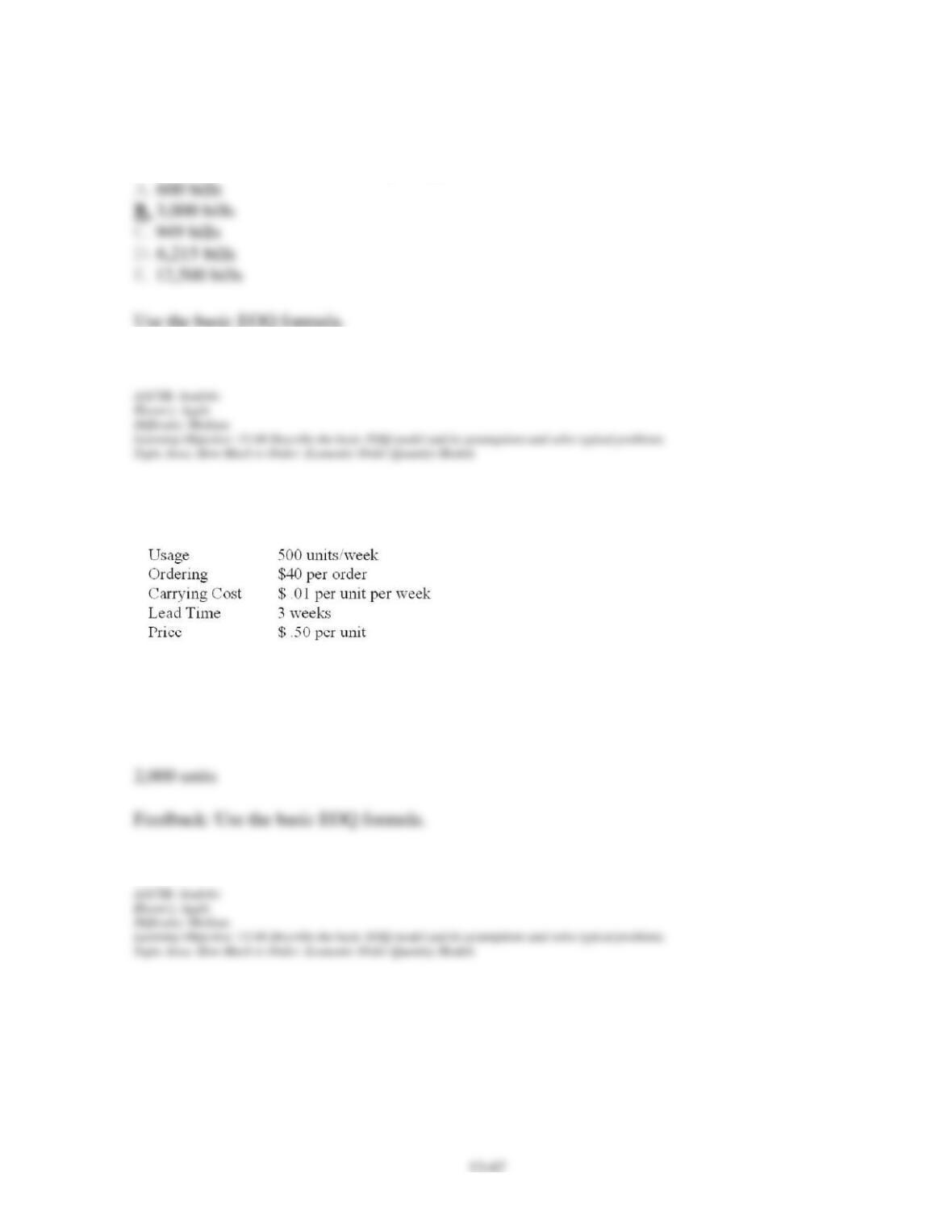
Given the following data for a particular inventory item:
142. What is the economic order quantity for this item?
Chapter 13 – Inventory Management
143. For the economic order quantity, what is the length of an order cycle?
144. For the economic order quantity, what is the reorder point?
145. For the economic order quantity, what is the average inventory level?
Chapter 13 – Inventory Management
146. For the economic order quantity, what are average weekly ordering costs?
147. For the economic order quantity, what are average weekly carrying costs?
148. For the economic order quantity, what are average weekly total costs, including the cost
of the inventory item?
Chapter 13 – Inventory Management
The materials manager for a billiard ball maker must periodically place orders for resin, one
of the raw materials used in producing billiard balls. She knows that manufacturing uses resin
at a rate of 50 kilograms each day, and that it costs $.04 per day to carry a kilogram of resin in
inventory. She also knows that the order costs for resin are $100 per order, and that the lead
time for delivery is four (4) days.
149. At what point should resin be reordered?
150. If order size was 1,000 kilograms of resin, what would be the length of an order cycle?
Chapter 13 – Inventory Management
151. If the order size was 1,000 kilograms of resin, what would be the average inventory
level?
152. If the order size was 1,000 kilograms of resin, what would be the daily total inventory
costs, EXCLUDING the cost of the resin?
Chapter 13 – Inventory Management
153. What is the economic order quantity for resin?
154. A firm stocks a seasonal item that it buys for $22/unit and sells for $29 unit. During the
season, daily demand can be described using a Poisson distribution with a mean of 2.4.
Because of the nature of the item, units remaining at the close of business each day must be
removed at a cost of $2 each. What is the optimum stocking level, and what is the effective
service level?
Chapter 13 – Inventory Management
155. Joe’s Coffee Shoppe has fresh doughnuts delivered each morning. Daily demand for
plain doughnuts is approximately normal with a mean of 200 and a standard deviation of 15.
Joe pays $1.20 per dozen and has a standing order for 16 dozen. Joe and the staff eat any
leftovers. What is the implied shortage cost?
= 15
Ce = $1.20 per dozen
Chapter 13 – Inventory Management
156. A restaurant prepares Peking Duck daily at a cost of $18 per duck. Each duck generates
revenue of $47 if sold. Demand for Peking Duck can be described by a Poisson distribution
with a mean of 4.2 ducks per day. Unsold ducks at the end of each day are converted to duck
soup at an additional cost of $5 over and above the resulting value as soup. How many ducks
should be prepared each day?
Chapter 13 – Inventory Management
157. A machine is expected to use approximately three spare parts during its useful life. The
spares cost $200 each and have no salvage value or other use. The manager has ordered five
spares. Assuming a Poisson usage rate, what range of shortage cost is implied?
13–76
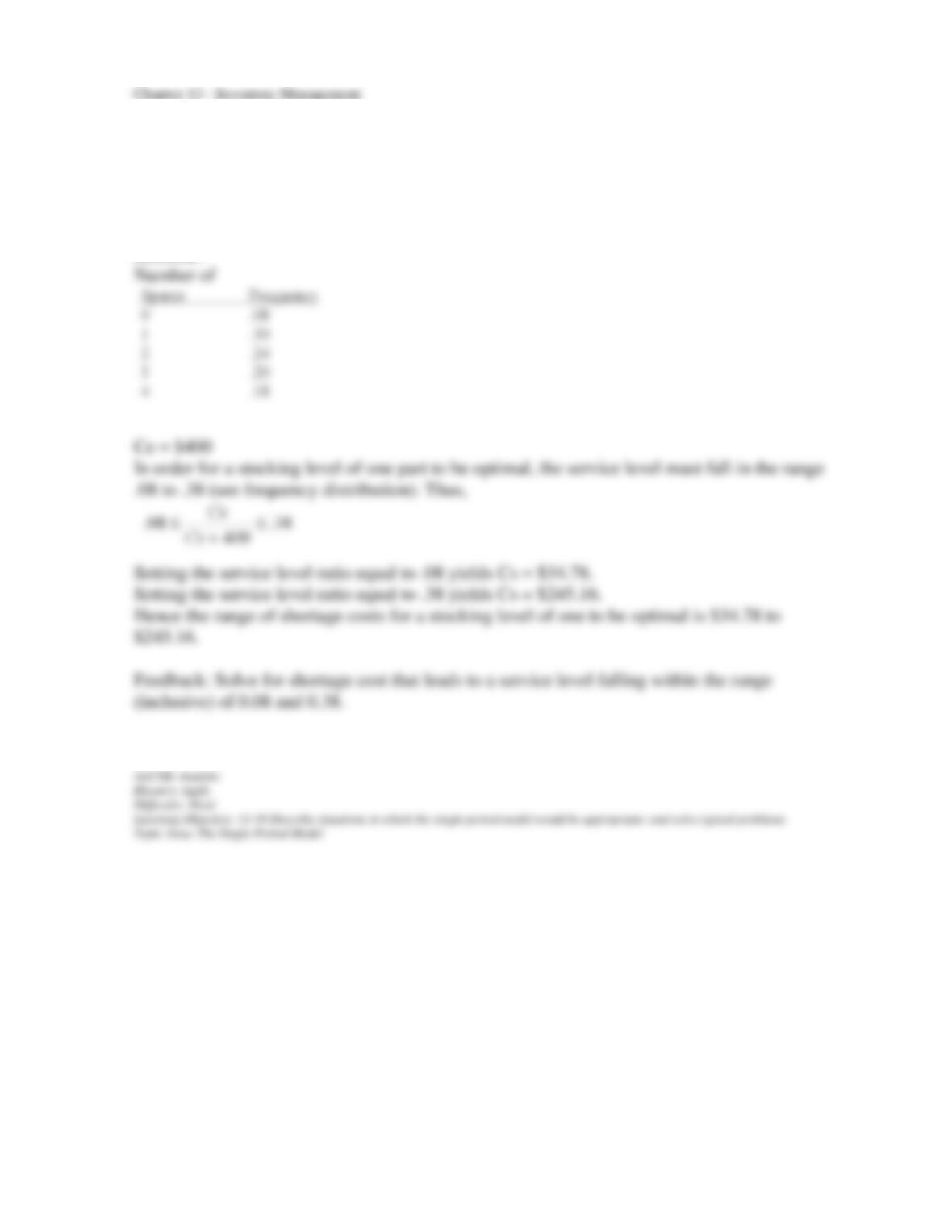
158. A manager intends to order a new machine and must now decide on the number of spare
parts to order along with the machine. The parts cost $400 each and have no salvage value.
The manager has compiled a frequency distribution for the probable usage of spare parts, as
shown. For what range of shortage costs would stocking one spare part constitute an optimal
decision?
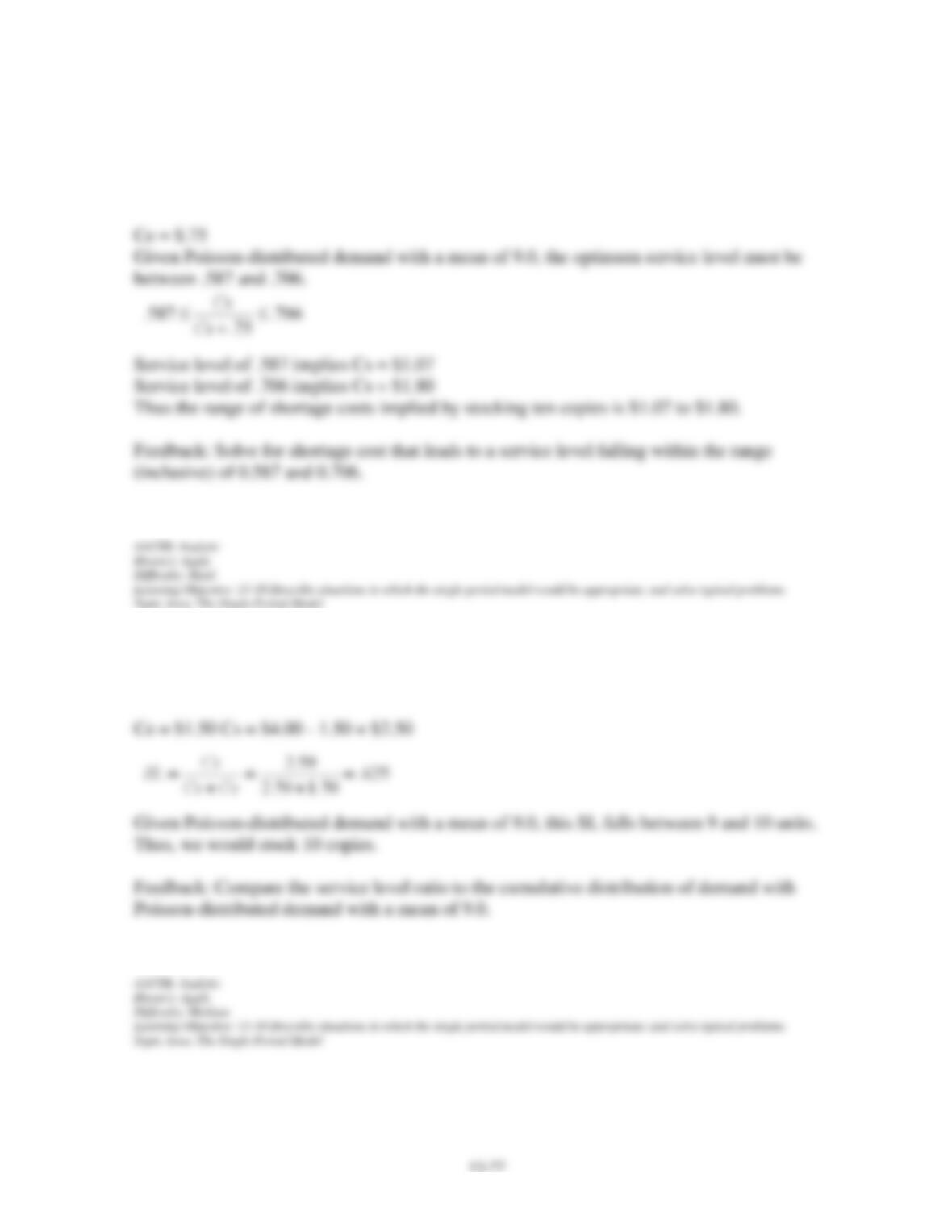
The Corner Newsstand has demand for a certain weekly magazine that can be approximated
by a Poisson distribution with a mean of 9.0. Magazines are purchased for $1.50.
Chapter 13 – Inventory Management
159. If unsold copies can be returned for half credit and the owner stocks ten copies, what is
the implied range of shortage cost?
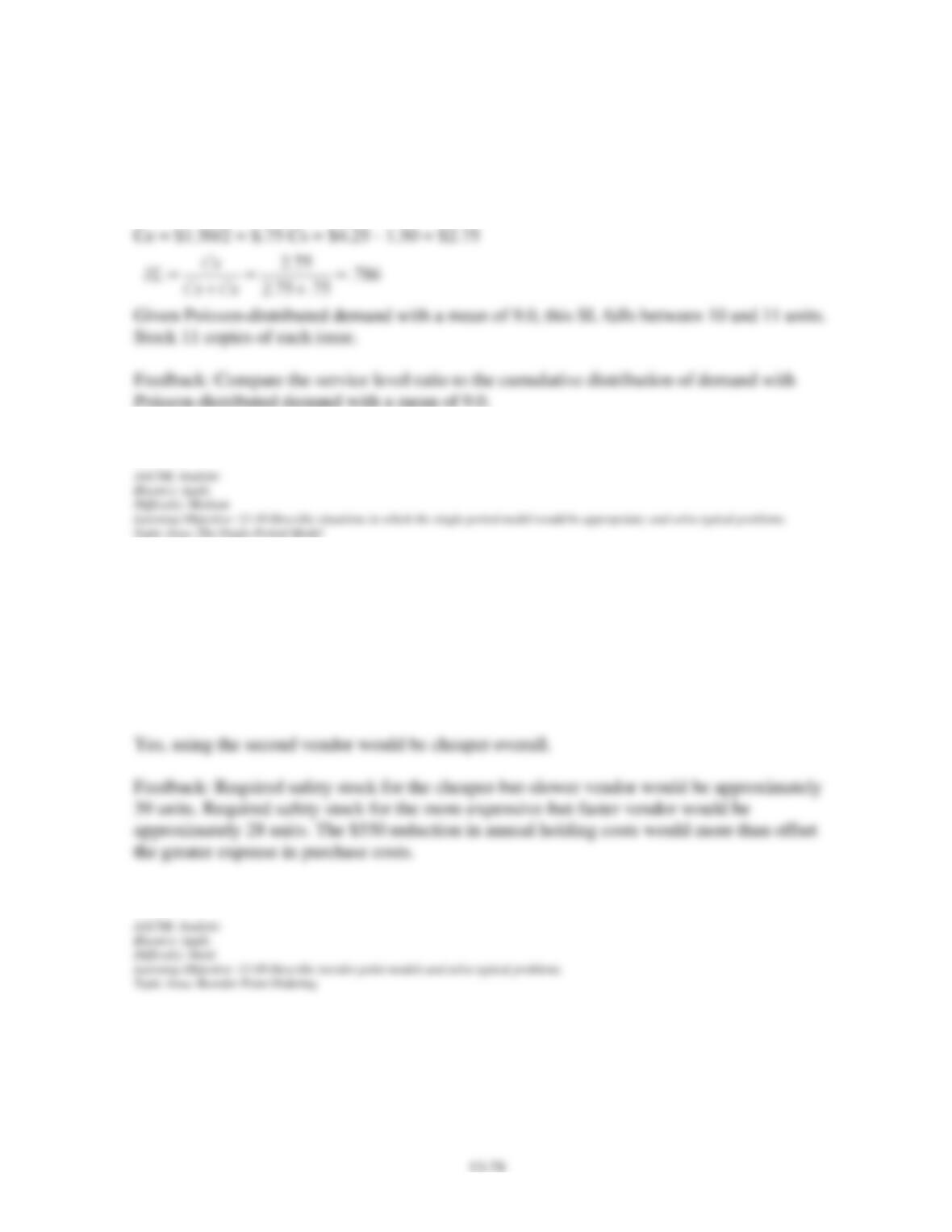
160. If unsold copies must be destroyed and copies sell for $4.00 each, find the optimum
stocking level.
Chapter 13 – Inventory Management
161. If unsold copies can be returned for half credit and copies sell for $4.25 each, find the
optimal stocking level.
162. Demand for a component averages 80 units per week, with a weekly standard deviation
of demand of 14 units. The current supplier of this component offers a four-week lead time.
Stockout risk is to be kept at 8%. Assume that it costs $50 to hold one unit in inventory for a
year. Suppose the annual cost for the items would be $500 higher if they were purchased from
another vendor, but that vendor would offer a two-week lead time. Would it be better to go
with the more-expensive but more-responsive vendor?