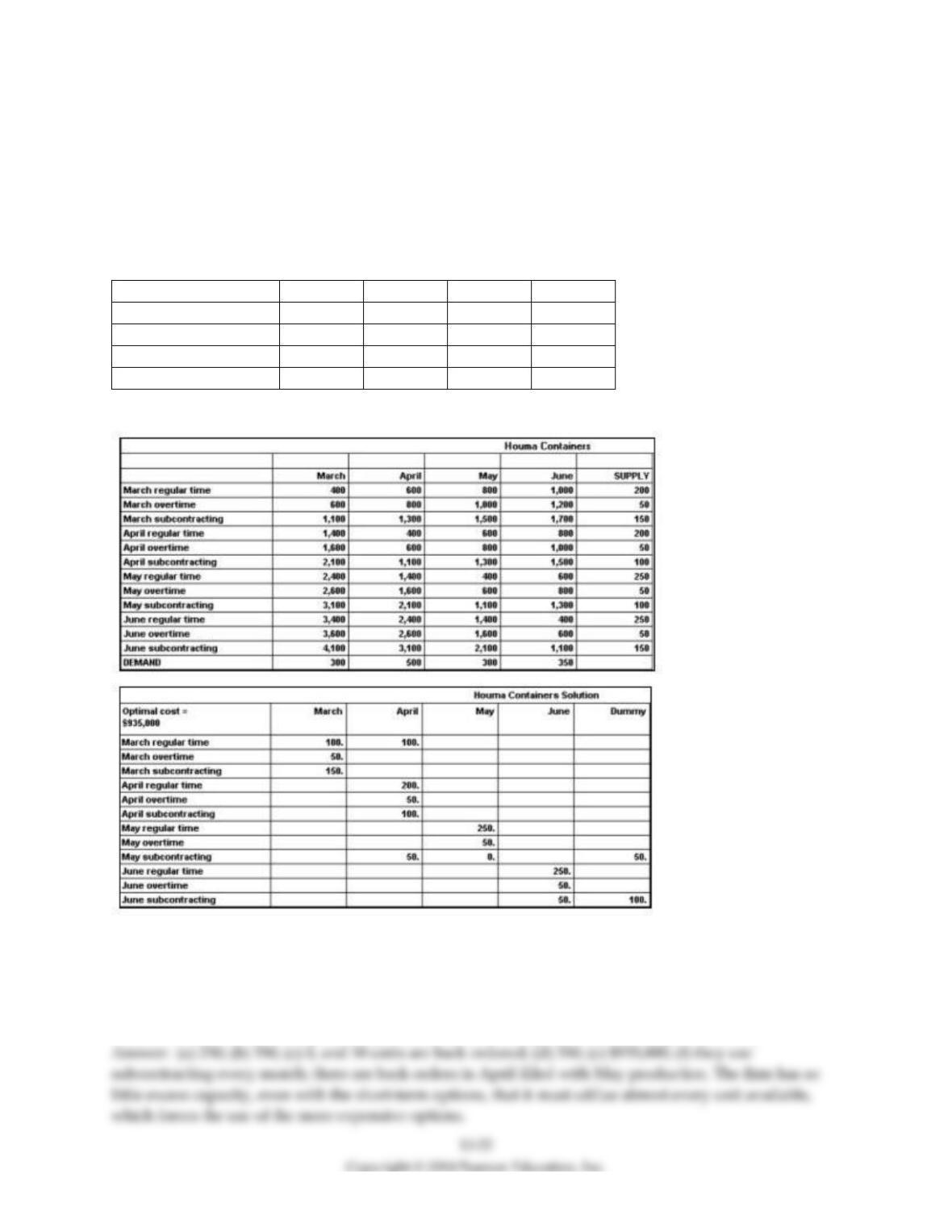
23) Houma Containers, Inc., makes industrial fiberglass tanks that are used on offshore oil platforms.
Demand for the next four months and capacities of the plant are shown in the table below. Unit cost on
regular time is $400. Overtime cost is 150% of regular time cost. Subcontracting is available in substantial
quantity but at a very high cost, $1100 per unit. Holding costs are $200 per tank per month; back orders
cost the firm $1000 per unit per month. Houma’s management believes that the transportation algorithm
can be used to optimize this scheduling problem. The firm has no beginning inventory and anticipates no
ending inventory.
March
April
May
June
Demand
300
500
300
350
Regular capacity
200
200
250
250
Overtime capacity
50
50
50
50
Subcontract cap.
150
100
100
150
Answer the following questions based on the data table and solution table shown below.
a. How many units will be produced on regular time in June?
b. How many units will be produced by subcontracting over the four-month period?
c. What will be the inventory at the end of April?
d. What will be total production from all sources in April?
e. What will be the total cost of the optimum solution?
f. Does the firm utilize the expensive options of subcontracting and back ordering? When; why?
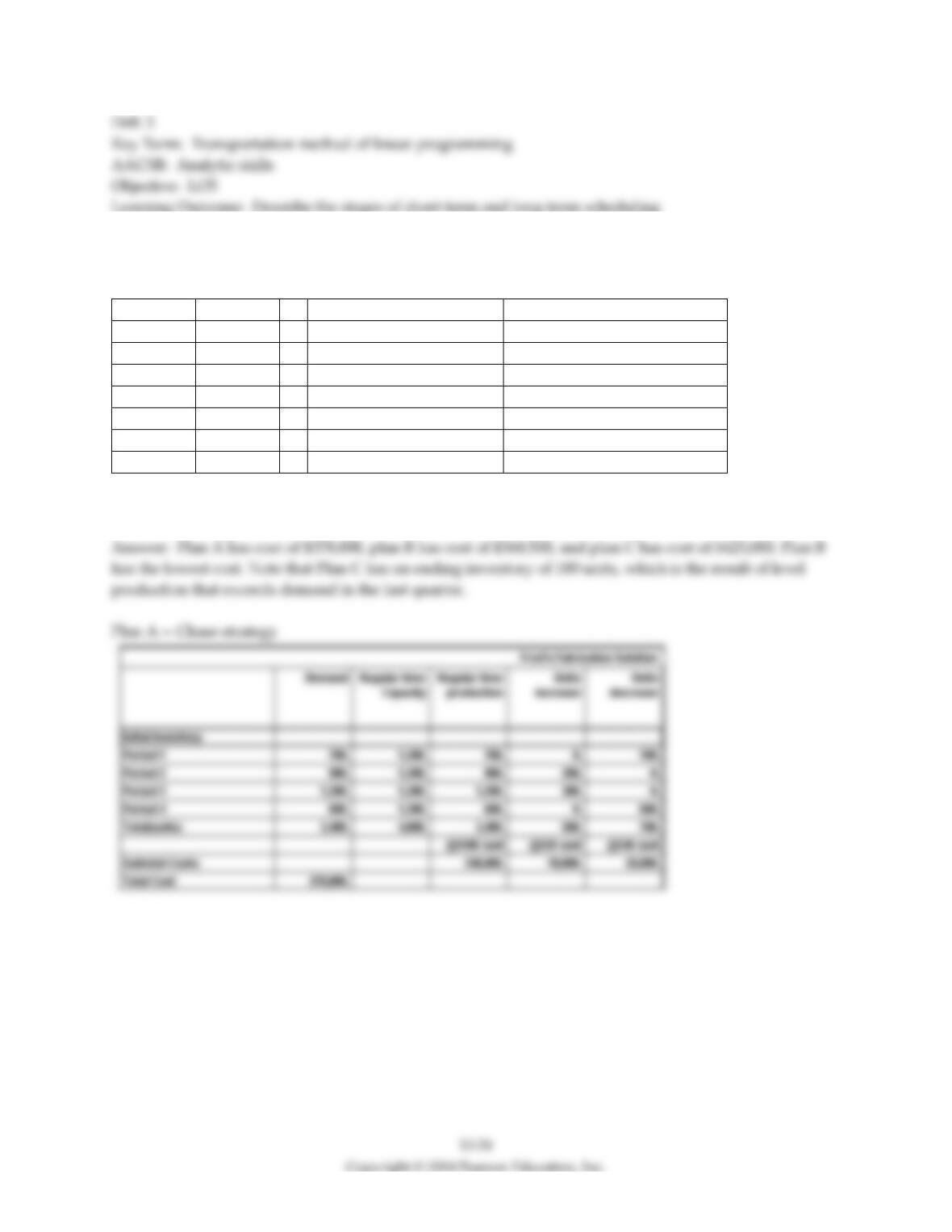
24) Fred’s Fabrication has the following aggregate demand requirements and other data for the upcoming
four quarters.
Quarter
Demand
Previous quarter’s output
800 units
1
700
Beginning inventory
0 units
2
900
Stockout cost
$100 per unit
3
1200
Inventory holding cost
$10 per unit at end of quarter
4
600
Hiring workers
$20 per unit
Laying off workers
$40 per unit
Subcontracting cost
$200 per unit
Unit cost
$100 per unit
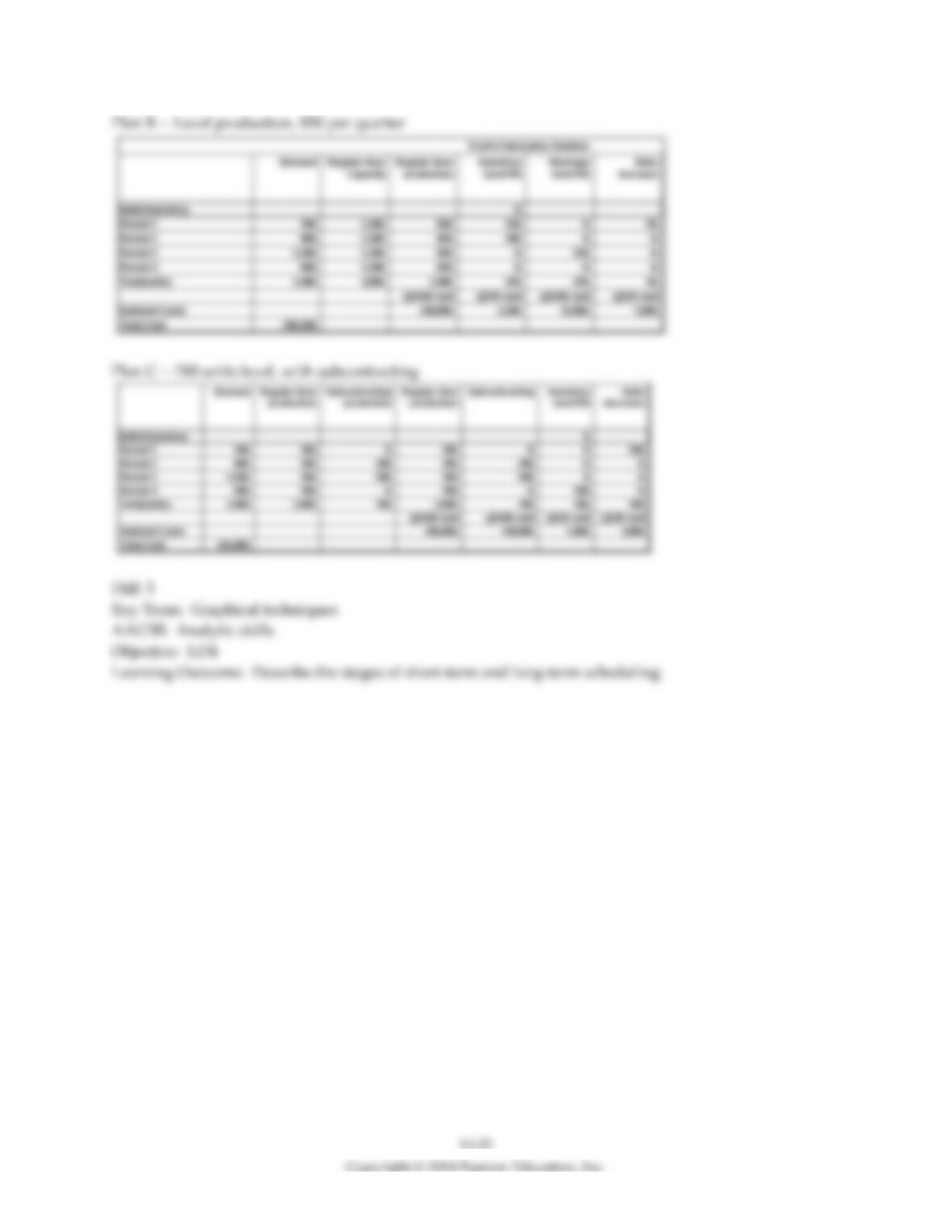
Which of the following production plans is better: Plan A–chase demand by hiring and layoffs; Plan B–
pure level strategy, or Plan C–700 level with the remainder by subcontracting?
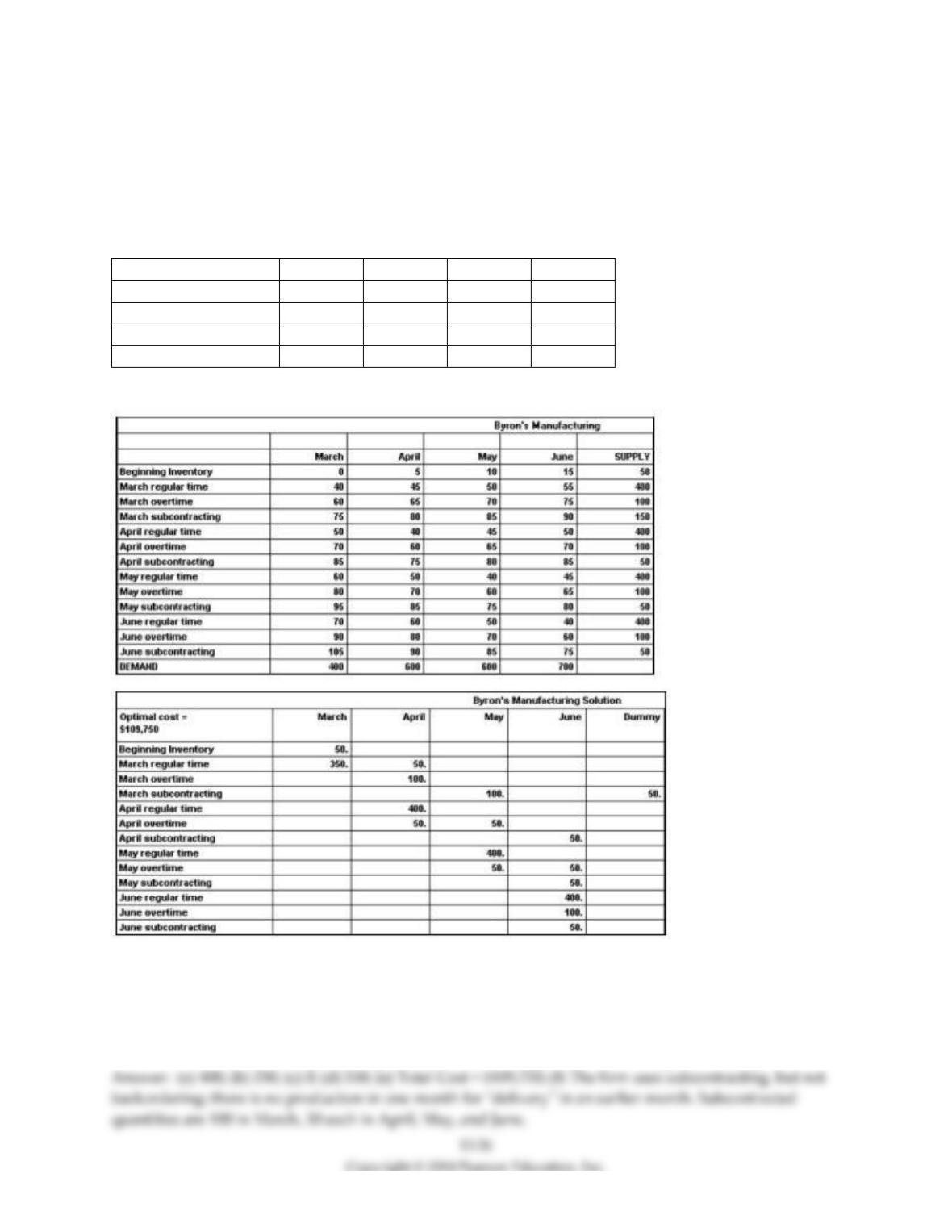
25) Byron’s Manufacturing makes tables. Demand for the next four months and capacities of the plant are
shown in the table below. Unit cost on regular time is $40. Overtime cost is 150% of regular time cost.
Subcontracting is available in substantial quantity at $75 per unit. Holding costs are $5 per table per
month; back orders cost the firm $10 per unit per month. Byron’s management believes that the
transportation algorithm can be used to optimize this scheduling problem. The firm has 50 units of
beginning inventory and anticipates no ending inventory.
March
April
May
June
Demand
400
600
600
700
Regular capacity
400
400
400
400
Overtime capacity
100
100
100
100
Subcontract cap.
150
50
50
50
Answer the following questions based on the data table and solution table shown below.
a. How many units will be produced on regular time in June?
b. How many units will be produced by subcontracting over the four-month period?
c. What will be the inventory at the end of April?
d. What will be total production from all sources in April?
e. What will be the total cost of the optimum solution?
f. Does the firm utilize the expensive options of subcontracting and back ordering? When; why?
1) Techniques for controlling the cost of labor in services include accurate scheduling of labor hours to
assure quick response to customer demand, on-call labor for unexpected demand, flexibility of labor
skills for reallocation of available labor, and flexibility in rate of output or hours of work to meet
changing demand.
2) Aggregate planning for fast food restaurants is very similar to aggregate planning in manufacturing,
but with much smaller units of time.
3) Which of the following is NOT one of the successful techniques for controlling the cost of labor in
services?
A) accurate scheduling of labor-hours to assure quick response to customer demand
B) an on-call labor resource that can be added or deleted to meet unexpected demand
C) little flexibility in worker hours to decrease the burden on management
D) flexibility of individual worker skills that permits reallocation of available labor
E) flexibility in rate of output or hours of work to meet changing demand
4) Which of the following statements regarding aggregate planning in services is FALSE?
A) Approaches to aggregate planning differ by the type of service provided.
B) Some service organizations conduct aggregate planning in exactly the same way as manufacturing
firms, but with demand management taking a more active role.
C) Aggregate planning in some service industries may be easier than in manufacturing.
D) Labor is the primary aggregate planning vehicle.
E) Level scheduling is far more common than using a chase strategy.
5) Aggregate planning for service firms that provide intangible output deals mainly with:
A) smoothing the production rate and finding the optimal size of the workforce.
B) capital investment decisions.
C) centralized purchasing.
D) centralized production.
E) planning for human resource requirements and managing demand.
6) What are successful techniques of controlling the cost of labor involved in service firms?
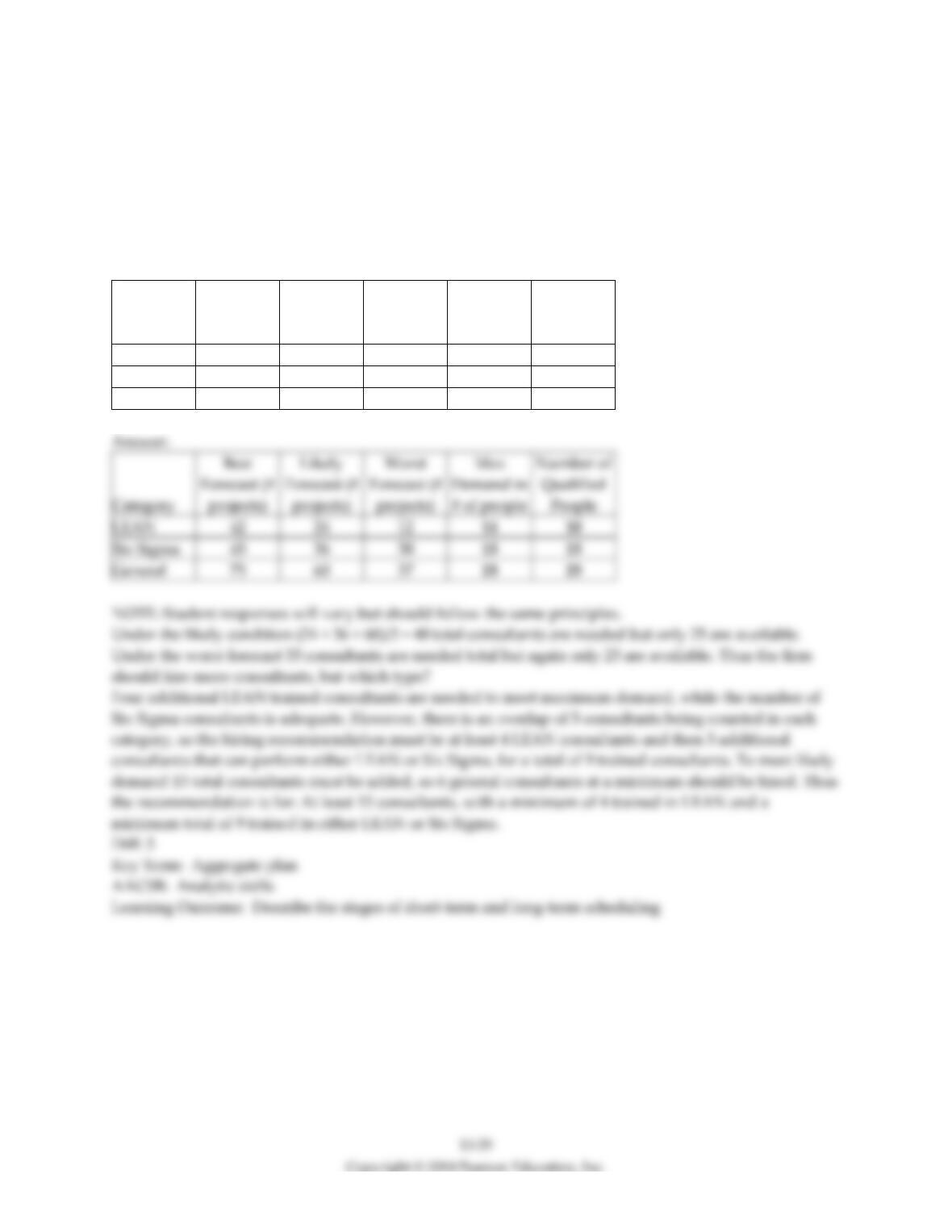
7) A large consulting firm is deciding on if its workforce should be expanded, maintained, or decreased.
Suppose that demand is given in week-long projects, and that a consultant can work on 3 projects each
month (1 week off for personal leave and/or other duties such as conferences, etc). Currently there are 25
consultants. Ten consultants are trained for LEAN and 15 for Six Sigma, with 5 of those consultants being
overlaps (the consultant is trained for BOTH LEAN and Six Sigma). Assume that all consultants can do
the general work. Complete the table (the forecast period is an upcoming month) and prepare a
recommendation.
Category
Best
Forecast (#
projects)
Likely
Forecast (#
projects)
Worst
Forecast (#
projects)
Max
Demand in
# of people
Number of
Qualified
People
LEAN
42
24
12
Six Sigma
45
36
30
General
75
60
57
Category
Best
Forecast (#
Likely
Forecast (#
Worst
Forecast (#
Max
Demand in
Number of
Qualified
LEAN
42
24
12
Six Sigma
45
36
30
General
75
60
57
Section 7 Revenue Management
1) A hotel room that goes unrented and an airline seat that goes unsold are both examples of perishable
inventory in services.
2) Which of the following characteristics makes revenue management UNATTRACTIVE to organizations
that have perishable inventory?
A) demand can be segmented
B) service can be sold in advance of consumption
C) capacity is easily changed
D) variable costs are low and fixed costs are high
E) demand fluctuates
3) Revenue management is MOST likely to be used in which one of the following situations?
A) a fast food restaurant with wide demand fluctuations during the day
B) a dental clinic that wants to fill its appointment book
C) a firm with a good counterseasonal product mix
D) a shipping company that can change its fleet size easily
E) an airline attempting to fill “perishable” seats at maximum revenue
4) Revenue (or yield) management is best described as:
A) a situation where management yields to labor demands.
B) a situation where the labor union yields to management demands.
C) a process designed to increase the rate of output.
D) allocation of scarce resources to customers at prices that will maximize revenue.
E) management’s selection of a product mix yielding maximum profits.
5) Industries in which revenue management techniques are easiest to apply are those where:
A) use tends to be predictable, and pricing tends to be fixed.
B) use tends to be predictable, and pricing tends to be variable.
C) use tends to be uncertain, and pricing tends to be fixed.
D) use tends to be uncertain, and pricing tends to be variable.
E) All of the above, i.e., there is no difference.
6) To use revenue management strategies, a business should have which combination of costs?
A) high variable and high fixed
B) low variable and high fixed
C) high variable and low fixed
D) low variable and low fixed
E) either A or B
7) A hotel room that goes unrented, a dental appointment that no patient booked, and an airline seat that
went unsold, are all examples of ________ in services.
8) ________ involves capacity decisions that determine the allocation of resources to maximize revenue or
yield.
9) What is the primary management challenge when implementing revenue management?
10) Identify the five conditions that make revenue management of interest.
11) To make revenue management work, the company needs to manage what three issues?
12) A small private university normally charges the same price –$200–per credit-hour for all courses and
for all students. While the university is pretty near capacity in the fall and spring, it finds that its
classrooms are only about 60 percent occupied during the summer session. A student of operations
management wonders if revenue management might be useful to both the university and its students
alike. This student, with help from some economics majors, estimates a demand curve for summer course
enrollment. Points on this demand curve include 9000 credit-hours at the current rate of $200, 12,000
credit hours at $180, 15,000 credit-hours at $160, and 18,000 credit-hours at $140. Based on this demand
curve, what price point would best serve the university, if its objective is the greatest revenue for the
summer session?
13) A professional services firm is investigating revenue management as a means of taking advantage of
unused capacity. Analysts for this firm estimate a demand curve for the firm’s service, which is sold by
the hour. Points on this demand curve include 9000 hours at the current rate of $60 per hour, 9500 hours
at $55, 10,000 hours at $50, and 10,500 hours at $45. Based on this demand curve, what price point would
be best for the firm, if its objective is maximum revenue?