Chapter 13 – Inventory Management
99. The management of supply chain inventories focuses on:
100. An operations strategy for inventory management should work towards:
Chapter 13 – Inventory Management
101. Cycle stock inventory is intended to deal with ________.
102. An operations strategy which recognizes high carrying costs and reduces ordering costs
will result in:
Chapter 13 – Inventory Management
103. The need for safety stocks can be reduced by an operations strategy which:
104. If average demand for an item is 20 units per day, safety stock is 50 units, and lead time
is four days, the ROP will be:
Chapter 13 – Inventory Management
105. With an A-B-C system, an item that had a high demand but a low annual dollar volume
would probably be classified as:
106. The fixed order interval model would be most likely to be used for this situation:
Chapter 13 – Inventory Management
107. Which item would be least likely to be ordered under a fixed order interval system?
108. Which one of these would not be a factor in determining the reorder point?
Chapter 13 – Inventory Management
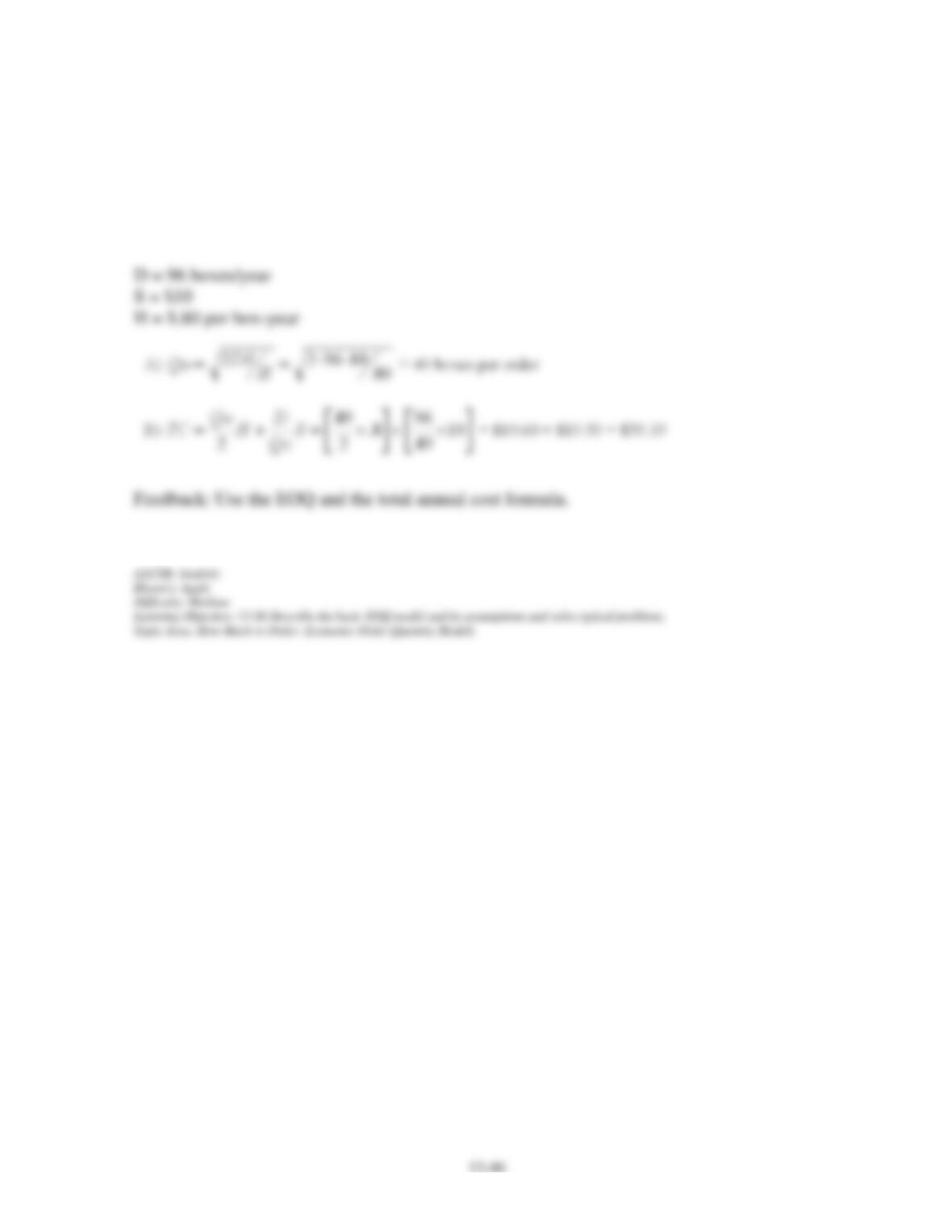
109. A car rental agency uses 96 boxes of staples a year. The boxes cost $4 each. It costs $10
to order staples, and carrying costs are $0.80 per box on an annual basis.
Determine:
(A) the order quantity that will minimize the sum of ordering and holding boxes of staples
(B) the annual cost of ordering and carrying the boxes of staples
Chapter 13 – Inventory Management
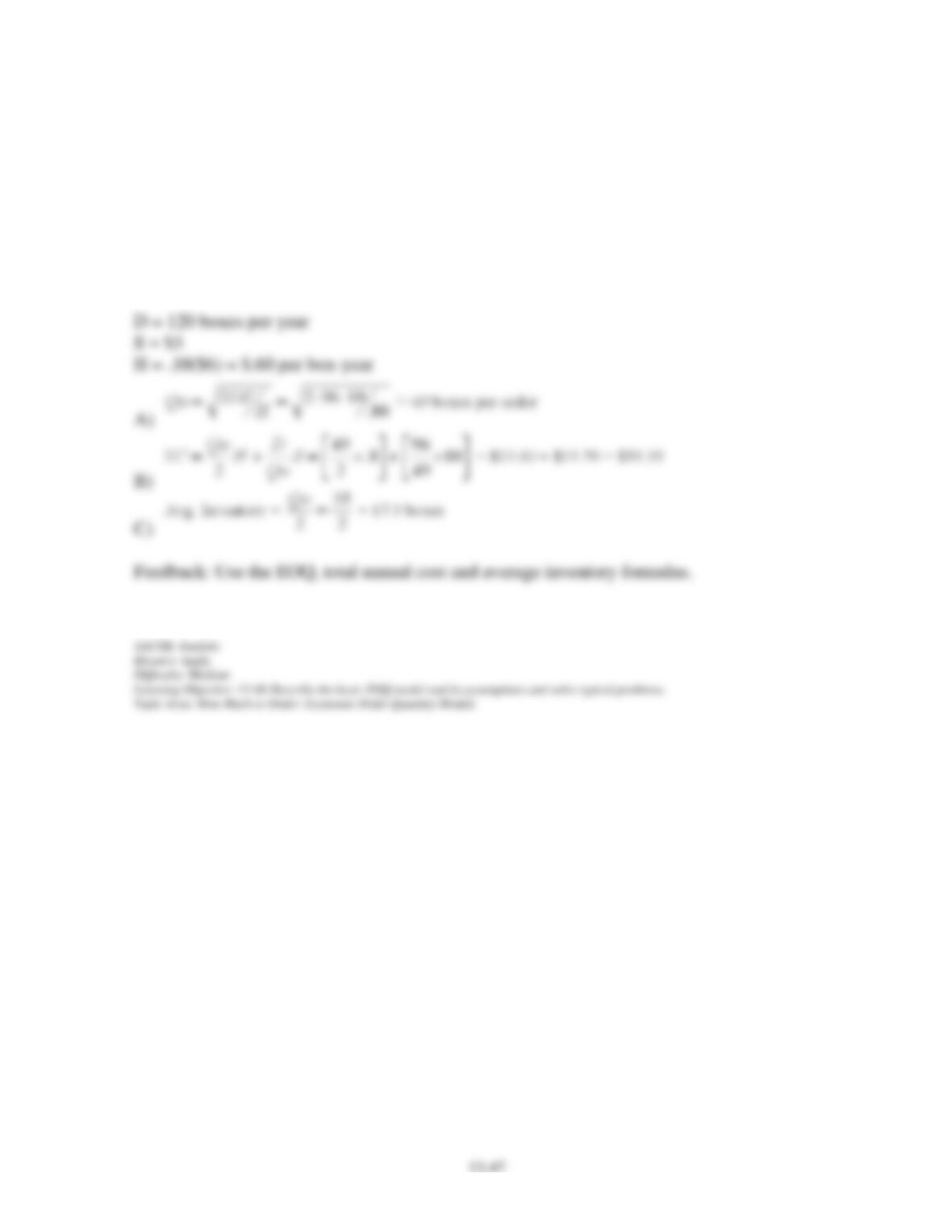
110. A service garage uses 120 boxes of cleaning cloths a year. The boxes cost $6 each.
Ordering cost is $3 and holding cost is 10 percent of purchase cost per unit on an annual basis.
Determine:
(A) The economic order quantity
(B) The total cost of carrying the cloths (excluding purchase price)
(C) The average inventory
Chapter 13 – Inventory Management
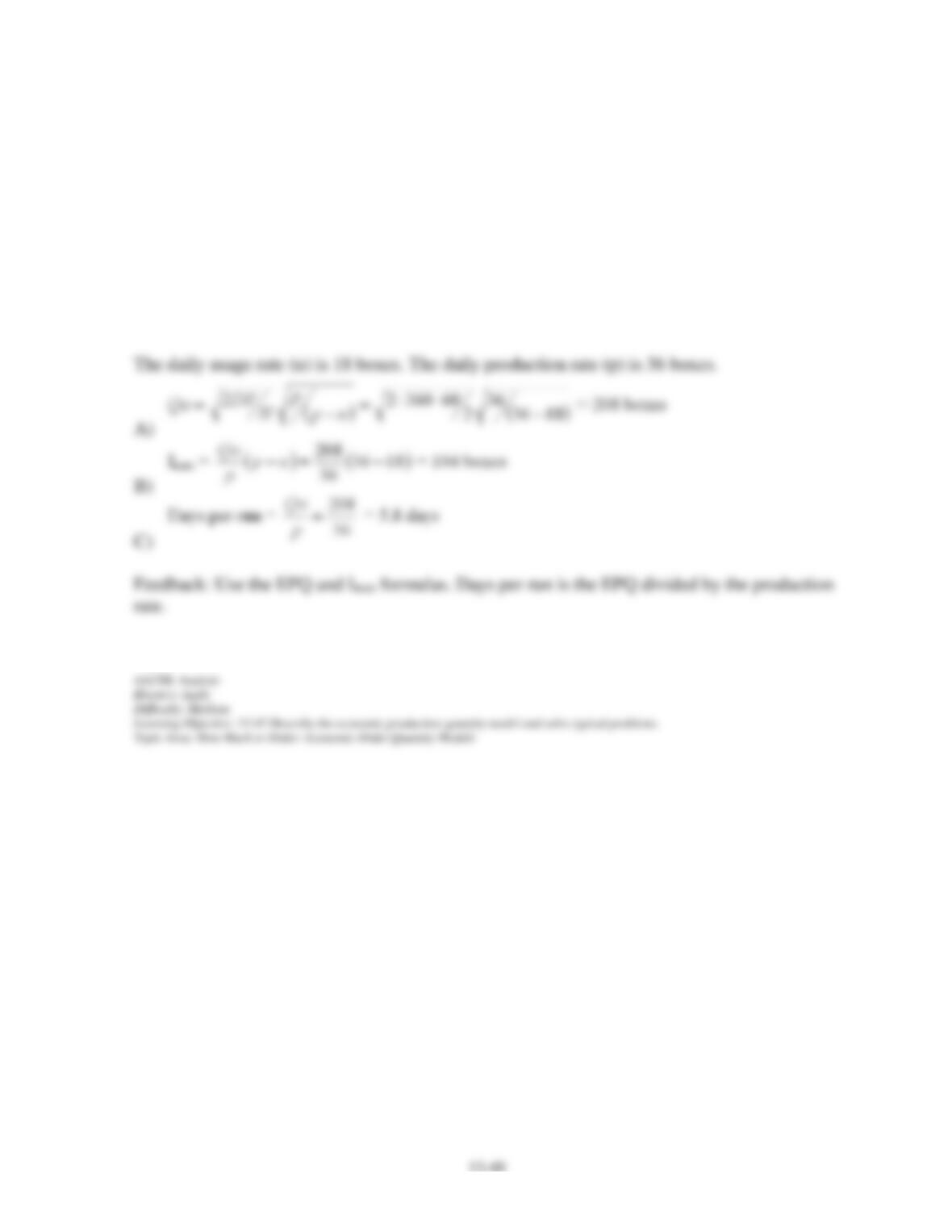
111. A shop that makes candles offers a scented candle, which has a monthly demand of 360
boxes. Candles can be produced at a rate of 36 boxes per day. The shop operates 20 days a
month. Assume that demand is uniform throughout the month. Setup cost is $60 for a run, and
holding cost is $2 per box on a monthly basis.
Determine the following:
(A) the economic run size
(B) the maximum inventory
(C) the number of days in a run
Chapter 13 – Inventory Management
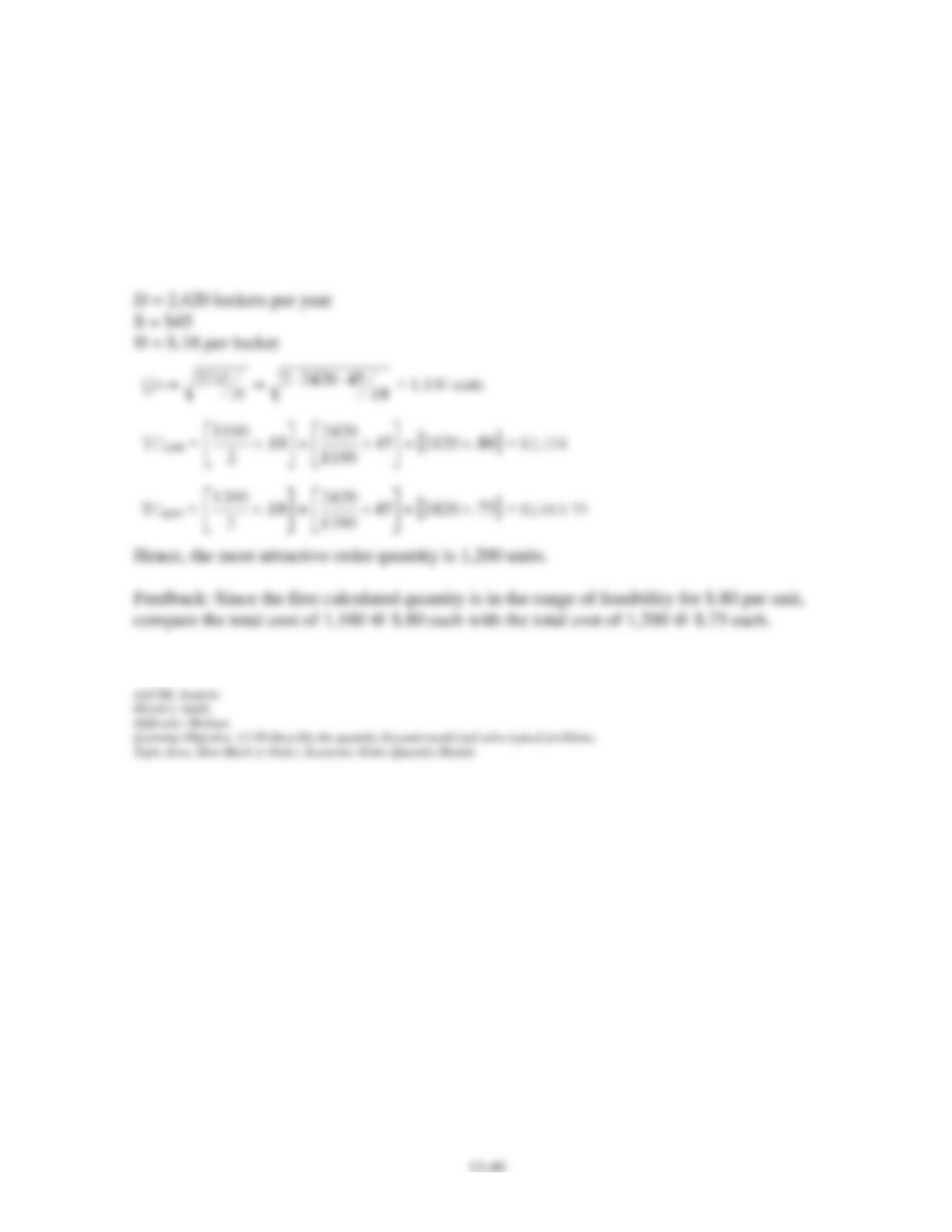
112. Estimated demand for gold-filled lockets at Sam’s Bargain Jewelry and Housewares is
2,420 lockets a year. Manager Veronica Winters has indicated that ordering cost is $45, and
that the following price schedule applies: 1 to 599 lockets, $.90 each; 600 to 1,199 lockets,
$.80 each; and 1,200 or more, $.75 each. What order size will minimize total cost if carrying
cost is $.18 per locket on an annual basis?
Chapter 13 – Inventory Management
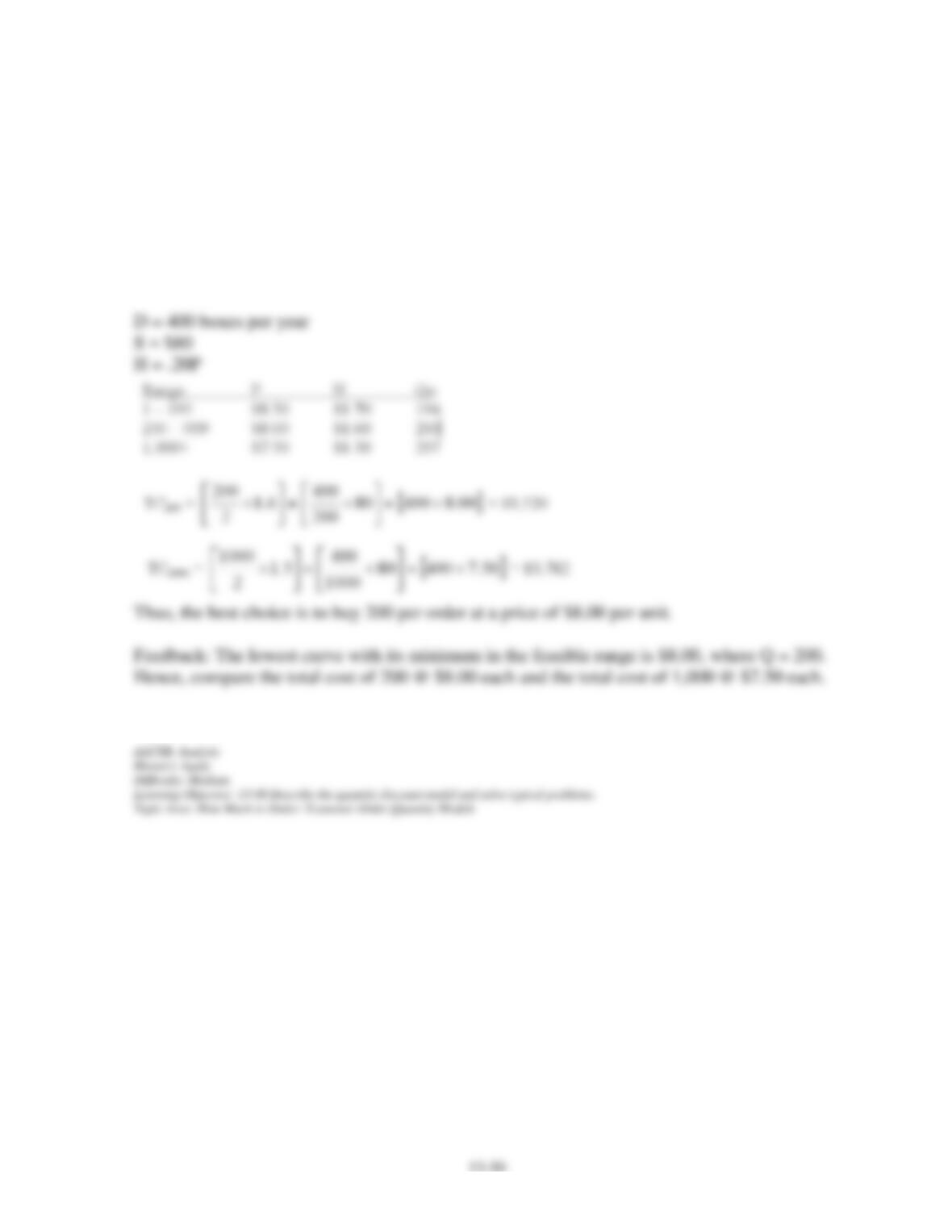
113. Suppose that you are the manager of a production department that uses 400 boxes of
rivets per year. The supplier quotes you a price of $8.50 per box for an order size of 199
boxes or less, a price of $8.00 per box for orders of 200 to 999 boxes, and a price of $7.50 per
box for an order of 1,000 or more boxes. You assign a holding cost of 20 percent of the price
to this inventory. What order quantity would you use if the objective is to minimize total
annual costs of holding, purchasing, and ordering? Assume ordering cost is $80/order.
Chapter 13 – Inventory Management
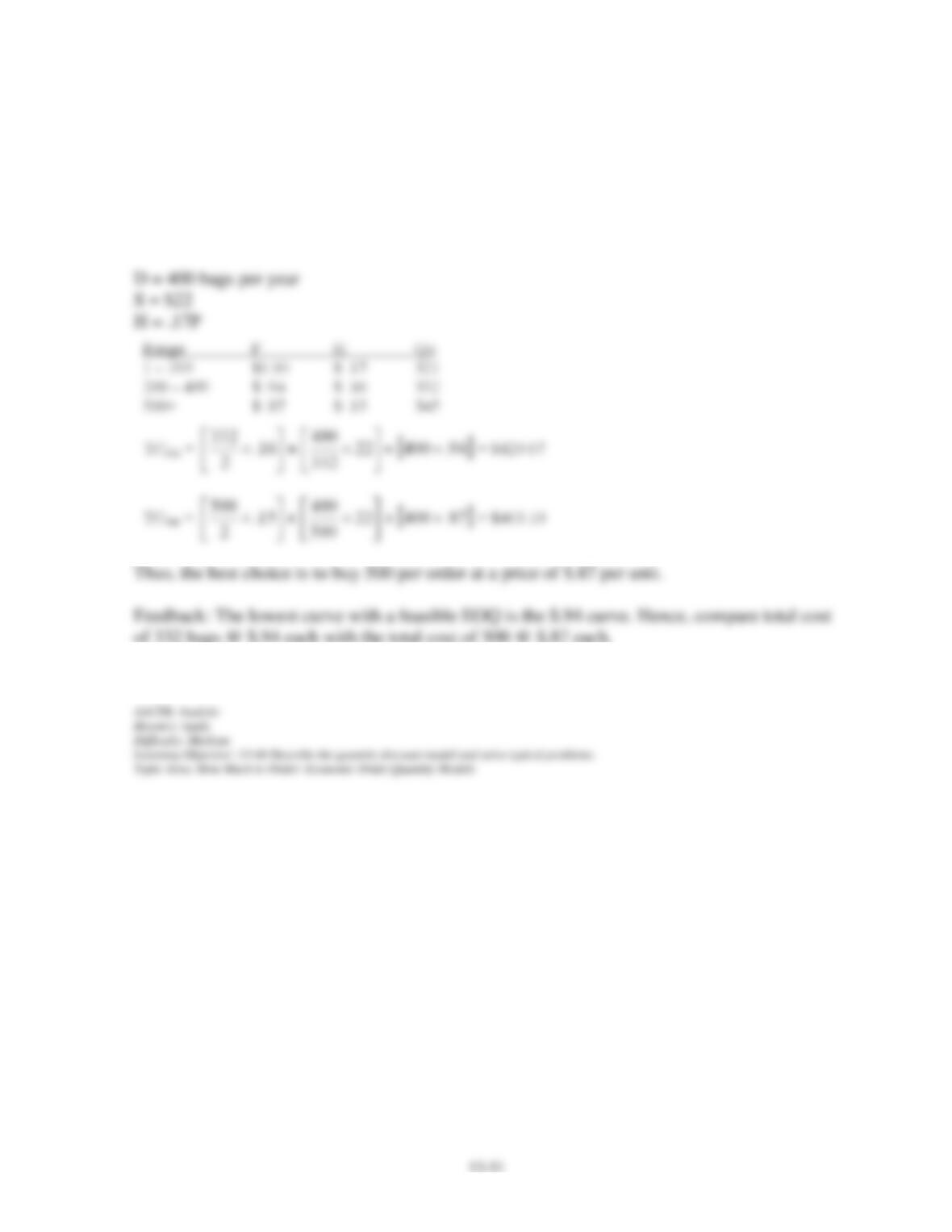
114. The operator of a concession at a downtown location estimates that he will sell 400 bags
of circus peanuts during a month. Carrying costs are 17 percent of unit price and ordering cost
is $22. The price schedule for bags of peanuts is: 1 to 199, $1.00 each; 200 to 499, $.94 each;
and 500 or more $.87 each. What order size would be most economical?
Chapter 13 – Inventory Management
13–52
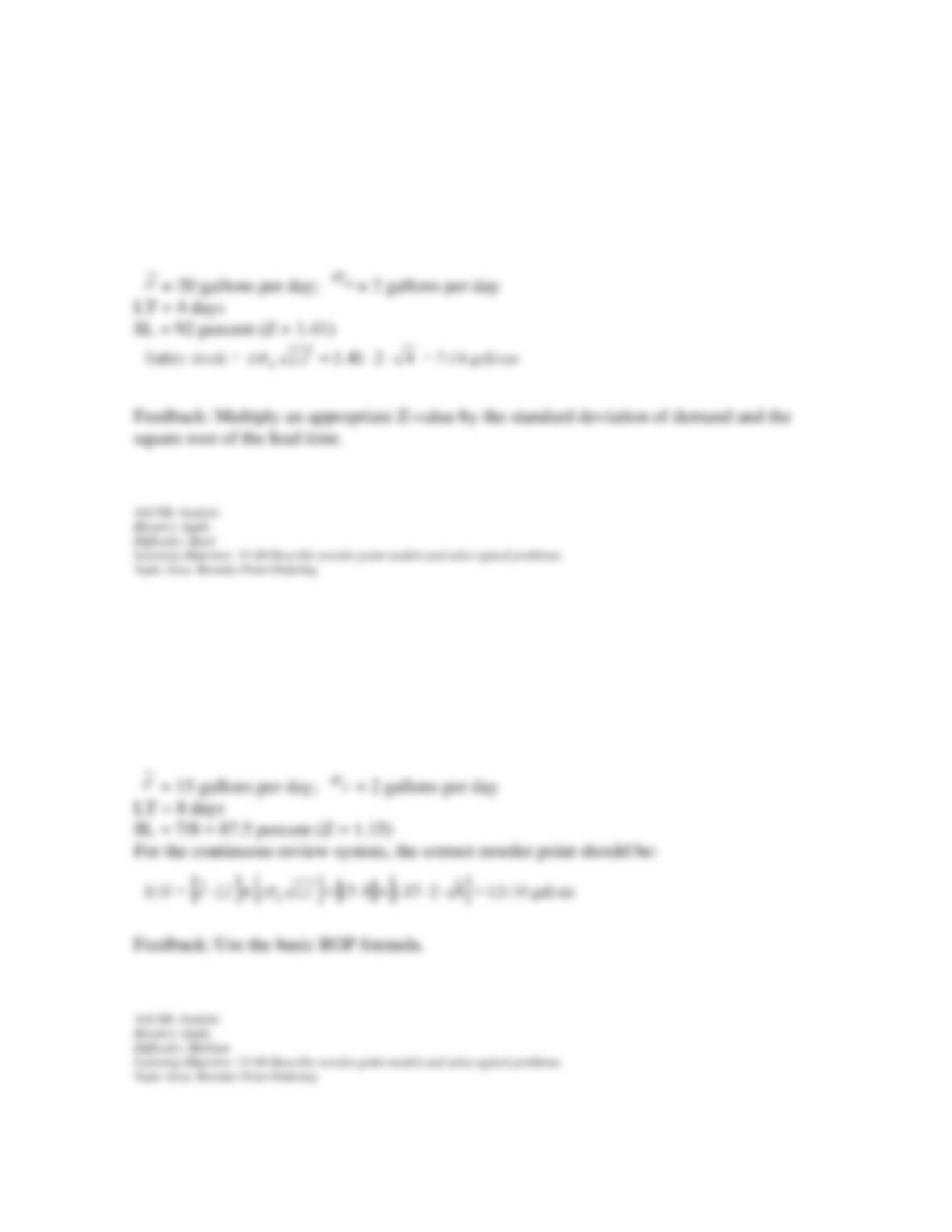
115. A dry cleaning firm uses an average of 20 gallons of cleaning fluid a day. Usage tends to
be normally distributed with a standard deviation of two gallons per day. Lead time is four
days, and the desired service level is 92 percent. What amount of safety stock is appropriate if
a fixed order size of 600 gallons is used?
116. Suppose that usage of cooking oil at Harry’s Fish Fry is normally distributed with an
average of 15 gallons/day and a standard deviation of two gallons/day. Harry has just fired the
manager and taken over operating the restaurant himself. Harry has asked you to help him
decide how to reorder cooking oil in order to achieve a service level which is seven times the
risk of stockout (7/8). Lead time is eight days. Assume that cooking oil can be ordered as
needed.
Chapter 13 – Inventory Management
13–53
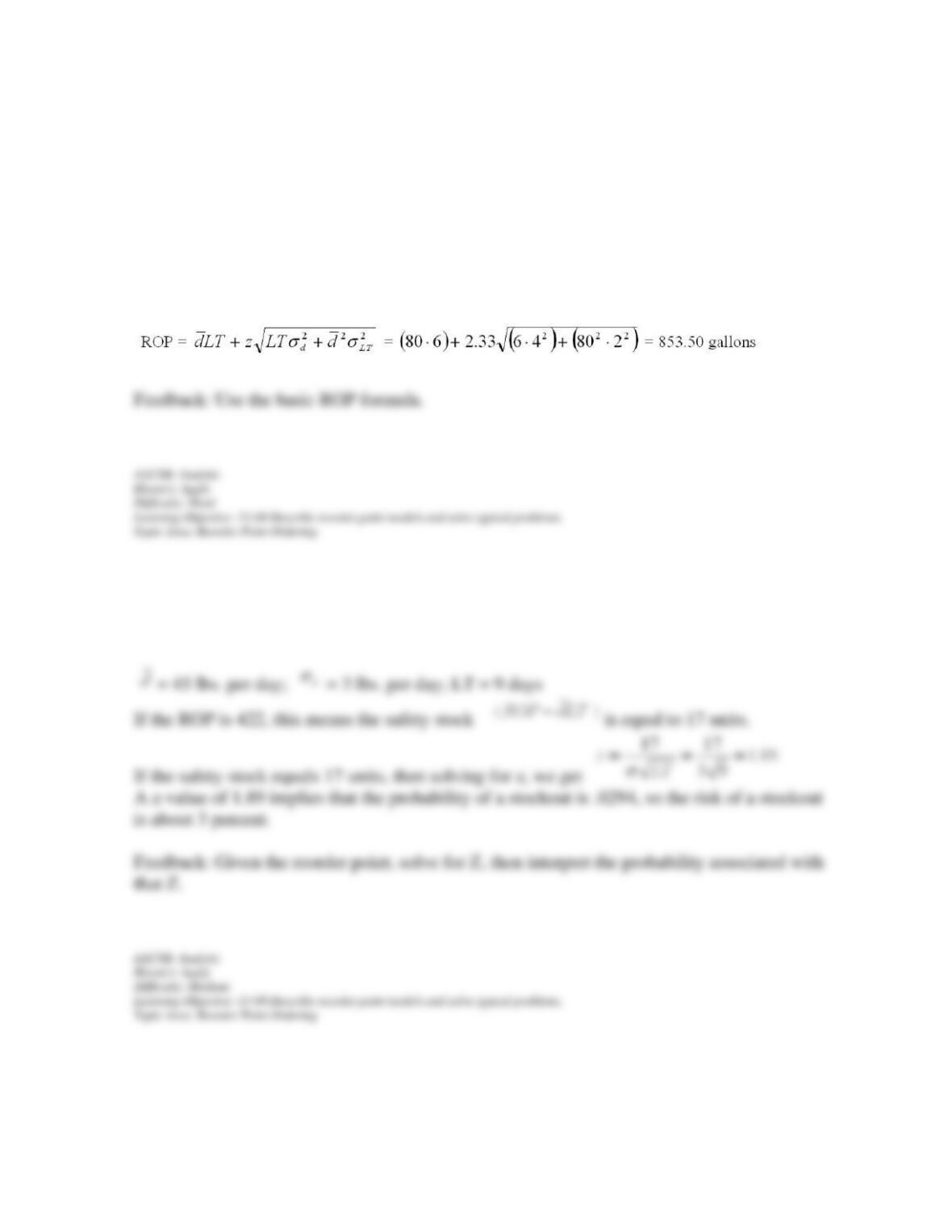
117. A bakery’s use of corn sweetener is normally distributed with a mean of 80 gallons per
day and a standard deviation of four gallons per day. Lead time for delivery of the corn
sweetener is normal with a mean of six days and a standard deviation of two days. If the
manager wants a service level of 99 percent, what reorder point should be used?
For a 99 percent service level, the appropriate z-value is 2.33. Given this, the reorder point
should be:
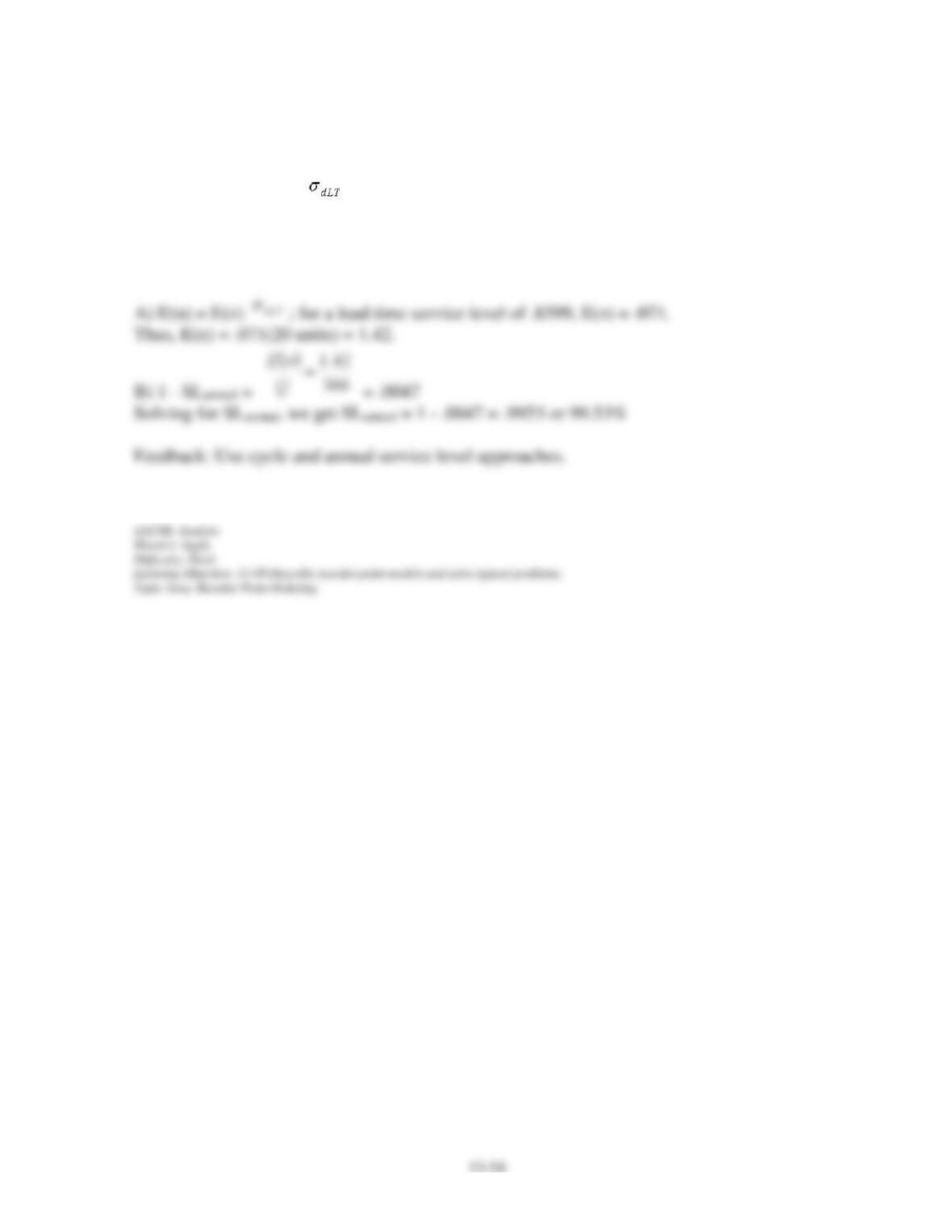
118. A manager reorders lubricant when the amount on-hand reaches 422 pounds. Average
daily usage is 45 pounds, which is normally distributed with a standard deviation of three
pounds per day. Lead time is nine days. What is the risk of a stockout?
Chapter 13 – Inventory Management
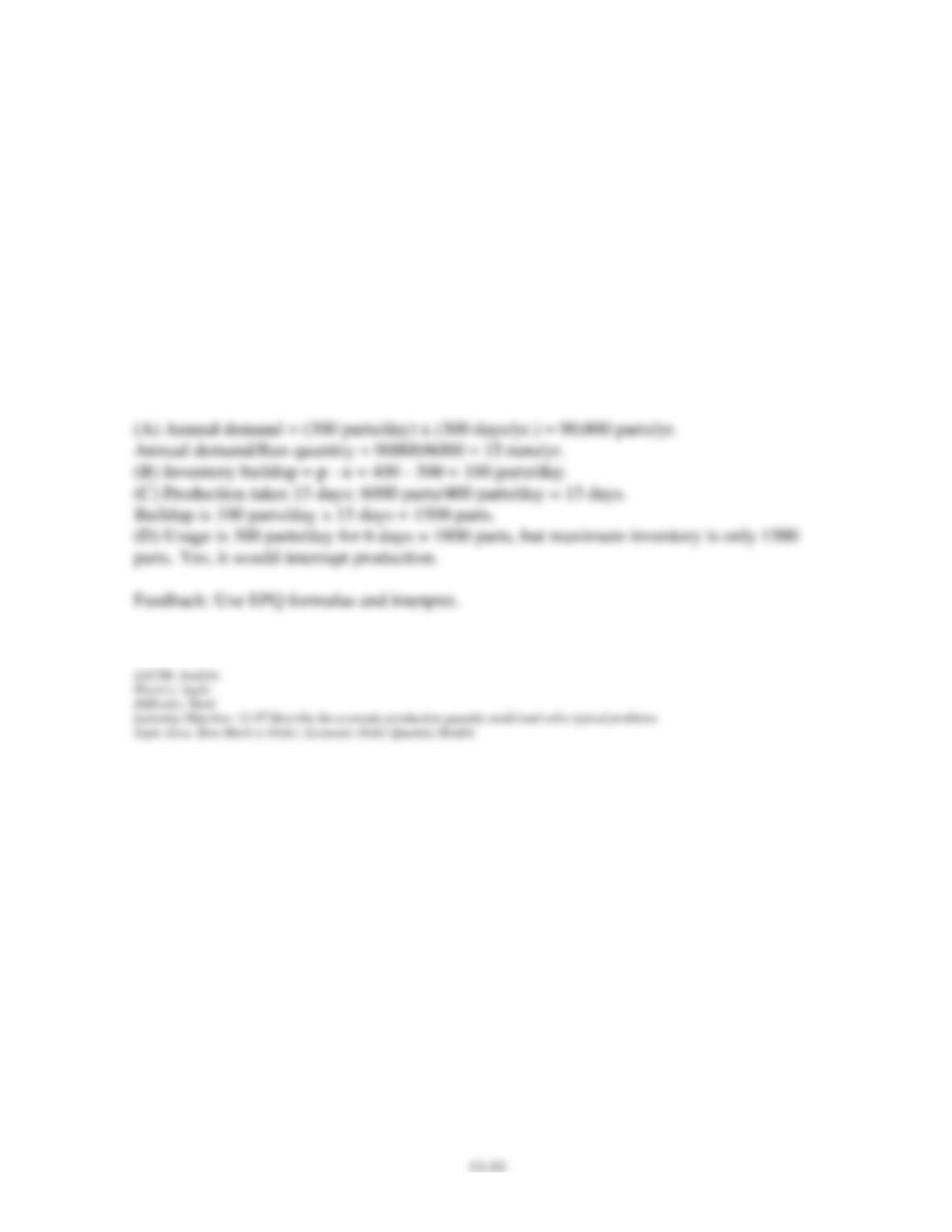
119. Given the following information:
Order quantity = 300; = 20 units; desired lead time service level = .86.
Find:
(A) the expected number of units short per cycle
(B) the annual service level
Chapter 13 – Inventory Management
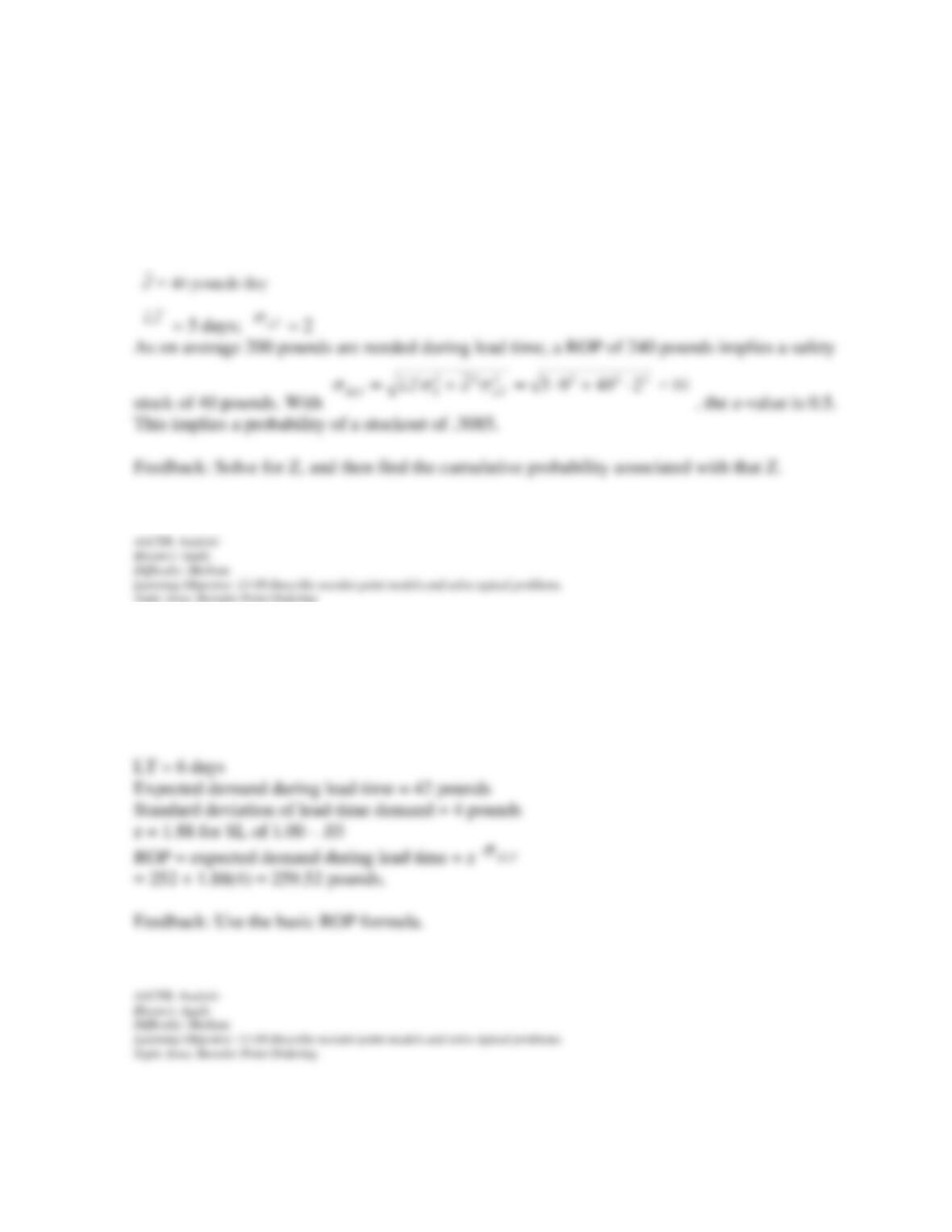
120. A company can produce a part it uses in an assembly operation at the rate of 50 an hour.
The company operates eight hours a day, 300 days a year. Daily usage of the part is 300 parts.
The company uses the part every day. The run size is 6,000 parts. The annual holding cost is
$2 per unit, and setup cost is $100.
(A) How many runs per year will there be?
(B) While production is occurring, how many parts per day are being added to inventory?
(C) Assuming that production begins when there are no parts on hand, what is the maximum
number of parts in inventory?
(D) The machine is dedicated to this product. Every so often, preventive maintenance, which
requires six working days, must be performed on it. Does this interrupt production cycles, or
is there enough time between cycles to perform the maintenance? Explain.
Chapter 13 – Inventory Management
13–56
121. The injection molding department of a company uses 40 pounds of a powder a day.
Inventory is reordered when the amount on hand is 240 pounds. Lead time averages five days.
It is normally distributed and has a standard deviation of two days. What is the probability of
a stockout during lead time?
122. A shop owner uses a reorder point approach to restocking a certain raw material. Lead
time is six days. Usage of the material during lead time is normally distributed with a mean of
42 pounds and a standard deviation of 4 pounds. When should the raw material be reordered if
the acceptable risk of a stockout is 3%?
Chapter 13 – Inventory Management
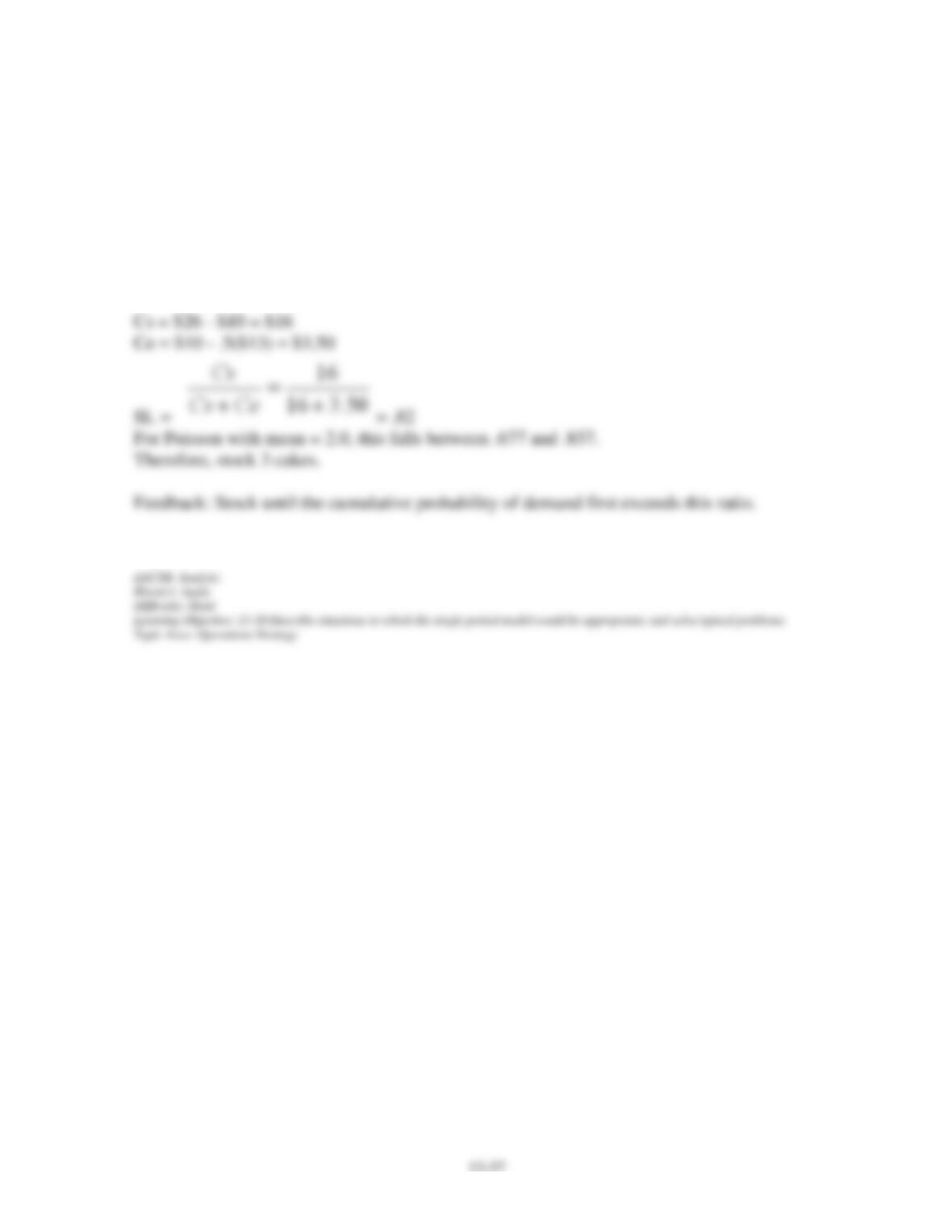
123. The manager of a bakery orders three ‘cake-to-go’ wedding cakes every Saturday to
accommodate last minute purchases. Demand for the cakes can be described by a Poisson
distribution that has a mean of 2. The cakes cost $10 each to prepare, and they sell for $26
each. Any cakes that haven’t been sold by the end of the day are sold for half price the next
day. Usually, half of those are sold and the rest are tossed. What stocking level would be
appropriate?
Chapter 13 – Inventory Management
13–58
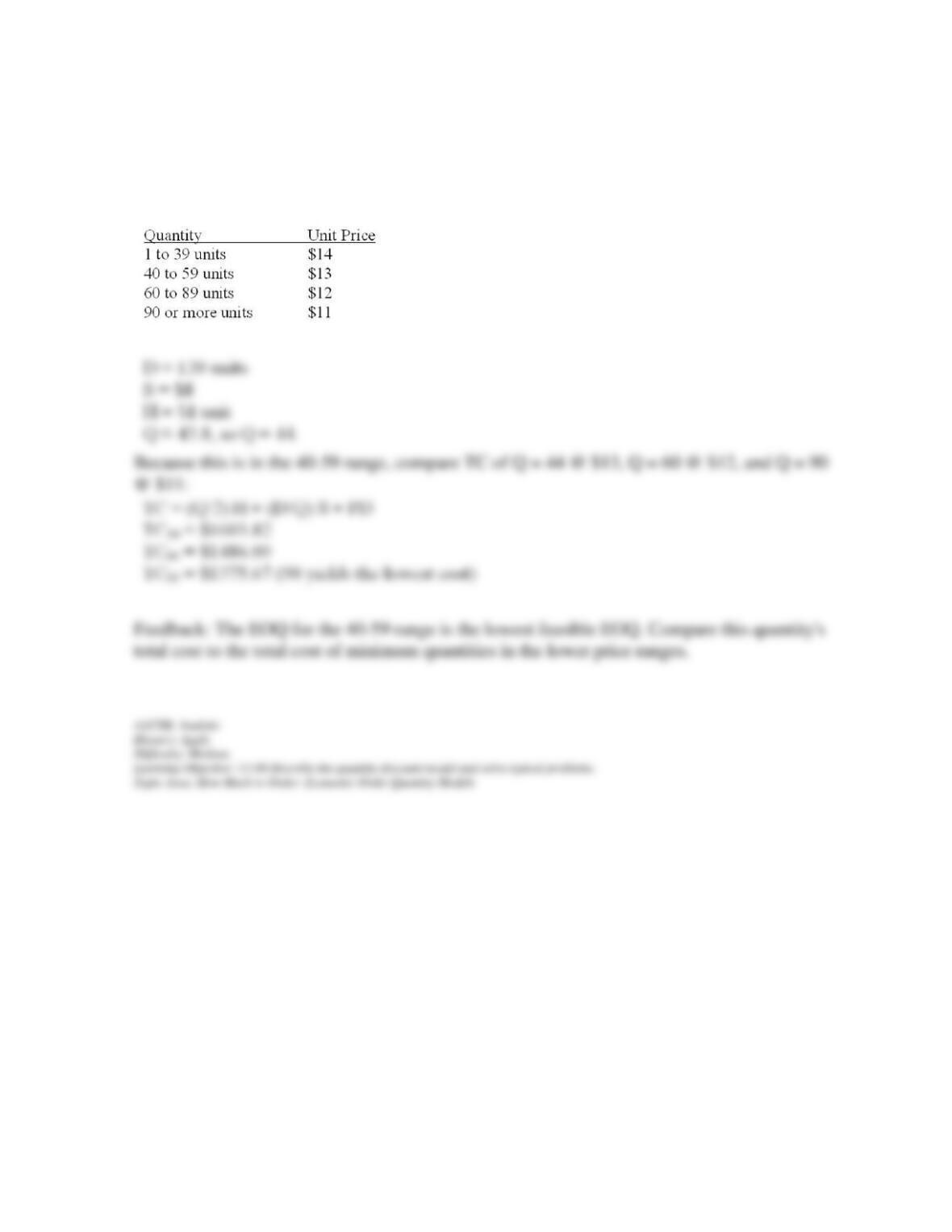
124. A manager has just received a revised price schedule from a vendor. What order quantity
should the manager use in order to minimize total costs? Annual Demand is 120 units,
ordering cost is $8, and annual carrying cost is $1 per unit.
A manufacturer is contemplating a switch from buying to producing a certain item. Setup
cost would be the same as ordering cost. The production rate would be about double the usage
rate.
Chapter 13 – Inventory Management
13–59
125. Compared to the EOQ, the economic production quantity would be approximately:
126. Compared to the EOQ, the maximum inventory would be approximately:
The manager of the Quick Stop Corner Convenience Store (which never closes) sells four
cases of Stein beer each day. Order costs are $8.00 per order, and Stein beer costs $.80 per
six-pack (each case of Stein beer contains four six-packs). Orders arrive three days from the
time they are placed. Daily holding costs are equal to five percent of the cost of the beer.