Introduction to Operations and Supply Chain Management, 4e (Bozarth/Handfield)
Chapter 12S Supply Chain Information Systems
Learning Objective 12S-1
1) All information systems are computer-based.
2) Accuracy is a key performance dimension for strategic decision-making information flows.
3) The purpose of the execution and transaction processing supply chain activities are to record
and retrieve data and execute and control physical and monetary flows.
4) Which of these supply chain activities is the most day-to-day, routine activity?
A) control of monetary flows
B) capacity decision making
C) warehouse location determination
D) workforce leveling
5) Which of these supply chain activities is the most strategic?
A) inventory levelling
B) entering new markets
C) supplier evaluation systems
D) job scheduling
6) A key performance measure for an execution and transaction processing system would be:
A) flexibility.
B) form.
C) function.
D) accuracy.
7) Flexibility is a key performance dimension for information flows in a(n):
A) strategic decision-making activity.
B) global planning activity.
C) routine decision-making activity.
D) execution and transaction processing activity.
8) The three ways information adds value, ranked in order from lowest to highest value are:
A) visibility, mirroring, creation of new customer relationships.
B) mirroring, creation of new customer relationships, visibility.
C) visibility, , creation of new customer relationships, mirroring.
D) creation of new customer relationships, mirroring, visibility.
9) A(n) ________ as a set of interrelated components that collect, process, store, and distribute
information to support decision making, coordination, and control in an organization.
10) The term ________ represents the most basic function of information in the supply chain.
11) ________ takes visibility a step further and seeks to replace certain physical processes with
virtual ones.
12) The third, and most important, way information adds value is by the ________, involves
taking raw information and organizing, selecting, synthesizing, and distributing it.
13) What are the information needs at the four levels (execution and transaction processing,
routine decision making, tactical planning, and strategic decision making) of supply chain
activity?
Learning Objective 12S-2
1) Enterprise resource planning applications span the supplier, customer, and internal supply
chain areas.
2) ERP system’s traditional strengths lie in routine decision making and in execution and
transaction processing.
3) Customer relationship management refers to planning and control activities and information
systems that link a firm with its downstream customers.
4) Internal supply chain management is used to link higher level planning and location decision
making with lower level activities within the same supply chain.
5) Warehouse and transportation planning systems support strategic planning efforts by
allocating fixed logistics capacity in the best possible way, given business requirements.
6) Design collaboration is a typical customer relationship management application.
7) One ERP vendor is known simply as SAP.
8) A supply chain information system that links a company with an entity upstream is called
a(n):
A) customer relationship management system.
B) supplier relationship management system.
C) internal supply chain management system.
D) business process modeling tool.
9) A supply chain information system that is used in the internal supply chain at the strategic
level is a(n):
A) CRM.
B) DSS.
C) ERP.
D) SRM.
10) An execution and transaction processing level system that is used throughout the supply
chain is a(n):
A) CRM system.
B) DS system.
C) ERP system.
D) SRM system.
11) Which of the following statements regarding enterprise resource planning systems is NOT
correct?
A) Most companies using ERP use their system to serve all of the information requirements.
B) The primary advantage of ERP systems is that they pull together all of the classic business
functions into a single, tightly integrated package.
C) All of the business functions running from an ERP system use a common database.
D) Making ERP systems integrate with other applications in a business presents a significant
technological challenge.
12) Logistics information systems that support tactical planning efforts by allocating fixed
logistics capacity in the best possible way given business requirements are known as:
A) decision support systems.
B) network design applications.
C) warehouse management and transportation execution systems.
D) warehouse and transportation planning systems.
13) A typical SRM application is:
A) negotiations.
B) market analysis.
C) order management.
D) service center management.
14) A typical CRM application is:
A) design collaboration.
B) the sell process.
C) sourcing decisions.
D) supply collaboration.
15) Computer-based information systems that allow users to analyze, manipulate, and present
data in a manner that aids higher-level decision making are called ________.
16) A system that controls all aspects of a company’s business from production, through human
resources, to accounting and other departments and accomplishes this with a centralized database
is ________.
17) Long-term strategic questions such as facility location and sizing are addressed by ________.
18) ________ are logistics information systems that initiate and control the movement of
materials between supply chain partners.
19) Warehouse and transportation planning systems support ________ planning efforts.
20) Market analysis, order management, and service center management are all examples of
applications found in a(n) ________ system.
21) What are the functions and relationships between both customer and supplier relationship
management and internal supply chain management?
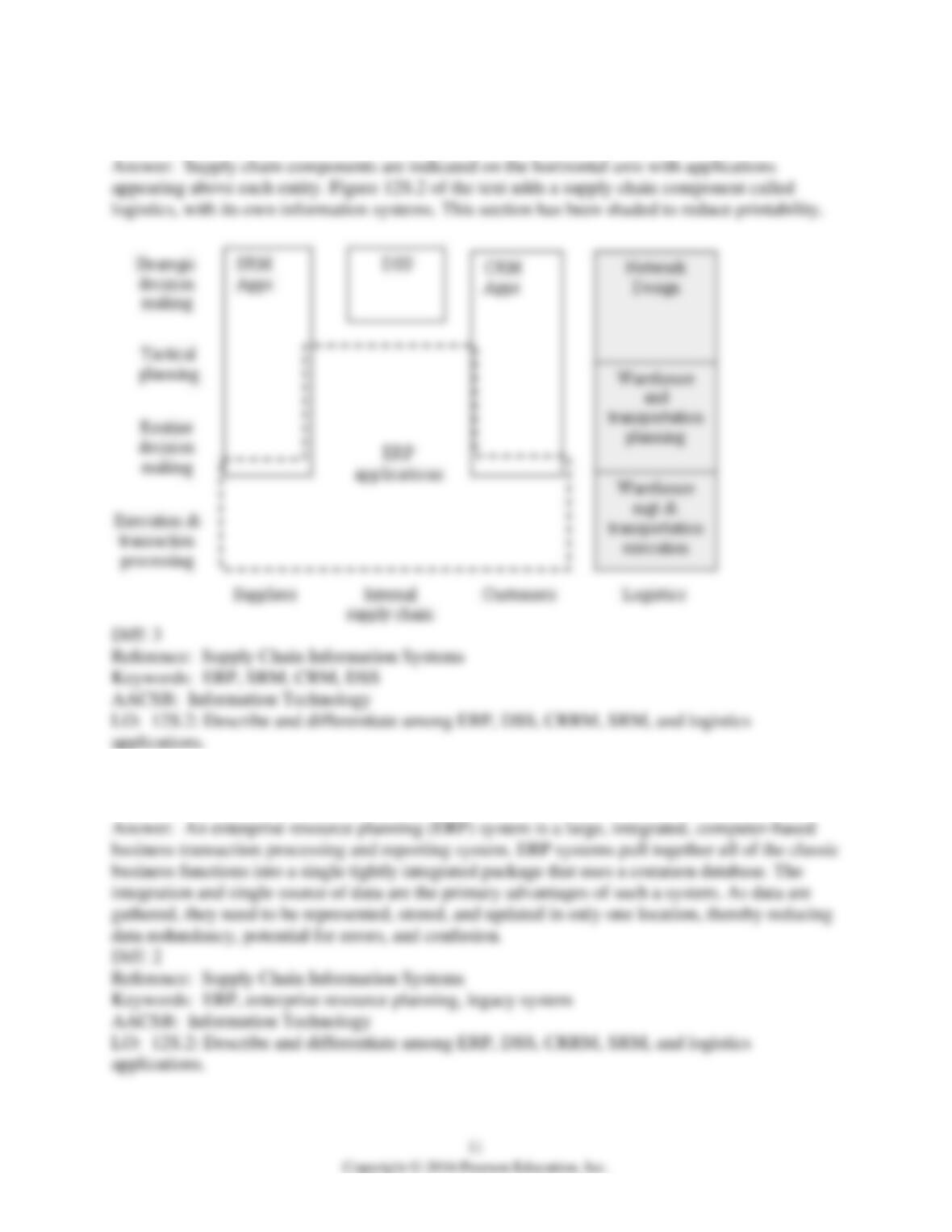
22) Sketch the supply chain and indicate which information systems address which areas of the
supply chain.
23) What is the purpose of an ERP system and what advantages does it hold over the more
traditional system it replaces?
Learning Objective 12S-3
1) Business process modeling tools differ from business process management systems (BPMS)
in that business process modeling tools are aimed at business process analysis and design and
BPMS are used only to manage processes.
2) Before the Internet was widely adopted by business, the vast majority of computer systems
were completely isolated from one another.
3) Before the Internet was widely adopted by business, most computer systems shared a common
database but sharing software was a difficult task.
4) The cloud affords users the ability to rapidly scale capacity up or down depending on demand.
5) The cloud has made it more difficult for firms to outsource portions of their business.
6) One characteristic of cloud computing is that the provider’s computing resources may serve
multiple consumers with the resources dynamically allocated according to customer demand.
7) Which of these is NOT an essential characteristic of the cloud model?
A) preservation of metadata
B) on-demand self-service
C) broad network access
D) resource pooling
8) Which of these is NOT an essential characteristic of the cloud model?
A) rapid elasticity
B) telepresence
C) on-demand self-service
D) resource pooling
9) Which of these is an essential characteristic of the cloud model?
A) distributed intelligence
B) third normal form
C) on-demand self-service
D) hierarchical functionality
10) Which of these is an essential characteristic of the cloud model?
A) distributed intelligence
B) third normal form
C) asynchronous communication
D) resource pooling
11) Which of these is an essential characteristic of the cloud model?
A) broad network access
B) third normal form
C) asynchronous communication
D) address mapping
12) Business process modeling tools allow the user to:
A) connect to the cloud without using the Internet.
B) manage internal supply chain relationships.
C) manage external supply chain relationships.
D) simulate the performance of a new process.
13) An organization can use ________ as a repository to access documents or other files from
anywhere in the world whenever they are needed.
14) At one time, if an organization wanted to automate using a computer system, they had to
develop the program on their own. Today, there is software available to perform virtually every
business function although most of them will not conform exactly to what a company needs.
Describe two software tools that can be used for business process analysis and design.
15) What are the salient features of cloud computing?
16) How will cloud computing impact operations and supply chain management?
17) Provide an example of a business transaction you recently conducted that took place with the
help of the cloud. Describe the front and back office activities that would have been required to
conduct the same business transaction in a pre-cloud business world.
18) The authors make the point that cloud computing has in many respects made life easier for
business and for consumers. Discuss three negative aspects to cloud computing.