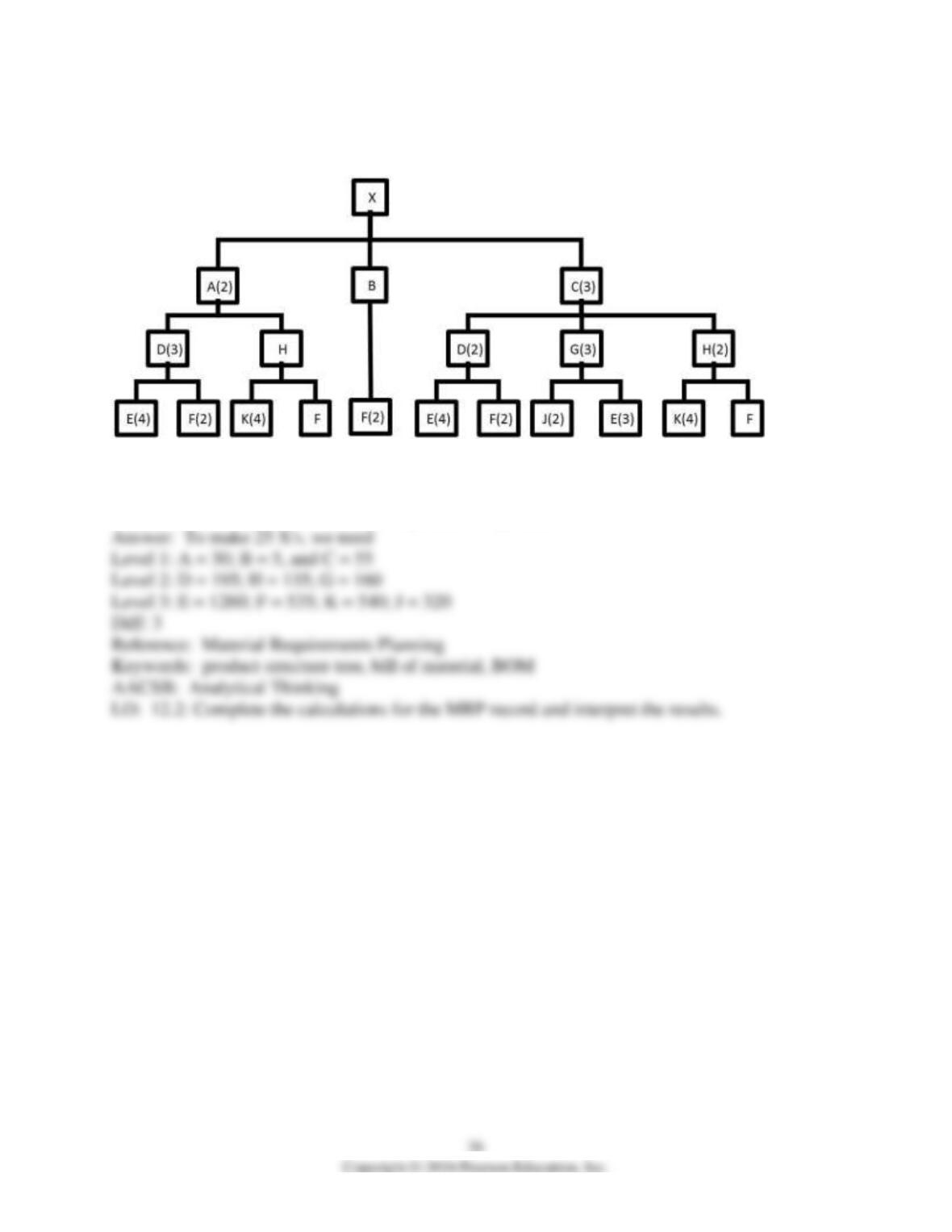
37) Consider the product structure tree shown below:
With a beginning inventory of twenty for all components on level one, five for all components
on level two, and zero for all components on level three and finished items, how many of each
component on level three are needed to produce 25 product X’s?
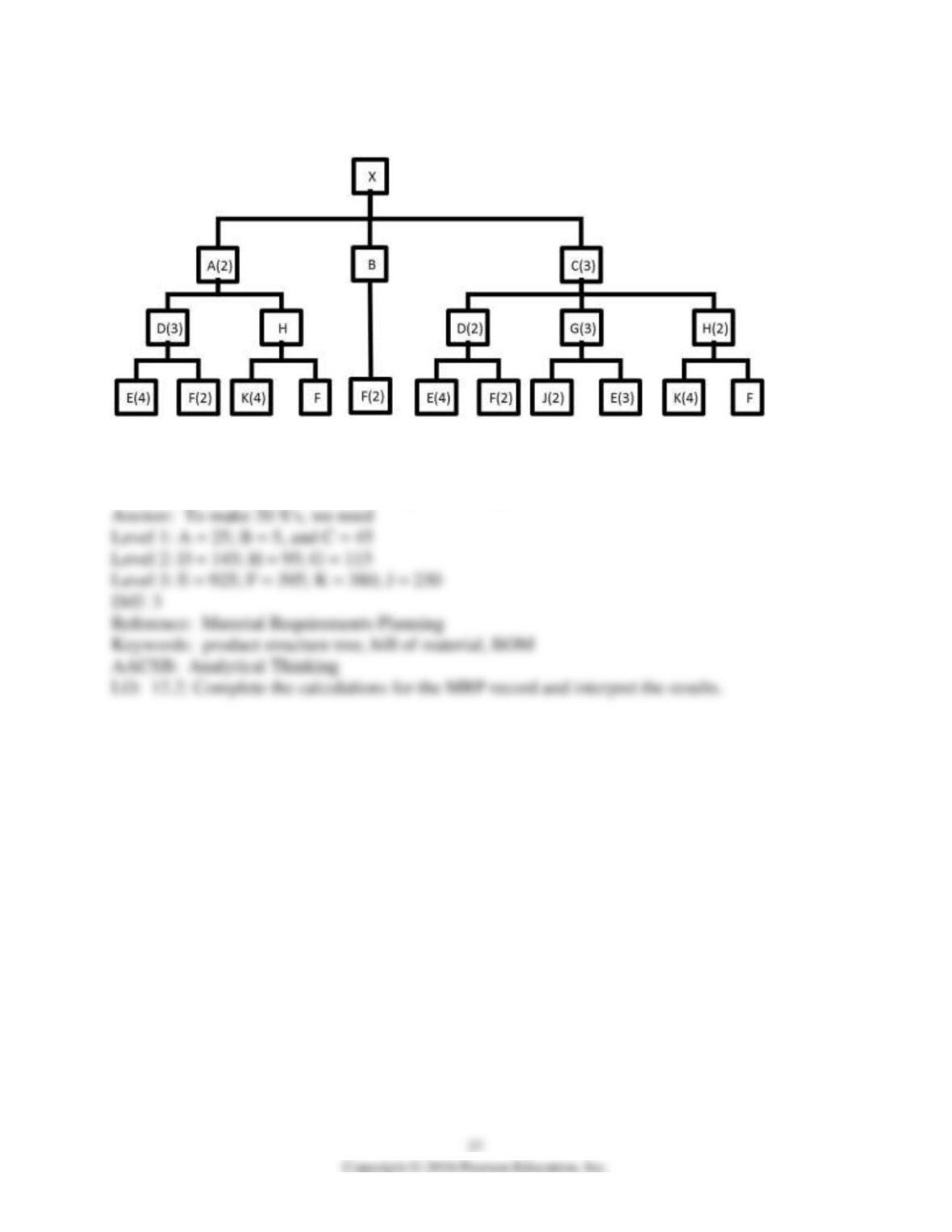
38) Consider the product structure tree shown below:
With a beginning inventory of fifteen for all components on level one, twenty for all components
on level two, and zero for all components on level three and finished items, how many of each
component on level three are needed to produce 20 product X’s?
39) What are three advantages of using an MRP system?
40) What organizational disciplines are required in order for an organization to successfully run a
material requirements planning system?
Learning Objective 12-3
1) If a job has a negative critical ratio then it must be early.
2) RFID tags can be used to trace the movement and location of materials.
3) Using the information in the table, determine a schedule for these five jobs using the critical
ratio sequence.
Job
Process Time
Due Date
A
2
7
B
8
16
C
4
4
D
10
17
E
5
15
A) C-D-B-E-A
B) A-C-E-B-D
C) C-A-E-B-D
D) A-D-B-E-C
4) Calculate the average lateness using the earliest due date criterion to determine the schedule
for these five jobs.
Job
Process Time
Due Date
A
2
7
B
8
16
C
4
4
D
10
17
E
5
15
A) 3
B) 10
C) 12.4
D) 14
5) What is the average lateness of these seven jobs if they are scheduled using the critical ratio
criterion?
Job
Process Time
Due Date
Job 1
15
23
Job 2
7
15
Job 3
12
34
Job 4
8
16
Job 5
11
27
Job 6
10
19
Job 7
13
28
A) 24.3
B) 21.7
C) 22.5
D) 23.4
6) What is the average lateness of these seven jobs if they are scheduled using the earliest due
date criterion?
Job
Process Time
Due Date
Job 1
15
23
Job 2
7
15
Job 3
12
34
Job 4
8
16
Job 5
11
27
Job 6
10
19
Job 7
13
28
A) 19.2
B) 18.7
C) 17.8
D) 16.5
7) What are the third, fourth, and fifth jobs in a critical ratio sequence?
Job
Process Time
Due Date
Job 1
15
23
Job 2
7
15
Job 3
12
34
Job 4
8
16
Job 5
11
27
Job 6
10
19
Job 7
13
28
A) Job 6, Job 5, Job 2
B) Job 2, Job 5, Job 7
C) Job 6, Job 4, Job 7
D) Job 4, Job 2, Job 7

8) For a given job, the amount of processing time remaining divided by the amount of time until
the job is due is its ________.
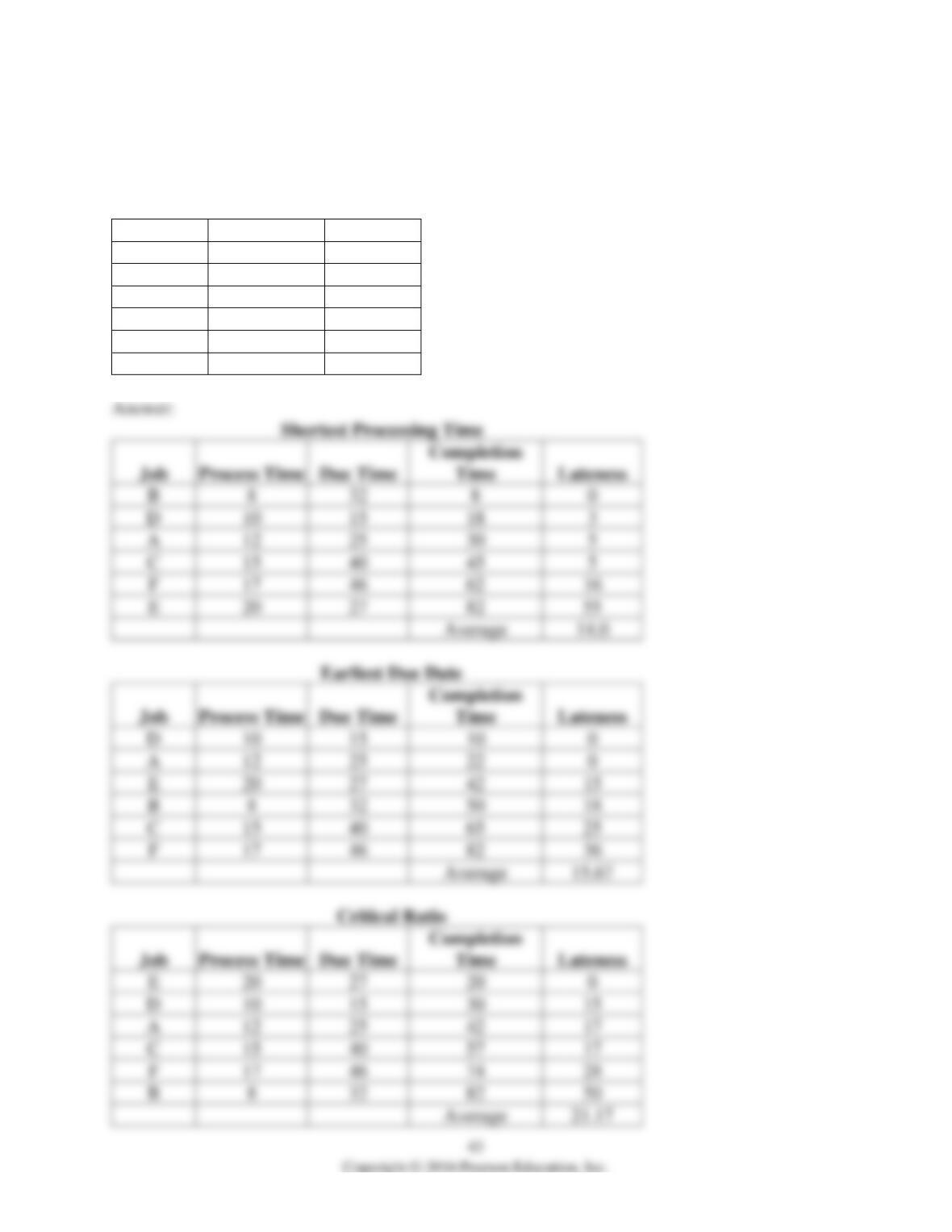
9) There are six jobs that are awaiting processing at a machining center. The jobs are shown in
the table with their processing time and scheduled completion time. Schedule the jobs by earliest
due date, shortest processing time and the critical ratio rule and calculate average lateness for all
the jobs. Which scheduling technique performs BEST?
Job
Process Time
Due Time
A
12
25
B
8
32
C
15
40
D
10
15
E
20
27
F
17
46
32
15
25
40
46
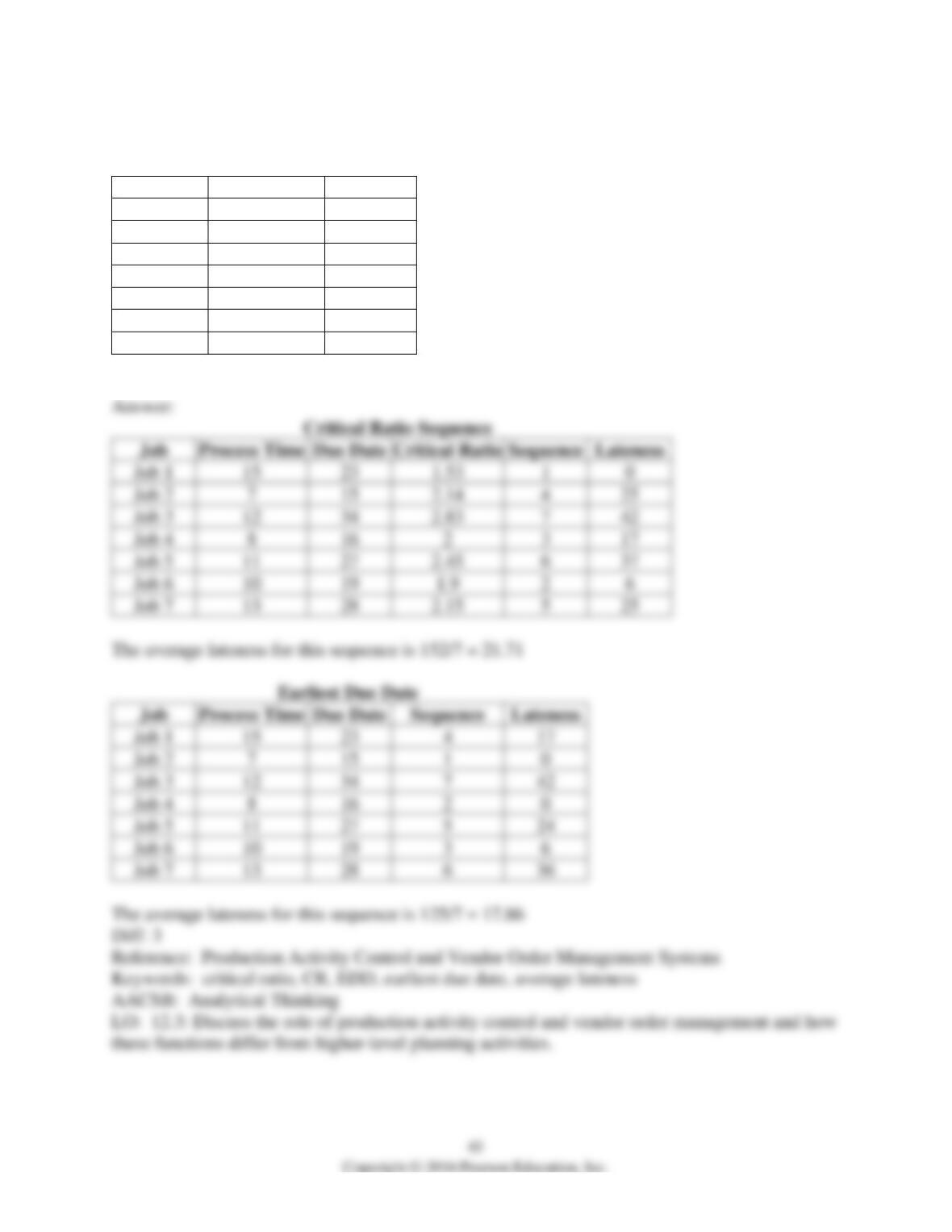
10) Determine a schedule for these jobs using the critical ratio criterion and calculate the average
lateness. Then develop an earliest due date sequence and calculate average lateness.
Job
Process Time
Due Date
Job 1
15
23
Job 2
7
15
Job 3
12
34
Job 4
8
16
Job 5
11
27
Job 6
10
19
Job 7
13
28
Due Date
Sequence
Due Date
Learning Objective 12-4
1) Distribution requirements planning is used to synchronize supply chain partners at the
production activity control level.
2) Distribution requirements planning is identical to material requirements planning except
instead of gross requirements, a DRP record shows forecasted demand.
3) A time-phased planning approach that uses planned orders at the point of demand to
determine forecasted demand at the source level is:
A) RFID.
B) EDD.
C) DRP.
D) MRP.
4) In distribution requirements planning the MRP records do not use the term gross
requirements; instead the amount is shown as:
A) net requirements.
B) total requirements.
C) distributed requirements.
D) forecasted demand.
5) Forecasts in a company using a distribution requirements planning system are typically based
on:
A) historical data from upstream supply partners.
B) historical data from downstream supply partners.
C) upstream supply partners’ requirements.
D) downstream supply partners’ requirements.
6) ________ is a tool that can be used to synchronize supply chain partners at the master
production schedule level.
7) The planned orders entries for members of a DRP system are rolled up into the entry labeled
________ in the distribution requirements planning system.