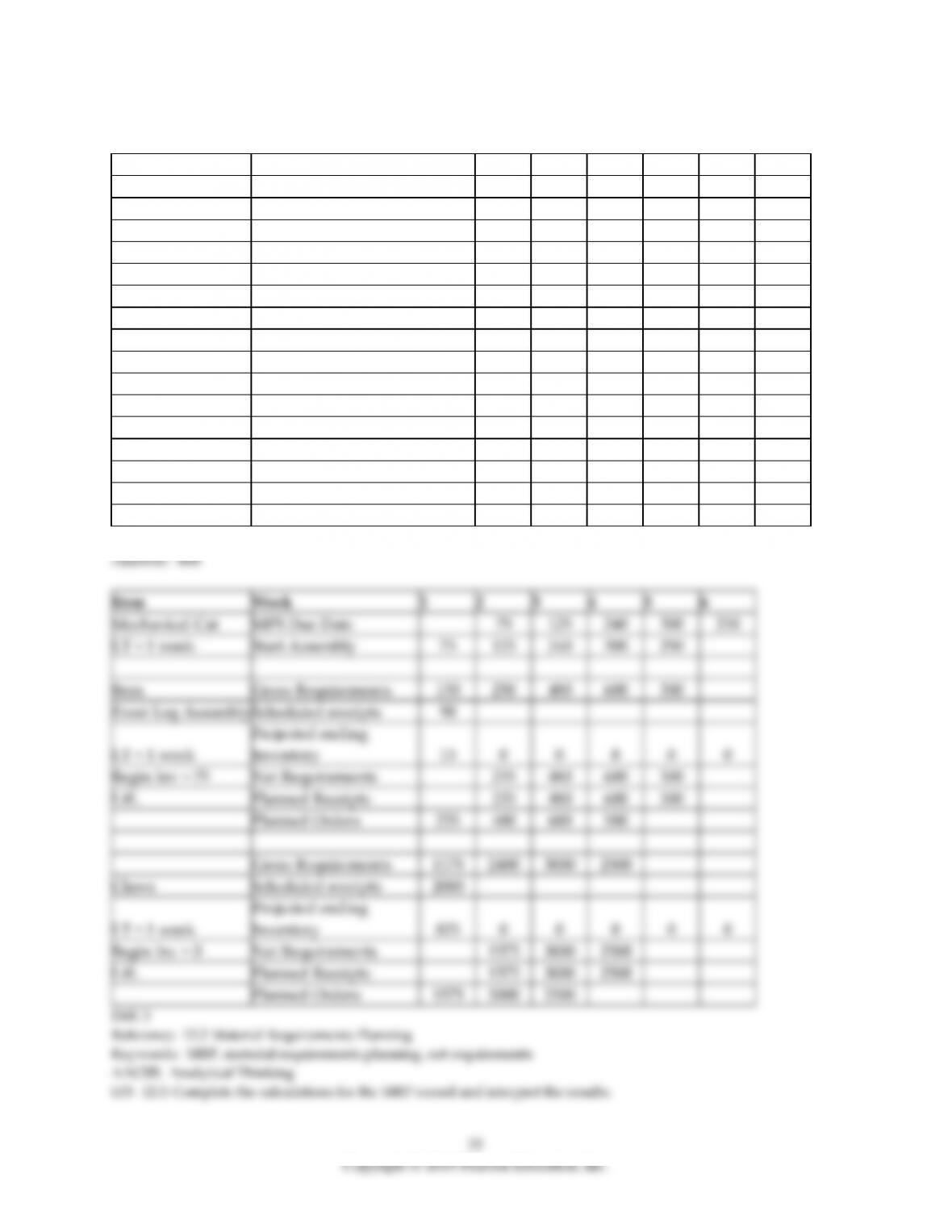
38) What are the net requirements Front Leg Assemblies in Week 4
Item
Week
1
2
3
4
5
6
Mechanical Cat
MPS Due Date
75
125
240
300
250
LT = 1 week
Start Assembly
Item
Gross Requirements
Head Assembly
Scheduled receipts
90
LT = 1 week
Projected ending Inventory
Begin Inv = 100
Net Requirements
Planned Receipts
Planned Orders
Gross Requirements
Whiskers
Scheduled receipts
2000
LT = 1 week
Projected ending Inventory
Begin Inv = 1200
Net Requirements
Planned Receipts
Planned Orders
Mechanical Cat
MPS Due Date
75
LT = 1 week
Start Assembly
75
125
240
300
250
Item
Gross Requirements
150
250
480
600
500
Front Leg Assembly
Scheduled receipts
90
LT = 1 week
Inventory
15
Begin Inv = 75
Net Requirements
Planned Receipts
235
480
600
500
Planned Orders
Gross Requirements
1175
2400
3000
2500
Claws
Scheduled receipts
2000
LT = 1 week
Inventory
Begin Inv = 0
Net Requirements
L4L
Planned Receipts
1575
3000
2500
Planned Orders
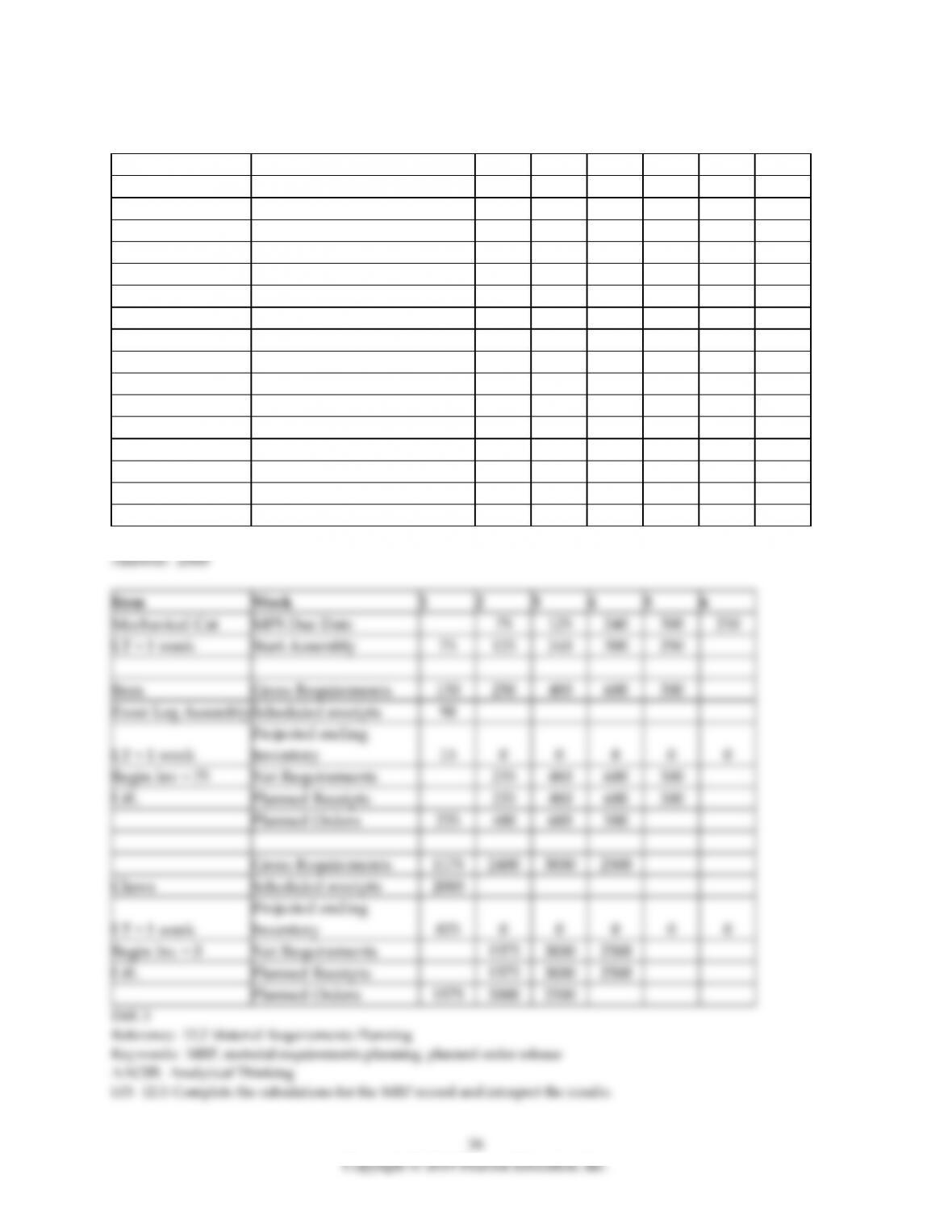
39) What is the Planned order for Front claws in Week 3?
Item
Week
1
2
3
4
5
6
Mechanical Cat
MPS Due Date
75
125
240
300
250
LT = 1 week
Start Assembly
Item
Gross Requirements
Head Assembly
Scheduled receipts
90
LT = 1 week
Projected ending Inventory
Begin Inv = 100
Net Requirements
Planned Receipts
Planned Orders
Gross Requirements
Whiskers
Scheduled receipts
2000
LT = 1 week
Projected ending Inventory
Begin Inv = 1200
Net Requirements
Planned Receipts
Planned Orders
Mechanical Cat
MPS Due Date
75
LT = 1 week
Start Assembly
125
240
300
250
Item
Gross Requirements
150
250
480
600
500
Front Leg Assembly
Scheduled receipts
90
LT = 1 week
Inventory
15
Begin Inv = 75
Net Requirements
L4L
Planned Receipts
235
480
600
500
Planned Orders
Gross Requirements
1175
2400
3000
2500
Claws
Scheduled receipts
2000
LT = 1 week
Inventory
Begin Inv = 0
Net Requirements
L4L
Planned Receipts
1575
3000
2500
Planned Orders
37
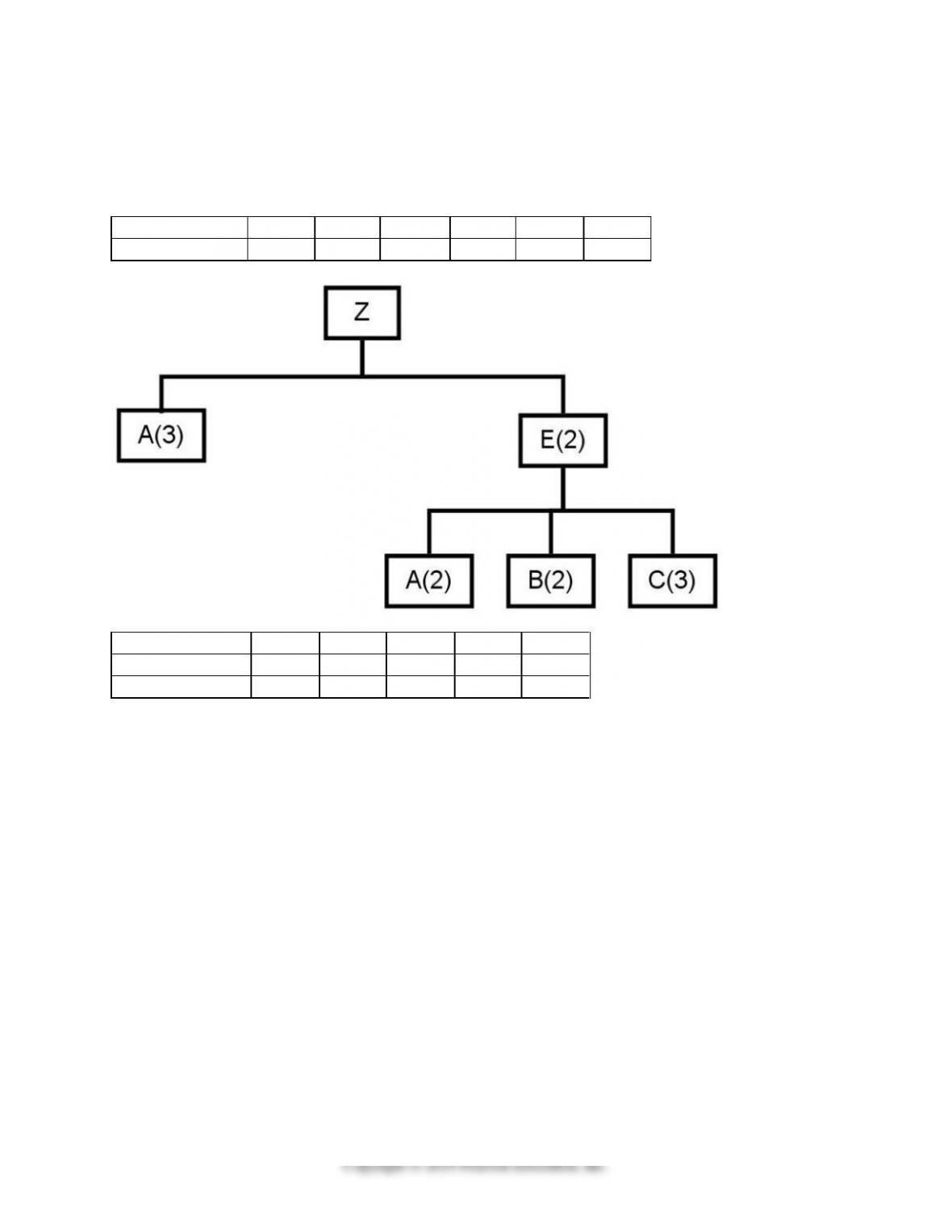
40) The table shows a master schedule for end item Z that is produced according to the product structure
tree shown below. Beginning inventories and lead times for components of Z are given in the table. The
lot sizes for A, B, and C are 100 units and an L4L rule for E. Complete a materials requirement plan for
components A, B, and C.
Period
1
2
3
4
5
6
MPS Qty
0
0
0
250
275
275
Component
A
B
C
D
E
Lead Time
1
2
2
2
1
Beginning Inv
50
75
100
15
40
38
Copyright © 2019 Pearson Education, Inc.
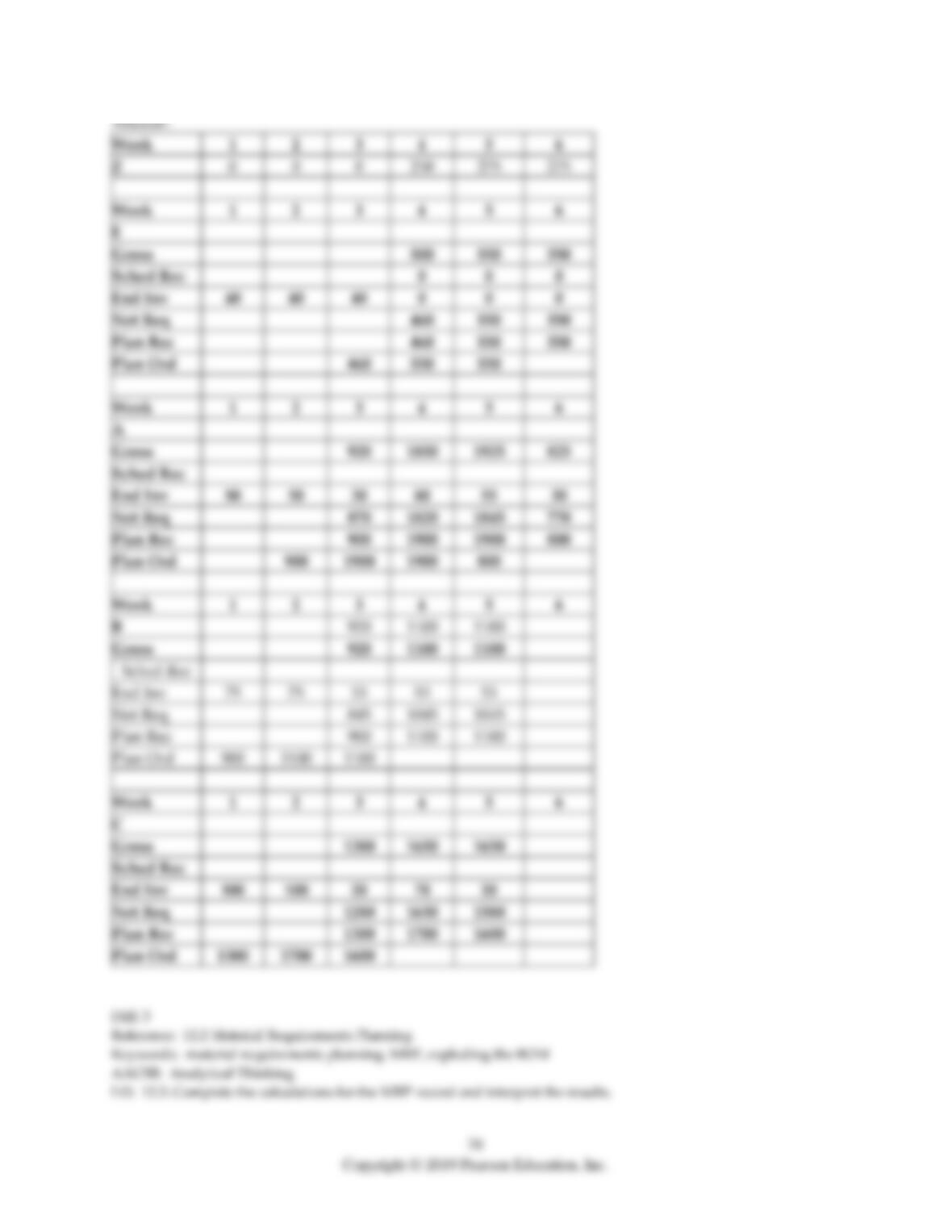
Answer:
Week
1
2
3
4
5
6
Z
0
0
0
250
275
275
Week
1
2
3
4
5
6
E
Gross
500
550
550
Sched Rec
0
0
0
End Inv
40
40
40
0
0
0
Net Req
460
550
550
Plan Rec
460
550
550
Plan Ord
460
550
550
Week
1
2
3
4
5
6
A
Gross
920
1850
1925
825
Sched Rec
End Inv
50
50
30
80
55
30
Net Req
870
1820
1845
770
Plan Rec
900
1900
1900
800
Plan Ord
900
1900
1900
800
Week
1
2
3
4
5
6
B
920
1100
1100
Gross
920
1100
1100
Sched Rec
End Inv
75
75
55
55
55
Net Req
845
1045
1045
Plan Rec
900
1100
1100
Plan Ord
900
1100
1100
Week
1
2
3
4
5
6
C
Gross
1380
1650
1650
Sched Rec
End Inv
100
100
20
70
20
Net Req
1280
1630
1580
Plan Rec
1300
1700
1600
Plan Ord
1300
1700
1600
Diff: 3
Reference: 12.2 Material Requirements Planning
Keywords: material requirements planning, MRP, exploding the BOM
AACSB: Analytical Thinking
LO: 12.5: Complete the calculations for the MRP record and interpret the results.

12.3 Production Activity Control and Vendor Order Management Systems
1) Using the information in the table, determine a schedule for these five jobs using the critical ratio
sequence.
Job
Process Time
Due Date
A
2
7
B
8
16
C
4
4
D
10
17
E
5
15
A) C-D-B-E-A
B) A-C-E-B-D
C) C-A-E-B-D
D) A-D-B-E-C
2) Calculate the average lateness using the earliest due date criterion to determine the schedule for these
five jobs.
Job
Process Time
Due Date
A
2
7
B
8
16
C
4
4
D
10
17
E
5
15
A) 3
B) 10
C) 12.4
D) 14

3) What is the average lateness of these seven jobs if they are scheduled using the critical ratio criterion?
Job
Process Time
Due Date
Job 1
15
23
Job 2
7
15
Job 3
12
34
Job 4
8
16
Job 5
11
27
Job 6
10
19
Job 7
13
28
A) 24.3
B) 21.7
C) 22.5
D) 23.4
4) What is the average lateness of these seven jobs if they are scheduled using the earliest due date
criterion?
Job
Process Time
Due Date
Job 1
15
23
Job 2
7
15
Job 3
12
34
Job 4
8
16
Job 5
11
27
Job 6
10
19
Job 7
13
28
A) 19.2
B) 18.7
C) 17.8
D) 16.5

5) What are the third, fourth, and fifth jobs in a critical ratio sequence?
Job
Process Time
Due Date
Job 1
15
23
Job 2
7
15
Job 3
12
34
Job 4
8
16
Job 5
11
27
Job 6
10
19
Job 7
13
28
A) Job 6, Job 5, Job 2
B) Job 2, Job 5, Job 7
C) Job 6, Job 4, Job 7
D) Job 4, Job 2, Job 7
6) There were five jobs left before Saba could call it quits after a distinguished 30-year career in higher
education. If he decides to do them in EDD order, what is the average lateness?
Job
Process Time
Due Date
Job 1
12
23
Job 2
21
44
Job 3
18
34
Job 4
17
38
Job 5
11
27
A) 12.4
B) 9.4
C) 10.4
D) 11.4

7) There were five jobs left before Saba could call it quits after a distinguished 30–year career in higher
education. If he decides to do them in critical ratio order, what is the average lateness?
Job
Process Time
Due Date
Job 1
12
23
Job 2
21
44
Job 3
18
34
Job 4
17
38
Job 5
11
27
A) 18.2
B) 19.7
C) 19.2
D) 18.7
8) If a job has a negative critical ratio then it must be early.
9) RFID tags can be used to trace the movement and location of materials.
10) For a given job, the amount of time until the job is due divided by the amount of processing time
remaining is its ________.

11) There are six jobs that are awaiting processing at a machining center. The jobs are shown in the table
with their processing time and scheduled completion time. Schedule the jobs by earliest due date and the
critical ratio rule and calculate average lateness for all the jobs. Which scheduling technique performs
BEST?
Job
Process Time
Due Time
A
12
25
B
8
32
C
15
40
D
10
15
E
20
27
F
17
46

12) Determine a schedule for these jobs using the critical ratio criterion and calculate the average lateness.
Then develop an earliest due date sequence and calculate average lateness.
Job
Process Time
Due Date
Job 1
15
23
Job 2
7
15
Job 3
12
34
Job 4
8
16
Job 5
11
27
Job 6
10
19
Job 7
13
28

13) Determine a schedule for these jobs using the critical ratio criterion and calculate the average lateness.
Then develop an earliest due date sequence and calculate average lateness.
Job
Process Time
Due Date
Job 1
15
23
Job 2
7
15
Job 3
12
34
Job 4
17
28
Job 5
11
27

12.4 Synchronizing Planning and Control Across the Supply Chain
1) A time-phased planning approach that uses planned orders at the point of demand to determine
forecasted demand at the source level is:
A) RFID.
B) EDD.
C) DRP.
D) MRP.
2) In distribution requirements planning the MRP records do not use the term gross requirements;
instead the amount is shown as:
A) net requirements.
B) total requirements.
C) distributed requirements.
D) forecasted demand.
3) Forecasts in a company using a distribution requirements planning system are typically based on:
A) historical data from upstream supply partners.
B) historical data from downstream supply partners.
C) upstream supply partners’ requirements.
D) downstream supply partners’ requirements.
4) Distribution requirements planning is used to synchronize supply chain partners at the production
activity control level.
5) Distribution requirements planning is identical to material requirements planning except instead of
gross requirements, a DRP record shows forecasted demand.
6) ________ is a tool that can be used to synchronize supply chain partners at the master production level.
7) The planned orders entries for members of a DRP system are rolled up into the entry labeled ________
in the distribution requirements planning system.
8) What is DRP and how does a typical system work?