
C H A P T E R 1 2
The Employment Agreement
TRUE-FALSE QUESTIONS
1. Around half the states originally followed the employment–at-will rule.
2. A private-sector employee can avoid at-will status by negotiating a contract that provides for a specific term
of employment and defines how the contract can be terminated.
3. Even if an individual is an at-will employee, in most states the employer is prohibited from discharging the
employee for a reason that violates public policy.
4. Because federal law preempts the area, states have not enacted legislation regarding drug testing of private
employees.
5. The majority of states have refused to adopt the doctrine of self-publication to support a cause of action for
defamation.
6. The ban of the Fifth Amendment to the U.S. Constitution on unreasonable searches and seizures applies only
to governmental activity.
7. The WARN act requires employers to give employees at least 120 days advance notice of a plant closure
affecting at least 50 employees.

8. Because of sufficient federal protection, states have not enacted laws addressing illegal immigration.
9. The federal Sarbanes-Oxley Act removed several federal whistleblower provisions applicable to
nongovernment employees.
10. Rights under the Employee Polygraph Protection Act can be waived in advance by the employee.
11. The Patient Protection and Affordable Care Act prohibits insurers from denying health-care coverage or
charging higher premiums due to preexisting conditions.
12. States vary in their willingness to enforce noncompete agreements.
13. The Employee Polygraph Protection Act completely bans the use of polygraph exams.
14. The National Labor Relations Act prohibits employers from discriminating against any employee to
encourage or discourage membership in any labor organization.
15. Payment of workers’ compensation is based on fault.

174 MANAGERS AND THE LEGAL ENVIRONMENT
16. The Fair Labor Standards act does not limit the number of hours that an employee may work in a workweek
or workday, as long as the employee is paid appropriate overtime.
17. State and local governments are prohibited from complying with the overtime provisions of the Fair Labor
Standards Act by giving employees compensatory time in lieu of overtime pay.
18. The Occupational Safety and Health Administration (OSHA) has safety requirements but no requirements
regarding recordkeeping.
19. Pursuant to federal law, states have the same rules in place in regard to implied contracts of employment.
20. The National Labor Relations Act prohibits employers from interrogating employees about union sentiment
or activity.
MULTIPLE-CHOICE QUESTIONS
1. What type of statutes protect employees who report illegal activities going on within their company?
A. Reporting statutes.
B. Revealing statutes.
C. Discovery statutes.
D. Whistleblower statutes.
2. Which of the following are generally not subject to the employment-at-will rule?
A. Public employees

CHAPTER 12 THE EMPLOYMENT AGREEMENT 175
B. Employees who have express employment contracts for a fixed term and public employees
C. Public employees and union employees
D. Public employees, employees who have express employment contracts for a fixed term, and union
employees
3. Which of the following provides whistleblower protection for employees who provide information of
illegality to the SEC?
A. The Employee Retirement and Protection Income Security Act
B. The Dodd-Frank Wall Street Reform and Consumer Protection Act.
C. The Wagner Act
D. The SEC Accountability and Reform Act to Protect Consumer Investors
4. What did the U.S. Supreme Court rule regarding the drug testing of U.S. Customs Service employees in line
for transfer or promotion to certain sensitive positions involving drug interdiction or the handling of firearms?
A. That drug testing would be allowed only if the government could establish evidence of a drug
problem among that group of customs employees.
B. That the drug testing was illegal and unconstitutional.
C. That the drug testing was justified by the need for national security and by the extraordinary
safety hazards attendant to the positions involved.
D. That the drug testing would be allowed because the customs employees, as public employees,
had no greater rights than private employees.
5. Assuming a jurisdiction permits noncompete agreements, which of the following is considered in
determining whether restrictions are reasonable?
A. The duration of limitations
B. Geographic limitations
C. The scope of the activities prohibited and the duration of any limitations
D. The duration of limitations, geographic limitations, and the scope of the activities prohibited
6. Which of the following purport to give an employer the right to recoup some or all of an employee’s stock
option gain if he or she goes to work for a competitor within a certain period of time following exercise of the
option?
A. Climb back provisions
B. Incline clauses
C. Let loose clauses
D. Clawback provisions

176 MANAGERS AND THE LEGAL ENVIRONMENT
7. In states that apply the doctrine of ________, a defamatory statement by an employer to an employee may
constitute publication where it is foreseeable that the employee would be required to repeat it.
A. tort law
B. self-publication
C. slander
D. libel
8. The federal agency responsible for enforcing the provisions of the Occupational Safety and Health Act is
A. the Occupational Safety and Health Administration
B. the Safe Workplace Administration
C. the Health in the Workplace Administration
E. the Federal Employment Oversight Administration
9. Which of the following is true regarding genetic testing by employers?
A. There is a federal law prohibiting all employers from firing employees based on genetic information.
B. There is no federal law prohibiting employers from firing employees based on genetic information, but
many states have laws prohibiting the firing of employees based on genetic information.
C. There is a federal law prohibiting employers of health care workers form firing employees based on
genetic information, but other than that, employers are not subject to any limitations.
D. There is a federal law prohibiting employers of over a certain number of employees from firing
employees based on genetic information.
10. Which of the following is true regarding private employer monitoring of employee e-mail on company-owned
equipment?
A. There is a federal law prohibiting private employers from monitoring employee e-mail on company–
owned equipment.
B. Most states have state laws prohibiting private employers from monitoring employee e-mail on company-
owned equipment.
C. Most states allow private employers to monitor employee e-mail on company-owned equipment, but
employees must first be warned that the e-mail will be monitored.
D. Most courts have upheld a private employer’s right to monitor employee e-mail on company-owned
equipment.

11. Which of the following are included within OSHA requirements regarding posting of information?
A. OSHA requires that notices of any potentially dangerous conditions be posted.
B. OSHA requires that any citations for violations be posted.
C. OSHA requires that notices of any potentially dangerous conditions be posted and also that citations for
penalties be posted.
D. OSHA does not have any posting requirements.
12. Which of the following is not typically true of a state workers’ compensation statute?
A. The system is no-fault.
B. The system is based on the principle that the risks of injury in the workplace should be borne by
the state.
C. An employee is entitled to benefits regardless of the level of safety in the work environment.
D. An employee is entitled to benefits regardless of the degree to which the employee’s
carelessness contributed to the incident.
13. A ______ plan is a defined contribution pension plan funded with contributions by the participants or a
combination of participant and employer contributions.
A. 630(b)
B. 401(k)
C. Employee stock ownership
D. Defined benefit pension
14. Which of the following is true regarding compensation for hours worked under the Fair Labor Standards Act
when an employee is asked to be on standby – that is, available to return to work while off duty?
A. If an employee is asked to be on standby, the hours spent on standby will not be counted as hours
worked if the employee is generally free to use the time for his or her own purposes.
B. If an employee is asked to be on standby, the hours spent on standby will be counted as hours
worked for which the employee is entitled to compensation even if the employee is generally free to
use the time for his or her own purposes.
C. If an employee is asked to be on standby, the hours spent on standby will be counted as hours
worked; but the employee is only entitled to one–half of the employee’s regular pay for those hours.
D. If an employee is asked to be on standby, the hours spent on standby will be counted as hours
worked; but the employee is only entitled to three–fourths of the employee’s regular pay for those
hours.

15. The Fair Labor Standards Act requires that, with some exceptions, every employee be paid _________ for
hours worked in excess of _________ hours in a workweek.
A. One and one-half the regular rate of pay, 40
B. Two times the regular rate of pay, 40
C. One and one-half the regular rate of pay, 45
D. Two times the regular rate of pay, 45
16. The first minimum wage was set at
A. $1.00 per hour.
B. $2.50 per hour.
C. Fifty cents per hour.
D. Twenty-five cents per hour.
c17. Which of the following was the federal minimum wage in 2011?
A. $7.25 per hour.
B. $6.55 per hour.
C. $6.25 per hour.
D. $5.00 per hour.
18. Under federal law, it is illegal to employ anyone under the age of _______, except in specified agricultural
occupations.
A. fourteen
B. fifteen
C. sixteen
D. seventeen
19. Employees who must be paid both minimum wage and overtime as required by the Fair Labor Standards Act
are referred to as _________ employees.
A. exempt
B. nonexempt
C. covered
D. accommodated

20. Generally, employees who earn less than _________ per week are automatically considered eligible for
minimum wage and overtime as required by the Fair Labor Standards Act.
A. $240
B. $300
C. $455
D. $550
21. Which of the following federal laws governs most employer-sponsored retirement plans as well as many
other types of employer-sponsored employee benefit plans?
A. The Consolidated Omnibus Budget Reconciliation Act
B. The Employee Retirement Security Act
C. The National Labor Relations Act
D. The Fair Labor Standards Act
22. In a ______, the employer guarantees that the participant will receive an annual benefit for life following
retirement, or the actuarial equivalent of such a benefit, based on a formula in the plan regardless of
contributions made or the plan’s investment performance.
A. Defined contribution pension plan
B. 401(k) plan
C. Employee stock ownership plan
D. Defined benefit pension plan
23. Which of the following is true regarding drug testing of public and private employees by employers?
A. There are greater limits on drug testing in relation to public employees as compared to private employees
because public employees have rights under the U.S. Constitution.
B. There are greater limits on drug testing in relation to public employees as compared to private employees
because private employees have rights under the U.S. Constitution.
C. The limits on drug testing are the same in relation to public and private employees because both categories
of employees have rights under the U.S. Constitution.
D. There are no U.S. Constitutional limits on drug testing in relation to either public or private employees
because neither category has rights under the U.S. Constitution.
24. Employers must complete a(n) _________ form showing verification of the identity and employment
eligibility of all persons hired.

180 MANAGERS AND THE LEGAL ENVIRONMENT
A. A-12
B. I-9
C. Imm.1
D. A1
25. Courts in a minority of states have recognized a bad-faith exception to the at-will employment relationship
called the ______.
A. Implied covenant of good faith and fair dealing
B. Imposed contract of fair treatment
C. Imposed contract of fair treatment and ethical conduct
D. Implied obligation of fairness and ethics
26. Traditionally, defamation law requires ______, meaning that the communicator of the defamatory
information must disclose the information to a third party.
A. utterance
B. publication
C. exposure
D. revelation
27. The ______ prohibits employers from using genetic information to make decisions about hiring, firing, or
compensation.
A. The Family Medical History Act
B. Genetic Prohibition and Protection Act
C. The Privacy in Testing Act
D. Genetic Information Nondiscrimination Act
28. Programs in effect in some states requiring employers to pay employees wages approximating the real cost of
living in the locality are called ______ laws.
A. Real cost
B. Estimated expense
C. Living wage
D. Accurate wage

CHAPTER 12 THE EMPLOYMENT AGREEMENT 181
Fact Pattern 12-1 (Questions 29-30 apply)
Ricardo, an Italian citizen, who is trained in a specialized form of computer programming that is highly in
demand, is interested in coming to work in the U.S. A friend of his told him that he could come to the U.S.,
but that he would not be protected by U.S. employment laws and regulations. Ricardo also understands that a
strictly enforced rule is that he could only work in the U.S. for three years. Ricardo is inclined to come to the
U.S. but would like additional information regarding his rights and the process.
29. Refer to fact pattern 12-1. Which of the following would enable Ricardo to work in the U.S.?
A. A passport
B. An H-1B visa
C. A recognized visa
D. A work permit
30. Refer to fact pattern 12-1. If Ricardo comes to the U.S. to work with appropriate documentation, for how long will he
generally be authorized to work?
A. For up to two years
B. For up to three years
C. For up to six years
D. For up to ten years
31. Roxanne has a serious heart condition. She has worked as an administrator with employer-sponsored health
insurance at Big Company for ten years. She has been offered a great job at Up and Coming Company that
she would like to take. It pays slightly less but has great opportunities for advancement. Up and Coming has
health insurance, but there is a preexisting condition with the insurance excluding coverage for any
preexisting health condition for six months. Roxanne says that if she takes the job at Up and Coming she will
not be able to afford to continue her health insurance from Big Company. Up and Coming wants her to start
immediately. She is in a quandary about what to do. What would you advise her to consider?
A. She should consider relying on the Health Insurance Portability and Accountability Act which would
likely prohibit enforcement of the preexisting condition exclusion.
B. She should consider relying on the Consolidated Omnibus Budget Reconciliation Act which would
require that Big Company pay for the continuation of her insurance through Big Company for six months.
C. She should file for assistance with the insurance payments under the Worker Adjustment and Retraining
Notification Act.
D. She should not take the job with Up and Coming because she cannot afford to take a risk with the
preexisting condition exclusion.
Fact Pattern 12-2 (Questions 32-33 apply)
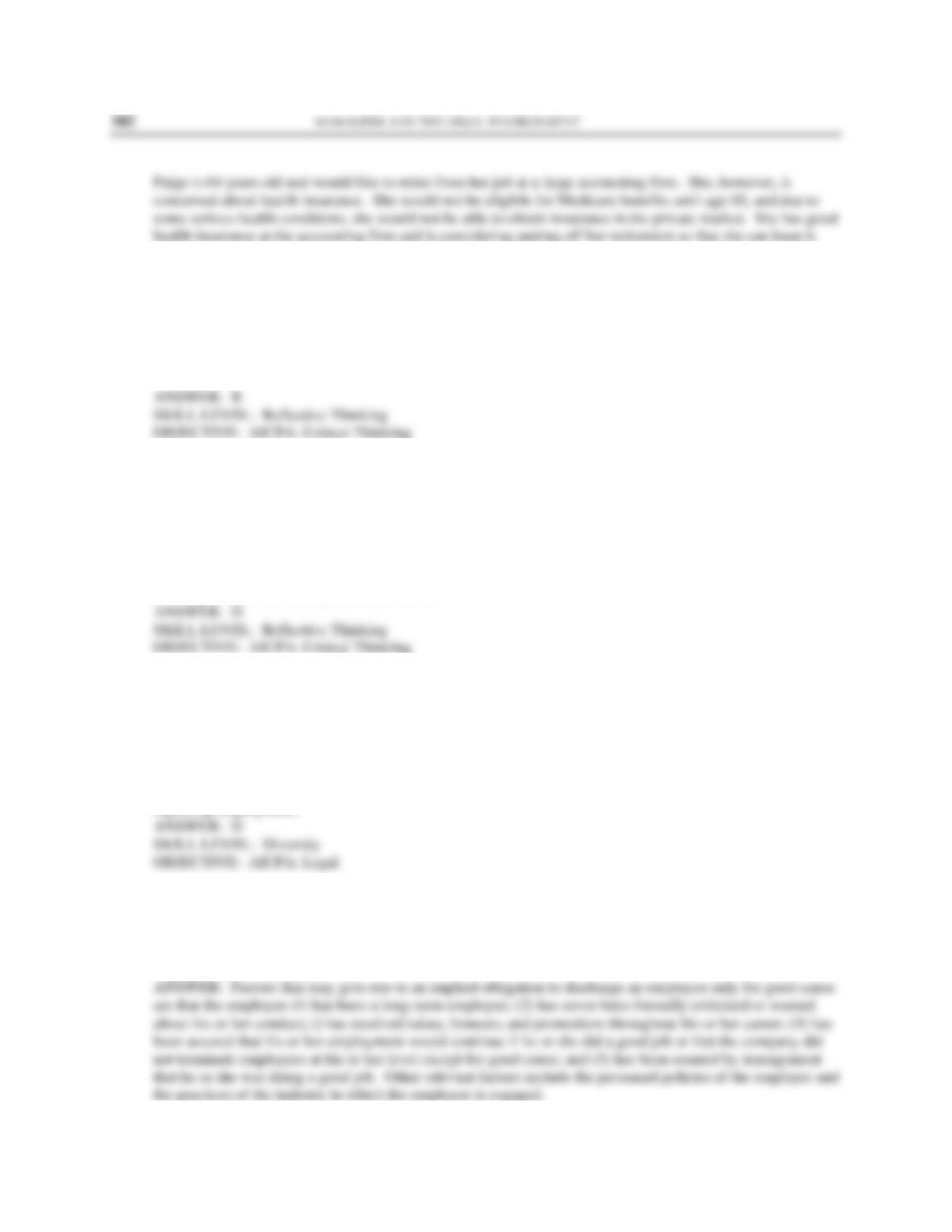
32. Refer to Fact Pattern 12-2. Which of the following would likely enable Paige to keep her insurance with the
accounting firm until she is eligible for Medicare?
A. The Health Insurance Portability and Accountability Act
B. The Consolidated Omnibus Budget Reconciliation Act
C. The Employee Security Act
D. The Insurance Protection Act
33. Refer to Fact Pattern 12-2. Assuming Paige exercises her rights under federal law to maintain her insurance
with the accounting firm upon her resignation, which of the following is true regarding the premiums?
A. The employer would be required to pay all of the premium.
B. The employer would be required to pay for one-half of the premium, and Paige would be required to pay
for one-half.
C. Paige and the employer would pay the premium based upon whatever arrangement was in effect during
her period of employment.
D. Paige would have to pay all the premium.
34. Which of the following is true regarding employment laws within the European Union?
A. The European Union has attempted to bring uniformity to the laws related to termination of employment.
B. No member states of the European Union recognize the U.S. concept of employment at will.
C. The European Union has attempted to bring uniformity to the laws related to termination of employment,
but laws of the United Kingdom provide significantly more benefits and legal protection to employees than
do the employment laws of France.
D. In order to facilitate trade, the European Union has mandated that all member states apply the same laws
regarding employment.
ESSAY QUESTIONS
1. List the factors set forth in the text that may give rise to an implied obligation to discharge the employee only
for good cause in jurisdictions recognizing the contract-based implied contract judicial exception to the
employment-at-will rule.
2. List exceptions, if any, to the Employee Polygraph Protection Act’s ban on polygraph testing.
3. Bertha works for Bad Taste, Inc. She has been employed for over 12 years by the company without a written
employment contract. Last year Bertha was promoted to the position of executive secretary. The company
policy manual issued 6 years ago promises that no employee may be terminated without 2 prior written
warnings regarding poor job performance. Bertha has always received excellent job reviews. Recently the
president resigned and was replaced by Fred, who promised to improve productivity by 20%. Bertha has just
learned from Fred that she is being replaced by Sheila, who was Fred’s former executive secretary. What
claims may Bertha make against Bad Taste, Inc. for wrongful discharge? Does the company have any
defenses? Discuss fully.
4. What standards are applied in regard to judicial review of ERISA decisions by plan administrators?
5. Joe is the owner of a manufacturing company called ProfitMax. Joe finds out that a union is attempting to
organize the employees at ProfitMax. Joe tells you that he will never deal with a union and that he has no
plans to pay a higher wage if the union is elected. Joe has plans to tell his supervisors that they may not
encourage union activity. Joe has plans to do surveillance regarding which employees attend union meetings
so that he can fire them. He is also going to announce to all employees that they will get a raise if they vote
against the union. He asks you what his obligations are if the union gets elected and if his other plans are
legal. He also wants to know what he can expect from his supervisors, some of whom he is suspicious of
supporting the union. What would you tell him?

184 MANAGERS AND THE LEGAL ENVIRONMENT
6. Melody just got out of law school and went to work at Big Law Firm. One of her first assignments is to help
a partner who just got reassigned to the employment law section of the firm. The partner asks her to provide
information regarding the legality of drug testing. What four factors should Melody tell the partner are
considered in determining whether drug testing will be deemed permissible in a particular situation?