
Name:
Class:
Date:
chapter 12
Page 1
Indicate whether the statement is true or false.
1. Typically, a vice president would NOT be considered to hold a high enough position to be included in the top
management team of an organization.
a.
True
b.
False
2. Transformational leadership is the most effective strategic leadership style.
a.
True
b.
False
3. The underlying premise of the balanced scorecard is that firms jeopardize their future performance possibilities when
strategic controls are emphasized at the expense of financial controls.
a.
True
b.
False
4. In the past, companies had a preference for insiders to fill top-level management positions because of the desire for
continuity and a continuing commitment to the firm’s current vision, mission, and chosen strategies.
a.
True
b.
False
5. Because of the current changing competitive landscape and varying levels of performance, an increasing number of
Boards of Directors are turning to insiders to succeed CEOs.
a.
True
b.
False
6. The most critical ability of a strategic leader is the ability to attract and then manage human capital.
a.
True
b.
False
7. The decision-making discretion of top-level managers is determined partly by external environmental factors such as
the industry structure, the industry’s rate of growth, and the degree to which products can be differentiated.
a.
True
b.
False
8. The Chapter 12 Strategic Focus reports on recent successes of NBC News, Nokia, and Standard Charter because of the
top managers’ decisions.
a.
True
b.
False
9. The advantages of long tenure (firm-specific human and social capital, knowledge, and power) seem to outweigh the
disadvantages of rigidity and maintaining the status quo.
a.
True
b.
False
10. The balanced scorecard focuses on both financial and non-financial controls.
a.
True

Name:
Class:
Date:
chapter 12
Page 2
b.
False
11. Criteria such as asset utilization improvements and changes in employee turnover rates are part of the internal business
processes perspective of the balanced scorecard.
a.
True
b.
False
12. For 15 years, Edward was a compensation specialist at a mid-sized firm. He was laid off when the firm experienced
financial setbacks. Edward has decided to open his own business as a compensation consultant to small firms. He can
expect that his main source of human capital will be a bank line of credit.
a.
True
b.
False
13. The firm’s core ideology motivates the firm’s employees through the company‘s heritage.
a.
True
b.
False
14. Organizational culture is a complex set of ideologies, symbols, and core values that are shared throughout the firm, but
its development is so subtle and poorly understood that top managers cannot influence its content.
a.
True
b.
False
15. Strategic leaders are most likely to integrate ethical values into their decisions when the company has explicit ethics
codes that are integrated into the business through extensive ethics training.
a.
True
b.
False
16. Competitive aggressiveness, proactiveness, risk aversion, innovativeness, and autonomy are the five dimensions
characterizing the entrepreneurial mind-set.
a.
True
b.
False
17. In addition to determining new strategic initiatives, top-level managers also develop the appropriate organizational
structure and reward systems of a firm.
a.
True
b.
False
18. An emphasis on strategic controls encourages managers to be risk averse.
a.
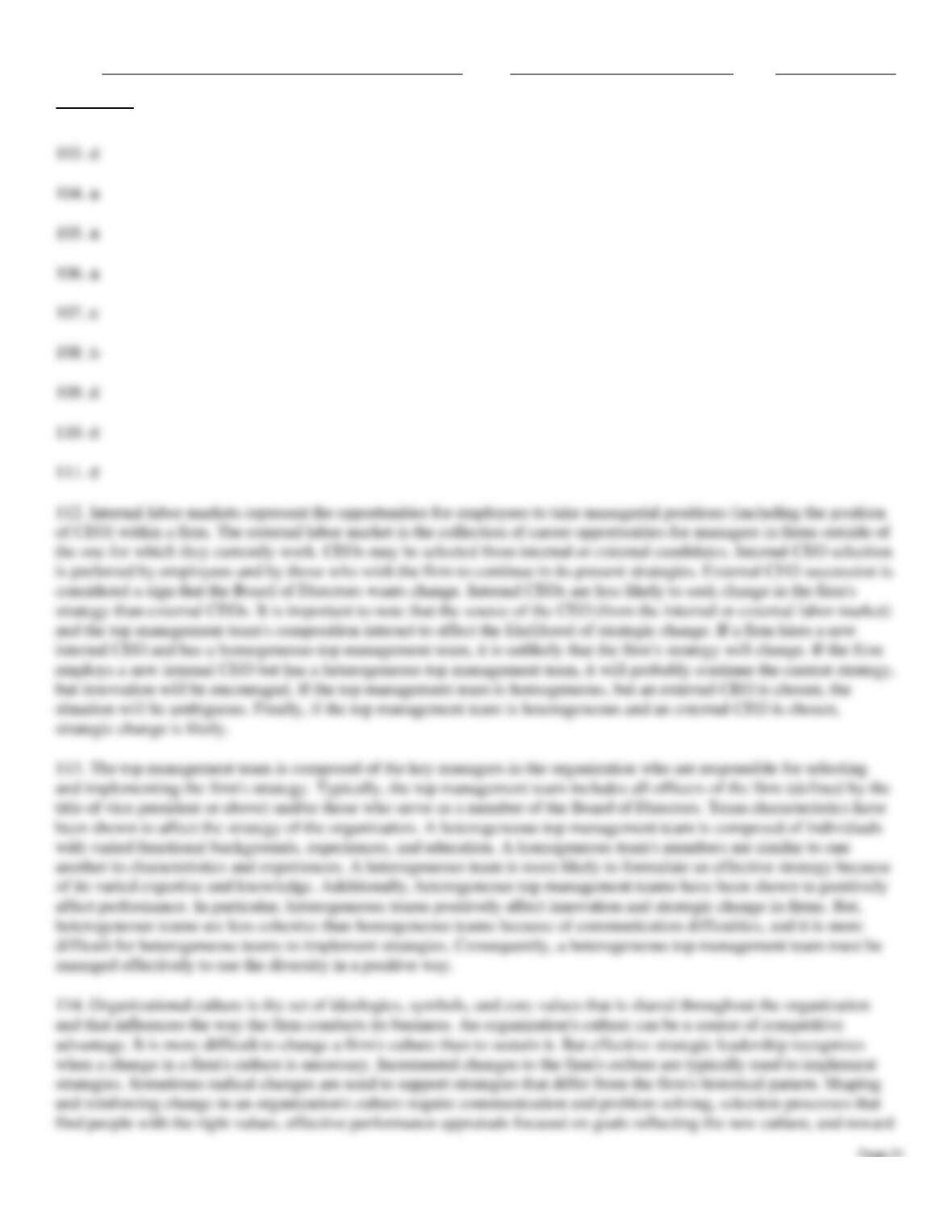
True
b.
False
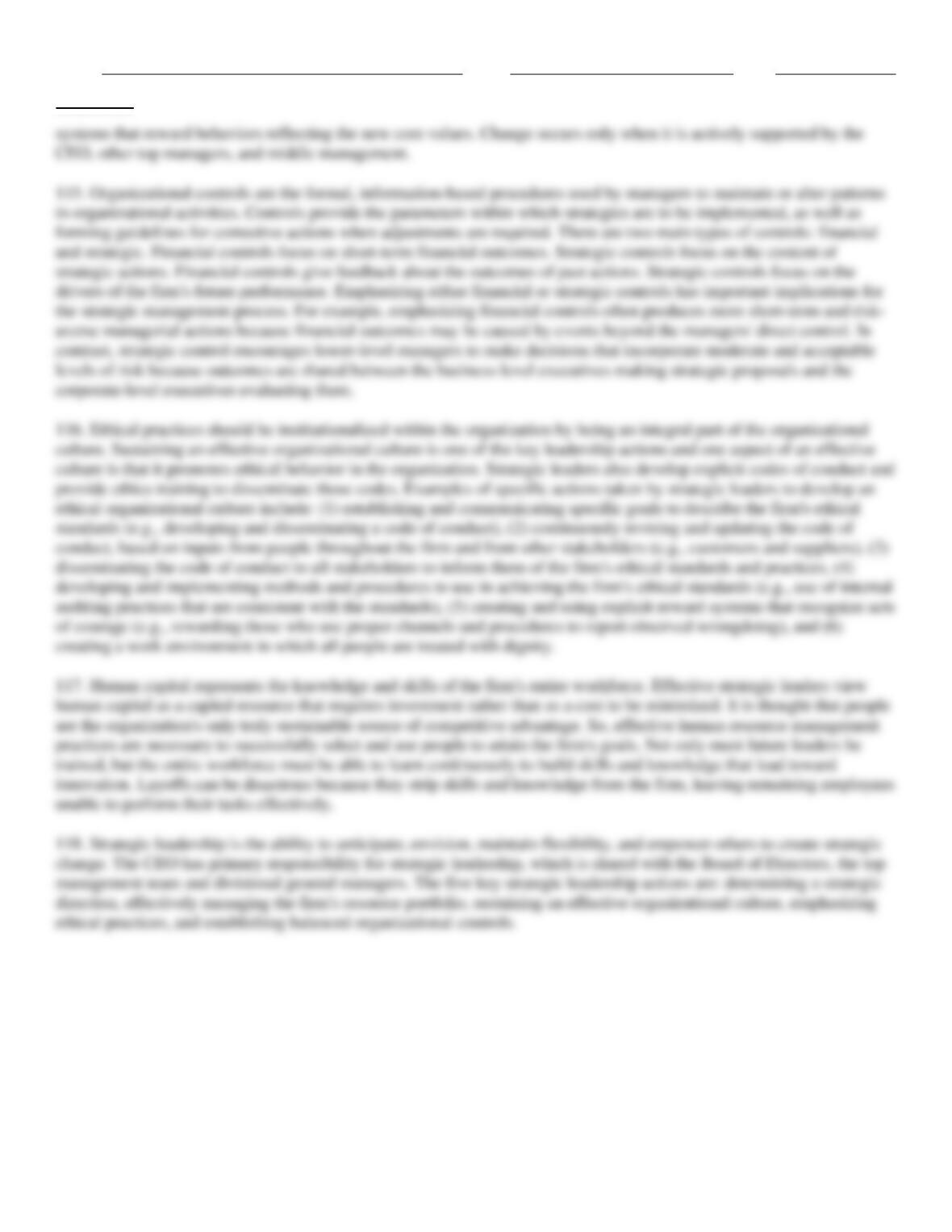
19. Strategic control focuses on the content of strategic actions rather than their outcomes.
a.
True
b.
False
20. As the dynamics of competition accelerate, people are perhaps the only truly sustainable source of competitive
advantage.

Name:
Class:
Date:
chapter 12
Page 3
a.
True
b.
False
21. The CEO is the individual with primary responsibility for effective strategic leadership within an organization.
a.
True
b.
False
22. Financial controls provide feedback about the outcomes of the firm’s past actions and predictions about the results of
the firm’s future actions.
a.
True
b.
False
23. Rewarding those who use proper channels and procedures to report observed wrongdoings is an example of an action
that should be taken by a strategic leader to develop an ethical organizational culture.
a.
True
b.
False
24. Internal labor markets consist of the career opportunities for managers within the firm for which they currently work.
a.
True
b.
False
25. The CEO of YorkMark, Inc., has an exceptional amount of power in the organization. It is likely the Board of
Directors is composed of sympathetic outside members and insiders who report to the CEO.
a.
True
b.
False
26. The more homogeneous a top management team, the more likely those managers will be innovative and willing to
pursue strategic change.
a.
True
b.
False
27. Employees usually have a strong preference for firms to use the internal managerial labor market when selecting top
management team members and the CEO.
a.
True
b.
False
28. Selection of an insider as a new CEO indicates a firm’s desire to encourage innovation and strategic change.
a.
True
b.
False
29. Strategic leadership is the ability to anticipate, envision, maintain flexibility, and empower others to create strategic
change as necessary.
a.
True
b.
False
30. Including talent from both the internal and external labor markets increases the likelihood that the firm will be able to
form an effective top management team.

Name:
Class:
Date:
chapter 12
Page 4
a.
True
b.
False
31. To influence employees’ judgment and behavior, ethical practices must shape the firm’s decision-making process, but
should be a peripheral part of organizational culture.
a.
True
b.
False
32. Firm size, firm age, the executive’s tolerance for ambiguity, and his or her commitment to strategic outcomes are all
factors that may affect managerial discretion.
a.
True
b.
False
33. Effectively managing the firm’s resource portfolio (financial, human, social, and organizational capital) may be the
most important strategic leadership task.
a.
True
b.
False
34. Compared to homogeneous top management teams, heterogeneous top management teams with an internally
promoted CEO are more likely to change their firm’s strategies when necessary and to support innovation.
a.
True
b.
False
35. Incremental changes to a firm’s culture can be used to implement strategies effectively.
a.
True
b.
False
36. The balanced scorecard’s perspective on learning and growth is intended to improve the firm’s ability to innovate.
a.
True
b.
False
37. Members with substantive expertise in the firm’s core functions and businesses aid the effectiveness of the top
management team.
a.
True
b.
False
38. When the new CEO is from inside the firm and a heterogeneous top management team is in place, the strategy may
not change, but innovation is likely to continue.
a.
True
b.
False
39. The training of future strategic leaders yields a competitive advantage for a firm, in part because knowledge and skills
are necessary for successful execution of strategy.
a.
True
b.
False
40. External social capital is increasingly critical to firm success as few if any companies have all the resources to

Name:
Class:
Date:
chapter 12
Page 5
successfully compete against their rivals.
a.
True
b.
False
41. The firm’s envisioned future encourages employees to stretch beyond their expectations of accomplishment and
requires significant change and progress to be realized.
a.
True
b.
False
42. Top management team members and CEOs who have long tenure on the team and in the organization have greater
influence in Board decisions.
a.
True
b.
False
43. GM’s previous CEO, Dan Akerson, was building new capabilities in technology development and marketing,
especially in customer service. This is an example of a CEO developing capabilities into core competencies.
a.
True
b.
False
44. A CEO may gain power by holding the titles of both CEO and Chairman of the Board.
a.
True
b.
False
45. When a new CEO is selected from outside the firm, a change of strategy is likely, especially if the top management
team is homogenous and highly cohesive.
a.
True
b.
False
46. The more heterogeneous and the larger the top management team, the easier it is to implement strategy effectively.
a.
True
b.
False
47. The strategic direction of a firm usually focuses on the coming 3 to 5 years.
a.
True
b.
False
48. The experience that results from long tenure in a firm is known to extend the breadth of an executive’s knowledge
base.
a.
True
b.
False
Indicate the answer choice that best completes the statement or answers the question.
49. Which of the following is NOT one of the five dimensions thought to characterize an employee’s entrepreneurial
mind-set?
a.
Autonomy

Name:
Class:
Date:
chapter 12
Page 6
b.
Reactivity
c.
Risk taking
d.
Innovativeness
50. Monahegan Plasma Company is facing a performance downturn and realizes that a major rethinking of its strategy is
in order. Under these circumstances, Monahegan Plasma would benefit from a(n):
a.
internal CEO with short tenure.
b.
external CEO with a heterogeneous top management team.
c.
dual CEO/chairperson with a homogenous top management team.
d.
CEO with long tenure who has a strong sense of hubris.
51. An example of the external labor market is the situation where:
a.
an assessment center operated by an external consulting firm evaluates company managers for promotion
potential.
b.
a new vice president of marketing is hired from a competitor.
c.
the senior vice president of finance is promoted to CEO.
d.
a vice president of human resources is sent to a university executive MBA program for professional
development.
52. The premise of the balanced scorecard is that firms jeopardize future performance possibilities when they:
a.
overemphasize financial controls and neglect strategic controls.
b.
overemphasize strategic control and neglect financial controls.
c.
overemphasize strategic and financial controls and neglect ethical controls.
d.
neglect short-term controls of all kinds in favor of long-term strategic controls.
53. Actions that effective strategic leaders can take to develop an ethical organizational culture include all of the following
EXCEPT:
a.
relying on the fundamental goodness of individuals.
b.
using reward systems that recognize acts of courage.
c.
communicating goals that describe the firm’s ethical standards.
d.
creating a work environment where individuals are treated with dignity.
54. The ability to attract and manage ____ may be the most important skill a strategic leader must have.
a.
human capital
b.
financial resources
c.
responses to competitors’ actions
d.
investment strategies
55. Executive headhunters have approached Charles about taking the position of senior vice president of marketing for a
well-known company. Although this company has been highly successful since 1995, Charles has heard persistent rumors
of overly aggressive marketing tactics, questionable reporting of sales data, and an atmosphere of intolerance of criticism.
The CEO is a powerful and charismatic individual, who built the company from a small regional firm to an international
powerhouse in only a decade. The other top managers have been hand-picked by the CEO, as have a number of the
members of the Board of Directors. The salary for this position is very high and includes generous stock options. It would
be a major step up in Charles’s career and would position him to move to CEO of another company in the future. Charles
has prided himself on his high moral values and is viewed as an exceptionally ethical person by his peers. What should

Name:
Class:
Date:
chapter 12
Page 7
Charles do?
a.
Charles should take the job because he can effect real change in the culture of the organization, and take
advantage of the personal financial and career opportunities.
b.
Charles should realize that personal moral values and the realities of the corporate world differ in both quality
and degree. Consequently, he can take a job in an ethically borderline company without tainting his personal
moral standing.
c.
Charles should not rely on rumors to dissuade him from making an advantageous career decision.
d.
Charles should not take the job because the culture of the organization is set by the CEO and other top
managers. He would have little influence on the organizational culture as one of many top managers.
56. A CEO gains power from all of the following circumstances EXCEPT:
a.
when many of the outside directors are appointed by the CEO.
b.
when the CEO is also the chairman of the Board.
c.
when tenure of the top management team is shorter than the tenure of the Board.
d.
the fact that inside Board members report to the CEO.
57. A heterogeneous top management team is composed of individuals with:
a.
different functional backgrounds, experience, and education.
b.
similar commitments to the organization’s core ideology and culture.
c.
a high level of education and industry expertise.
d.
long tenure in the organization who have held various functional positions.
58. Determining the strategic direction of a firm involves:
a.
implementation of a balanced scorecard.
b.
developing an entrepreneurial mind set.
c.
specifying the vision and the strategy to achieve that vision over time.
d.
exploiting and maintaining core competencies.
59. Which of the following is NOT one of the four perspectives in the balanced scorecard framework?
a.
entrepreneurial
b.
financial
c.
customer
d.
learning and growth
60. In the balanced scorecard framework, ____ controls are used to assess the organization’s success in creating a climate
that supports change and innovation.
a.
learning and growth
b.
financial
c.
operational
d.
innovational
61. Normally, the more involved a Board of Directors is in shaping the firm’s strategic direction, the:
a.
more balanced the organization is.
b.
higher the corporation’s performance is.
c.
more rapidly executive decisions can be made.

Name:
Class:
Date:
chapter 12
Page 8
d.
more difficult it becomes to make effective executive decisions.
62. Sony previously selected Sir Howard Stringer as CEO. Sir Howard was not Japanese and he was not a Sony employee
before his selection. Which of the following statements is FALSE?
a.
Sony’s top management team will be more heterogeneous with the addition of Sir Howard.
b.
Sir Howard will have a broader perspective of the firm and its competitive environment than would a Sony
insider.
c.
If Sony’s top management team is homogeneous, Sir Howard’s future impact on Sony’s strategy is ambiguous.
d.
The decision-making process on Sony’s top management team will be smoother and faster with the addition of
Sir Howard.
63. The more heterogeneous the top management team, the:
a.
more difficult it will be for the team to implement strategies.
b.
more likely it is that the team will be cohesive.
c.
less innovative the team’s decisions will tend to be.
d.
less diverse the team membership will be.
64. Christina is evaluating Maximum Brands as an investment opportunity. She is very concerned about future financial
performance by Maximum Brands. Christina does not believe that the CEO can act as a steward. Christina will probably
be most concerned if:
a.
there is CEO duality.
b.
many of the members of the Board of Directors are outsiders.
c.
the positions of chairman of the Board and CEO are held by different persons.
d.
there is an independent Board leadership structure.
65. All of the following are external environmental sources that affect managerial discretion EXCEPT:
a.
industry structure.
b.
corporate culture.
c.
market growth rate.
d.
potential for product differentiation.
66. Which of the following will increase the probability that a lower-level manager will become a successful strategic
leader?
a.
Appointing many outside Board members.
b.
Increasing the firm’s sales.
c.
Increasing the homogeneity of the top management team.
d.
Training and development programs.
67. Which of the following is NOT related to a CEO having long tenure in his or her position?
a.
More effective strategic control
b.
Greater influence on board decisions
c.
More limited perspective
d.
A broader knowledge base
68. To successfully implement a firm’s strategy, the workforce must be viewed as a:

Name:
Class:
Date:
chapter 12
Page 9
a.
variable cost.
b.
depreciating asset.
c.
resource to be maximized.
d.
renewable asset.
69. Firms needing to change their strategies should:
a.
create more heterogeneous top management teams.
b.
focus on their core customer base.
c.
implement transformational leadership.
d.
emphasize the training and development of internal managerial talent.
70. Which of the following factors most encourages stability in a firm’s strategy?
a.
A new CEO hired from outside the firm but within the industry
b.
Internal CEO succession and a homogeneous top management team
c.
External CEO succession and a heterogeneous top management team
d.
A new CEO hired from outside the industry
71. The top management team is composed of the:
a.
heterogeneous group of advisors selected by the CEO.
b.
CEO and chairperson of the Board.
c.
key individuals who are responsible for selecting and implementing a firm’s strategy.
d.
officers listed in a firm’s annual report and the Board of Directors.
72. Which of the following is NOT a benefit to the firm using the internal labor market to select a new CEO?
a.
Internal hiring results in an increased level of innovation.
b.
Insiders are familiar with the firm’s products, markets, technologies, and operating procedures.
c.
Use of the internal labor market reduces turnover among existing employees.
d.
Insiders are more familiar with a firm’s operating procedures.
73. Omicron Artificial Intelligence is able to respond quickly to competitors’ actions and to opportunities in the
marketplace. This is an example of:
a.
agility.
b.
a core competency.
c.
flexibility.
d.
responsiveness.
74. CEO duality refers to:
a.
firms where there is both a president and a CEO.
b.
CEOs who sit on the Board of Directors of other firms.
c.
CEOs who hold office in more than one company.
d.
the situation where the CEO is also chairperson of the Doard of Directors.
75. The top management team at Ingenuity, Inc., has assigned a team of scientists to a multi-year project to investigate the
viability of growing large amounts of fur from cloned cells of minks and foxes to produce no-kill fur products for coats
and other clothing items. This idea would satisfy all the dimensions of the entrepreneurial orientation EXCEPT:

Name:
Class:
Date:
chapter 12
Page 10
a.
innovativeness.
b.
risk taking.
c.
proactiveness.
d.
competitive autonomy.
76. Four perspectives are integrated to form the balanced scorecard framework. The financial perspective focuses on the
view of the firm by the:
a.
customer.
b.
employee.
c.
shareholder.
d.
general society.
77. Two key strategic leadership actions include:
a.
monitoring the hiring of key employees and focusing on growth but not learning initiatives.
b.
designing and then implementing the balanced scorecard.
c.
setting appropriate financial targets and establishing an effective business level synergy.
d.
determining strategic direction and establishing balanced organizational controls.
78. A characteristic of the manager that may affect managerial discretion is his/her:
a.
amount of industry experience.
b.
level of education.
c.
tolerance for ambiguity.
d.
length of tenure.
79. Competitive aggressiveness describes a firm’s:
a.
tendency to engage in new ideas and creative processes.
b.
willingness to allow employees to take actions free of organizational constraints.
c.
ability to be a leader in the marketplace.
d.
propensity to take actions that allow it to outperform rivals consistently and substantially.
80. Faced with declining enrollment and increased competition from not-for-profit organizations offering inexpensive art
courses for new hobbyists, the for-profit Delta Academy of Art has steadfastly stayed true to its mission of offering high-
quality classical art instruction for both beginners and advanced artists at high tuition. Delta has been noted for the
excellence of its artistic training for decades. This is an example of:
a.
adhesion to the status quo.
b.
lack of an envisioned future.
c.
competence becoming a liability.
d.
failure to have a clear core ideology.
81. The firm of Bergeron has existed for hundreds of years, having made exquisite clocks and watches. In its advertising it
refers to clocks the firm made for such past royalty as Marie Antoinette and the Czars of Russia. Employees are constantly
reminded of the firm’s rich history and its long tradition of excellence of design and execution. Bergeron is motivating its
employees through its:
a.
core ideology.
b.
envisioned future.

Name:
Class:
Date:
chapter 12
Page 11
c.
organizational culture.
d.
business strategy.
82. Clarita Cosmetics is confronting a decline in sales due largely to a general economic downturn. The top management
team is debating whether to lay off employees. In the debate, the following statements are made. Which of the statements
is FALSE?
a.
If Clarita Cosmetics lays off a large number of employees, there will be a significant loss of human capital that
will cause further downturns in the firm’s performance.
b.
A moderate-sized layoff at Clarita Cosmetics will probably improve firm performance.
c.
If Clarita Cosmetics restructures, it ought to increase investments in training and development.
d.
A layoff will increase the slack at Clarita Cosmetics and allow the firm to absorb the increased number of
errors employees may make until they learn their new tasks.
83. Billy Kroghmen is the son of a very prominent Fortune 500 CEO. Billy has had troubles. He failed out of multiple
colleges, universities, and correspondence schools. He finally received his undergraduate degree from a university with
only a post office box for an address. He then enrolled in the school’s combined graduate accounting and law school
programs, graduating with honor with degrees in both areas. After graduation, he twice failed both the CPA and bar
exams, managing to set record low scores on the ethics portions of both. Despite these academic setbacks, Billy’s career
now seems to be thriving. He has been appointed to a number of “blue ribbon” government committees, is on the Board of
Directors of two corporations and one prestigious not-for-profit organization. In at least one instance, a donor credited
Billy with the idea for making a large contribution to the not-for-profit. Widespread speculation is that his career
advancement is based largely on social relationships through friends and family. We would classify Billy as ____ on ____
capital, and ____ on ____ capital.
a.
high; social; low; human
b.
high; human; high; social
c.
high; human; low; social
d.
None of these options are correct.
84. The Board of Directors for TundraPro, Inc., is searching for a new CEO. The firm is in need of new direction after
suffering several years of declining performance and increasingly demoralized management and employees. The Board
has decided it needs a CEO who can be a transformational leader. To this specific end, the Board needs to identify
applicants who have
a.
high levels of honesty, trustworthiness, and integrity.
b.
high emotional intelligence.
c.
Both A and B are correct.
d.
low tolerance for ambiguity.
85. Strategic control focuses on the ________ of strategic actions, whereas financial controls focus on the _____ of
strategic actions.
a.
revenues; costs
b.
long-term financial outcomes; short-term financial performance
c.
content; outcomes
d.
outcomes; content
86. Which of the following is NOT associated with heterogeneous top management teams?
a.
Higher firm performance
b.
Innovation and strategic change

Name:
Class:
Date:
chapter 12
Page 12
c.
Diminished debate among top managers
d.
Better strategic decisions
87. Which of the following is NOT a factor that determines the amount of a manager’s decision discretion?
a.
Characteristics of the manager
b.
Characteristics of the organization
c.
Cohesiveness of the Board of Directors
d.
The external environmental
88. ____ provide information about the results of past actions, but do not communicate the drivers of the firm’s future
performance.
a.
Financial controls
b.
Accounting information systems
c.
Policies and procedures
d.
Strategic feedback systems
89. Which of the statements about CEO duality is FALSE?
a.
CEO duality is associated with high CEO power.
b.
CEO duality has been blamed for slow response to change by the organization.
c.
CEO duality is relatively rare in the U.S. except in large Fortune 500 firms.
d.
If the CEO acts a steward, CEO duality facilitates effective decisions and actions.
90. The ____ is a framework firms can use to verify that they have established both strategic and financial controls to
assess their performance.
a.
managerial model
b.
holistic control system
c.
balanced scorecard
d.
internal auditing system
91. The effective development and management of the firm’s ____ may be its only sustainable competitive advantage.
a.
capital base
b.
human capital
c.
technology
d.
organizational culture
92. The CEO/chairman of PharmaPacifica was recently killed in an airplane crash. This tragedy has thrown
PharmaPacifica into turmoil as there is no one in the organization qualified to step into the former CEO’s shoes. This is an
example of:
a.
a failure of succession management.
b.
managerial hubris.
c.
the risk inherent in CEO duality.
d.
excessive reliance on the internal managerial labor market.
93. Which of the following statements is TRUE regarding effective organizational cultures?
a.
Once a corporate culture is developed, strategic leaders can focus on other activities.

Name:
Class:
Date:
chapter 12
Page 13
b.
A strategy that is historically new for a firm should be implemented by incremental changes in the
organization’s culture.
c.
A central task of strategic leaders is to revise the corporate culture on an annual basis after analyzing the
changes occurring in the competitive environment.
d.
Organizational culture can be a source of competitive advantage because it influences employee behavior and
how the firm’s conducts its business.
94. The CEO of Icon Image Associates wishes to radically change the corporate culture of the firm. She knows that she
must convince others at Icon Image of the necessity for the culture change and gain their active support. The CEO knows
that the key players in energizing the culture change and fostering alignment with the new strategic vision are:
a.
the members of the Board of Directors.
b.
top management team members.
c.
the CEO, top managers, and middle managers.
d.
rank-and-file employees.
95. Which key strategic leadership action plays a key role in influencing how the firm conducts its business and regulates
and controls employees’ behavior?
a.
Effectively Managing the Firm’s Resource Portfolio.
b.
Determining Strategic Direction.
c.
Regulating and Controlling Employees.
d.
Sustaining an Effective Organizational Culture.
96. The Enron employee who reported the financial manipulations at the company to her superiors can be considered to
have engaged in:
a.
managerial opportunism.
b.
white-collar crime.
c.
vindictive disloyalty.
d.
an act of courage.
97. Exploiting and maintaining core competencies is part of the key strategic leadership action “Effectively Managing the
Firm’s Resource Portfolio.” Which of the following is most important for developing and using core competencies?
a.
Extensive financial assets
b.
Transformational leadership
c.
High-quality human capital
d.
An ethical organizational culture
98. The most effective leadership style is ____ leadership.
a.
pragmatic
b.
charismatic
c.
inspirational
d.
transformational
99. A CEO’s breadth of knowledge base is constrained by:
a.
his or her relationship with the Board of Directors.
b.
whether he or she is also the chairperson of the Board of Directors.

Name:
Class:
Date:
chapter 12
Page 14
c.
his or her long tenure with the firm.
d.
the level of social capital in the firm.
100. The CEO of CLEO, Inc., in all her communications to employees consistently refers to her dream of CLEO
becoming the company of choice for employee assistance programs. She keeps this theme uppermost and it is reflected in
the firm’s motto, the title of its Web newsletter, and even on the company t-shirts and mugs. This is an example of the
firm’s:
a.
core ideology.
b.
organizational culture.
c.
strategy.
d.
envisioned future.
101. The primary responsibility for effective strategic leadership of the organization rests with the:
a.
Board of Directors.
b.
top management team.
c.
CEO.
d.
stakeholders.
102. Shaping and reinforcing a new organizational culture requires all of the following EXCEPT:
a.
effective communication.
b.
effective performance appraisals.
c.
adherence to the firm’s traditional core values.
d.
an appropriate reward system.
103. Research shows that ____________ is the most effective means of ensuring that employees comply with the firm’s
ethical requirements.
a.
a written code of ethics
b.
a statement in the firm’s mission statement
c.
a speech on ethics by the CEO of the company
d.
a value-based culture
104. Organizational controls provide:
a.
the parameters within which strategies are to be implemented.
b.
goals and objectives that must be achieved.
c.
information on action steps to be taken to implement the corporate strategy.
d.
managers with guidelines on how to treat employees.
105. An organization’s ____ is composed of the key individuals who are responsible for selecting and implementing the
firm’s strategies.
a.
top management team
b.
Board of Directors
c.
keiretsu
d.
governance circle
106. When the top management team is homogeneous and a new CEO is selected from inside the firm, it is:

Name:
Class:
Date:
chapter 12
Page 15
a.
unlikely that the current strategy will change.
b.
likely that product innovation will continue.
c.
likely there will be a change in strategy.
d.
unlikely the new CEO will have a long tenure.
107. Criteria for reevaluating internal business processes using the balanced scorecard include all of the following
EXCEPT:
a.
asset utilization improvements.
b.
improvements in employee morale.
c.
increases in employee skills.
d.
changes in turnover rates.
108. ____ capital increases cooperation among individuals inside and outside the firm.
a.
Human
b.
Social
c.
Visionary
d.
Cultural
109. Human capital refers to:
a.
the net present value of the future competencies of the workforce.
b.
the amount of money purchasers of the firm would pay for the continuing employment of the present
workforce.
c.
the value-added that the firm’s workforce contributes to each product produced or service rendered.
d.
knowledge and skills of the firm’s work force.
110. The goal of investing in human capital is to:
a.
increase the number of employees in the firm.
b.
reduce organizational slack.
c.
maximize current productivity per employee.
d.
develop a workforce capable of continuous learning.
111. Managerial actions that support development of an ethical organizational culture include all of the following
EXCEPT:
a.
establishing a code of conduct.
b.
disseminating the code of conduct to all stakeholders to inform them of the firm’s ethical standards and
practices.
c.
creating a work environment in which people are treated with dignity.
d.
disciplining whistle-blowers.
112. Discuss how the managerial succession process and the composition of the top management team interact to affect
strategy.
113. What is a top management team, and how does it affect a firm’s performance and its abilities to innovate and design
and implement effective strategic changes?

Name:
Class:
Date:
chapter 12
Page 16
114. What is organizational culture? What must strategic leaders do to develop and sustain an effective organizational
culture?
115. What are organizational controls? Why are strategic controls and financial controls important aspects of the strategic
management process?
116. As a strategic leader, what actions could you take to establish and emphasize ethical practices in your firm?
117. Define human capital and its importance to the firm’s success.
118. What is strategic leadership, who has primary responsibility for strategic leadership, and what are the five key
strategic leadership actions?

Name:
Class:
Date:
chapter 12
Page 17
Answer Key

Name:
Class:
Date:
chapter 12

Name:
Class:
Date:
chapter 12
Page 19

Name:
Class:
Date:
chapter 12
Name:
Class:
Date:
chapter 12
Page 21
Name:
Class:
Date:
chapter 12
Page 22