Introduction to Operations & Supply Chain Management, 5e (Bozarth)
Chapter 12 Managing Production across the Supply Chain
12.1 Master Scheduling
1) Which of the following statements regarding master production scheduling calculations is BEST?
A) Forecasted demand always exceeds booked orders.
B) Booked orders always exceed forecasted demand.
C) If booked orders are greater than forecasted orders, there must be a master production schedule for
that period.
D) If ending inventory is greater than or equal to zero, there is no master production schedule quantity
for that period.
2) On the master schedule record, the amount of product that will be finished and available for sale at the
beginning of each week is the:
A) master production schedule.
B) booked orders.
C) projected inventory.
D) available to promise inventory.
3) On the master schedule record, the amount of product that will be finished and available for sale each
week given those units have already been promised to customers is the:
A) master production schedule.
B) booked orders.
C) projected inventory.
D) available to promise inventory.
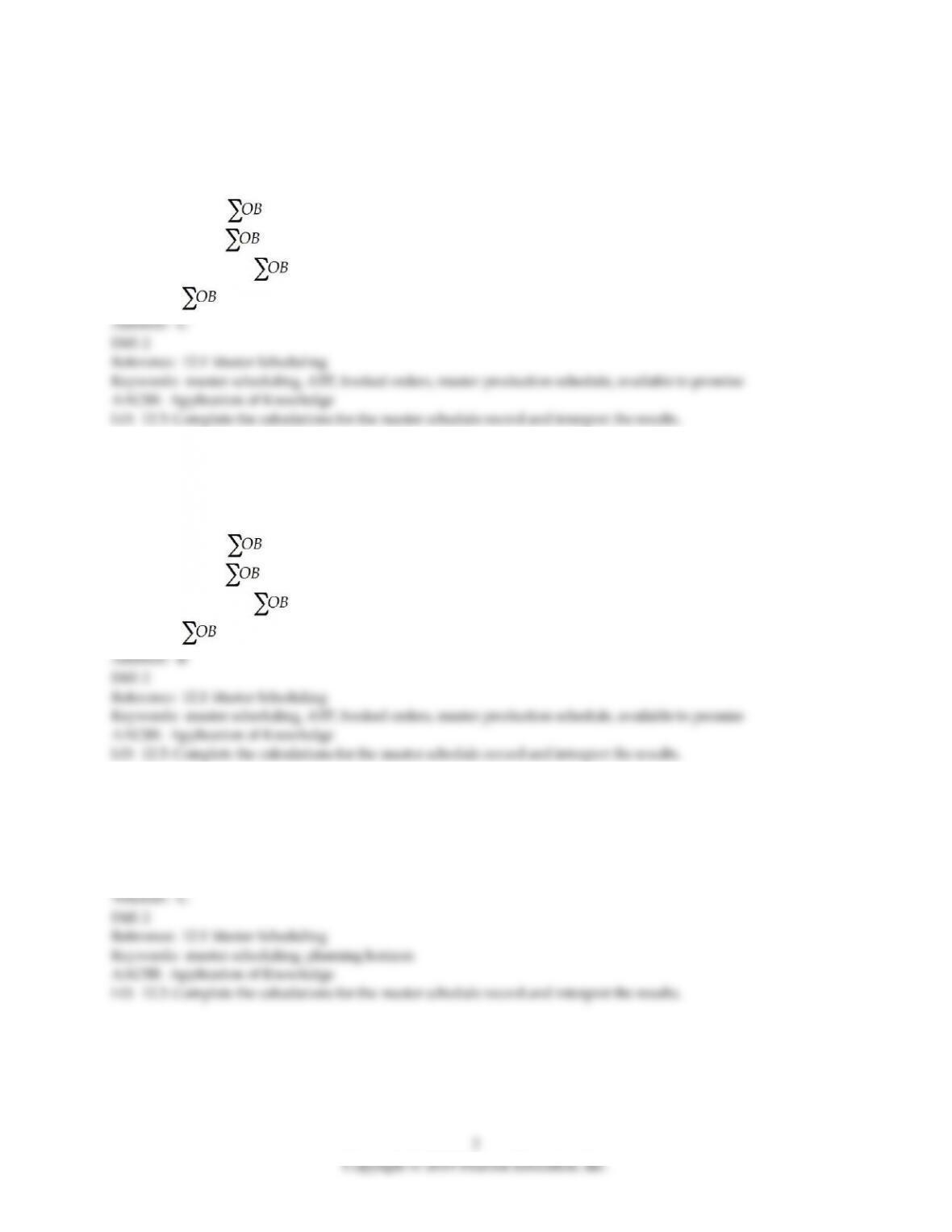
4) Which of these correctly explains the relationship between available to promise inventory and the
master production schedule for the first week of the schedule when production is scheduled? Note that
ATP is available to promise, MPS is master production schedule, EI is ending inventory, and OB is orders
booked.
A) ATP = MPS +
B) MPS = ATP +
C) ATP = EI + MPS –
D) MPS = + ATP – EI
5) Which of these correctly explains the relationship between available to promise inventory and the
master production schedule for any week beyond the first week of the schedule when production is
scheduled? Note that ATP is available to promise, MPS is master production schedule, EI is ending
inventory, and OB is orders booked.
A) ATP = MPS +
B) MPS = ATP +
C) ATP = EI + MPS –
D) MPS = + ATP – EI
6) The length of time that the master schedule record extends into the future is the:
A) transient phase.
B) ATP.
C) planning horizon.
D) forecast.
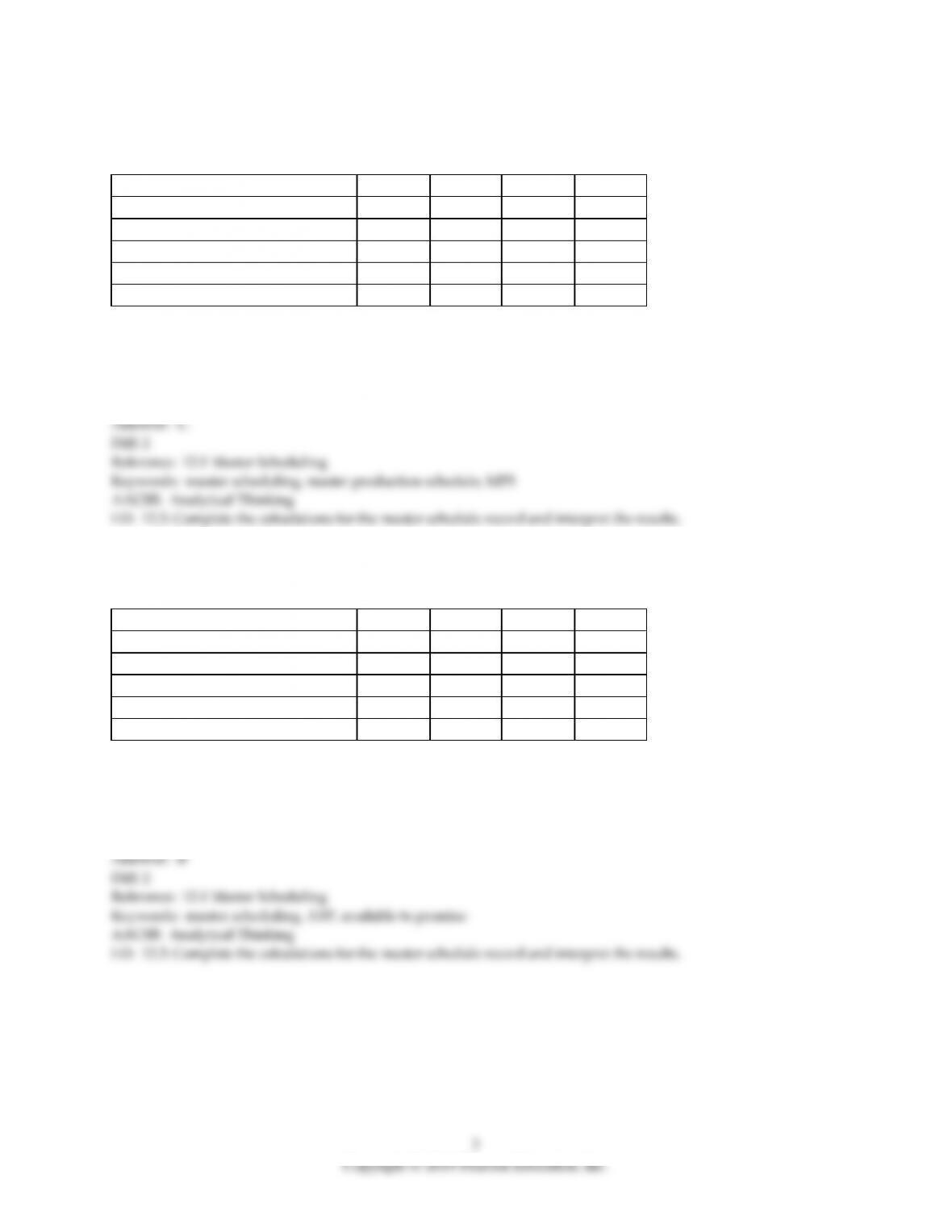
7) Given the forecast and booked orders shown in the table, and a beginning inventory of 25, what is the
master production schedule quantity for period 4?
Period
1
2
3
4
Forecasted Demand
70
65
60
55
Booked Orders
80
50
30
10
Projected ending inventory
Master production schedule
55
Available to Promise
0
A) 35
B) 40
C) 55
D) 70
8) Given the forecast and booked orders shown in the table, and a beginning inventory of 20, what is the
available to promise inventory for the first period? There are no LOT quantity constraints.
Period
1
2
3
4
Forecasted Demand
200
220
240
200
Booked Orders
190
80
30
10
Projected ending inventory
Master production schedule
Available to Promise
A) 0
B) 10
C) 20
D) 40
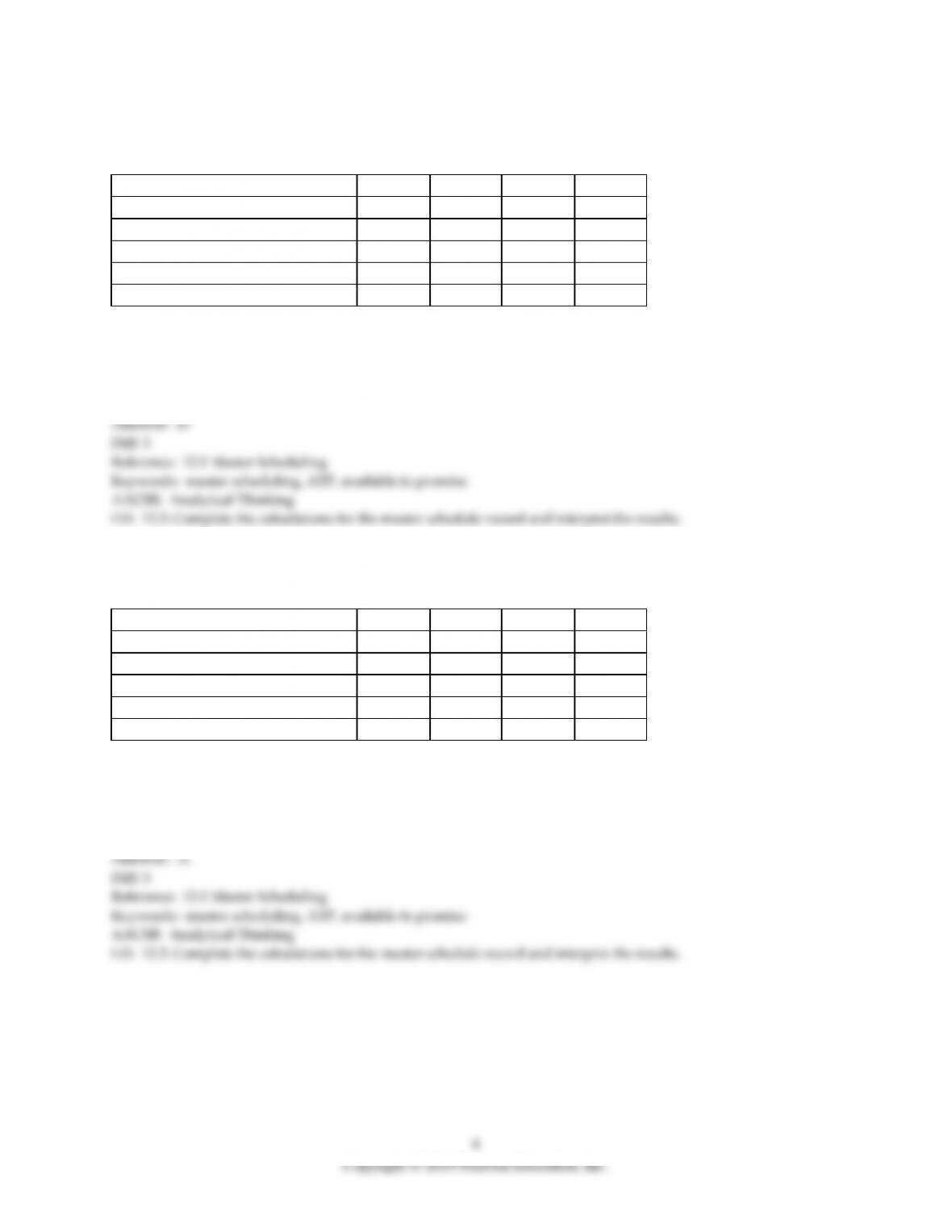
9) Given the forecast and booked orders shown in the table, and a beginning inventory of 0, what is the
available to promise inventory for period 3? There are no LOT quantity constraints.
Period
1
2
3
4
Forecasted Demand
100
100
90
90
Booked Orders
103
87
54
21
Projected ending inventory
Master production schedule
Available to Promise
A) 0
B) 12
C) 24
D) 36
10) Given the forecast and booked orders shown in the table, and a beginning inventory of 75, what is the
available to promise inventory for period 4? The company operates with a lot size of 50.
Period
1
2
3
4
Forecasted Demand
500
450
400
600
Booked Orders
520
400
325
450
Projected ending inventory
Master production schedule
Available to Promise
A) 150
B) 145
C) 155
D) 140
11) Given the forecast and booked orders shown in the table, and a beginning inventory of 120, what is
the MPS for period 4? The company operates with a lot size of 144.
Period
1
2
3
4
Forecasted Demand
500
450
400
600
Booked Orders
520
400
325
450
Projected ending inventory
Master production schedule
Available to Promise
A) 432
B) 576
C) 288
D) 144
12) Given the forecast and booked orders shown in the table, and a beginning inventory of 120, what is
the ATP for period 4? The company operates with a lot size of 144.
Period
1
2
3
4
Forecasted Demand
500
450
400
600
Booked Orders
520
400
325
450
Projected ending inventory
Master production schedule
Available to Promise
A) 92
B) 108
C) 126
D) 144
13) Given the forecast and booked orders shown in the table, and a beginning inventory of 120, what is
the projected ending inventory for period 4? The company operates with a lot size of 144.
Period
1
2
3
4
Forecasted Demand
500
450
400
600
Booked Orders
520
400
325
450
Projected ending inventory
Master production schedule
Available to Promise
A) 34
B) 38
C) 46
D) 22
14) Master scheduling accomplishes which of these?
A) calculates the quantity of material orders
B) calculates the timing of material orders
C) determines when specific products will be made
D) sets overall workforce levels
15) Which step in the top down model of manufacturing planning and control system comes after sales
and operations planning?
A) master scheduling
B) material requirements planning
C) production activity control
D) vendor order management
16) Which of these statements is best?
A) Master scheduling shows the sales and operations plan in greater detail on a product–by-product
basis.
B) Sales and operations planning shows the master schedule in greater detail on a product–by-product
basis.
C) Master scheduling shows the sales and operations plan in greater detail on a supplier–by-supplier
basis.
D) Sales and operations planning shows the master schedule in greater detail on a supplier–by-supplier
basis.
17) Since the booked orders figure represents actual customer demand in a master schedule, that value is
always less than or equal to forecasted demand.
18) From a revenue standpoint, a producer would rather have higher forecasted demand than booked
orders.
19) A unit that has not been sold or otherwise committed to any other customer should be considered
available to promise.
20) Available to promise inventory is always zero for the first week in the master production schedule.
21) The longer the production and supplier lead times, the longer the master scheduling record’s
planning horizon needs to be.
22) In order to calculate the ending inventory for period 42, you need to know what the ending inventory
was for period 41.
23) Material requirements planning is performed at a greater level of detail than master scheduling.
24) An operations manager should be able to take the master schedules and add them up to arrive at the
inventory and production levels in the sales and operations plan.
25) Confirmed demand for products is called ________ in master scheduling.
26) The estimated inventory level of an end item at the end of each time period is the ________.
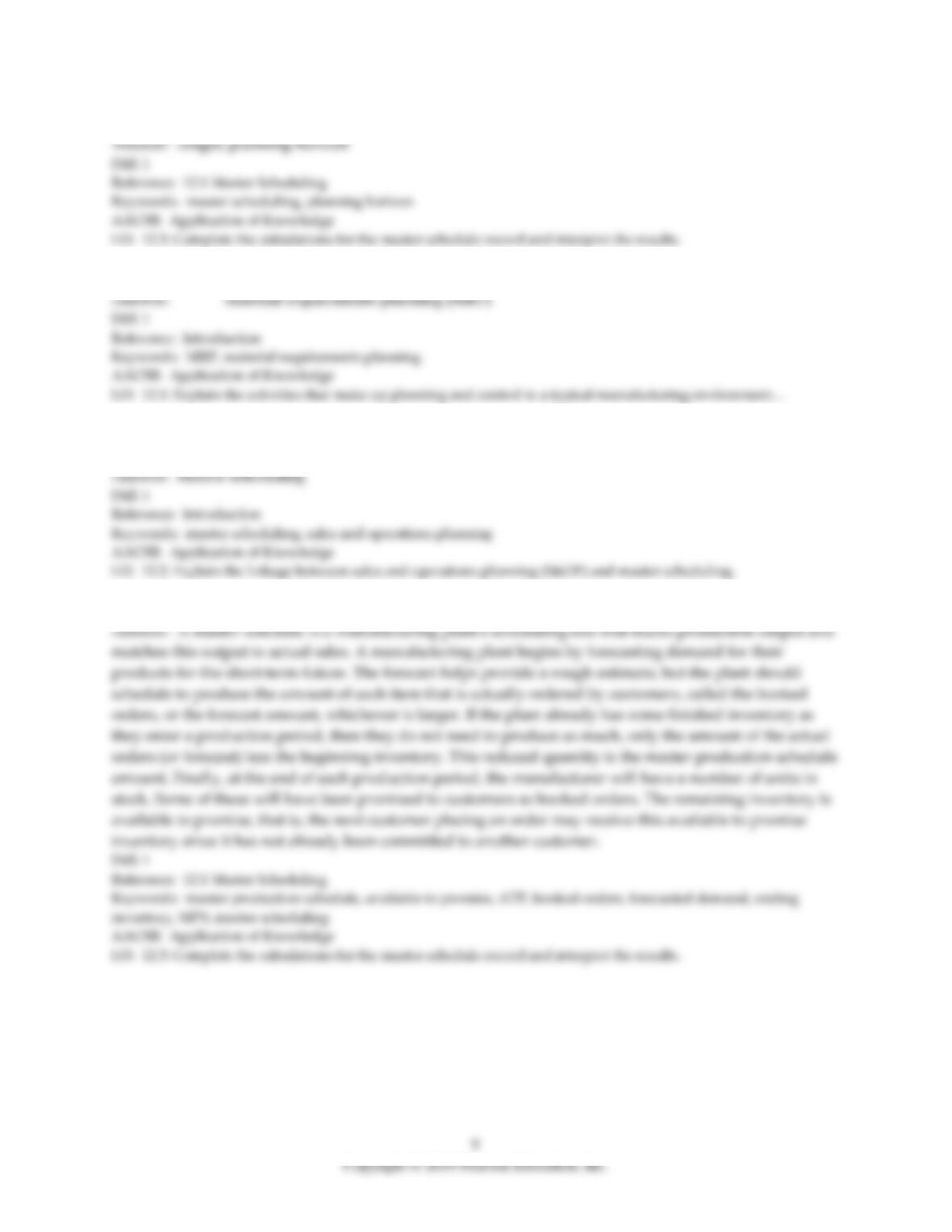
27) The longer the production and supplier lead times, the ________ the MPS record’s ________ should be.
28) ________ translates the master schedule for final products into detailed material requirements.
29) ________ translates the sales and operations plan into specifics by product and establishes when each
customer order will be fulfilled.
30) Explain all of the information that is provided by a master schedule.
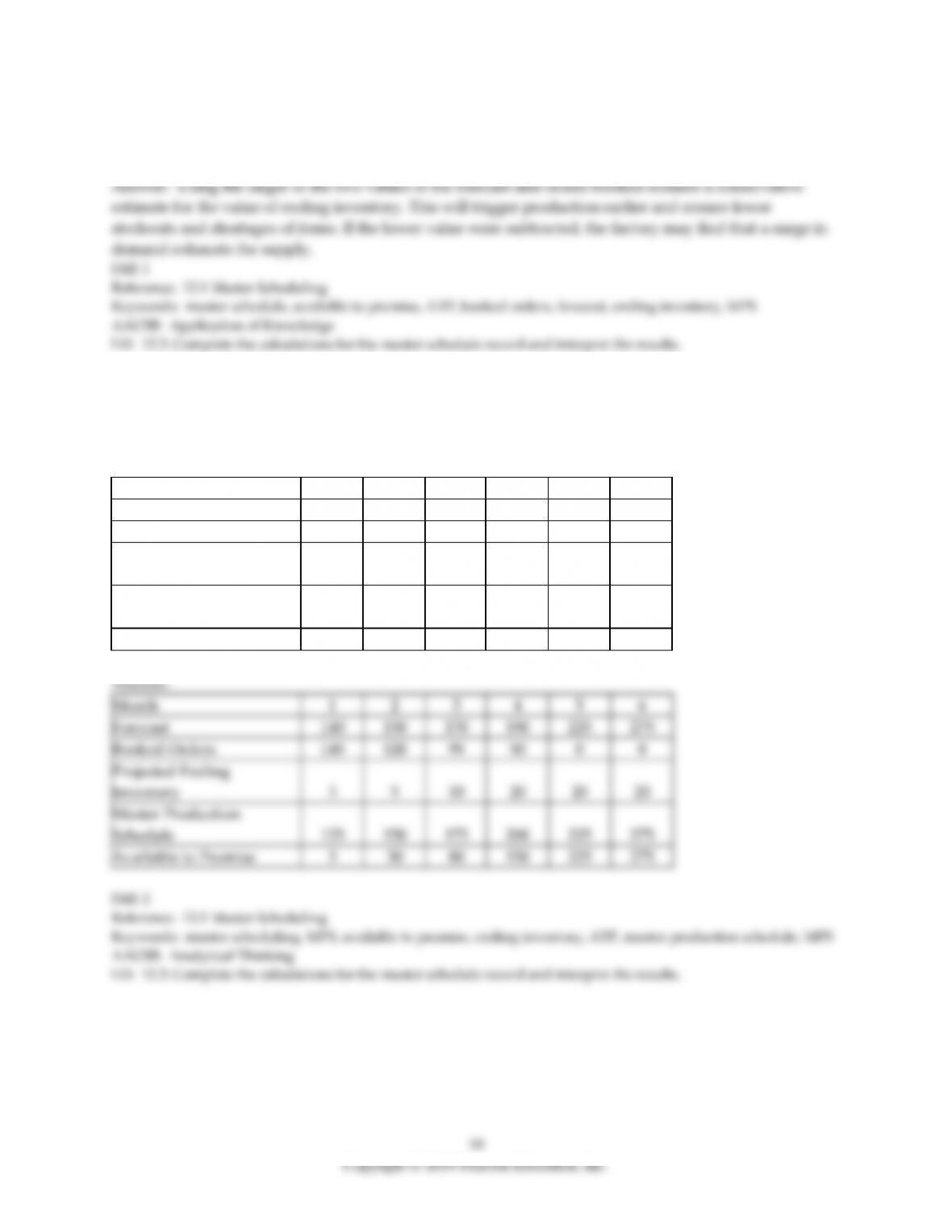
31) When calculating ending inventory, what does the option presented in the -maximum(F,OB) portion of
the equation accomplish? In other words, why don’t we always subtract the F value or always subtract
the OB value.
32) A manufacturing company enters 2016 with a forecast and customer orders as shown in the table.
They have a beginning inventory of 25 units and a batch size of 25 units (all MPS quantities must be in
multiples of 25). Complete the rest of the master production schedule by filling in the projected ending
inventory, master production schedule quantity, and available to promise rows.
Month
1
2
3
4
5
6
Forecast
140
150
170
190
225
275
Booked Orders
145
120
95
50
0
0
Projected Ending
Inventory
Master Production
Schedule
Available to Promise
Month
1
2
3
4
5
6
Forecast
140
150
170
190
225
275
Booked Orders
145
120
95
50
0
0
Projected Ending
Inventory
5
5
10
20
20
20
Master Production
Schedule
125
150
175
200
225
275
Available to Promise
5
30
80
150
225
275
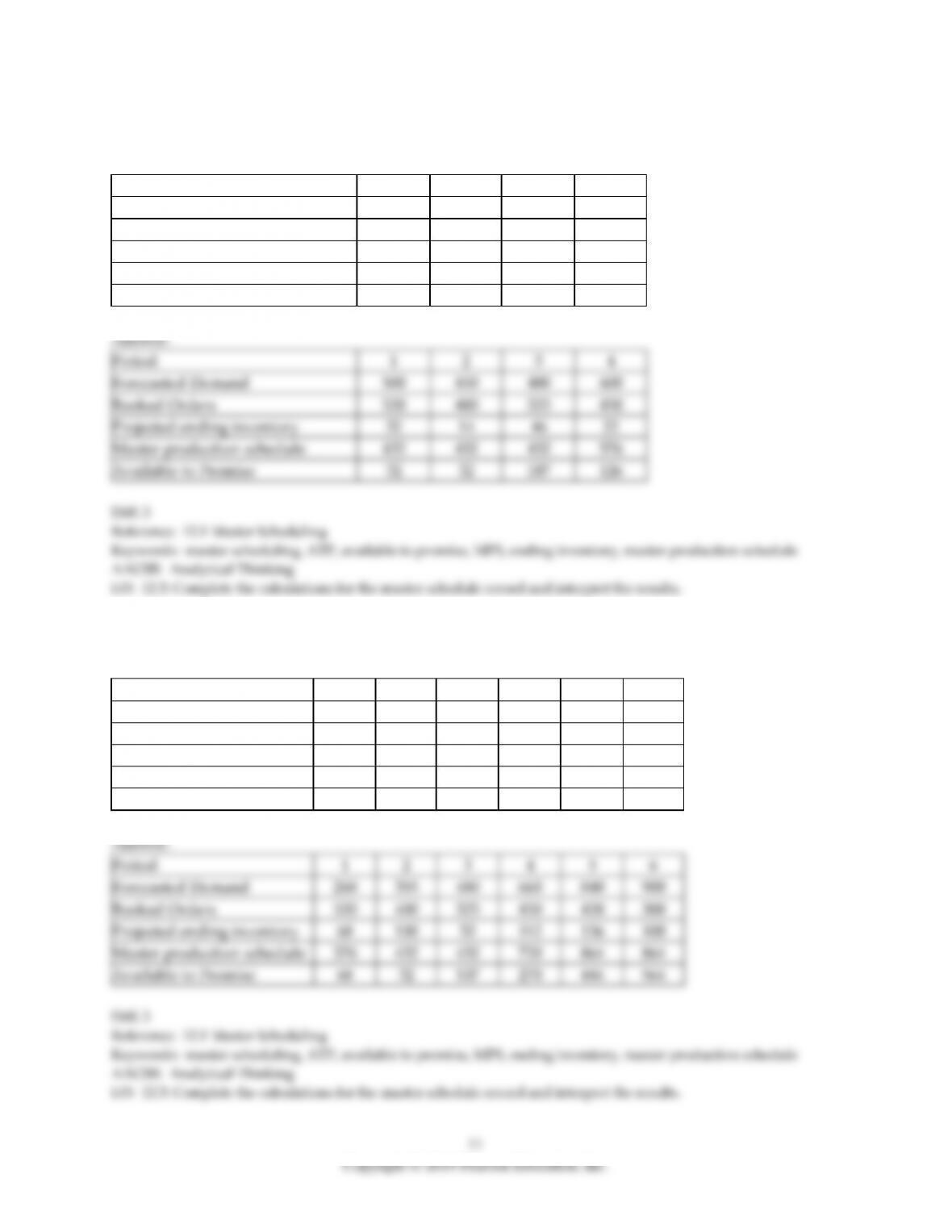
33) Given the forecast and booked orders shown in the table, and a beginning inventory of 120, complete
this master production schedule. The company operates with a lot size of 144.
Period
1
2
3
4
Forecasted Demand
500
450
400
600
Booked Orders
520
400
325
450
Projected ending inventory
Master production schedule
Available to Promise
Period
1
2
3
4
Forecasted Demand
500
450
400
600
Booked Orders
520
400
325
450
Projected ending inventory
32
14
46
22
Master production schedule
432
432
432
576
Available to Promise
32
32
107
126
34) Given the forecast and booked orders shown in the table, and a beginning inventory of 12, complete
this master production schedule. The company operates with a lot size of 144.
Period
1
2
3
4
5
6
Forecasted Demand
268
355
480
660
840
900
Booked Orders
520
400
325
450
420
300
Projected ending inventory
Master production schedule
Available to Promise
Period
1
2
3
4
5
6
Forecasted Demand
268
355
480
660
840
900
Booked Orders
520
400
325
450
420
300
Projected ending inventory
68
100
52
112
136
100
Master production schedule
576
432
432
720
864
864
Available to Promise
68
32
107
270
444
564
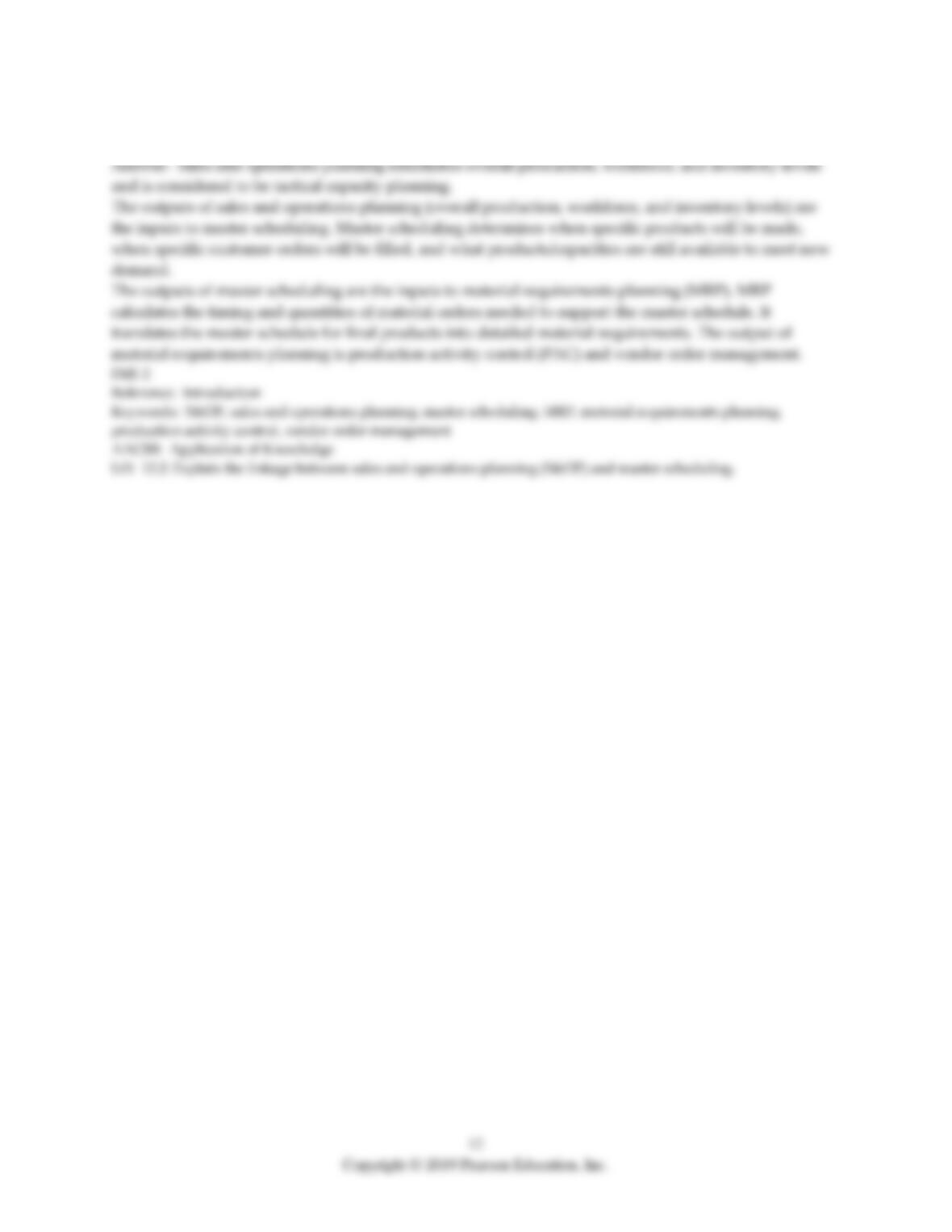
35) Describe the scope, inputs, and outputs of sales and operations planning, master scheduling, and
MRP.
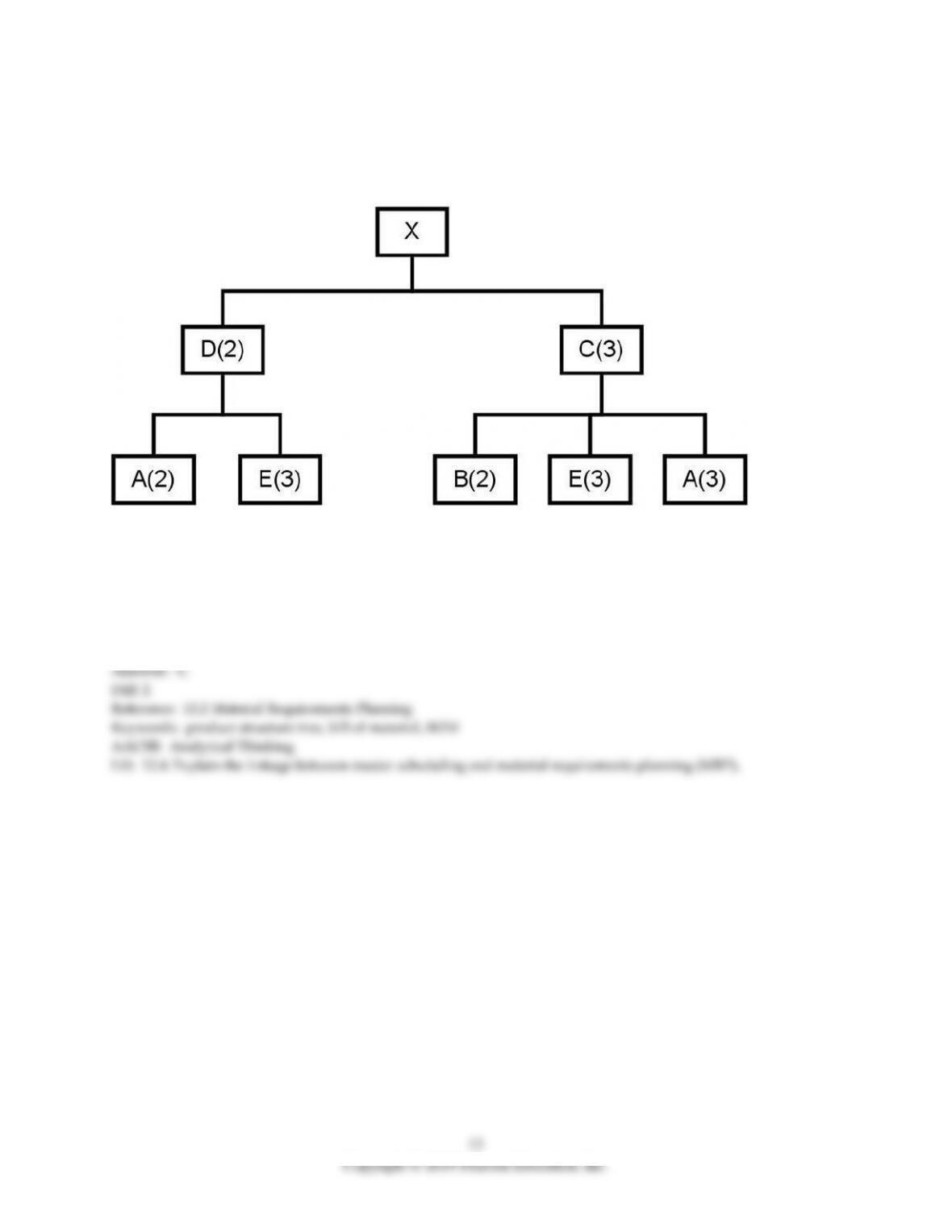
12.2 Material Requirements Planning
1) Consider the product structure tree shown below:
With a beginning inventory of zero for all components and finished items, how many assembly A’s are
needed to produce 25 product X’s?
A) 125
B) 250
C) 325
D) 400
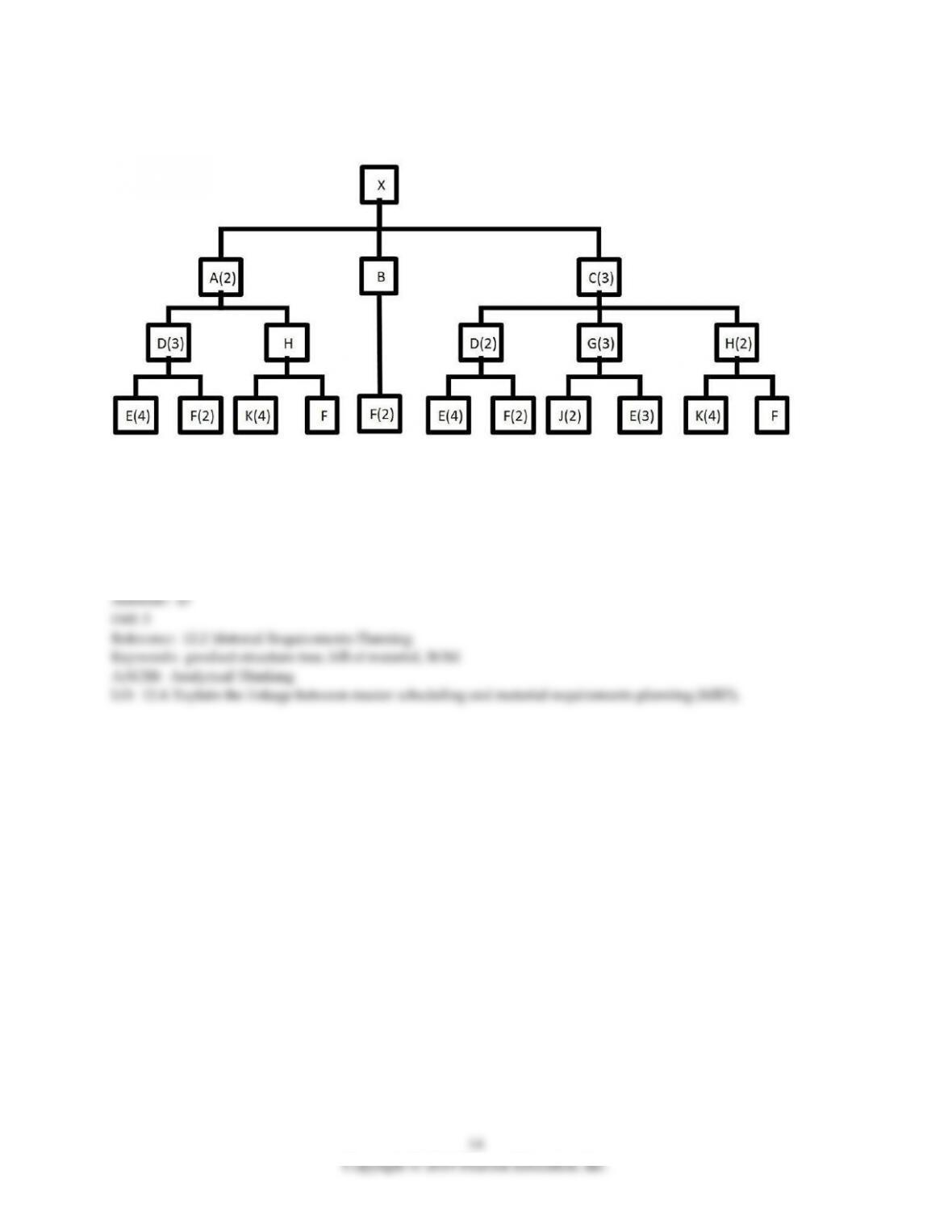
2) Consider the product structure tree shown below:
With a beginning inventory of zero for all components and finished items, how many assembly E’s are
needed to produce 20 product X’s?
A) 900
B) 1000
C) 1200
D) 1500
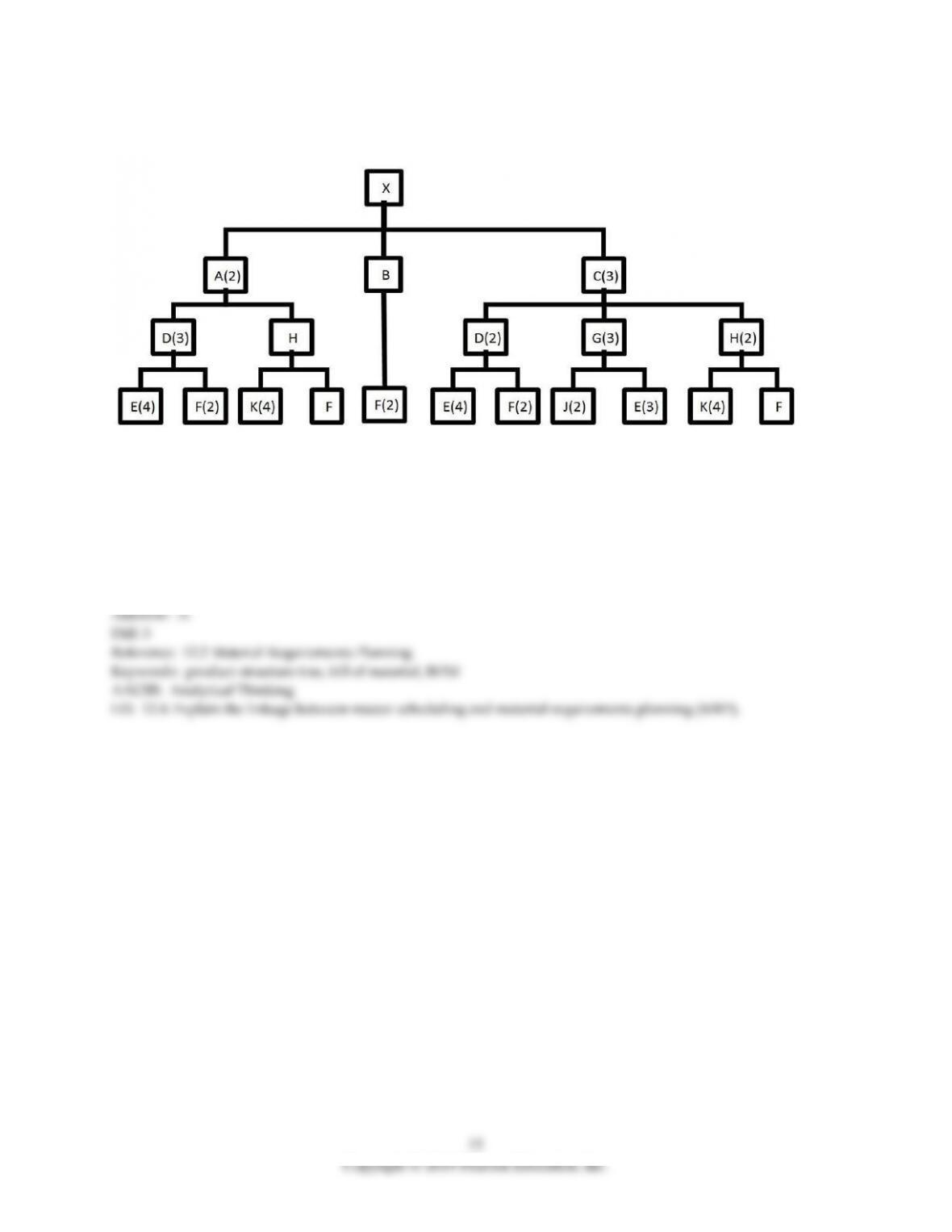
3) Consider the product structure tree shown below:
With a beginning inventory of ten for all components on level one, five for all components on level two,
and zero for all components on level three and finished items, how many assembly E’s are needed to
produce 20 product X’s?
A) 1175
B) 1500
C) 1325
D) 1225
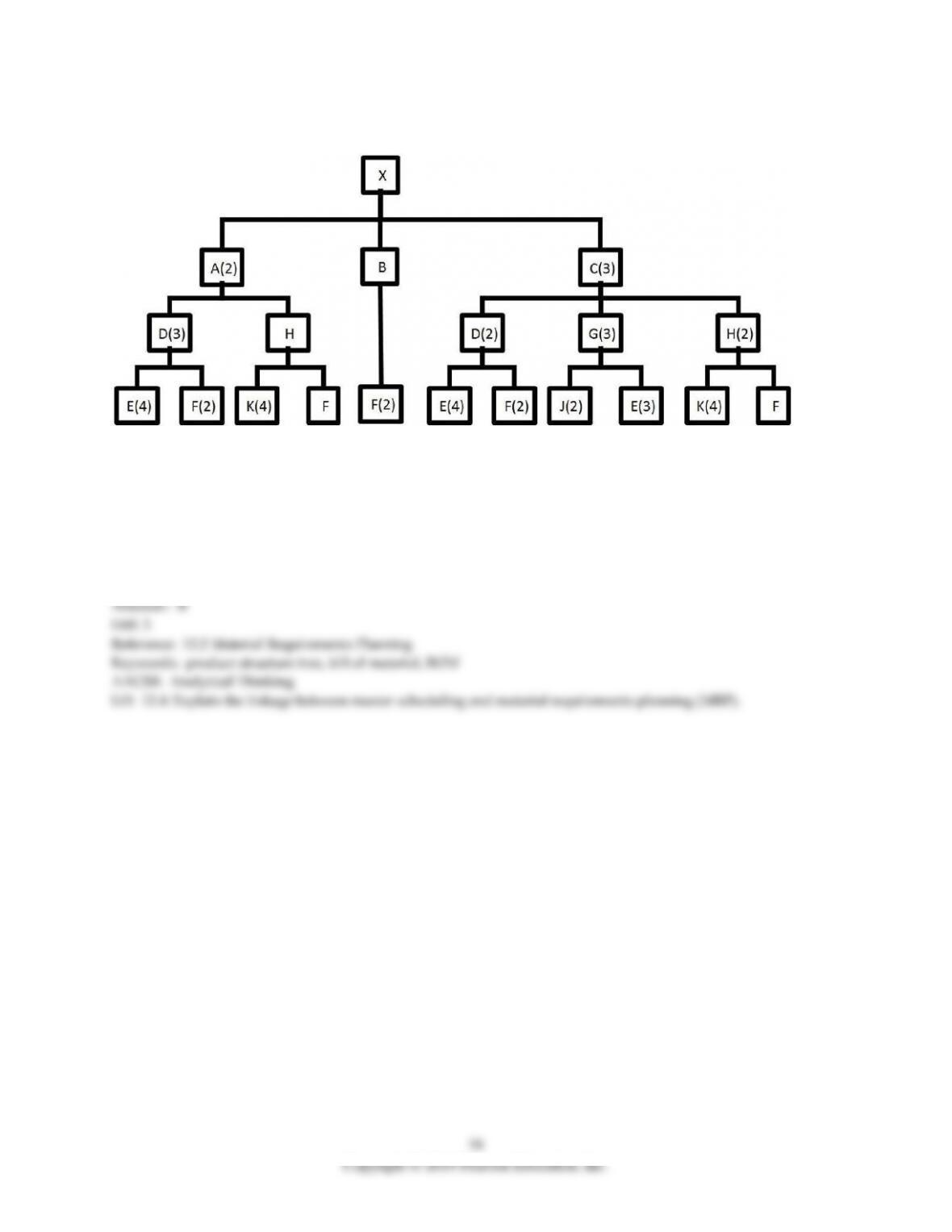
4) Consider the product structure tree shown below:
With a beginning inventory of twenty for all components on level one, five for all components on level
two, and zero for all components on level three and finished items, how many K’s are needed to produce
25 product X’s?
A) 530
B) 540
C) 550
D) 560
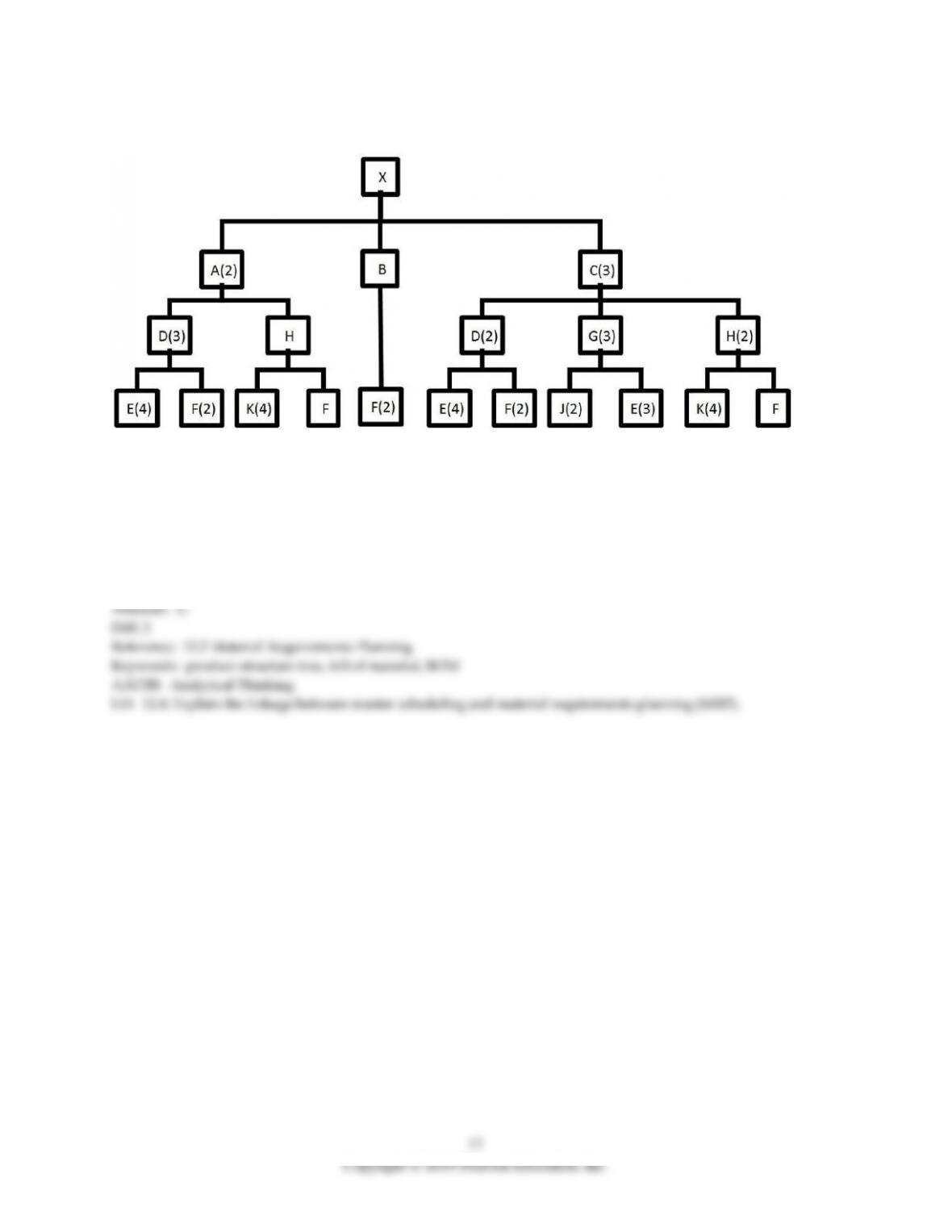
5) Consider the product structure tree shown below:
With a beginning inventory of twenty for all components on level one, five for all components on level
two, and zero for all components on level three and finished items, how many more K‘s than F’s are
needed to produce 25 product X’s?
A) 15
B) 10
C) 5
D) 0
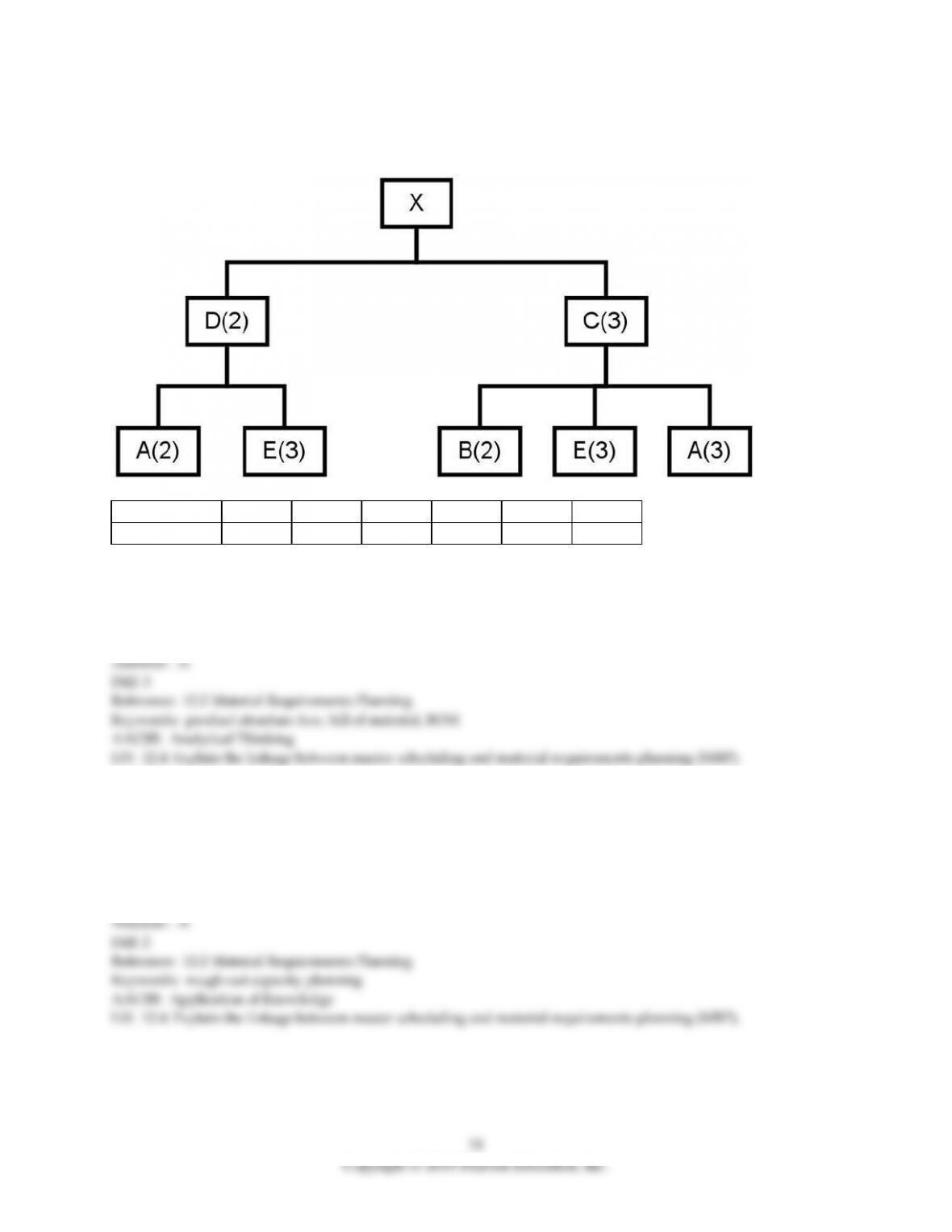
6) With an inventory as shown in the table, how many assembly E’s should be produced or purchased to
produce 15 product X’s with this product structure tree?
Item
X
A
B
C
D
E
Inventory
5
15
20
8
6
17
A) 91
B) 147
C) 193
D) 225
7) The planning technique that uses the master production schedule to monitor key resource
requirements is:
A) rough-cut capacity planning.
B) horizon planning.
C) resource planning.
D) handfield planning.
8) If a manufacturer had no inventory of any kind but had orders for 10 finished units of their sole
product, their buyer would know what parts to order if they were supplied with a:
A) backward schedule.
B) bill of material.
C) rough-cut capacity plan.
D) planning horizon order sheet.
9) An MRP system cannot answer the question:
A) “how much?”
B) “when?”
C) “what?”
D) “why?”
10) Which of these actions would tend to make an MRP system less nervous?
A) using the same component, such as a fastener, at multiple levels throughout the product structure tree
B) making the minimum order quantity as small as possible
C) increasing the number of levels in a product structure tree
D) increasing the minimum order quantities only at the highest level of a bill or materials
11) MRP is NOT capable of:
A) lowering inventory levels.
B) helping a firm meet their master schedule commitments.
C) telling a firm’s suppliers what needs to be made and by when.
D) sequencing jobs at a machining center.
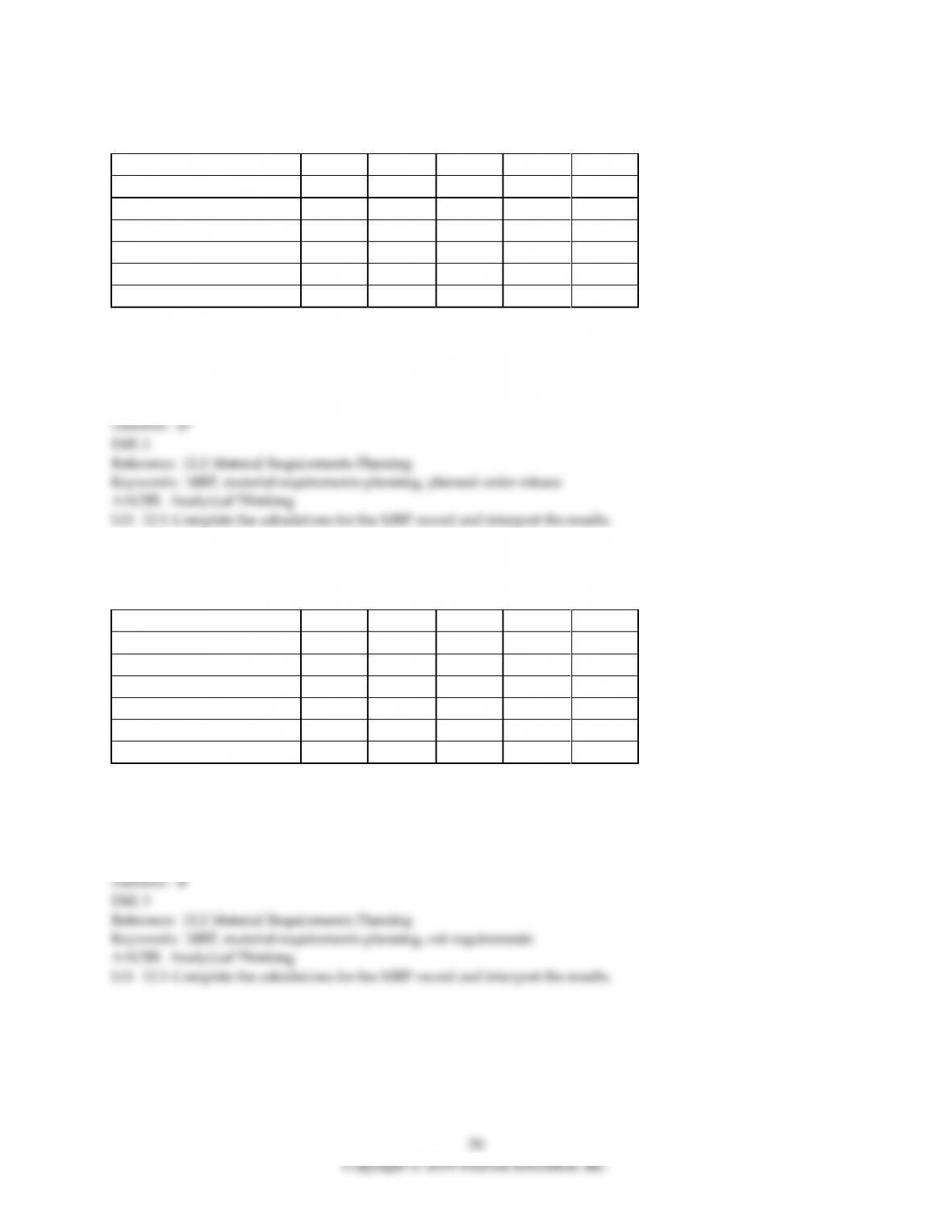
12) Using this MRP record and a lead time of 3 weeks, what should the planned orders be in week 1?
1
2
3
4
5
Gross Requirements
400
500
300
Scheduled receipts
0
0
0
0
0
Projected ending Inventory
100
100
Net Requirements
Planned Receipts
300
Planned Orders
A) 200
B) 300
C) 400
D) 500
13) There is no beginning inventory. What are the net requirements in week 4 if there is a scheduled
receipt of 100 units each week and a two week production lead time?
1
2
3
4
5
Gross Requirements
500
450
400
500
300
Scheduled receipts
100
100
100
100
100
Projected ending Inventory
Net Requirements
Planned Receipts
450
400
300
300
Planned Orders
300
300
A) 250
B) 300
C) 350
D) 400