CHAPTER 12—THE ANALYSIS AND VALUATION OF BONDS
TRUE/FALSE
1. For a bond the present value model incorporates both the coupon receipts and the capital gain or loss.
2. The major problem facing a bond analyst is the ability to forecast the basic interest rate level since
yield spreads are generally inconsequential.
3. Yield to maturity and current yield are equal when the bond is selling for exactly par value.
4. An interest rate is the price of loanable funds.
5. The internal rate of return is that discount rate that sets the present value of cash flows from an
investment equal to its par value.
6. If an investor buys a high coupon bond, and rates then fall, the investor has “locked up” that high yield
as a realized yield.
7. The three major theories explaining the term structure of interest rates are the expectations hypothesis,
the liquidity differential hypothesis, and the segmented quality hypothesis.
8. The expectations hypothesis is also known as both the institutional theory and the hedging pressure
theory.
9. Bond price volatility varies directly with the term to maturity and directly with the coupon.
10. The longer the time to maturity, the greater the percentage change in a bond’s price.
11. There is an inverse relationship between duration and coupon.
2
12. The lower a bond’s yield to maturity, the greater its duration.
13. Because you expect market interest rates to decline during the next four months, if you were offered
two bonds with equal duration, you would select the one with the higher measure of convexity.
14. The fundamental determinants of interest rates are the real risk free rate, inflation, and the risk
premium.
15. According to the expectations hypothesis, a rising yield curve indicates that investors demand for long
maturity bonds is expected to rise.
16. According to the segmented market hypothesis, yields for a particular maturity segment depend on
supply and demand within the maturity segment.
17. For a given change in yield bond price volatility is inversely related to term to maturity.
18. For a given change in yield bond price volatility is inversely related to coupon.
19. For a given change in yield bond price volatility is directly related to duration.
20. Convexity is a measure of how much a bond’s price-yield curve deviates from the linear approximation
of that curve.
21. The price-yield curve is a concave curve representing the relationship of bond prices and yields.
22. The realized yield measures the expected rate of return of a bond that you expect to sell prior to its
maturity.
3
23. The term structure of interest rates is a dynamic function that relates the term to maturity to the yield to
maturity of bonds.
MULTIPLE CHOICE
1. The annual interest paid on a bond relative to its prevailing market price is called its ____.
a.
Promised yield
b.
Yield to maturity
c.
Coupon rate
d.
Effective yield
e.
Current yield
2. If the holding period is equal to the term to maturity for a corporate bond the rate of discount
represents the
a.
Coupon yield.
b.
Effective yield.
c.
Yield to call.
d.
Yield to maturity.
e.
Reinvestment rate.
3. The nominal yield of a bond is the
a.
Annual coupon as a percent of the current price.
b.
Annual rate earned including the capital gain or loss.
c.
Rate earned giving consideration to coupon reinvestment.
d.
Coupon rate.
e.
Promised yield to maturity.
4. If the coupon payments are not reinvested during the life of the issue then the
a.
Promised yield is greater than the realized yield.
b.
Promised yield is less than the realized yield.
c.
Nominal yield declines.
d.
Nominal yield is greater than the promised yield.
e.
Current yield equals the yield to maturity.
5. The importance of the reinvestment assumption increases with a ____ coupon and a ____ term to
maturity.
a.
Low, short
b.
Low, long
c.
High, short
d.
High, long
e.
Zero, very long
4
6. The best way for an investor to “lock in” to high interest rates would be to purchase a bond that has a
____ coupon and a ____ term to maturity.
a.
Low, short
b.
Low, long
c.
High, short
d.
High, long
e.
Zero, very long
7. The yield to call is a more conservative yield measure whenever the price of a callable bond is quoted
at a value
a.
Equal to or greater than par plus one year’s interest.
b.
Equal to par.
c.
Equal to par less one year’s interest.
d.
Less than par.
e.
Five percent over par.
8. Which of the following is not a major risk premium component for bond investors?
a.
Quality differentials.
b.
Term to maturity.
c.
Indenture provisions.
d.
Yield to maturity.
e.
Exchange rate risk differences.
9. The term structure of interest rates is a static function that relates the
a.
Term to call and the yield to maturity.
b.
Term to maturity and the yield to maturity.
c.
Term to call and the yield to call.
d.
Term to maturity and the coupon rate.
e.
Term to maturity and the current yield.
10. There are four major factors accounting for the existence of yield differentials. Which of the following
is not a factor?
a.
Segments
b.
Sectors
c.
Indentures
d.
Coupons
e.
Maturities
5
11. The convexity of a bond is affected as follows:
a.
Positively with maturity.
b.
Positively with yield.
c.
Inversely with coupon.
d.
Choices a and b.
e.
Choices a and c.
12. Which of the following statements is true?
a.
An inverse relationship exists between coupon and convexity.
b.
A direct relationship exists between maturity and convexity.
c.
An inverse relationship exists between yield and convexity.
d.
Choices a and c.
e.
All of the above statements are true.
13. If you expected interest rates to fall, you would prefer to own bonds with
a.
long durations and high convexity.
b.
long durations and low convexity.
c.
short durations and high convexity.
d.
short durations and low convexity.
e.
none of the above.
14. If you expected interest rates to fall, you would prefer to own bonds with
a.
short maturities and low coupons.
b.
long maturities and high coupons.
c.
long maturities and low coupons.
d.
short maturities and high coupons.
e.
none of the above.
15. If you expected interest rates to rise, you would prefer to own bonds with
a.
short maturities and low coupons.
b.
long maturities and high coupons.
c.
long maturities and low coupons.
d.
short maturities and high coupons.
e.
None of the above.
16. According to the liquidity preference hypothesis yield curves generally slope upward because
a.
investors prefer short maturity obligations to long maturity obligations.
b.
investors prefer long maturity obligations to short maturity obligations.
c.
investors prefer less volatile long maturity obligations.
d.
investors prefer more volatile short maturity obligations.
e.
None of the above.
6
17. According to the segmented-market hypothesis a downward sloping yield curve indicates that
a.
demand for long term bonds has fallen and demand for short term bonds has fallen.
b.
demand for long term bonds has risen and demand for short term bonds has fallen.
c.
demand for long term bonds has fallen and demand for short term bonds has risen.
d.
demand for long term bonds has risen and demand for short term bonds has risen.
e.
None of the above.
18. According to the segmented-market hypothesis a rising yield curve indicates that
a.
demand for long term bonds has fallen and demand for short term bonds has fallen.
b.
demand for long term bonds has risen and demand for short term bonds has fallen.
c.
demand for long term bonds has fallen and demand for short term bonds has risen.
d.
demand for long term bonds has risen and demand for short term bonds has risen.
e.
None of the above.
19. According to the expectations hypothesis a rising yield curve indicates that investors expect
a.
future short term rates to fall
b.
future short term rates to rise
c.
future long term rates to rise
d.
future long term rates to fall
e.
None of the above.
20. The price-yield relationship for a bond will become more convex
a.
For a low coupon bond.
b.
For a high coupon bond.
c.
For a long maturity bond.
d.
Choices b and c.
e.
Choices a and c.
21. Convexity is a desirable feature of bonds because.
a.
As interest rates decline, the price of a low convexity bond decreases at a decreasing rate.
b.
As interest rates decline, the price of a high convexity bond decreases at an increasing rate.
c.
As interest rates decline, the price of a low convexity bond increases at a decreasing rate.
d.
As interest rates decline, the price of a high convexity bond increases at an increasing rate.
e.
As interest rates decline, the price of a high convexity bond decreases at a decreasing rate.
22. The position of a bondholder that is long a callable bond is equal to being
a.
Long a noncallable bond + long a call option on the bond.
b.
Long a noncallable bond + short a call option on the bond.
c.
Short a noncallable bond + long a call option on the bond.
d.
Short a noncallable bond + short a call option on the bond.
e.
None of the above.
7
23. Option adjusted duration can be calculated as
a.
Duration of noncallable bond − duration of call option on the bond.
b.
Duration of noncallable bond + duration of call option on the bond.
c.
Duration of callable bond − duration of call option on the bond.
d.
Duration of callable bond + duration of call option on the bond.
e.
None of the above.
24. The option adjusted duration will approach the duration to maturity, when
a.
Interest rates are significantly above the coupon rate because the option has very little
chance of being called, and the call option will have very little value.
b.
Interest rates are significantly below the coupon rate because the option has very little
chance of being called, and the call option will have very little value.
c.
Interest rates are significantly above the coupon rate because the option has a high chance
of being called, and the call option will have significant value.
d.
Interest rates are significantly below the coupon rate because the option has a high chance
of being called, and the call option will have significant value.
e.
None of the above.
25. The promised yield to maturity calculation assumes that
a.
All coupon interest payments are reinvested at the current market interest rate for the
bond.
b.
All coupon interest payments are reinvested at the coupon interest rate for the bond.
c.
All coupon interest payments are reinvested at short term money market interest rates.
d.
All coupon interest payments are not reinvested.
e.
None of the above
26. If the coupon payments are not reinvested during the life of the issue then the
a.
Promised yield is greater than realized yield.
b.
Promised yield is less than realized yield.
c.
Nominal yield declines.
d.
Nominal yield is greater than promised yield.
e.
Current yield equals the yield to maturity.
27. Consider a bond portfolio manager who expects interest rates to decline and has to choose between the
following two bonds.
Bond A: 10 years to maturity, 5% coupon, 5% yield to maturity
Bond B: 10 years to maturity, 3% coupon, 4% yield to maturity
a.
Bond A because it has a higher coupon rate.
b.
Bond A because it has a higher yield to maturity.
c.
Bond B because it has a lower coupon rate.
d.
Bond A or Bond B because the maturities are the same.
e.
None of the above.
8
28. What measures the expected rate of return of a bond assuming that you sell it prior to its maturity?
a.
Yield to maturity
b.
Current yield
c.
Realized yield
d.
Coupon rate
e.
None of the above
29. The yield to call is a more conservative yield measure whenever the price of a callable bond is quoted
at a value
a.
Equal to or greater than par plus one year’s interest.
b.
Equal to par.
c.
Equal to par less one year’s interest.
d.
Less than par.
e.
Five percent over par.
30. Which of the following is not a risk premium component of bonds?
a.
Bond quality
b.
Term to maturity of the bond
c.
Indenture provisions
d.
Foreign bond risk
e.
All of the above are risk premium components of bonds.
31. Which term-structure hypothesis suggests that any long-term interest rate simply represents the
geometric mean of current and future on-year interest rates expected to prevail over the maturity of the
issue?
a.
Expectations hypothesis
b.
Liquidity preference hypothesis
c.
Segmented market hypothesis
d.
Preferred habitat hypothesis
e.
Hedging pressure hypothesis
32. Which of the four major yield spreads defines the difference in yields between pure government
agency bonds and corporate bonds?
a.
Segments
b.
Sectors
c.
Coupons
d.
Seasoning
e.
Maturity
9
33. All of the following are one of Malkiel’s stated relationships between yield changes and bond prices
except
a.
Bond prices move inversely to bond yields.
b.
Longer-maturity bonds experience larger price changes than shorter-maturity bonds.
c.
Bond price volatility increases at a diminishing rate as term to maturity increases.
d.
Bond price movements resulting from equal absolute increases or decreases in yield are
symmetrical.
e.
Bond price volatility is inversely related to the coupon rate.
34. Which duration is computed by discounting flows using the yield to maturity of the bond?
a.
Effective
b.
Macaulay Duration
c.
Modified Duration
d.
Present Value Duration
e.
Cash Flow Duration
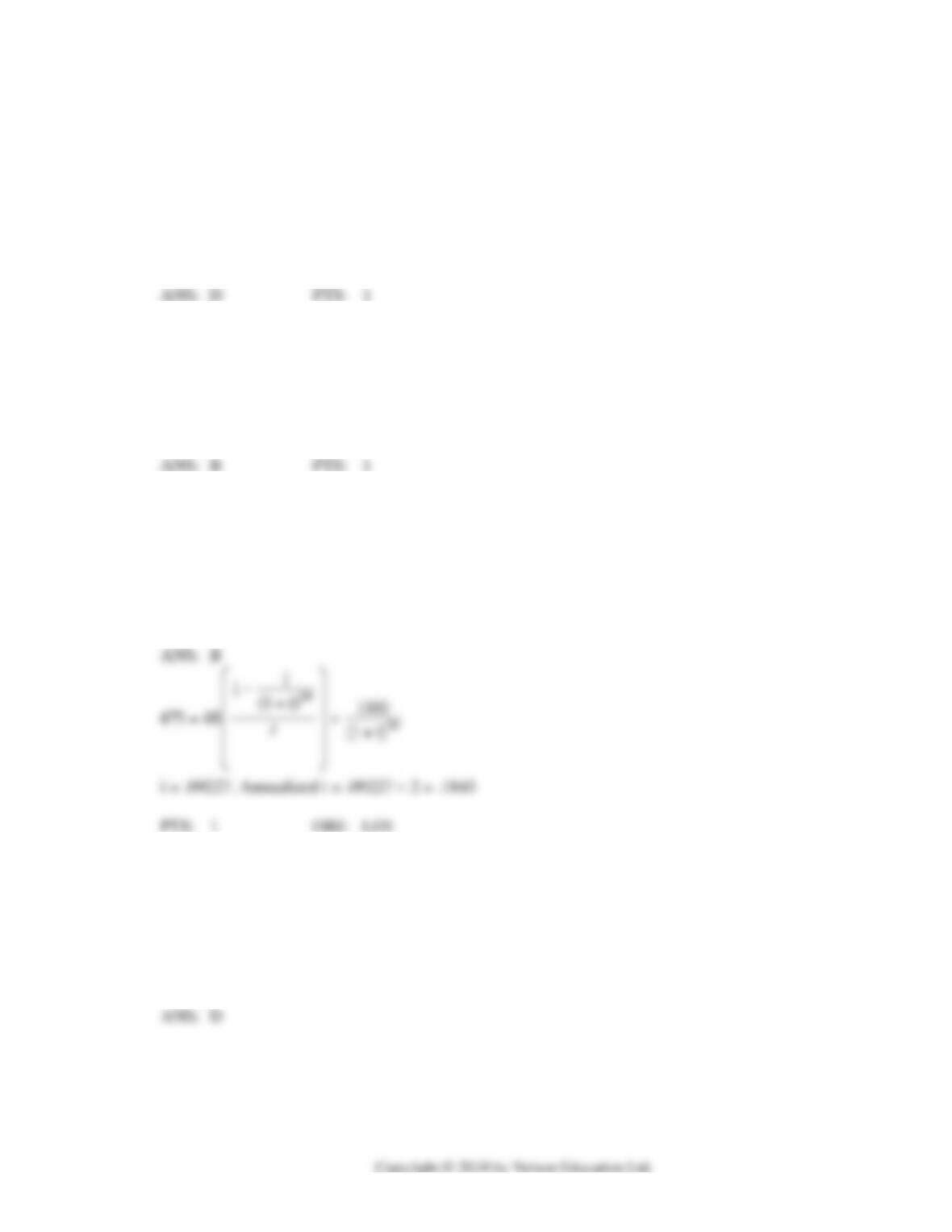
35. Consider a 12%, 15 year bond that pays interest semiannually, and its current price is $675. What is
the promised yield to maturity?
a.
10.23%
b.
18.45%
c.
17.77%
d.
2.31%
e.
9.26%
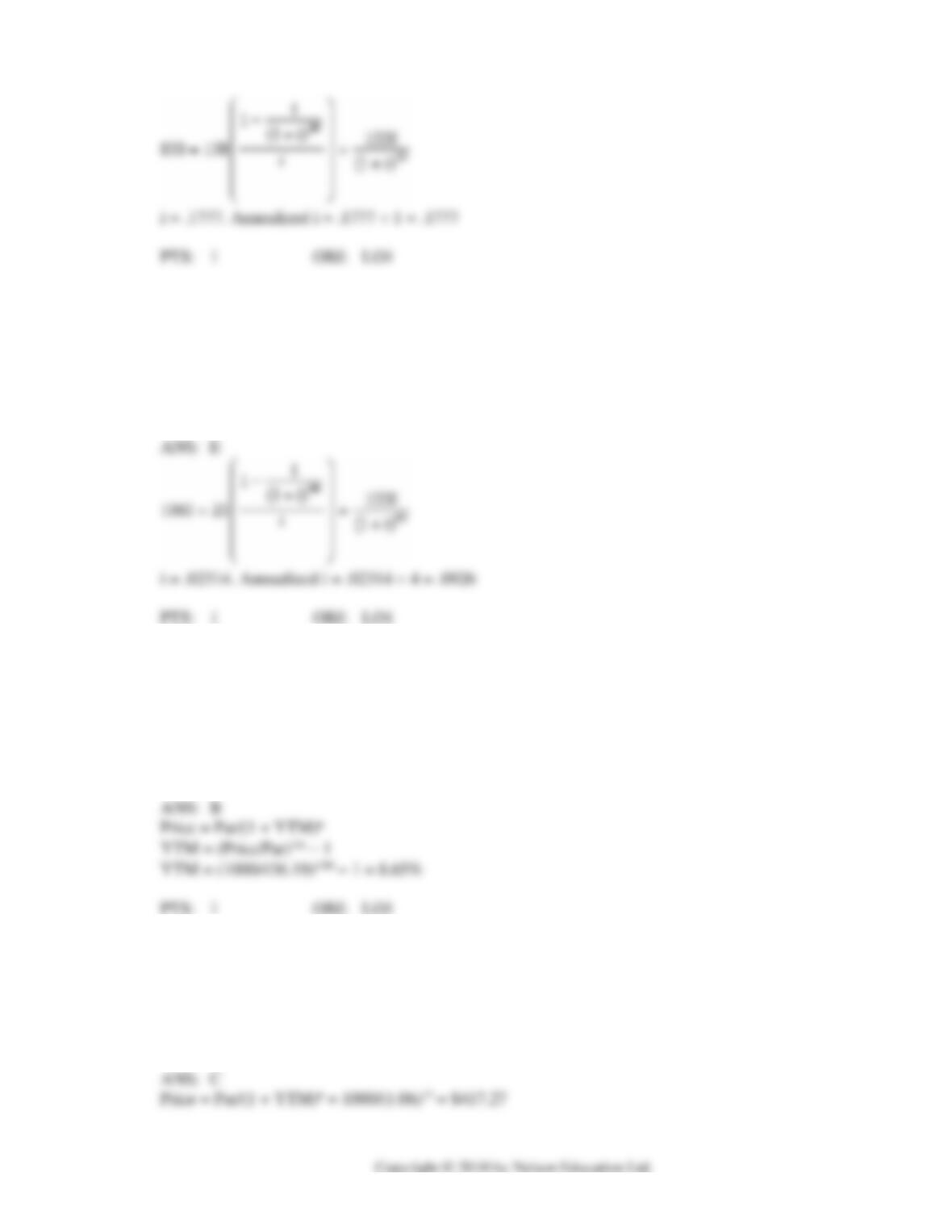
36. Consider a 15%, 20 year bond that pays interest annually, and its current price is $850. What is the
promised yield to maturity?
a.
10.23%
b.
18.45%
c.
2.31%
d.
17.77%
e.
9.26%
10
37. Consider a 10%, 15 year bond that pays interest annually quarterly, and its current price is $1060.
What is the promised yield to maturity?
a.
10.23%
b.
18.45%
c.
2.31%
d.
17.77%
e.
9.26%
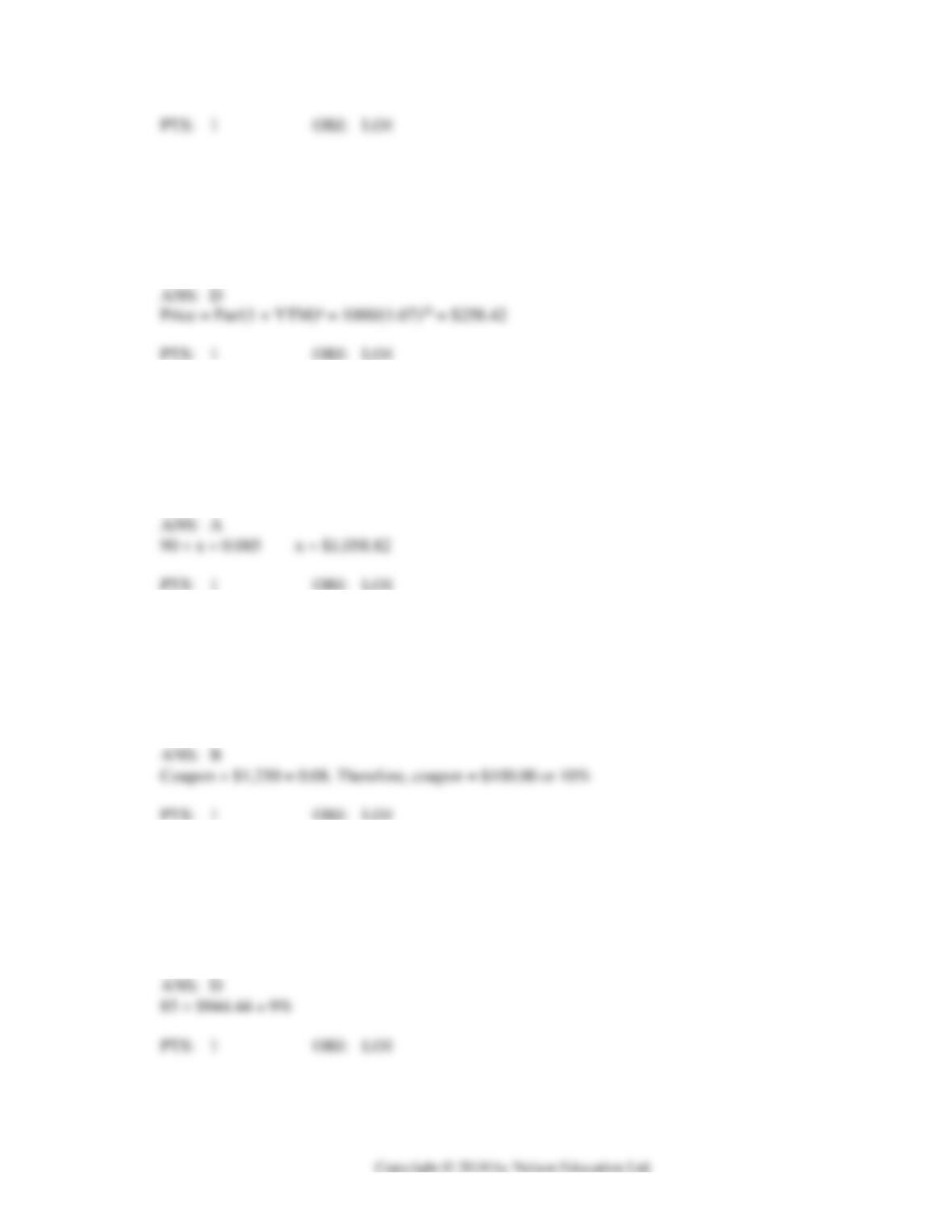
38. Consider a zero coupon bond that has a current price of $436.19 and matures in 10 years. What is its
yield to maturity?
a.
0.86%
b.
8.65%
c.
8.00%
d.
58.80%
e.
6.564%
39. What is the current price of a zero coupon bond with a 6% yield to maturity that matures in 15 years?
a.
$4.17
b.
$41.27
c.
$417.27
d.
$4,172.00
e.
None of the above
11
40. What is the current price of a zero coupon bond with a 7% yield to maturity that matures in 20 years?
a.
$1,000
b.
$2,582
c.
$25.82
d.
$258.42
e.
$100.00
41. Consider a bond with a 9% coupon and a current yield of 8 1/2%. What is this bond’s price?
a.
$1058.82
b.
$1009.00
c.
$1085.00
d.
$1062.44
e.
$1077.96
42. Consider a bond with a current yield of 8% and a price of $1,250. What is this bond’s coupon?
a.
8.0%
b.
10.0%
c.
11.0%
d.
8.5%
e.
9.6%
43. Consider a bond with a price of $944.44 and a coupon of 8 1/2%. What is the current yield?
a.
9.4%
b.
6.8%
c.
8.6%
d.
9.0%
e.
11.0%
12
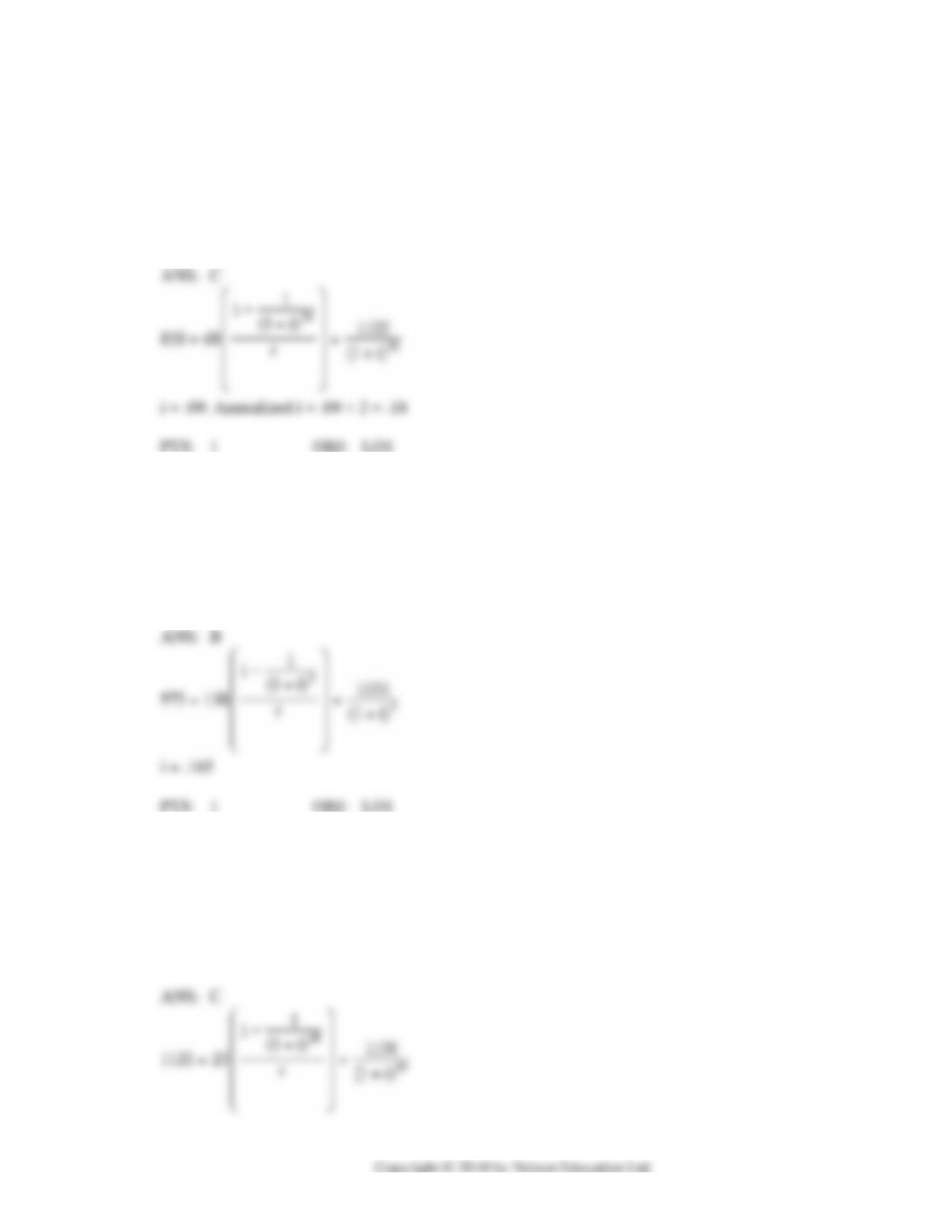
44. Suppose you have a 12%, 20 year bond traded at $850. If it is callable in 5 years at $1,100, what is the
bond’s yield to call? Interest is paid semiannually.
a.
8%
b.
9.0%
c.
18.0%
d.
9.4%
e.
16.5%
45. Suppose you have a 15%, 25 year bond traded at $975. If it is callable in 5 years at $1050, what is the
bond’s yield to call? Interest is paid annually.
a.
15%
b.
16.5%
c.
7.65%
d.
8.52%
e.
9.64%
46. Suppose you have an 10%, 20 year bond traded at $1,120. If it is callable in 5 years at $1,150, what is
the bond’s approximate yield to call? Interest is paid quarterly.
a.
7.78%
b.
8.00%
c.
9.40%
d.
9.36%
e.
9.72%