Chapter 12 – MRP and ERP
54. In MRP, under lot-for-lot ordering, “planned-order receipts” are:
55. Under lot-for-lot, order sizes for component parts are essentially determined directly from
which one of the following?
Chapter 12 – MRP and ERP
56. In MRP, the gross requirements of a given component part are calculated from:
57. The identification of parent items is called:
Chapter 12 – MRP and ERP
58. Periodic updating of an MRP system to account for all changes which have occurred
within a given time interval is called:
59. An MRP system whose records are updated continuously is referred to as a(n):
Chapter 12 – MRP and ERP
60. Which is true of a net-change system?
61. Which one of the following most closely describes the MRP approach that is used for
components or subassemblies to compensate for variations in lead time?
Chapter 12 – MRP and ERP
62. Which of the following lot sizing methods does not attempt to balance ordering (or setup)
and holding costs?
63. When MRP II systems include feedback, they are known as:
Chapter 12 – MRP and ERP
64. The multiplication process used by MRP to determine lower level requirements is called:
65. _______ is choosing how many to order or make.
Chapter 12 – MRP and ERP
66. Which of the following is not usually necessary in order to have an effective MRP
system?
67. The _________ of ERP makes it valuable as a strategic planning tool.
Chapter 12 – MRP and ERP
68. A recent effort to expand the scope of production resource planning by involving other
functional areas in the planning process has been:
69. Which statement concerning MRP II is false?
Chapter 12 – MRP and ERP
70. Which of these items would be most likely to have dependent demand?
71. Which of these products would be most likely to have dependent demand?
Chapter 12 – MRP and ERP
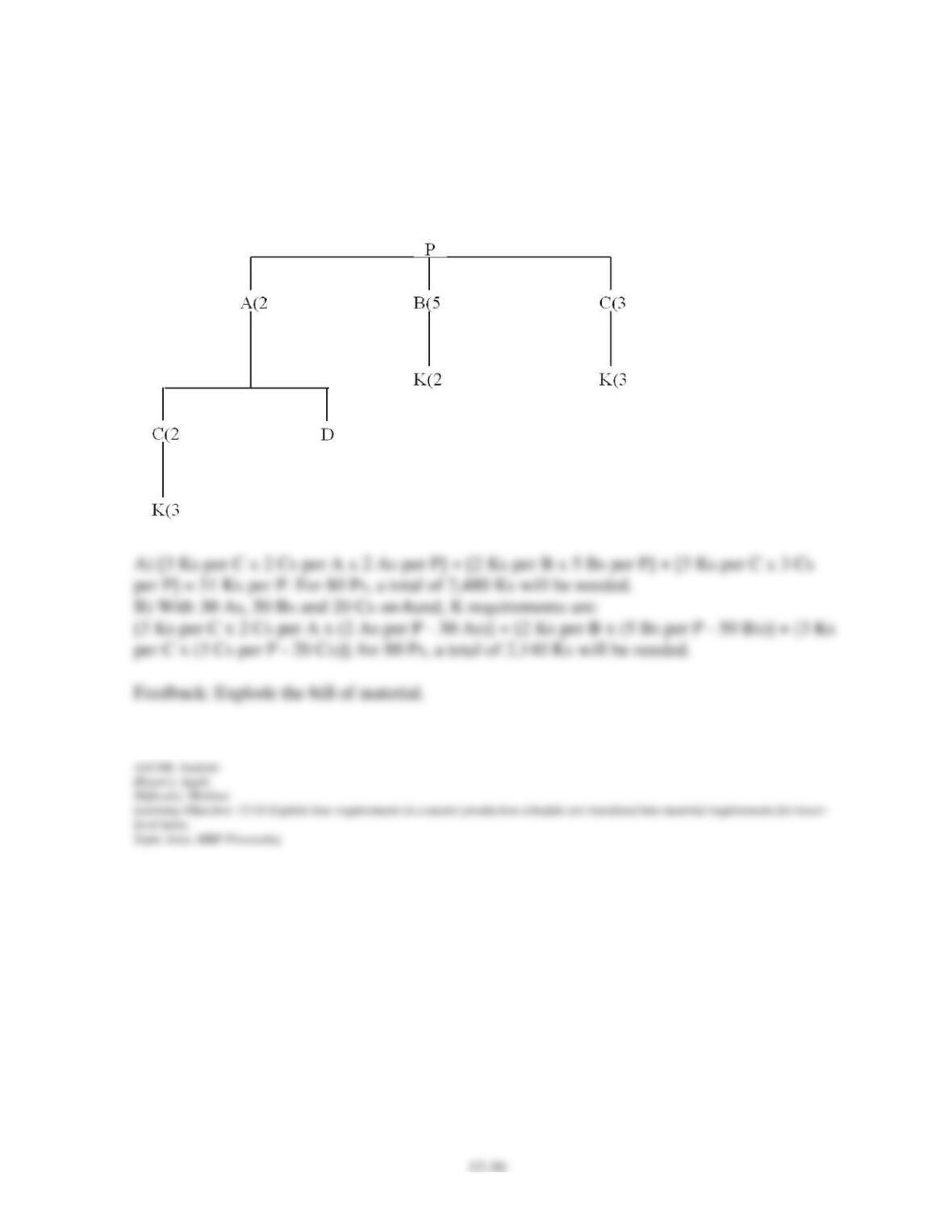
72. Using the product tree shown, determine the following:
(A) the quantity of component K that will be needed to assemble 80 units of P, assuming no
on-hand inventory of any components exists.
(B) the quantity of component K needed to assemble 80 units of P, given on-hand inventory
of 30 A’s, 50 B’s and 20 C’s.
Chapter 12 – MRP and ERP
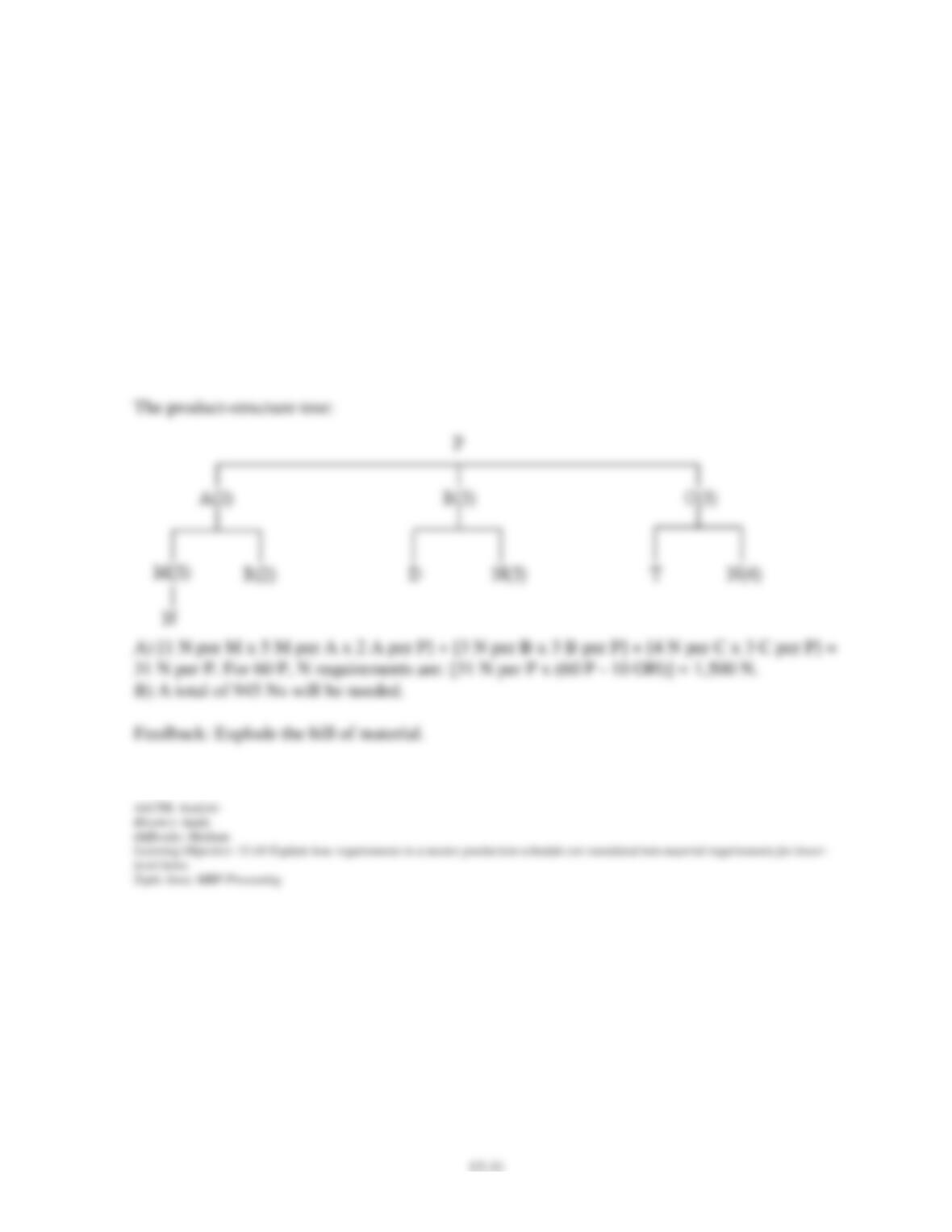
73. The following is a list of components required to produce one unit of end item P:
P: 2 A’s, 3 B’s, 3 C’s
A: 5 M’s, 2 R’s
B: 1 D, 3 N’s.
C: 1 T, 4 N’s
M: 1 N
Determine the number of N’s that will be needed to make 60 P’s in each of these cases:
(A) There are currently 10 P’s on hand.
(B) On-hand inventory consists of 15 P’s, 10A’s, 20 B’s, 10 C’s, 100 N’s, 300 T’s, and 200
M’s.